Magdalena Młynarczyk, Joanna Orysiak, Emilia Irzmańska, Piotr Prus, Elżbieta Łastowiecka-Moras (2022). The impact of double gloves on hands temperature and blood volume changes at low temperature: A Case Study. In: Physical Ergonomics and Human Factors. AHFE Open Access, vol. 63, pp. 237–243. https://doi.org/10.54941/ahfe1002619
A young, healthy man wore the selected protective clothing and double gloves, which met the requirements of EN 511 standard. The selected manual tasks (e.g., Valpar Component Work Samples 1 - VCWS 1 Small Tools (Mechanical) (Bases of Virginia, LLC, USA)) were performed in a climatic chamber at low temperature (-1 degrees Celsius; 30.2 degrees Fahrenheit).Before entering and after exiting the chamber, changes in finger temperature and blood volume were determined using an infrared thermographic camera and plethysmograph. A decrease in both finger and hand temperature was observed after exposure to cold. In conclusion, the impact of low environment temperature (1h exposure) on the reduction of finger and hand skin temperature was significant. Even properly selected protective gloves, allowing for simultaneous performance of manual tasks, did not prevent the decline in hand and finger temperature. The low environment temperature (1h exposure) has a negative effect on hand and finger skin temperature, despite the use of appropriately selected protective gloves.
A cold microclimate is defined as conditions of the environment where, inter alia, the air temperature is <10 oC (ISO 11079). Working in a cold microclimate, without adequate protection, may lead to cold stress, which is characterised by a decrease in core temperature (due to excessive, uncon- trolled heat loss from the body) (ISO 11079). Too sharp a decline in core temperature can even lead to hypothermia. Therefore, proper selection of protective clothing and other personal protective equipment, including gloves, is very important.
The cooling of the body can be global – in which case the amount of heat produced by the processes taking place in the body to maintain homeostasis (core temperature at a certain level of 37±1 oC) is lower than the amount of heat received by the environment, or local – cooling of specific body areas (Bogdan et al. 2012; Młynarczyk et al. 2021).
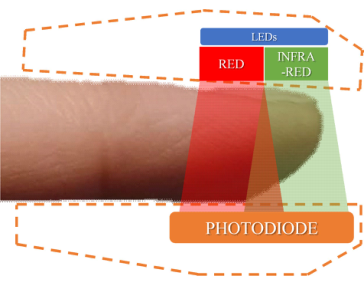
Figure 1: Construction of a photoplethysmography sensor.
With local cooling, vasoconstriction on the skin of the entire body (in parti- cular on distal parts) occurs first, resulting in reduced peripheral circulation and thereby limiting heat loss from within the body (Bogdan et al. 2012; Młynarczyk et al. 2021).
The first effects of local cooling are, inter alia: peripheral vasoconstri- ction and cooling of distal body parts. These manifest with (Marszałek 2009; Młynarczyk et al. 2021):
decreased ability to exercise
extension of the reaction time
decreased muscle contraction strength
impaired precision of movements
difficulty in maintaining balance.
Then, a decrease in work efficiency is observed, as well as an increase in the incidence of accidents. It is worth noting that manual work under such conditions is also less efficient, as finger dexterity and the precision of movements deteriorate (Makowiec-Da˛browska et al. 2007).
Vasoconstriction of the blood vessels, and more specifically the assessment of blood volume changes in the microvascular tissue under the skin (which occur as a result of the pulsatile nature of blood (Moraes et al. 2018)), can be examined using a photoplethysmograph (PPG). This technique measures small fluctuations in the intensity of the reflected infrared light that are asso- ciated with changes in tissue perfusion (Borucka et al. 2014). In order to measure optical properties, radiation is emitted by an LED onto the skin (Figure 1).
Depending on the blood volume in the skin, more or less radiation is absorbed, therefore, the reflected or transmitted radiation measured by a photodetector directly corresponds to changes in blood volume in the sele- cted skin area. The photoplethysmograph (PPG) has a limited penetration depth, so surface vessels that are sensitive to skin temperature are measured (Allen 2007). The photoplethysmographic test is based on the analysis of the pulse wave curve, which represents local changes in the volume of flowing blood upon exposure to a cold stimulus. The frequency of these changes takes
The Impact of Double Gloves on Hands Temperature and Blood Volume Changes 239
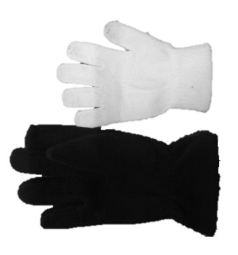
Figure 2: Tested set of gloves.
into account the rhythmic rate of the heart responsible for differences in the speed of blood flow through the vessels in a given area of the skin.
In addition, changes as a result of vasoconstriction can also be observed with the thermography technique, which allows for a quick analysis of the skin temperature distribution (Carpes et al. 2018), e.g. on the fingers of the hands.
The aim of this case study was to determine the impact of gloves on fin- ger temperature, as well as blood volume changes in microvascular tissue under the skin in a cold environment using infrared thermographic camera and photoplethysmographic test.
MATERIALS AND METHOD A young, healthy man (19 years old, height: 173 cm, body mass: 70 kg) wore the selected protective clothing and double gloves. He spent 1h in a climatic chamber at low temperature (-1 oC; 30.2 oF) performing the selected manual tasks.
Tested gloves The set of gloves consisted of white gloves - five-finger gloves made of knitted and polyester fibres with enhanced mechanical parameters and black gloves - five-finger gloves made of knitted fleece and polyester fibers with insulating properties (Figure 2) (Orysiak et al. 2022).
The selected set of gloves met the requirements of EN 511 standard: 1st performance level (resistance to convective cold) and 2nd performance level (resistance to cold contact) (Orysiak et al. 2022).
Methodology
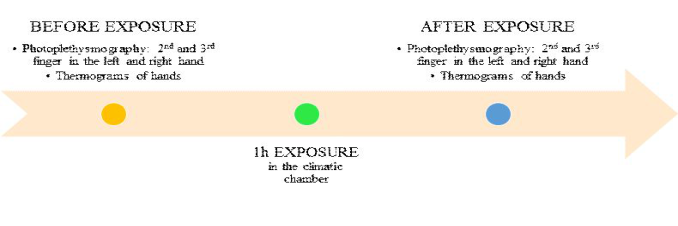
The participant spent 1h in the climatic chamber, performing various manual steps. The test was conducted according to the scheme presented in Figure 3.
The plethysmograph (Rheoscreen light, Medis, Germany) and infrared thermographic camera (FLIR, ThermaCAM SC660) were used.
In the climatic chamber, the participant performed selected manual tasks (Valpar Component Work Samples 1 - VCWS 1 Small Tools
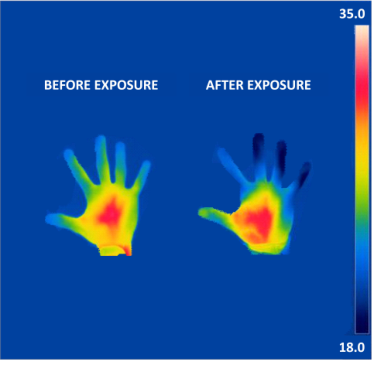
Figure 3: Test scheme.Figure 4: A sample of thermograms (emissivity coefficient 0.95, air temperature in the room 20 oC, distance from camera approx. 1 m).
(Mechanical) (Bases of Virginia, LLC, USA1)), which are described in detail in (Orysiak et al. 2021). The participant was required to screw in small screws (in any position), complete a set (screw, cap, cap, nut) and screw the set into the bottom two rows of holes on the wall and had to thread cotter pins through the holes in the bolts. This helped simulate working conditi- ons, where the ability to make precise finger and hand movements and to work with small tools in tight or awkward spaces are desirable.
RESULTS AND DISCUSSION
Thermograms Thermograms were done before and after 1h exposure at low temperature (air temperature -1 oC). The analysis of the thermograms showed that the fingers were colder after 1 hour of exposure, despite the use of gloves. A sample of thermograms is presented in Figure 4.
1VCWS 1 Small Tools. Available online: https://www.basesofva.com/vcws-1-small-tools-mechanical/ (accessed on 08 February 2022).
The Impact of Double Gloves on Hands Temperature and Blood Volume Changes 241
Table 1. Skin temperature values on the fingertips of the right hand.
Note: Sp01 - thumb, Sp02 - index finger, Sp03 - middle finger, Sp04 - ring finger, Sp05 - little finger.
Single thermograms were analyzed for temperature changes on the finger- tips: Sp01 - thumb, Sp02 - index finger, Sp03 - middle finger, Sp04 - ring finger, Sp05 - little finger. The obtained results were presented in Tables 1–2.
The thermograms showed that the fingertips were cool at the start of the study - especially on the right hand (see Table 1). Nevertheless, a decrease in skin temperature was observed after exposure, mainly on the fingertips that the participant did not use during manual activities. This tendency was also observed on the left hand (see Table 2). A decrease between 2 to 3 oC was observed on the right hand and c.a. 3.5 oC on the left hand. The differences in temperature fall between the right and left hand resulted from the fact that the volunteer was right-handed and performed manual tasks with this hand.
The lowest temperature recorded on the fingertips was 18.2 oC. Accor- ding to ISO 9886, the minimum skin temperature in a cold environment is 15 °C (especially for the face, fingers and toes). On the other hand, a redu- ction in manual dexterity is already observed in the skin temperature range of 12-20 °C (Ray et al. 2019). According to (Makowiec-Da˛browska et al. 2007), in the skin temperature range of 20-27 oC, a reduction in the efficie- ncy of work involving manipulation of small objects is already observed, as well as, a reduction in strength. For the skin temperature range of 15-20 oC, a decrease in the efficiency of working with the whole hand and fingers and even occasional pain is observed (Makowiec-Da˛browska et al. 2007).
Photoplethysmography Blood flow measurements by photoplethysmography, before and after expo- sure to the cold environment, were taken on two fingers (index and middle fingers) (see Table 3).
Table 3. Amplitude changes recorded during photoplethysmography.
Table available in the original PDF paper.
Measurement point
Difference
Left hand Right hand Before exposure
After exposure
Difference Before exposure
After exposure
0.14 0.21 0.07 0.11 0.44 0.33
index finger 0.19 0.22 0.03 0.10 0.20 0.10 middle finger
The test results showed a slight expansion of blood vessels (increased amplitude of the measurement). It can, therefore, be concluded that the photoplethysmograph tests were not performed quickly enough after leaving the climatic chamber. The blood vessels on the fingertips may have already dilated.
CONCLUSION
The choice of gloves for the work environment and the activities performed is very important, but also very difficult. The conducted research has shown that even when using the correct protective clothing and gloves (that meet the requirements of EN 511), after only 1-hour exposure to a cold environment, disturbances in the distribution of the finger skin temperature may occur. It should be noted that this was only a short 1-hour exposure to the temperature of -1 oC, while the work shift usually lasts 8 hours.
The study also showed that an infrared thermographic camera combined with photoplethysmography may be used as a new way to analyze physiolo- gical changes occurring in the hands after exposure to a cold environment. In addition, the infrared thermographic camera allows for rapid detection of disturbing changes in real-world conditions, even while working.
The presented results were a case study, but in the future research both the numbers of volunteers, the scope of the physiological test and the detailed analysis will be improved.
ACKNOWLEDGMENT
This paper is published and based on the results of a research task carried out within the scope of the fifth stage of the National Programme “Improvement of safety and working conditions”supported within the scope of state services by the Ministry of Family and Social Policy. Task no. 2.SP.21 entitled “Study on the influence of cool and cold microclimate on employee’s physiological responses during manual work”. The Central Institute for Labour Protection – National Research Institute is the Programme’s main co-ordinator.
REFERENCES
Allen, J. (2007), “Photoplethysmography and it application in clinical physiological measurement.” Physiol Meas., 8(3), R1-39.
The Impact of Double Gloves on Hands Temperature and Blood Volume Changes 243
Bogdan, A., Marszałek, A., Bugajska, J., and Zwoli´nska, M. (2012), “Oddziaływanie ´srodowiska termicznego na organizm człowieka [The influence of the thermal environment on the human body].” CIOP-PIB, Warsaw (in Polish). Borucka, K., Naskre˛t, D., and Wierusz-Wysocka, B. (2018), “Metody oceny
mikrokra˛˙zenia w skórze u pacjentów z cukrzyca˛ [Methods for evaluating the skin microcirculation in patients with diabetes].” Clinical Diabetology, 3(5), 190–197. Carpes, F. et al. (2018), “Insights on the use of thermography in human physiology practical classes.” Advances in Physiology Education, 521-525. EN 511:2006 Protective Gloves Against Cold. European Committee for Standardi-
zation: Brussels, Belgium, 2006. ISO 11079:2007 Ergonomics of the thermal environment - Determination and interpretation of cold stress when using required clothing insulation (IREQ) and local cooling effects, ISO: Geneva, Switzerland, 2007. ISO 9886:2004 Ergonomics - Evaluation of thermal strain by physiological measu-
rements, ISO: Geneva, Switzerland, 2004. Makowiec-Da˛browska, T., Bogdan, A., Kurczewska, A., Stefko, A. and Kami´nska, W. (2007), “Bezpieczna praca w zimnym mikroklimacie [Safe work in a cold microclimate].” CIOP-PIB, Warsaw (in Polish). Marszałek, A. (2009), “Wpływ zimnego ´srodowiska na organizm człowieka [The
influence of a cold environment on the human body].” Bezpiecze´nstwo Pracy. Nauka i Praktyka [Occupational Safety - Science and Practice], 01, 10–12 (in Polish). Młynarczyk, M., Orysiak, J. and Irzma´nska, E. (2021), “Wpływ ekspozycji na zimno na sprawno´s´c manualna˛ pracownika u˙zywaja˛cego re˛kawic ochronnych [The impact of exposure to cold on manual skills of a worker using protective gloves]”. Bezpiecze´nstwo Pracy. Nauka i Praktyka [Occupational Safety - Science and Practice], 7, 22–26 (in Polish). Moraes, JL. et al. (2018), “Advances in Photopletysmography Signal Analysis for
Biomedical Applications.”Sensors (Basel), 18(6):1894, DOI: 10.3390/s18061894. Orysiak, J., Młynarczyk, M. and Irzma´nska, E. (2022), “The Impact of Protective Gloves on Manual Dexterity in Cold Environments - A Pilot Study.” Int. J. Environ. Res. Public Health, 19, 1637, DOI: 10.3390/ijerph19031637. Ray, M., King, M. and Carnahan, H. (2019), “A review of cold exposure and manual
performance: implications for safety, training and performance.” Safety Science, 115, 1–11, DOI: 10.1016/j.ssci.2019.01.014.
LISTED IN THE AHFE DIGITAL BOOKSTORE CATALOGUE
Explore the complete digital volume
Physical Ergonomics and Human Factors
Read this individual research paper free through the original publisher, or explore the full digital proceedings book.
ISBN 978-1-958651-39-1
Explore this ISBN in the AHFE Bookstore ↗Listed in the July 2026 bookstore catalogue; search by ISBN to confirm current availability · Digital book purchase optional