Fangfei Liu, Haina Wang, Yun Chen (2023). Design of strength assistance gloves for female heavy manual workers based on visualization of electromyographic signals. In: Emerging Technologies in Healthcare and Medicine. AHFE Open Access, vol. 116, pp. 128–138. https://doi.org/10.54941/ahfe1004364
In recent years, due to the disappearance of the cumulative effect of fertility, low birth rates, and aging populations, labour shortages have emerged, leading to a social trend of male labour shortages in heavy labour industries, with more women starting to fill the labour gap. By investigating the situation, population characteristics, needs, and work scenarios of female heavy manual workers, user interviews were conducted, and based on the results, the design direction of wearable labour protection equipment was proposed. Based on the collection, analysis, and visualization of electromyographic signals, it is proposed to design intelligent glove products through strength assisted structural design. This product is based on female body characteristics, taking into account the usage habits of workers related to heavy physical work, and has played a role in helping women reduce their physical burden and strengthen safety protection.
The traditional definition of male industry is that it conforms to the char- acteristics of male labour in the conventional concept, and the majority of practitioners are male, such as construction, welding, rail transit, driving, etc. However, the number of female workers in these industries is constantly increasing, showing a significant trend in various countries around the world. In China, more and more middle-aged women are starting to engage in heavy manual labour, which is closely related to the labour shortage caused by low birth rate and aging population. For example, in 2020, the total number of urban migrant workers in China was 286 million, and surprisingly, up to one-third of these workers were women, who were burdened with a huge amount of work, filling the employment gap caused by male labour short- ages. Other countries around the world have also begun to adapt to this employment characteristic. Around 2010, Canadian women began to engage in traditional male industries that require strict physical fitness and technical abilities, such as metal cutting and welding, and pipeline maintenance (CCTV Media 2012).
Design of Strength Assistance Gloves for Female Heavy Manual Workers 129
Although the number of women participating in industries such as con- struction has increased, they still account for only a small proportion of the total number of workers, so there is little attention and research given to them. For example, migrant women in the construction industry who enter urban areas for work from rural areas endure difficult living and work- ing conditions, and enjoy lower wages and fewer benefits. As a female construction worker said, “I have never seen female workers get the same remuneration as male workers”. They often work as temporary workers, lack safety protection.
In summary, this article focuses on the difficulties faced by female heavy manual workers and, based on research results, considers designing a product that enhances the physical strength of female workers while ensuring safety, providing employment assistance, and increasing their wages and benefits.On this basis, considering the physical characteristics of women, it will provide them with more appropriate protection measures. In summary, this product will be a glove device with power assistance and hand protection functions that uses EMG signal visualization image analysis to issue commands.
INVESTIGATION AND RESEARCH Present Situation Data Display
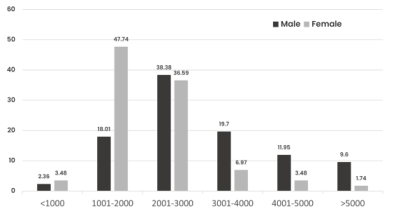
The increase in female workers in traditional male industries is a structural change that countries around the world are facing, and addressing the issue of equal pay and treatment for male and female workers is the future opti- mization direction. The industry with the smallest gender pay gap is the construction industry in the United States, but the average income of female workers is still 94% of that of male workers in the same category. In China, taking the salary level of migrant workers entering cities as an example (Yang, Zhang, 2012), based on gender differences, the average salary of male work- ers is mostly higher than 2000 yuan, while the salary of female workers is more concentrated in the range of 1000 to 2000 yuan (see Figure 1).
Figure 1: Wage distribution of migrant workers.
According to relevant surveys, the primary issue that needs to be addressed for female heavy manual workers is safety during the labour process (Qin, Arlene, 2008). For example, the majority of female workers in the con- struction industry are middle-aged people with primary or middle school education. Due to their low education level and insufficient understanding of
industry norms, their safety protection ability and self-protection awareness are often relatively poor (Wanli Liu, 2020). During a field visit to a con- struction site, 24% of surveyed female workers believed that the workplace had complete protective equipment and mechanisms, while 48% of surveyed female workers received formal safety training before starting work. A sig- nificant conceptual mistake is that most female workers believe that work safety mainly depends on their behavior, and as long as they are careful and attentive, there will be no dangerous situations (Wei, Dan, 2014). Based on the current development trend of the industry, it is estimated that the prob- lem of insufficient safety protection and awareness among female workers will continue to exist for a relatively long period of time in the future. This hidden danger deserves social attention.
User Research The author collected some representative existing research, including female workers from various representative industries, for comparative analysis. By summarizing and summarizing, the characteristics of the user group, the main problems and needs faced in the labouring process, and the work scenarios were summarized (see Table 1).
Table 1. Comparative analysis of literature research on female workers.
Table available in the original PDF paper.
Construction site regime: an analysis of the formation of female construction
Study on the living conditions of migrant women in traditional male industries
Research on the plight of migrant women workers in urban life from the perspective of gender
Crowd characteristics
-41 ∼50 years old -Mainly from rural areas -Low educational level -All married women
-Born in the countryside -Unskilled and underprivileged labour -Most married and have kids
-30∼50 years old -Mainly with primary and junior high school education -All married Labour content Specific explanation Cooking and operate simple machines. Also many heavy and dangerous work
Old machinery and equipment, high noise intensity in the workshop during operation
Different numbers and degrees of female workers in various types of work, such as elevator operators. Safety problem Only 50% have received formal safety knowledge training before taking up posts
Poor working environment, lack of special protection during menstruation
Gender and situational oppression exist in garment factories
The production of construction industry is mobile, open-air and diverse
Working in the construction industry is dirty, tiring and high-risk. Compared with other industries, the salary is slightly higher Working scene Most are construction sites, lacking gender considerations in accommodation and daily life
Design of Strength Assistance Gloves for Female Heavy Manual Workers 131
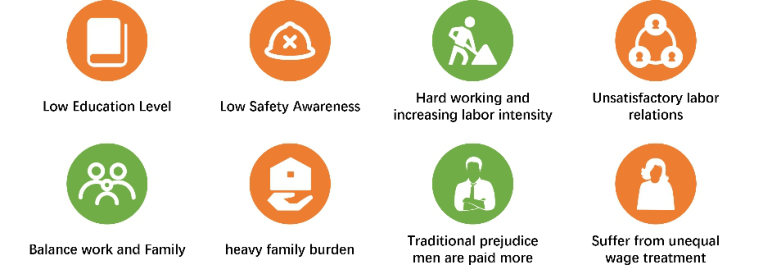
User characteristics Combining with the analysis of the characteristics and behavior patterns of the analysis target users, most of the female heavy manual workers have the following characteristics (see Figure 2):
Figure 2: User characteristics.
User Requirements Based on user characteristics and behavior analysis, it has been found that users’ urgent needs in their work include safety protec- tion and improving labour ability. These needs can be achieved by improving human-machine interaction methods and means in high-intensity labour. These requirements will be further validated in subsequent user interviews.
Usage Scenario Typical labour scenarios have the characteristics of high labour intensity, high physical demand, and repetitive movements. Typical types of actions include handling, lifting, and towing, which often occur at construction sites, loading and unloading centers, production workshops, etc.
An Overview of the Existing Products At present, there are few product designs targeting female heavy manual workers in the market, and there is a gap in research on labour assistance products based on female physical conditions.
The author divides the existing competitive protective gloves into two cate- gories. The first type of product is traditional protective gloves, such as fabric labour protection gloves and rubber anti slip gloves. Their disadvantage is that the protection method is simple and the protection effect provided is poor; The second type is automatic assist gloves that apply new technologies, such as the RoboGlove, a muscle strengthening glove developed by General Motors in collabouration with NASA. With the pressure sensor and support frame inside the glove, it can simulate the movements of hands and fingers (JIEMIAN News. July 8th, 2016). Undoubtedly, the second type of inno- vative products can provide effective force assistance in actual labour, but the social trend of increasing female workers was not taken into account in the design process. Male users are still the default model in terms of human- machine interaction, and insufficient consideration is given to the differential characteristics of female bodies.
RELEVANT THEORETICAL RESEARCH Research on Surface Electromyography Technology
Surface electromyogram signal (EMG), as the name implies, collects the bioelectrical signals generated by the corresponding nerves during muscle activity (mainly on the surface of human skeletal muscle) through the elec- trode sheet adhered to the skin surface, then records and analyses them (Wang J., 2000). Surface electromyography (EMG) has stability and regularity, and has been applied in lots of fields in recent years, such as clinical medical detec- tion and rehabilitation training, external robot motion control, biomedicine and so on.
The experiment shows that the linear discriminant analysis can be used to process the surface EMG signals and realize the feature recognition of different hand movements. Linear discriminant analysis (LDA), also known as Fisher linear discriminant analysis, is a classical method of linear classi- fication by combining the features of different objects and classifying them based on the types. The bioelectrical signals of the two skeletal muscles of flexor carpi radialis and brachioradialis muscle were simultaneously col- lected through the electrode sheet on the skin surface, and the data were processed. The mean absolute value (MAV) and root mean square (RMS) of the obtained data were taken as the characteristic parameters, and the samples were classified and analysed by linear discriminant analysis (LDA) method (Wang H., 2015). Compared with other feature recognition algo- rithms, the experimental results show that this recognition method can distinguish fist clenching, fist spreading and wrist inversion from the samples with high recognition accuracy.
COMPARATIVE ANALYSIS AND CONCLUSION Based on the user analysis results obtained from relevant literature research, the author has developed a semi-structured interview outline to further val- idate user needs. The interview questions focused on three research focuses, namely labour content, protection measures, and wage differences, and explored the common work-related injuries suffered by female heavy man- ual workers. Summarize the obtained corpus after the interview (see Table 2, Table 3).
Table 2. Interview outline and questions.
Table available in the original PDF paper.
What kind of heavy physical labour have you been engaged in? Why did you choose to enter the traditional male industry?
QUESTION 1 – LABOUR CONTENT QUESTION 2 – MEANS OF PROTECTION
Is labour protection equipment allocated? What is the type, frequency and effect of the equipment allocated?
QUESTION 3 – SALARY DIFFERENCE
Are you facing difficulties in finding a job? Is there a pay difference with male workers engaged in the same or similar work? Is there a workload variance?
(ADD) QUESTION 4 – EMPLOYMENT INJURIES
What injuries (body parts) have you suffered in the process of engaging in heavy physical labour? For what reason did you finally give up the job mentioned above?
Design of Strength Assistance Gloves for Female Heavy Manual Workers 133
Table 3. Compilation of textual materials obtained from interviews.
Table available in the original PDF paper.
Interview Questions
Interviewee 1 53 years old Interviewee 2 62 years old Interviewee 3 43 years old Types of manual labour was responsible for pushing mortar, plastering and painting walls on the construction site.
used to be a female worker in the marble factory of Renhe Town, responsible for polishing of stones.
Due to the lack of labour at home, once helped build houses, mainly responsible for relatively light work.
Wages (compared with male)
wage level is relatively high (to migrant workers), about 1/4 lower than male workers
Pushing mortar, and carrying things up stairs are the most tiring. Painting the wall makes arm ache
None The salary difference is not big, ranging from 180 to 300, based on volume of work Heavy work The impact of the mill is strong, and finger tips are sore. It is very tired to hold the machine for a long time
Mixing cement is the most tiring part, which needs to be stirred with a long handle shovel. The wrist is very tired
Protective equipment and use
Cotton gloves purchased in stores are mainly used to prevent slipping.
Equipped with rubber anti-skid gloves(must wear) and dust masks. Distributed monthly.
Equipped with rubber protective gloves, full aprons and hard hats, which should be worn every day. Labour injury Nose and throat are very uncomfortable. Worried about pneumoconiosis, lung cancer
It’s always grind cocoons on your hands, and it’s even more dangerous that bricks hit your feet.
At the age of 50, her fingers and palms were sometimes numb. The doctor suggested reducing the labour intensity.
At the same time as the interview, the author also used a heat map to cal- culate the vulnerable areas of female workers’ hands based on their hand injuries or wear (see Figure 3). It can be seen that the second joint of the fingers and the upper part of the palm are both vulnerable areas. Next, the author used Nvivo software to encode and analyze the obtained text materi- als, and identified keywords such as palm position and labour type that need to be protected. The keywords were displayed using a word cloud diagram (see Figure 4). By analyzing the frequency of the occurrence of various key- words and the graph of vulnerable areas of the hands, it can be concluded that female heavy manual workers have severe hand injuries and wear. Gloves, as the most commonly mentioned protective equipment by respondents, are in line with user usage habits and suitable for common types of labour, mak- ing them the best medium for human-machine interaction in heavy manual labour.
Figure 3: Vulnerable areas of hands.Figure 4: Interview word cloud map.
PRODUCT AND STRUCTURAL DESIGN AI Assisted Scheme Generation
The author attempts to explore solutions using the Midjourney AI painting tool installed in the Discord community. Because Midjourney has natural lan- guage processing and deep learning functions, it is very suitable for generating image materials from user interview research results. Through AI technology assisted design, highly creative product shapes can be quickly generated, and a large number of solutions with different styles can be produced in batches. Although the usability of the generated solution diagrams is low due to cur- rent technological limitations, and the product structure and details are still not considered, the inspiration it provides can still be utilized by designers (Liu, Shuliang, 2023).
In the process of using AI assisted technology to participate in this product design, the author first compiled the corpus materials obtained from the pre- vious research. A qualitative analysis of interview materials was conducted to rank the importance of key words in hand protection for female heavy manual workers, which can be summarized in order as “gloves, rubber lift- ing, shovelling, pushing, palm protection, soreness”, etc. Then, based on understanding the Midjorney generation rules, the keywords used to gen- erate commands were organized. On the basis of the preliminary research results, suitable preferences for colors, materials, styles, etc. were supple- mented and input. In the actual process of image generation, the obtained scheme images often have problems such as chaotic generation logic and not meeting the requirements, especially the problem of finger errors. Therefore, the author made multiple minor adjustments to the keywords and refreshed a large number of images as alternatives.
Design Scheme Refinement Based on a large number of inspirational design solutions generated by AI assisted design, the author comprehensively considered the current situation of the problem, existing products, and relevant theories, and then suggested designing a product for female heavy manual workers, which can help them cope with the physical requirements of heavy manual labour. When perform- ing movements such as handling and grasping, electromyography collection technology is used for motion recognition and judgment, By using mechanical
Design of Strength Assistance Gloves for Female Heavy Manual Workers 135
structures to achieve muscle protection and strength assistance maintenance during the movement process, it compensates for the weakness of women’s insufficient strength. This product combines factors such as hand movement dynamics, and is defined as an intelligent glove. Its function is to achieve impact cushioning through materials and assist in maintaining grip Wrist elastic bandforce through mechanical structures.
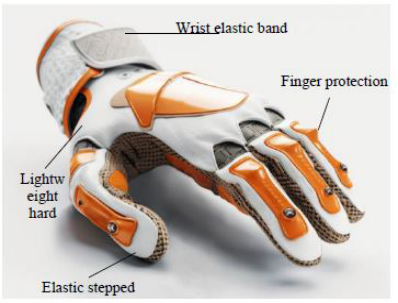
Firstly, a structural design was carried out for the product, which can be divided into glove wearing parts, thickened protective structures, force assistance modules, and detection modules (see Figure 5). The operational mechanism of detection and force assistance in the overall process is divided into information collection, status judgment, and action feedback. After determining the structure, the final product appearance was determined using AI generation scheme, with a natural and simple appearance style and eye-catching colors to serve as a safety reminder.
Figure 5: Product structure diagram.
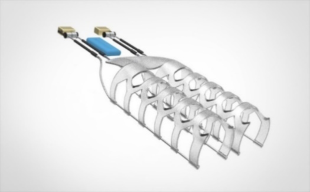
The power assist module is hidden under the glove fabric layer and adjusts the structure of the rubber finger sleeve by using a DC motor to pull the wrapped plastic steel wire, thereby assisting users in maintaining the bending state of their fingers and providing continuous power. The schematic dia- gram of this structure is shown below (see Figure 6). The use of mechanical structural changes has to some extent compensated for the shortcomings of insufficient muscle strength in women, reduced their physical labour bur- den, and played a role in preventing high-risk diseases such as carpal tunnel syndrome among heavy manual workers.
Figure 6: Reinforcement structure diagram.
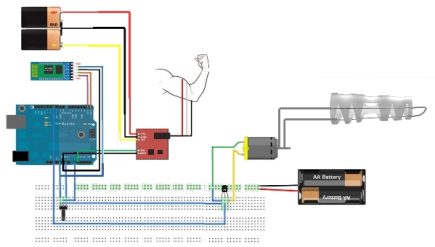
The detection module includes muscle electrical sensors and power sup- ply. The muscle electrical sensor uses muscle sensor V3, which comes with three electrode plates. After pasting the electrode patch onto the two muscle positions of the flexor digitorum, connect the Arduino board to obtain the EMG signal amplified, corrected, and smoothed by ADC. The author demon- strated and verified the detection and force assisted structure using a circuit (see Figure 7).
Figure 7: Circuit connection diagram.
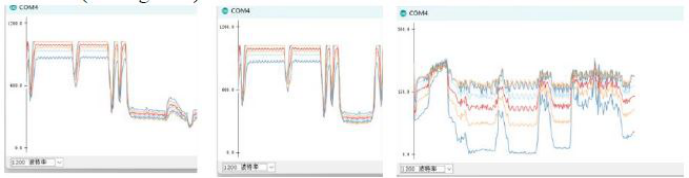
In practical use, the electromyography module collects data from the user’s work. If it determines that the user is performing gripping or other actions, it will send action commands to the force assist module to achieve interactive prediction of actions. The EMG data visualization image obtained during the experiment is shown t, which can show obvious changes in the data curve during the clenching movement(see Figure 8).
Figure 8: EMG signal visualization image obtained by holding action in the experiment.
This product focuses on hardware and structural design, hoping to con- duct design research based on female body characteristics models to solve the inefficient human-machine interaction problems caused by insufficient strength of female workers. The author believes that in the future, there will be more design solutions that focus on female heavy manual workers, and this product can serve as a touchpoint to participate in the construction of service systems.
Design of Strength Assistance Gloves for Female Heavy Manual Workers 137
EVALUATION PLAN The product is in the model testing stage and there is insufficient consid- eration of production costs. In the next stage, the author plans to conduct application experiments on the target user of this product in actual work sce- narios, test whether the product has stable response ability to high-frequency movements in heavy physical labour, evaluate the effectiveness of the prod- uct, and propose improvement suggestions for the product structure based on actual usage data.
DISCUSSION AND CONCLUSION Although the number of female heavy manual workers is constantly increas- ing, the proportion of the group is still small, and they have not received the due attention in China and other developing countries. This project focuses on the issues of fatigue and safety that they face in actual labour scenarios, extracts user needs, starts with the differences in physical conditions between different genders, applies electromyography technology, builds motion recog- nition methods, and designs intelligent protective gloves equipment. Unlike traditional labour protection products, this solution adds an intelligent mod- ule that, in addition to the basic needs of hand protection, adds a force assist structure to reduce the burden on women’s muscles and improve the human-machine interaction process during heavy physical labour.
This topic aims to guide society to pay attention to the minority group of female heavy manual workers. Although the author believes that the use effect of this product is positive, the shortcomings in the research process cannot be ignored. The sample for the interview study mainly came from middle-aged rural women in eastern Shandong Province, China, with insuf- ficient diversity in population selection and a sample size that did not meet expectations. In the future, this project aims to expand interview samples from the perspectives of population, region, and type of labour, in order to increase the objectivity of the research.
ACKNOWLEDGMENT
The completion of this study is inseparable from every female heavy man- ual worker who expresses their experiences and demands. Their detailed and patient answers allowed me to truly understand the challenges faced by Chi- nese female workers, and also strengthened my confidence in research. And I also want to thank my supervisor for guidance.
REFERENCES
CCTV Media. (March 12, 2012) the women’s army took the ride of “labour shortage” to enter the tradition-al male industry. http://news.cntv.cn/20120312/ 123181.shtml JIEMIAN News. (July 8th, 2016) t GM wants to put “robots” on workers.
https://m.jiemian.com/article/735120_toutiao.html Liu, Shuliang. (2023). On the Impact of AI Drawing on Cultural and Creative Fields.
Contemporary Animation (02), 91–95.
Qin, Arlene, & Xie, Peng. (2008). A Study on the Survival Situation of Migrant Women in Traditional Male Industries: A Survey on Female Construction Site Workers in Changsha City. Xiangchao: Theory Edition, 000(006), 16–18. (2021-09-01). Regulations on labour protection of female workers in Heilongjiang
Province. Heilongjiang Daily, 006. Robo glove of General Motors imitates human hands [J]. Industrial design, 2012 (04): 42–43. Wang, H., Mao, A. M. & Li, L. W. (2015). Recognition of surface EMG sig-
nal features based on linear discriminant analysis. Journal of Henan Univer- sity of Science and Technology (Natural Science Edition) (06), 831–835. Doi: 10.16186/j.cnki.1673–9787.2015.06.015. Wang, J., and Jin, S.-G. (2000). Surface electromyographic signal analysis and its application research. China Sports Science and Technology (08). Doi: 10.16470/j.csst.2000.08.009. Wanli Liu. (2020). Study on the Dilemma of Urban Life of Migrant Female Workers
under the Perspective of Gender--Taking Guangzhou City X Garment Factory as an Example. Time People, 000(020), P. 1–2. Wei, Dan. (2014). Construction site polity: An analysis of the reasons for the formation of female construction workers’ groups. Southern Population, 000(003), 35–42. Yang, P. Zhang, G. S. (2012). Empirical analysis of gender wage differentials among
migrant workers–Based on the improved brown decomposition method. Journal of Guangdong Business School, 027(004), 74–83.
LISTED IN THE AHFE DIGITAL BOOKSTORE CATALOGUE
Explore the complete digital volume
Emerging Technologies in Healthcare and Medicine
Read this individual research paper free through the original publisher, or explore the full digital proceedings book.
ISBN 978-1-958651-92-6
Explore this ISBN in the AHFE Bookstore ↗Listed in the July 2026 bookstore catalogue; search by ISBN to confirm current availability · Digital book purchase optional