The sleeping posture is crucial determinant of infant growth and development. Sleeping in the prone position is associated with a higher risk of sudden infant death syndrome. Therefore, medical recommendations advocate placing infants in the supine position during sleep. Furthermore, certain medical conditions, such as cranial deformity, hip dislocation, and torticollis, may manifest as head-turn preferences, wherein infants consistently face a specific direction, either right or left. Detecting and addressing these sleeping postures are critical for preventing accidental infant deaths during sleep and identifying potential underlying health issues. In this study, we present an automatic method for classifying infant sleeping postures into four categories: supine, prone, right lateral, and left lateral, using only videos. Although various methods exist for classifying sleeping postures during infancy, such as those involving acceleration and pressure seat sensors, they often require physical attachments that may cause discomfort to the infants. To address this limitation, we present a contactless approach that employs video images recorded using an infrared camera. The camera was positioned to record the entire infant bedding area without imposing restrictions on the installation angle. We analyzed the video data collected from the home of each participant and classified the sleeping postures of the participants into four categories. Subsequently, the classification accuracy was calculated for each night. The participants of the experiment were two infants under one year of age. To evaluate data accuracy, we excluded instances of data involving individuals other than the participants and data outside the field of view of the camera. “Vision Pose,” a skeleton estimation software capable of detecting joint points in images, was employed for body position analysis. Specifically, we extracted the two-dimensional coordinates of eight joint points: both shoulders, both elbows, both hips, shoulder center, and hip center. We classified the infant sleeping postures by measuring the distance between these joint points. A linear support vector machine was applied to the features, and classification was conducted in two steps. In the initial step, the sleep data were categorized into two groups: supine or prone and right lateral or left lateral. Subsequently, each of these categories was further divided into two classifications, yielding four types of sleeping postures. Our proposed model demonstrates an impressive average accuracy of 92.3% in estimating the four sleeping postures: supine, prone, right lateral, and left lateral. Our study establishes the feasibility of non-contact sleeping posture classification using an infrared camera. This approach holds promising potential for real-life home environments and childcare facilities, where continuous monitoring of infant sleeping postures can significantly contribute to promoting safe sleep practices and early identification of potential health concerns.
The sleeping posture of infants is crucial to their well-being. Sudden infant death syndrome (SIDS) is a major concern in regards to infant sleep and, leads to the death of thousands of infants (Ouattara et al., 2022). Recognizing the risk factors associated with this syndrome, such as sleeping in the prone, right lateral, or left lateral positions, medical recommendations advocate proper sleep positioning to reduce risk (Jones, 2004). In childcare facilities, regular monitoring of infant sleep states is necessary to prevent SIDS, and routine checks are conducted to monitor infant breathing, body positioning, and sleep status. Ensuring that infants sleep on their backs where their faces are visible is crucial for effective position monitoring. The risk of suffocation inci- dents increases with co-sleeping and breastfeeding while lying sideways with the infant (Tokutake et al., 2018). During infancy, imbalanced muscle devel- opment may lead to uneven features in the body, implying that the sleeping posture is influential in the growth and development of an individual (Boere- Boonekamp and van der Linder-Kuiper, 2001). Due to the softness of infant bones, there is a risk of developing plagiocephaly associated with sleeping in the supine position (Ben Zvi and Thompson, 2021). Additionally, postural deformities, such as hip dislocation, muscular torticollis, and cranial defor- mity, have been attributed to the orientation of the face towards either right or left while in the supine position (Porter et al., 2008; Sato, 2020; Konishi et al., 1986; Dunsirn et al., 2016). Early detection is crucial for preventing postu- ral deformities in at-risk infants (Sato, 2020), and continuous monitoring of sleep posture throughout the night is vital for reducing the risk of accidents and symptoms. Previous research has utilized pressure, acceleration, and iner- tial sensors to classify infant sleep postures (Matar et al., 2020; Tang et al., 2021; Abdulsadig and Rodriguez-Villegas, 2023; Airaksinen et al., 2020). Although these methods enable the monitoring of sleep patterns throughout the night, they may involve sensor interventions that can disrupt sleep quality. Moreover, these studies often focus on adult subjects, with limited research targeting infants.
To address these issues, this study proposes a non-contact detection method that uses only one camera to confirm the sleep postures of infant. Because of its non-invasive approach, this method can be adapted to various environments, ensuring minimal interference with infant comfort. The main objective of this study was to develop an automatic method for classifying infant sleeping postures using video data.
SKELETON DETECTION The posture classification method proposed in this study utilizes the skeletal coordinates of infants obtained from images. We used Vision Pose (NEXT- SYSTEM Co., Ltd., Japan), a high-precision pose estimation artificial intelli- gence engine, to perform human skeletal analysis and detection using camera images without using markers or depth sensors to extract two-dimensional (2D) joint coordinates from the videos. The coordinate system is defined with the origin at the bottom-left of the video, the horizontal right direction as the
Automatic Classification of Infant Sleeping Postures Using an Infrared Camera 3
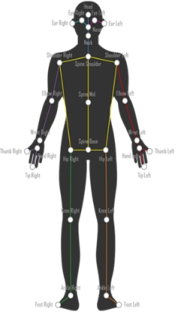
x-axis, and the vertical upward direction as the y-axis for acquiring the coor- dinates. Up to 30 detectable joint positions were available, which allowed us to acquire the 2D coordinates of each joint point (Figure 1). Vision Pose is capable of detecting the bodies of small children and infants; however, it may encounter challenges in cases where body parts are obscured, such as when the child is covered with bedding during sleep. For undetectable data, the value was set to zero. In this study, data interpolation was performed for undetectable joint coordinate points by calculating the median value of the preceding and succeeding detected data points, if available.
DATA SET The participants of this study were two infants (one male and one female), with an average age of 8 months. The focus of this study was to classify sleeping postures, specifically in infants, limiting the age range to less than 1 year. Filming was conducted at the homes of the participants to capture their overnight sleep patterns over a total six nights each. A single infrared camera was used for recording, with specific instructions to position the camera and capture the entire body of the infants, from their head to their feet.
Table 1. Participant characteristics and sleep data.
Table available in the original PDF paper.
Sub number Data number Age Sex Sleep time Analyzable data 1 1 6months Boy 8h49min 328 1 2 6months Boy 9h30min 242 1 3 6months Boy 10h 450 1 4 6months Boy 9h9min 337 1 5 6months Boy 10h53min 163 1 6 6months Boy 10h6min 249 2 7 10months Girl 10h29min 224 2 8 10months Girl 10h27min 424 2 9 10months Girl 10h42min 467 2 10 10months Girl 10h12min 281 2 11 10months Girl 10h46min 61 2 12 10months Girl 10h18min 143
METHODS
The analysis method for posture classification is described below.
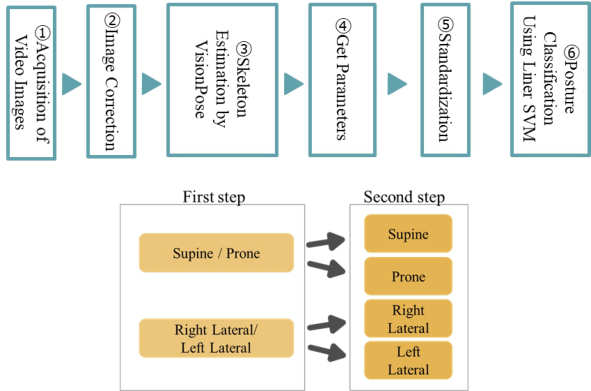
Figure 2: Flow of analysis and classification steps.
The sleep posture classification for each recorded data point was per- formed overnight. One image was captured per minute, and image correction processing was applied to prevent interference from individuals other than the participants. The skeletal estimation was performed using these data. As the filming took place in the homes of the participants, some data contained reflections from non-participants. To ensure accuracy, data with reflections from non-participants, instances of infants outside the field of view of the camera, and undetectable skeletal data were excluded from the analysis (Table 1). In this study, we obtained the 2D coordinates of eight joint points: both shoulders, both elbows, both hips, shoulder center, and hip center to achieve four posture classifications (supine, prone, right lateral, and left lat- eral). The classification process involved two steps. In the first step, the data were grouped into two categories: supine or prone and right lateral or left lat- eral. Second, the former categories were further classified into four posture categories (Figure 2). In the first step, we calculated three parameters: the lengths between the shoulders, hips, and elbows. For the second step, three parameters were considered: the difference in the x-coordinates between the right and left shoulders, between the right elbow and shoulder center, and between the left elbow and shoulder center. To account for variations in the size of the infant bodies in the images owing to different filming conditions, all parameters were standardized based on the distance between the shoulder and hip center coordinates in the supine position, which was obtained for each data point. Using these parameters, we trained a linear support vector machine with a training-to-test data ratio of 7:3 for posture classification and subsequently calculated the classification accuracy.
Automatic Classification of Infant Sleeping Postures Using an Infrared Camera 5
RESULT
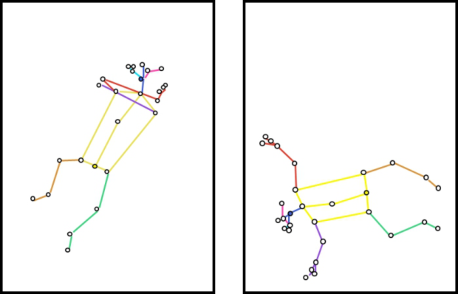
The results of the posture classification are shown in Table 2. A high classi- fication accuracy of 92.3% is achieved. As shown in the table, the F1-scores for the right and left lateral postures are relatively low. The possible causes of misclassification are erroneous skeletal detection by Vision Pose and varia- tions in the body axis (Figure 3). Erroneous skeletal detection occurred when the infants were covered with thin bedding or when their faces were not cap- tured well, resulting in the reversal of the estimation of the left and right sides. In the second posture classification step, we utilized the x-coordinate values of each joint point, assuming that the body axis connecting the shoulder and hip center was perpendicular to the x-axis. However, owing to the multiple movements exhibited by the infants, the body axis may change in multiple ways, deviating from a state perpendicular to the x-axis. This change caused misclassifications such as classifying the supine position as prone or the right lateral position as left lateral.
Figure 3: Skeletal misidentification (left) and variation in the body axis (right).
Upon analyzing the data for each night, it was observed that certain data numbers experienced a significant reduction in the available data for classifi- cation. In this study, only data with the complete 2D coordinates of the eight joint points were used for classification. However, we speculate that the data volume can be increased by re-evaluating and adjusting the parameters used in the calculations. Furthermore, because the annotations were conducted by
a single person, the certainty of the correct labels could be limited. Misclassi- fications were observed in postures with transitional movements. To address this limitation, we propose generating accurate labels through multiple anno- tators to assess inter-rater agreement and subsequently applying the model for posture classification.
CONCLUSION
In this study, we propose a method for classifying infant sleeping postures into four categories using video recordings. Our approach involves obtaining 2D joint coordinates by utilizing Vision Pose. Reconsideration of the calcu- lation parameters is seen to be critical in enhancing accuracy. Moreover, we encountered issues such as reduced classification accuracy owing to skele- tal misidentification and a decrease in the number of analyzable data points caused by undetectable joint positions. To address these issues, it is essential to compare the performances of alternative skeleton estimation software and select the optimal skeleton for posture classification. Our proposed approach allows non-contact sleeping posture classification using a single camera, mak- ing it viable for implementation in home and childcare environments. The primary objective of this study was to classify infant sleeping postures into four categories, with the aim of preventing accidental deaths during sleep and facilitating early symptom detection. In future research, we aim to conduct a more exhaustive classification considering the head and body axis postures to obtain more detailed and comprehensive information.
ACKNOWLEDGMENT
The authors would like to extend their heartfelt appreciation to Kao Cor- poration for its generous contribution to the valuable data used in this research.
REFERENCES
Abdulsadig, R. S. and Rodriguez-Villegas, E. (2023). Sleep Posture Monitoring Using a Single Neck-Situated Accelerometer: A Proof-of-Concept, IEEE Access Volume 11, pp. 17693–17706. Airaksinen, M., Räsänen, O., Ilén, E., Häyrinen, T., Kivi, A., Marchi, V., Gallen,
A., Blom, S., Varhe, A., Kaartinen, N., Haataja, L. and Vanhatalo, S. (2020). Automatic Posture and Movement Tracking of Infants with Wearable Movement Sensors, Scientific Reports Volume 10, No. 1, p. 169. Ben Zvi, I. and Thompson, D. N. (2021). Torticollis, facial asymmetry and plagiocephaly in normal newborns, European Journal of Pediatrics Volume 181, pp. 865–873. Boere-Boonekamp, M. M. and van der Linden-Kuiper, L. T. (2001). Positional prefer-
ence: prevalence in infants and follow-up after two years, Pediatrics Volume 107, No. 2, pp. 339–343. Dunsirn, S., Smyser, C., Liao, S., Inder, T. and Pineda, R. (2016). Defining the nature and implications of head turn preference in the preterm infant, Early human development Volume 96, pp. 53–60.
Automatic Classification of Infant Sleeping Postures Using an Infrared Camera 7
Jones, M. W. (2004). Supine and Prone Infant Positioning: A Winning Combination, The Journal of Perinatal Education Volume 13, No. 1. Konishi, Y., Mikawa, H. and Suzuki, J. (1986). Asymmetrical head-turning of
preterm infants: some effects on later postural and functional lateralities, Devel- opmental Medicine & Child Neurology Volume 28, No. 4, pp. 450–457. Matar, G., Lina, J. M. and Kaddoum, G. (2020). Artificial neural network for in-bed posture, IEEE Journal of Biomedical and Health Informatics Volume 24, No. 1. NEXT-SYSTEM Co., Ltd. [Online]. Available: https://www.next-system.com/vision
pose/feature/born. [Accessed 29/7/2023]. Ouattara, B. S., Tibbits, M. K., Toure, D. M. and Baccaglini, L. (2022). Sudden unexpected infant death rates and risk factors for unsafe sleep practices, World Journal of Pediatrics Volume 18, pp. 1–5. Porter, D., Michael, S. and Kirkwood, C. (2008). Is there a relationship between
preferred posture and positioning in early life and the direction of subsequent asymmetrical postural deformity in non ambulant people with cerebral palsy?, Child: care, health and development Volume 34, No. 5. Sato, H. (2020). Postural deformity in children with cerebral palsy, Physical Therapy Research Volume 23, pp. 8–14. Tang, K., Kumar, A., Nadeem, M. and Maaz, I. (2021). CNN-based smart sleep
posture recognition system, IoT Volume 2, No. 1 pp. 119–139. Tokutake, C., Haga, A., Sakaguchi, K., Samejima, A., Yoneyama, M., Yokokawa, Y., Ohira, M., Ichikawa, M. and Kanai, M. (2018). Infant Suffocation Incidents Related to Co-Sleeping or Breastfeeding in the Side-Lying Position in Japan, The Tohoku Journal of Experimental Medicine Volume 246, No. 2, pp. 121–130.
LISTED IN THE AHFE DIGITAL BOOKSTORE CATALOGUE
Explore the complete digital volume
Emerging Technologies in Healthcare and Medicine
Read this individual research paper free through the original publisher, or explore the full digital proceedings book.
ISBN 978-1-958651-92-6
Explore this ISBN in the AHFE Bookstore ↗Listed in the July 2026 bookstore catalogue; search by ISBN to confirm current availability · Digital book purchase optional