Yurie Kondo, Shima Okada, Masanobu Manno, Yusuke Sakaue, Masaaki Makikawa (2023). Verification of the Effects of Exercise on the Body and Mind Using a Boxing Glove-Type Sensory Augmentation Device. In: Artificial Intelligence, Social Computing and Wearable Technologies. AHFE Open Access, vol. 113, pp. 391–397. https://doi.org/10.54941/ahfe1004212
The background of this study is the increased number of people lacking exercise owing to the rise in remote work since the outbreak of the new coronavirus infection. As exercise is strongly linked to mental health, a lack of physical activity leads to an increase in psychological stress among individuals. Currently, few devices are available that can accurately evaluate exercise movements and allow people to engage in casual workouts. Therefore, this study aimed to investigate the effects of boxing training on the body and mind by using a sensory augmentation device with a high amusement factor. The sensory augmentation device used in this study was designed for boxing, a high-intensity full-body exercise. Inertial sensors were placed on the wrist of the boxing glove to determine the type and power of the punching action. The device then produces sound, vibration, and light according to according to the force used to give the punching action a more spectacular appearance. We measured mental and physical states during amusement-oriented training using this boxing glove-type sensory enhancer and evaluated its effects. The results demonstrated that training with a sensory augmentation device led to heightened motor induction and increased positive emotions. This suggests that the production of sound, vibration, or light influences the reward circuits of the emotional system. Potential applications of this technology include exploring its effectiveness in various exercise movements to determine its impact on physical and mental well-being.
The coronavirus disease-2019 spread, and people were restricted from leav- ing the house owing to the high infectiousness of the disease. This has led to a rapid spread of teleworking and online classes. As a result, people spent
more time sitting in chairs and physical inactivity progressed. The Min- istry of Health, Labor, and Welfare has set a goal of over 8,000 steps per day to prevent locomotive syndrome. However, the current situation is that less than 50% of the population has achieved this goal (Miyachi, 2012). In addition, because there is a strong link between exercise and mental health, exercise not only maintains basic physical fitness and improves health but also refreshes the mind by activating the brain (Paul et al. 2020). In contrast, lack of exercise worsens blood flow and causes people to feel tired quickly, which leads to negative emotions and insomnia. Consequently, people who refrained from unnecessary outings to avoid contact with others experienced reduced interactions with others and negative emotions.
In recent years, musical exercise, which adds entertainment value as an activity that improves both exercise and mental health, has gained attention. This allows for a heightened sense of wellbeing and sustained aerobic activity. This may also be due to the desire to exercise continuously and the activa- tion of frontal lobe functions (Blood and Zatorre, 2001). It is thought that pleasure is generated by the stimulation of the brain, and these functional areas are called reward systems. Activation of the reward system is effective in reducing the lack of exercise and the risk of dementia.
The purpose of this study was to develop a device that can induce moti- vated exercise in a casual manner and to evaluate the effects of exercise using this device on the body and mind.
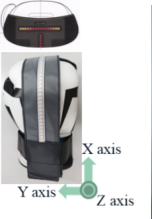
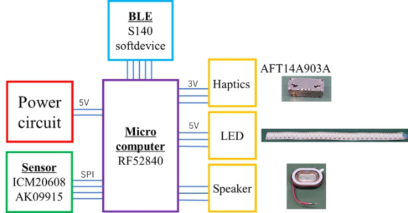
BOXING GLOVE-TYPE SENSORY AUGMENTATION DEVICE For the type of exercise, we focused on boxing, a full-body exercise that com- bines aerobic and anaerobic exercises and has a higher intensity per training session than that of other exercise movements. Figure 1 shows the developed boxing glove-type sensory expansion device, and Figure 2 shows its configu- ration. The band was attached to a boxing glove. An inertial sensor installed on the wrist of the boxing glove was used to determine the type and power of the punch movement in the boxing movement.
Figure 1: Appearance of the boxing glove-type sensory augmentation device.
When a punch operation is detected, the type of the punch is first deter- mined. Four types of punches can be determined: jab, straight, hook, and upper. A jab is a punch that emphasizes speed. A straight punch inflicts heavy
Verification of the Effects of Exercise on the Body and Mind 393
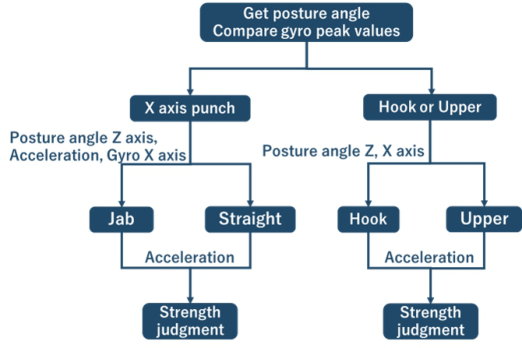
damage on a target. It punches by transmitting the rotations of the hips to the arms. A hook is a punch that strikes the target from the side. The arm is swung strongly during hip rotation. An upper cut is a punch that thrusts upward from the bottom toward the target. The knee is slightly bent, and the body’s spring is used to extend the knee, while at the same time the arm is pushed upward from below. The above four types of punches were judged using the acceleration and gyro measured by the sensors, and the posture angle was obtained from them. Subsequently, the power of the punch was determined. A flowchart of the type of punch and power determination is shown in Figure 3.
Figure 2: Overview of the boxing glove-type sensory augmentation device.Figure 3: Flow chart for punch judgment.
To determine the punch power, it was first determined whether the accel- eration at the time of punching was below the first threshold value. Subse- quently, it was determined whether the acceleration measured at the time of stopping the punch after the arm was extended to the maximum was above the second threshold value. The first threshold was set at four levels to divide the punching power into stages. When these conditions are satisfied, three different types of presentations are generated in accordance with the punch- ing action based on the judgment results. The staging details are listed in
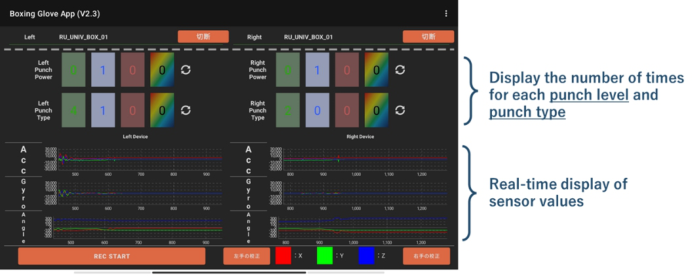
Table 1. The type of sound generated from the speaker, magnitude of the haptic vibration, and color of the LED light are changed according to the punching power to provide feedback to the user, thereby encouraging moti- vated exercise. The exercise results, such as the number of punches, can be transferred to an Android application and saved (see Figure 4).
Table available in the original PDF paper.
Table 1. Punch presentation content.
Table available in the original PDF paper.
Level Type of impact sound Vibration Light 1 Impact sound 1 Small Green 2 Impact sound 2 Medium Blue 3 Impact sound 3 Large Red 4 Impact sound 4 Large Rainbow
Figure 4: Application screen.
METHODS
This study aimed to evaluate the effects of exercise on the body and mind by using a boxing glove-type sensory augmentation device. In addition, we will verify whether a boxing glove-type sensory augmentation device can add entertainment to exercise and improve health while enjoying exercise. A total of 32 participants (58.9±17.1 years old), 13 men and 19 women, who par- ticipated in night kickboxing exercise for the middle aged (organized by a boxing gym) and kickboxing exercise for the young to elderly, were included in this study. After performing the exercise using a boxing glove-type sensory augmentation device, the participants completed a questionnaire. The ques- tionnaire was a subjective evaluation of whether the participants enjoyed the exercise using a boxing glove-type sensory augmentation device. The Japanese version of positiveand Negative affect schodule (PANAS) scales was used to evaluate positive and negative emotions.
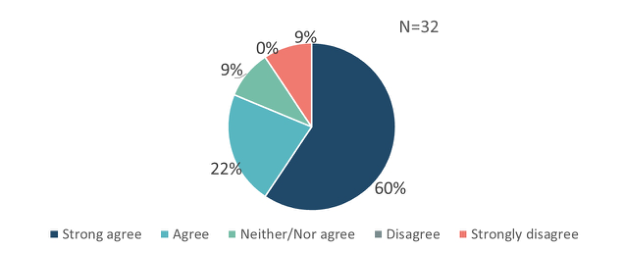
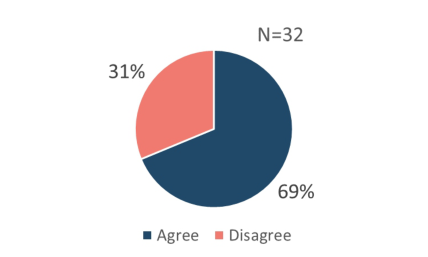
RESULTS & DISCUSSION The results of the exercise questionnaire using the boxing glove-type sen- sory enhancers are shown in Figures 5 and 6. Eighty-two percent of the
Verification of the Effects of Exercise on the Body and Mind 395
respondents enjoyed exercising using the boxing glove-type sensory augmen- tation device. In addition, 69% of the respondents preferred using the boxing glove-type sensory augmentation device again. These results suggest that stimulating the senses with sound, vibration, and light during exercise can induce motivational behaviors.
Figure 5: Pie chart showing the percentage of participants who enjoyed exercising using the boxing-glove type sensory augmentation device.Figure 6: Pie chart showing the percentage of participants who wanted to use the boxing glove-type sensory augmentation device again.
Additionally, there was an increase in positive sentiments regarding the subjective evaluation questionnaire (Watson et al., 1998) using the Japanese version of the PANAS (see Table 2).
Table 2. Compared to the average of JAPANESE PANAS.
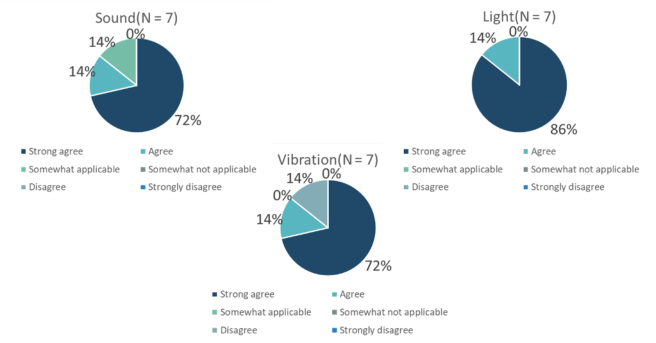
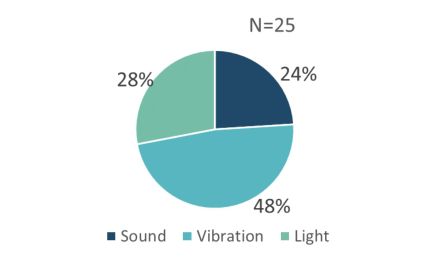
Figures 7 and 8 present the results of the respondents who answered which of the three types of feedback (sound, vibration, or light) was the most effec- tive. During the trial session in the night kickboxing exercise for middle-aged
individuals, each feedback content was answered using a six-point scale, and during the trial session in the kickboxing exercise for the young to elderly individuals, the most effective content was selected from among the three feedback contents. The illuminance of the surrounding environment affects the light sensitivity.
Figure 7: Pie chart showing what was effective in the feedback content. (In night kickboxing exercise for middle-aged individuals).Figure 8: Pie chart showing what was effective in the feedback content. (In kickboxing exercise for the young to the elderly individuals).
CONCLUSION
The background of this study is that the number of people who lack physical activity has increased due to the restriction of going out and the increase in teleworking due to COVID-19. This causes blood flow to deteriorate and causes negative emotions. Therefore, for the purpose of this study, we propose a method to add amusement to exercise and induce motivational exercise using a boxing glove-type sensory augmentation device. The effects of this movement were also evaluated. From the experimental results, it can be inferred that the participants enjoyed the exercise, and their positive emo- tions increased. We also obtained the opinion that they would like to use this
Verification of the Effects of Exercise on the Body and Mind 397
device in the future. As this was a short-term trend, it is necessary to verify the effects of continued use of the boxing glove-type sensory augmentation device over a longer period. In addition, because motor ability varies from person to person, the device should be improved to be more versatile that can be set at different levels to suit each individual. We would then clarify whether it is effective for different types of exercise.
ACKNOWLEDGMENT
The authors acknowledge the support of Mr. Seichi Ikemoto and the Shiga Prefectural Government’s Biwako Cultural Park City Universities Collabora- tion Project.
REFERENCES
Miyachi, M. (September 2012). Measures of physical activity and exercise for health promotion by the Ministry of Health, Labour and Welfare, The Journal of Physical Fitness and Sports Medicine. Vol. 1, No. 3, pp. 467–472. Paul, A., Nath, T. K., Sharifa J., Islam, M. M., Lechner, A. M. (August 2020). Pub-
lic Open space, Green exercise and well-being in Chittagong, Bangladesh, Urban Forestry and Urban Greening. Vol. 55. Blood, A. J., Zatorre, R. J. (September 2001). Intensely pleasurable responses to music correlate with activity in brain regions implicated in reward and emotion, Proceedings of the National Academy of Sciences of the United States of America. Vol. 98, No. 20, pp. 11818–11823. Watson, D., Clark, L. A., Tellegen, A. (June 1988). Development and Validation of
Brief Measures of Positive and Negative Affect: The PANAS Scales, Journal of Personality and Social Psychology. Vol. 54, No. 6, pp. 1063–1070.
LISTED IN THE AHFE DIGITAL BOOKSTORE CATALOGUE
Explore the complete digital volume
Artificial Intelligence, Social Computing and Wearable Technologies
Read this individual research paper free through the original publisher, or explore the full digital proceedings book.
ISBN 978-1-958651-89-6
Explore this ISBN in the AHFE Bookstore ↗Listed in the July 2026 bookstore catalogue; search by ISBN to confirm current availability · Digital book purchase optional