Lokesh Singh, Sarvapali Ramchurn (2023). The Effect of Automated Agents on Individual Performance Under Induced Stress. In: Emerging Technologies in Healthcare and Medicine. AHFE Open Access, vol. 116, pp. 118–127. https://doi.org/10.54941/ahfe1004363
Induced stress is a phenomenon commonly experienced across different fields such as emergency services, healthcare, air traffic control, sports, and business - which necessitates the development of effective coping strategies and resilience for individuals or teams performing under pressure. This study aims to examine the effects of automated agents on individual performance during high-stress conditions. The design of these agents ensures they carry out identical tasks as participants based on predetermined frameworks. Participants underwent an experimentally designed task that aimed at inducing stress while measuring their performance amidst time pressure and auditory distraction. Results indicate that working with automated agents causes individuals to alter their approach by focusing narrowly on immediate concerns - making it challenging for them to consider several options or see broader contexts accurately. Regardless of ability level participants' performances were influenced by these automated agents. Future research will explore how these findings interact with physiological signals. This study highlights the importance of developing effective coping strategies and the potential impact of social factors on individual performance under induced stress.
Working under stress is a common experience experienced in many fields, such as medical emergencies, air traffic control, natural disaster management, sports, and business. To perform effectively, individuals must develop effec- tive coping strategies (Poole et al., 2004). As the goal of high-performing teams in the organization becomes significantly important, researchers have aimed to investigate factors that affect individual performance (Tummolini et al., 2004). In today’s fast-paced and technologically driven world, auto- mated agents have become increasingly prevalent in various domains, from customer service to healthcare. These automated agents, such as chatbots and virtual assistants, are designed to interact with individuals and provide assistance or perform tasks (Parasuraman & Mouloua, 2018). As their uti- lization expands, it becomes crucial to understand the implications of their presence on individual performance, particularly when individuals are under
The Effect of Automated Agents on Individual Performance Under Induced Stress 119
induced stress (Igbaria & Tan, 1997). Stress is inherent in daily life and can significantly impact an individual’s cognitive abilities, decision-making, and overall performance. It is known that stress can impair performance and increase the likelihood of errors or mistakes. However, the interaction between stress and the presence of automated agents remains an under- explored area of research (Nebeker & Tatum, 1993). This study aims to investigate the effect of automated agents on individual performance when exposed to induced stress in compitive environment. By examining how these agents influence cognitive processes, task execution, and stress responses, we can gain valuable insights into the potential benefits or drawbacks of utiliz- ing automated agents in high-stress situations. Understanding the impact of automated agents under stress is of practical importance in various fields (Dzindolet et al., 2003). For instance, in emergency response scenarios, where quick and accurate decision-making is critical, automated agents could either enhance or hinder performance(Lee & Mihailidis, 2005). Similarly, in healthcare settings, where healthcare professionals often face high-stress levels, automated agents could serve as valuable tools but may also intro- duce additional cognitive load or distractions. This research will employ a combination of experimental methodologies, incorporating stress induction techniques and performance-based assessments. Data analysis will iden- tify patterns, correlations, and potential moderating factors contributing to the observed effects. Ultimately, the findings of this study will provide valuable insights into the interaction between automated agents, individ- ual performance, and induced stress. This research has the potential to inform the design and implementation of automated agents in various con- texts, helping to optimize their effectiveness and minimize potential negative consequences.
Effect of Stress on Human Performance The impact of stress on human performance has been extensively studied (Matthews et al., 2000). This literature review examines how induced stress affects human performance in various areas, including cognition, decision- making, memory, and motor skills. The effects of induced stress on cognitive abilities have been the subject of numerous studies (Driskell & Salas, 2013). According to research, acute stress can improve or worsen cognitive func- tion depending on its intensity, duration, and specific elements (Klein, 1996). According to some studies, moderate stress can enhance cognitive perfor- mance by increasing attention, focus, and the rate at which information is processed (Singh et al., 2022). However, persistent or high stress levels have consistently been linked to cognitive dysfunction, including a decline in working memory capacity, a loss of executive control, and a decline in decision-making skills (Cohen, 1980). It has been discovered that induced stress has a significant impact on how decisions are made. According to research, stress can make people more risk-averse decision-makers because they prioritise averting potential losses over pursuing gains.
The relationship between stress and memory function is complicated. It has been demonstrated that acute stress can either improve or worsen memory
120 Singh and Ramchurn
depending on the specific memory system involved (Arnsten, 2009). Stress can make it easier for emotionally charged memories to become consolidated, which improves memory recall for emotionally charged events. However, stress can also make retrieving memories more difficult, especially when it comes to neutral or unemotional information. On the other hand, persis- tent stress has consistently been linked to negative memory effects, including hampered encoding, consolidation, and retrieval processes. It is crucial to remember that individual differences and environmental factors significantly influence how much stress affects performance outcomes. More research is required to understand the underlying mechanisms and develop effective stress management techniques to lessen the detrimental effects of stress on human performance.
Individual Performance and the Impact of Reward The effect of rewards on individual performance is a widely studied topic in organizational psychology and behavioural economics (Sarin & Mahajan, 2001). Numerous studies have investigated how rewards influence motiva- tion, task engagement, and overall performance. Dopaminergic pathways and the brain’s reward circuitry are involved in the underlying mechanisms (Baumeister, 1984). However, the effects of rewards on performance are modulated by individual differences, the nature of the task, and the stres- sor. Intrinsic motivation refers to engaging in an activity for its inherent enjoyment or satisfaction, while extrinsic motivation involves engaging in an activity to obtain external rewards (Eisenberger et al., 1999). Offering extrin- sic rewards for tasks that individuals find inherently interesting or enjoyable can sometimes decrease their intrinsic motivation, as the focus shifts to exter- nal rewards rather than the inherent satisfaction of the task itself (Porcelli & Delgado, 2009). Performance-contingent rewards are tied to achieving spe- cific performance goals. These rewards have been found to enhance task performance, particularly when the goals are challenging but achievable (Harackiewicz & Manderlink, 1984). They provide individuals with clear objectives and a sense of accomplishment when they are attained, thereby increasing motivation and effort. While rewards can initially boost perfor- mance, their long-term impact may be limited (Locke & Latham, 2002). Once individuals become accustomed to receiving rewards, their motivation can depend on rewards rather than intrinsic factors. This dependency can lead to a decrease in performance when rewards are removed or reduced. The impact of rewards on performance can vary across individuals. Some people may be more motivated by extrinsic rewards, while others may be driven by intrinsic factors or a combination of both. It is important to consider indi- vidual preferences and needs when designing reward systems to maximize effectiveness.
TASK DESIGN The task design for this study was created using Microsoft Excel. utilizing Macro and Visual Basics to design an automated system. This automated
The Effect of Automated Agents on Individual Performance Under Induced Stress 121
system mimicked the task that participants had to complete at both slower and faster speeds.
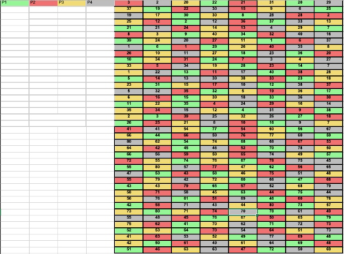
Individual Performance Measurement Task This study explored individual performance under induced time pressure and auditory distraction, contrasting outcomes with the influence of slow and fast automated agents (refer to Figure 1). A cohort of 32 participants was engaged in the experiment. Each participant was allocated a distinct colour and tasked with transferring blocks from a shared pool to their columns. Simultaneously, three automated agents, visible to participants, operated in the remaining columns. Half of these agents functioned rapidly, while the others operated more slowly.
Figure 1: Performance with slow automated agents.
The task sheet (see Figure 1) was segmented into 320 blocks, categorized into four colours. Each colour set contained blocks sequentially numbered from 1 to 80. Participants were directed to “cut” their designated coloured block using the Ctrl+x command and subsequently “paste” it into their column using Ctrl+v. This process was to be executed in numerical order, starting with block 1. The entire task was constrained to a 6-minute win- dow, challenging participants to transfer as many blocks as possible within this duration. For clarity, a participant might first transfer a green block labelled ‘1’ to their column, followed by the ‘2’ block, and so forth, until the task’s conclusion. Participants received periodic updates on the remain- ing task time to maintain the time pressure. Performance metrics were based on the number of blocks each participant successfully transferred within the 6 minutes. To further induce performance pressure, participants were informed of a tiered reward system: outperforming the automated agents could ele- vate their reward from £10 to £20, and the top performer would secure an additional £30 bonus. In essence, this study’s design required participants to swiftly and accurately transfer blocks within a time-limited setting while contending with automated agents of varying speeds. The primary evalua- tion criterion was the number of blocks each participant moved within the stipulated 6-minute duration. This study explored individual performance under induced time pressure and auditory distraction, contrasting outcomes
122 Singh and Ramchurn
with the influence of slow and fast automated agents (refer to Figure 1). A cohort of 32 participants was engaged in the experiment. Each participant was allocated a distinct colour and tasked with transferring blocks from a shared pool to their columns. Simultaneously, three automated agents, visi- ble to participants, operated in the remaining columns. Half of these agents functioned rapidly, while the others operated more slowly.
METHOD
There were 32 sessions total, each lasting about 30–40 minutes. Each partic- ipant received an overview of the task design, an introduction to the study, and an informed consent form. The overview included a demonstration of the Excel sheet display and instructions on completing the task. Following that, the Perceived stress scale form was distributed to participants in order to assess their immediate stress levels. The task was recorded using OBS soft- ware. Participants were informed about the remaining time to induce stress during the task. After completing the task, the questionnaire and NASA-TLX forms were distributed to the participants. Each session followed the same procedure.
Participant The subject pool was made up of people from varied ethnicities and genders. A total of 32 participants were recruited through an online advertisement. Subjects who wished to participate in the study were asked to fill out a Google form containing demographic information, including name, gender, age, occupation, and ethnicity. Of the 32 participants, 13 were working pro- fessionals, and 19 were students (M = 25.5, SD = 3.2). All participants were treated ethically by the current organisation’s ethics guidelines.
RESULT
In this section, we present the results of the experiments where statistical significance was set to a α =.05 level, pre-correction.
Perceived Stress Scale Before the task, participants’ perceived stress levels were assessed among 32 Participants. We looked at how they perceived stress using the Perceived Stress Scale (PSS). What we found was that people’s stress levels varied quite a bit. About 6.25% of the participants felt a high-stress level, and the same percentage felt low stress. The majority, which was 87.5% of the group, reported feeling a moderate level of stress. These results show that people in our study experienced stress differently, highlighting the importance of providing specific support to address their individual stressors.
Individual Performance Measurement Individual expertise was measured by the number of blocks removed by each participant in a 6-minute time limit. Participants were instructed not to use a watch while experimenting. They were informed about the remaining time
The Effect of Automated Agents on Individual Performance Under Induced Stress 123
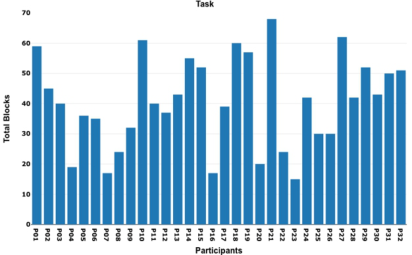
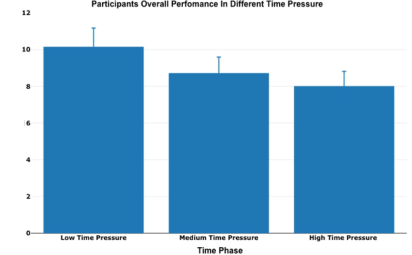
during the task: once after 2 minutes and a second in 4 minutes had passed, and again when one minute remained. The experiment organizer counted the last 20 seconds to place participants under time pressures. The entire experiment was divided into three-time phases. The first phase was designed to be under no time pressure, the second phase to be under moderate time pressure, and the third was under high time pressure. (see Figure 2) shows the total number of blocks removed by all 32 participants in 6 minutes. All 32 participants’ performance was divided into 3-time pressure phases. (see Figure 3) shows all participants’ average time to find and remove the block in 3 distinct time pressure phases. As can be seen (see Figure 3) average time taken to remove the blocks is decreased under time pressure.
Figure 2: Total blocks removed by each participant in individual performance measurement task.
(See Table 1) shows the average time taken by all participants in two sepa- rate time phases to remove each block. As a consequence of time pressure, the performance differed significantly. The difference in time is statistically signif- icant between the Third phase and the first phase. Participants’ performance increased under time pressure.
Figure 3: Average time taken to remove the single block in each phase.
They were able to remove blocks faster under time pressure. These find- ings indicated that time pressure-induced stress positively affected individual
124 Singh and Ramchurn
performance. Participants were given a questionnaire to validate the assump- tion of the individual expertise measurement task. According to the survey results, participants indicated that time constraints stress them out, but the results show that it helps them perform better.
Table 1. Average time taken to remove each block in time pressure phase.
Table available in the original PDF paper.
Phase Average Time (In Seconds) Phase 1 10.15 Phase 2 8.72 Phase 3 8.01
Performance With Automated Agents Participants were tested on block removal in 6 minutes, divided into two groups based on agent speed (slow or fast) and further categorized into slow, medium, and high time pressure phases.
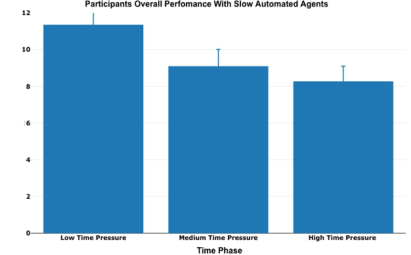
Performance With Slow Automated Agents A total of 16 participants took part in the experiment with slow agents, and the analysis focused on exploring the impact of these time phases on participants’ performance as measured by the number of blocks removed.
Figure 4: Performance with slow automated agents.
A repeated measures Analysis of Variance (rmANOVA) was conducted to examine the effect of different time phases on the number of blocks removed (see Figure 4). The rmANOVA revealed a significant effect of time phase on the number of blocks removed, F(1, 15) = 5.68, (p < 0.005), generalized eta-squared = 0.275 See Figure \ref{slow} for a histogram representation of mean blocks removed across different time phases). The effect size, mea- sured by generalized eta-squared, was moderatley large (0.80), indicating that approximately 27.5% of the variance in the number of blocks removed could be attributed to the time phase. This significant, large effect prompted fur- ther investigation through post-hoc tests to understand the nature of these
The Effect of Automated Agents on Individual Performance Under Induced Stress 125
differences across time phases. Pairwise comparisons were conducted using paired t-tests with Benjamini-Hochberg correction for multiple comparisons. The results indicated no significant difference between Phase 1 and Phase 2 (p = 0.112). Significant difference between Phase 3 and Phase 1 (p < 0.001). No significant difference between Phase 3 and Phase 2 (p < 0.0541). These results suggest that the number of blocks removed in Phase 3 was signifi- cantly higher than in Phase 1 and Phase 2. However, the number of blocks removed did not differ significantly between Phase 1 and Phase 2.
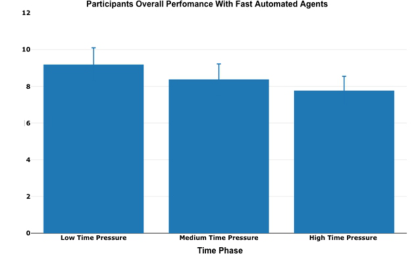
Performance With Fast Automated Agents A total of 16 participants took part in the experiment with fast agents, and the analysis focused on exploring the impact of these time phases on participants’ performance as measured by the number of blocks removed.
Figure 5: Performance with slow automated agents.
A repeated measures Analysis of Variance (rmANOVA) was conducted to examine the effect of different time phases on the number of blocks removed (see Figure 5). Contrary to expectations, the rmANOVA did not reveal a significant effect of the time phase on the number of blocks removed, F(1,15) = 0.67, (p = 0.42), with a generalized η2
p=0.04. The effect size, as measured by generalized eta-squared, was notably small (0.04), indicating that only approximately 4% of the variance in the number of blocks removed could be attributed to the time phase. Given the lack of significance in the primary rmANOVA, posthoc tests were also conducted to probe for possi- ble pairwise differences. Pairwise comparisons were conducted using paired t-tests with Benjamini-Hochberg correction for multiple comparisons. The results indicated no significant differences between the phases (all p = 0.6). These findings did not support the hypothesis that the time phase significantly affected the number of blocks removed by participants. This suggests that participants did not become significantly more or less efficient in removing blocks as the task progressed through different time phases. Future research may explore other variables or conditions that could impact the number of blocks removed during this task. The data suggest different behaviours in participants when interacting with slow and fast agents. For the slow agent
126 Singh and Ramchurn
condition, the time phase significantly impacted performance, although pair- wise comparisons did not pinpoint where the differences lay. This indicates a more complex relationship requiring further investigation or a more nuanced analytical approach. In contrast, participants competing with fast agents showed no change in performance across time phases. This could suggest that the fast speed of the agents may not have allowed for adaptation or alteration in strategies by the participants.
CONCLUSION
The findings contribute to understanding the complex dynamics between automated agents, stress, and individual performance, particularly in time- pressure environments. In stressfull environments, such as those simulated in sectors like healthcare, air traffic control, and business, coping strategies and resilience become paramount. This study delved into the influence of automated agents on individual performance under such stressors. Partici- pants, while subjected to time pressure and auditory distractions, engaged in tasks mirroring those of the automated agents. The findings underscore that the presence of these agents prompts individuals to narrow their focus to immediate tasks, often at the expense of broader contextual understand- ing. Notably, this influence was consistent across varying ability levels among participants. While the study revealed that participants adapted their strate- gies and improved performance when paired with slower agents, no such adaptation was observed with faster agents. This suggests that the pace of automated agents can significantly dictate human adaptability and strategy. The results also emphasize the dual-edged nature of time pressure: while it can enhance performance, possibly due to heightened focus or competitive drive, it can also limit strategic breadth. As we move forward, it’s crucial to integrate physiological metrics to gain a holistic understanding of these inter- actions. Moreover, individual differences, such as coping mechanisms, may play a pivotal role in this dynamic between automation, stress, and perfor- mance. This research underscores the need for tailored coping strategies in high-stress scenarios, especially when automation is in play.
REFERENCES
Arnsten, A. F. T. (2009). Stress signalling pathways that impair prefrontal cortex structure and function. Nature Reviews Neuroscience, 10(6), 410–422. Baumeister, R. F. (1984). Choking under pressure: self-consciousness and paradoxi-
cal effects of incentives on skillful performance. Journal of Personality and Social Psychology, 46(3), 610. Cohen, S. (1980). Aftereffects of stress on human performance and social behavior: a review of research and theory. Psychological Bulletin, 88(1), 82. Driskell, J. E., & Salas, E. (2013). Stress and human performance. Psychology Press. Dzindolet, M. T., Peterson, S. A., Pomranky, R. A., Pierce, L. G., & Beck, H. P.
(2003). The role of trust in automation reliance. International Journal of Human- Computer Studies, 58(6), 697–718. Eisenberger, R., Pierce, W. D., & Cameron, J. (1999). Effects of reward on intrinsic motivation—Negative, neutral, and positive: Comment on Deci, Koestner, and Ryan (1999).
The Effect of Automated Agents on Individual Performance Under Induced Stress 127
Harackiewicz, J. M., & Manderlink, G. (1984). A process analysis of the effects of performance-contingent rewards on intrinsic motivation. Journal of Experimental Social Psychology, 20(6), 531–551. Igbaria, M., & Tan, M. (1997). The consequences of information technology accep-
tance on subsequent individual performance. Information & Management, 32(3), 113–121. Klein, G. (1996). The effect of acute stressors on decision making. Stress and Human Performance, 49–88. Lee, T., & Mihailidis, A. (2005). An intelligent emergency response system: prelimi-
nary development and testing of automated fall detection. Journal of Telemedicine and Telecare, 11(4), 194–198. Locke, E. A., & Latham, G. P. (2002). Building a practically useful theory of goal setting and task motivation: A 35-year odyssey. American Psychologist, 57(9), 705. Matthews, G., Davies, D. R., Stammers, R. B., & Westerman, S. J. (2000). Human
performance: Cognition, stress, and individual differences. Psychology Press. Nebeker, D. M., & Tatum, B. C. (1993). The Effects of computer monitoring, standards, and rewards on work performance, job satisfaction, and stress 1. Journal of Applied Social Psychology, 23(7), 508–536. Parasuraman, R., & Mouloua, M. (2018). Automation and human performance:
Theory and applications. Routledge. Poole, M. S., Hollingshead, A. B., McGrath, J. E., Moreland, R. L., & Rohrbaugh, J. (2004). Interdisciplinary perspectives on small groups. Small Group Research, 35(1), 3–16. Porcelli, A. J., & Delgado, M. R. (2009). Acute stress modulates risk taking in
financial decision making. Psychological Science, 20(3), 278–283. Sarin, S., & Mahajan, V. (2001). The effect of reward structures on the performance of cross-functional product development teams. Journal of Marketing, 65(2), 35–53. Singh, L., Ramchurn, S., Malik, O., & Clark, J. R. (2022). Understanding the Impact
of Induced Stress on Team Coordination Strategy in Multi-User Environments. Tummolini, L., Castelfranchi, C., Ricci, A., Viroli, M., & Omicini, A. (2004). What I see is what you say: Coordination in a shared environment with behavioral implicit communication. ECAI, 4.
LISTED IN THE AHFE DIGITAL BOOKSTORE CATALOGUE
Explore the complete digital volume
Emerging Technologies in Healthcare and Medicine
Read this individual research paper free through the original publisher, or explore the full digital proceedings book.
ISBN 978-1-958651-92-6
Explore this ISBN in the AHFE Bookstore ↗Listed in the July 2026 bookstore catalogue; search by ISBN to confirm current availability · Digital book purchase optional