Lokesh Singh, Sarvapali Ramchurn, Obaid Malik, Jediah Clark (2022). Understanding the Impact of Induced Stress on Team Coordination Strategy in Multi-user Environments. In: Physical Ergonomics and Human Factors. AHFE Open Access, vol. 63, pp. 150–159. https://doi.org/10.54941/ahfe1002608
Managing air traffic control, medical emergencies and multi-robot systems are prime cases where human teams have to work on complex tasks. In such cases, these teams are continuously working under stress induced by instability, complexity and time pressure. The success of such teams is primarily driven by effective team coordination. The objective of this study is to understand the impact of induced stress on human team coordination strategy. In this study, two online tasks were designed to induce stress in participants, one in single-user and the other in multi-user collaborative environments, measuring individual and collaborative teamwork performances respectively. Both experiments were conducted under induced time pressure and auditory distraction. Our analysis showed that team members prefer to switch between different strategies and thus, the coordination shifts from explicit to implicit coordination. However, in the single-user environment, the participant's performance was influenced by their competitor's performance, regardless of the participant's abilities. Future research will determine how these effects interact with physiological signals.
INDRODUCTION People routinely work in teams to execute complex tasks that need close coordination among team members. Air traffic control, medical emergencies, and multi-drone management systems are prime examples of teams wor- king on complex tasks under stress induced by instability, complexity, and time pressure. As the role of high performing teams in organizations beco- mes significant, many researchers have set the goal of investigating ways to improve team performance (Clair, et al., 2011; Tummolini, et al., 2004). This article investigates how participants interpret and incorporate strategy when working as individuals and as members of a team. We conducted an expe- rimental analysis on individual expertise and team coordination behavior to better understand how humans use coordination methods such as verbal and nonverbal communication to improve performance. These findings will help us to better understand a team’s coordination strategy. In the following secti- ons we present a review of related research on individual expertise and team
Understanding the Impact of Induced Stress on Team Coordination Strategy 151
performance, followed by a literature review on team coordination behavior under stress.
Individual Expertise and Team Performance Over the last few decades, in some areas, organizational work culture has shifted from individual to team-based (Poole, et al., 2004). The question of how individual expertise and team performance are related to one ano- ther is important in determining what makes an effective team. The strongest team member is referred to as an individual who shows the highest expertise in performance (Ericsson & Smith, 1991). Expert team members perform well on the task and sub-tasks assigned to them (Lorsch, 1987). From this we conclude top performers are key contributors to high team performance. An experimental study (Baumann & Bonner, 2004), found that counting on the expert member was positively associated to team performance. High per- formers are expected to contribute more to team performance and to also motivate other team members to perform well (Predmore, 1991).
Team Coordination In the exist in literature, there are several definitions of teams. A team is a group of two or more individuals who work together toward a shared goa- l/mission and have each been allocated a specific role to work on (Fiore, et al., 2010; Serfaty, et al., 1993). To attain a goal, team members must coordinate, communicate, and adapt strategies under stress induced by unpredictabi- lity, complexity, and time pressure. Stress influences individual performance, which in turn influences team performance. Often, teams tend to work toge- ther in a coordinated manner. As such performance failure by a single member of the team can jeopardise a complete operation. Therefore, it is impor- tant to understand team coordination strategy to improve team performance. While significant work has been carried out to detect the impact of indu- ced stress on individuals, detection of stress in a multi-user environment is lacking (Driskell & Salas, 1991; Predmore, 1991). Increase in stress does not always imply a drop in performance (Serfaty, et al., 1993; Janis & Mann, 1977); in some cases, members simply alter their rate of information gathe- ring strategy (LaPorte & Consolini, 1991). According to previous research, teams who predominantly convey information by anticipating each other’s requirements outperform those who maintain less anticipatory communica- tion. Teams manage to hold or improve their performance when under time pressure by shifting their strategy from ‘explicit’ to ‘implicit’ coordination (Serfaty, et al., 1993). However, it is unknown which kind of proactive infor- mation exchange is the most efficient. See Table 1 for a description of each coordination type.
Explicit coordination is defined as the adoption of multiple processes that allow various team members to coordinate their multiple inter dependencies. Several studies in this area have highlighted two fundamental processes of explicit communication: 1) planning, and 2) the specific communication stra- tegies. The presence of unknown and changing situations throughout the action phase will push the team to adjust established plans, boosting explicit
Table 1. Description of each coordination group (Butchibabu, et al., 2016).
Table available in the original PDF paper.
Definition Examples
Coordination type
Subgroup of coordination type Explicit coordination Commanding other teammates to perform actions.
“Pick up block from column one” or “please remove block from yellow D1” Implicit coordination
“There are a lot of red colors”
Deliberative Information related to next step in sequence
“I am waiting for that block to be removed”
Reactive Status update not related to the next step in the sequence Silence Use of idle time Efficient use without communication with team members
coordination (March & Simon, 2005; Kleinman & Serfaty, 1989). Implicit coordination refers to a team’s ability to work collaboratively by anticipa- ting the demands of the task and their teammates, and then adjusting their behavior accordingly, without the necessity for direct communication among team members (Espinosa, et al., 2004; MacMillan, et al., 2004; Orasanu, 1990). Implicit coordination is one of the distinct modes of coordination. Previous studies show that the following behaviors are indicative of impli- cit coordination: providing relevant information, knowledge, or comments to other team members without prior request, sharing the workload or pro- actively assisting a coworker, keeping track of activity progress, teammate performance, and modifying one’s behavior to the actions required by others (Wittenbaum, et al., 1996).
TASK DESIGN Due to the circumstances surrounding COVID-19, it was important to make sure that the experiment could be carried out remotely. Thus, these experi- ments were designed on a Google sheet, which participants could access in real time from any location. All participants were able to view and edit the sheet. Microsoft Teams was used to connect participants and researchers with each other.
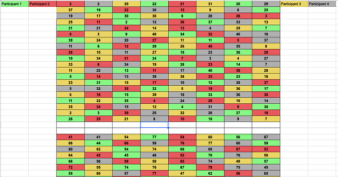
Individual Expertise Measurment Task The task was designed for measuring individual expertise under time pressure based on editable shared Google sheet (see Figure 1). The sheet was randomly divided into blocks of four different colors. The blocks of a single color were numbered from 1 to 80, making the total number of blocks 320. All partici- pants were randomly assigned a color. Four participants performed the task at the same time independently. Participants were instructed to perform the
Understanding the Impact of Induced Stress on Team Coordination Strategy 153
Figure 1: Individual expertise measurement task.
task on their respective empty columns. These empty columns were made on either side of the task design blocks. Participants were instructed to cut (Ctrl+x) the colored brick assigned to them from the bundle of colors and paste (Ctrl+v) them under an assigned column from top to bottom. They were also instructed to cut the blocks in an ascending order starting from number 1. The duration of the task was fixed to 5 minutes. Each participant had to fill their assigned column with as many blocks as possible within the stipulated time. Individual expertise was measured by the number of blocks removed by each participant in a 5-minute time limit. This experiment was organized in such a way that multiple participants can take part in the study at the same time. For this study, a maximum of four participants were par- ticipating at the same time. However, each participant completed their task independently. Participants were instructed not to use a watch while perfor- ming the experiment and were informed about the remaining time during the task: once after half-time and again when one minute remained. To place participants under time pressure, the experiment organizer counted the last 10 seconds. The entire experiment was divided into two time phases. The first phase was designed to have no time pressure and the second phase was designed to be under time pressure. Individual expertise was measured by the number of blocks removed by each participant in a 5-minute time limit.
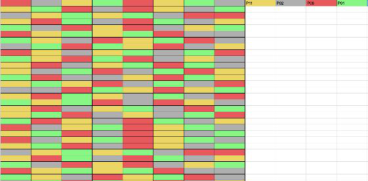
Team Performance Measuremnt Task Another task was designed for measuring team performance to evaluate the impact of individual expertise on overall team performance (see Figure 2). This task was not intended for participants to compete against each other, but rather work as a team in a coordinated manner. Individual expertise levels from individual expertise measurement tasks were used to distri- bute participants into teams for team performance measurement tasks. All 32 participants were divided into 8 teams, where each team consisted of four participants. A Google sheet (see Figure 2) was provided to each team one at a time. The sheet contained a total of 672 blocks in four different colors. Unlike individual expertise measurement tasks, these blocks were not num- bered. A color was assigned to each participant of a team. The duration of the task was fixed to 5 minutes for all participants. The rules of the task were two-fold. Firstly, only one block could be removed by one participant at a time. Secondly, a block could be removed only if the above block is empty. These aspects of the task created coordination on other participants.
Figure 2: Team performance measurement task.
Participants were also allowed to ask and interact with their fellow parti- cipants. Participants were instructed not to use a watch while performing the experiment. Auditory distraction and time pressure were introduced in second phase. The experiment organizer informed about the remaining time during the task: once after half-time and again when one minute remained. To place participants under time pressure, the experiment organizer counted the last 10 seconds. The entire experiment was divided into two time pha- ses. The first phase was under no time pressure while the second phase was under time pressure. We considered the number of blocks removed by each team as the score. Better scores indicate a higher performing team. Based on their score, teams were classified into high performing and low performing teams.
METHOD
This two-day experiment was entirely conducted online to learn the effect of time pressure based induced stress in individual and team performance. All the participants and researcher were connected using Microsoft teams. For data collection, both tasks were recorded using OBS software. There were 16 sessions total, each lasting about an hour. Each participant received an overview of the task design, an introduction to the study, and an informed consent form. The overview included a demonstration of the Google sheets display, as well as instructions on how to complete the task and communi- cate using the interface. Following that, the Perceived stress scale (Cohen, et al., 1983) form was provided to participants to assess their immediate stress level at the time of participating in the study followed by a training session that lasted roughly 5 minutes. The first experiment was conducted to quantify individual expertise followed by NASA-TLX (Hart, n.d.) and questionnaire. The second experiment was conducted to measure team per- formance in collaborative environment also followed by questionnaire and NASA-TLX form.
Participants The sample was made up of participants from varied ethnicities and gen- ders. A total of 32 participants (14 females and 18 males; mean age = 27.5 years, SD= 3.3) were recruited through an online advertisement. Subjects who wished to participate in the study were asked to complete a Google
Understanding the Impact of Induced Stress on Team Coordination Strategy 155
form containing demographic information including name, gender, age, occupation, and ethnicity. Out of the 32 participants, 20 were working pro- fessionals and 12 were students. Each participant received £10 monetary compensation for their participation. An additional monetary incentive of £80 and £40 were provided for the top two high performing teams. All par- ticipants were treated ethically in accordance with the current organizational ethics guidelines.
RESULT
In this section, we present the results of the experiments where statistical significance was set to a α = .05 level, pre-correction.
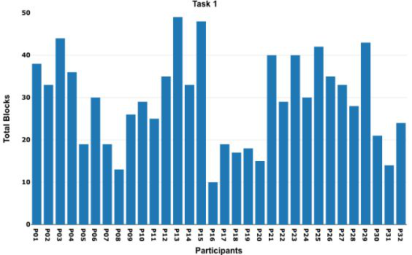
Individual Expertise Measurement The first task was designed to determine the effect of time pressures on indi- vidual performance. See Figure 3 for the total number of blocks removed by all 32 participants in 5 minutes. The average time to remove each block taken by all participants in two separate time phases is given in Table 2. Phase one is considered non-stressful, while phase two is considered stressful. An unpai- red two-sample Wilcoxon test was conducted to compare the average time per block during phase one and phase two. There was a statistically signifi- cant difference between the two-time phases (p < .0003). Additional post-hoc tests revealed that time per block during phase one (M = 7s, SD = 13.1s) was considerably longer than time per block during phase two (M = 6s, SD = 9.4s). These findings suggest that time pressure based induced stress has a positive impact on individual performance. Participants were given a questionnaire to validate the assumption of the individual expertise measu- rement task. According to the survey results, participants indicated that time constraints increased stress, but the results shows that it helps them perform better.
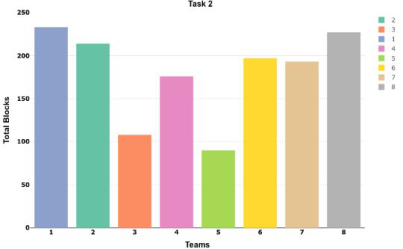
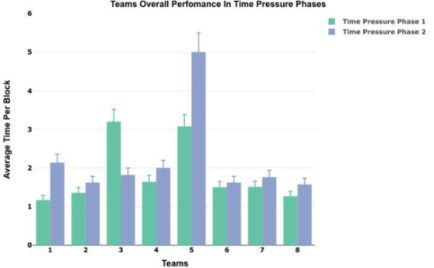
Team Performance Measurement The second task was design to determine the effect of time pressure on team performance. Total blocks removed by each team in 5 minutes is given in Figure 4. The average time taken to keep blocks at assigned location by all teams in 2 distinct time pressure phases is given in Figure 5. Phase one is con- sidered non-stressful, while phase two is considered stressful. Average time taken to remove single block in time pressure phase is given in Table 2. Ave- rage time taken to remove the blocks increases in team performance task under time pressure. We used an unpaired two-sample Wilcoxon test to compare the average time per block during phase one and phase two. We found a statistically significant difference between the two-time phase (p < .015). Additional post-hoc tests revealed that time per block during phase one (M = 1s, SD = 1.50s) was considerably shorter than time per block during phase two (M = 1.2s, SD = 1.72s). These findings suggest that time pressure based induced stress has a negative impact on team coordination. In the questionnaire analysis, participants indicated that time pressure made them stressed. They were not able to coordinate with fellow team members.
Figure 3: Total blocks removed in individual expertise measurement task.Table 2. Average time taken to remove single block in time pressure phase.
Table available in the original PDF paper.
Phase Average time by Individual (In seconds) Average time by teams (In seconds) Phase 1 11.64 1.61 Phase 2 8.81 1.92
Figure 4: Total blocks removed by each team in team performance task.
Overall a teams’ performance is negatively impacted by time pressure. They have also mentioned auditory distraction and experiment organizer interfe- rence increases stress. According to the NASA TLX analysis, participants indicated that this task was cognitively challenging and that they felt hurried or rushed while performing it.
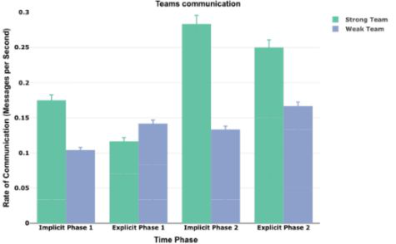
Evolved Coordination Tactics in Teams The number of blocks removed by each team in each time phase was used to measure team performance, and this was clearly conveyed to participants as part of the study protocol. Team coordination behavior from the experi- ment was characterized by an independent researcher as either implicit or explicit coordination according to previous literature (Butchibabu, et al., 2016). Overall, all eight teams showed higher rates of implicit communi- cation (M = 0.05, SD = 0.02) than explicit communication (M = 0.04, SD = 0.01).
Understanding the Impact of Induced Stress on Team Coordination Strategy 157
Figure 5: Average time take by teams to remove block in each phase.Figure 6: Rates of implicit and explicit communication in the top three and bottom three teams.
The first three teams with the quickest completion time had a significantly faster average time in removing a block as compared with the three teams with the longest completion times. Communication analysis was therefore performed to compare the fastest three teams to the slowest three teams. In both time phases, the top three teams exchanged implicit communication at a higher rate than the bottom three teams; additionally, the top three teams’ rate of implicit communication increased significantly under time pressure (see Figure 6).
DISCUSSION
These studies revealed the communication strategies used by the best and worst performing teams. We created two tasks for measuring individual expertise and team performance under time pressure. Both tasks demonstrate the effect of time pressure on participant performance. We found that top performing teams used implicit coordination more than explicit coordina- tion while under time pressure. Furthermore, under time constraints, the rate of communication increased for both high-performing and low-performing teams. We also found that individual performance was impacted by fellow participants. Overall, we gained understanding into communication patterns
by analyzing task structure and found that as time pressure increases, com- munication related to task completion becomes more important for team members, who are then better equipped to organize their actions.
ACKNOWLEDGMENT
We would like to thank Eirini Kateri, the independent analyst, for the time she spent classifying implicit and explicit coordination behavior from the team performance data.
REFERENCES
Baumann, M. R. & Bonner, B. L., (2004). The effects of variability and expectations on utilization of member expertise and group performance. Organizational Behavior and Human Decision Processes, 93(2), pp. 89-101. Butchibabu, A., Sparano-Huiban, C., Sonenberg, L. & Shah, J., 2016. Implicit
coordination strategies for effective team communication. Human factors, 58(4), pp. 595–610. Clair, A. S., Atrash, A., Mead, R. & Mataric, M.,(2011). Speech, gesture, and space: Investigating explicit and implicit communication in multi-human multi-robot collaborations. s.l., 2011 AAAI Spring Symposium Series. Cohen, S., Kamarck, T. & Mermelstein, R., (1983). A global measure of perceived
stress. Journal of health and social behavior, pp. 385-396. Driskell, J. E. & Salas, E., (1991). Group decision making under stress. Journal of Applied Psychology, 76(3), p. 473. Entin, E. E. & Serfaty, D., (1999). Adaptive team coordination. Human factors, 41(2),
pp. 312–325. Ericsson, K. A. & Smith, J., 1991. Toward a general theory of expertise: Prospects and limits. s.l., Cambridge University Press. Espinosa, J. A., Lerch, F. J. & Kraut, R. E., (2004). Explicit versus implicit
coordination mechanisms and task dependencies: One size does not fit all. Fiore, S. M. et al., (2010). Toward an understanding of macrocognition in teams: Predicting processes in complex collaborative contexts. Human Factors, 52(2), pp. 203–224. Janis, I. L. & Mann, L., (1977). Decision making: A psychological analysis of
conflict, choice, and commitment. Kleinman, D. L. & Serfaty, D., (1989). Team performance assessment in distributed decision making. s.l., University of Central Florida Orlando, FL, pp. 22–27. LaPorte, T. R. & Consolini, P. M., (1991). Working in practice but not in the-
ory: theoretical challenges of” high-reliability organizations”. Journal of Public Administration Research and Theory: J-PART, 1(1), pp. 19–48. Lorsch, J. W., (1987). Handbook of organizational behavior. In: Englewood Cliffs, NJ: Prentice-Hall. MacMillan, J., Entin, E. E. & Serfaty, D., (2004). Communication overhead: The
hidden cost of team cognition. March, J. G. & Simon, H. A., (2005). Cognitive Limits on Rationality. Orasanu, J., (1990). Shared mental models and crew decision making. Princeton, NJ. Poole, M. S. et al., (2004). Interdisciplinary perspectives on small groups. s.l., Small group research, pp. 3–16. Predmore, S. C., (1991). Microcoding of communications in accident investigation-
Crew coordination in United 811 and United 232.
Understanding the Impact of Induced Stress on Team Coordination Strategy 159
Serfaty, D., Entin, E. E. & Johnston, J. H., 1998. Team coordination training. Serfaty, D., Entin, E. E. & Volpe, C., (1993). Adaptation to stress in team decisionmaking and coordination. s.l., SAGE Publications Sage CA: Los Angeles, CA, pp. 1228–1232. Tummolini, L. et al., (2004). What I see is what you say: Coordination in a shared environment with behavioral implicit communication. ECAI, Volume 4. Wittenbaum, G. M., Stasser, G. & Merry, C. J., (1996). Tacit coordination in antici-
pation of small group task completion. Journal of Experimental Social Psychology, 32(2), pp. 129–152.
LISTED IN THE AHFE DIGITAL BOOKSTORE CATALOGUE
Explore the complete digital volume
Physical Ergonomics and Human Factors
Read this individual research paper free through the original publisher, or explore the full digital proceedings book.
ISBN 978-1-958651-39-1
Explore this ISBN in the AHFE Bookstore ↗Listed in the July 2026 bookstore catalogue; search by ISBN to confirm current availability · Digital book purchase optional