The lack of physical therapist (PT) resources has become a global problem [1]. The sit-to-stand-up (STS) training is one of the most important PT programs to improve the elderly’s mobility and prevent falling. In this research, a wearable (STS) motion navigation system utilizing asymmetric vibration techniques has been developed. Aiming to help the elderly do PT programs at their own house instead of paying the high cost and difficulty of making an appointment for PT.The asymmetric vibration method in this research uses a vibration speaker to play the asymmetric amplitude signal that drives the speaker to generate a vibration that could have a practical feeling, like pushing or pulling [2]. This kind of poke feeling is similar to the guiding training that the PT doctor is poking the shoulder to direct the motion. Based on this method, our lab has developed an upper-limb rehabilitation training system [3] and a walking training system [4][5]. For this research, the STS motion has been picked up from the PT program. The guiding system mainly has two functions. (a) the first is according to the user’s current STS motion by using an IMU sensor. The system could generate an asymmetric vibration from the vibration model which is attached to the front side of the chest or the back side of the neck to guide the user to lean the body. This will match the key index of the PT training of the recommended STS motion. This will decrease the required torque on the body joint due to this kind of motion [6]. User under the guidance could stand up easily. (b)The Second function is for the sitting down motion, the system will calculate the COG position according to the age, height, and gender information that is input to the system. It will calculate the balanced COG moving tunnel and according to the detected angular data and acceleration for judge the current situation needs what kind of revise. Guide the user through the asymmetric vibration to sit down in a balanced way, preventing falling down.To achieve these two functions, the following points have been researched. 1) The definition of the recommended STS motion was calculated from the simplified 3-D human model by the condition of COG position and the muscle simulation 2) The suitable asymmetric vibration setting was researched in the wave shape frequency and the power. We invite volunteers to vote for the poke feeling and choose the sensitive position around the upper body, 3) The guiding quality was evaluated by the volunteer experiment in the repeated test and the STS motion timing judgment. 4) the guided learning angular data from the volunteer was recorded by motion capture system and compared to the recommended database for evaluating the quality of this system. From the motion comparison results, our proposed device's effectiveness could be evaluated.Reference:[1] N. Hori S., et al., “Trends in outpatient rehabilitation practices in Japan: analysis using the National Database of Health Insurance Claims Open Data,” J. Rural, pp. 125–130, 2022. [2] T. Tanabe, H. Yano, and H. Iwata, “Properties of proprioceptive sensation with a vibration speaker type non-grounded haptic interface,” IEEE Haptics Symposium, pp. 21–26, 2016. [3] H.Y. Duan, T. Q. Wang, H. Lee, E. Tanaka, A Wearable Haptic System for Rehabilitation Based on the Asymmetric Vibration, SII2021, pp. 815-816, (2021).[4] E. Tanaka, H. Y. Duan, K. Osawa, K. Nakagawa, H. Lee, L. Yuge, Development of a Walking Promoter Using Vibration Speaker, LIFE2022, pp. 20-23.(in Japanese)[5] E. Tanaka, K. Osawa, J.-R. Zhuang, X. Wu, Y. Hua, K. Nakagawa, H.-H. Lee, and L. Yuge, “Development of walking assistance devices considering the users’ psychological and physical status,” The 16th IFToMM World Congress (WC2023), pp. 152–162, 2023. [6] E. Tanaka, K. Osawa, J.-R. Zhuang, X. Wu, Y. Hua, K. Nakagawa, H.-H. Lee, and L. Yuge, “Mechanical design of a standing-up assistance apparatus of leaning forward the upper body which can be transformed into a flat-lying posture,” JSME, pp. 712–727, 2011.
With the problem of the aging society, the lack of PT resources has become a global problem (Hori, 2022). The STS training is one of the most important PT programs to improve the elderly’s mobility and prevent falling. In this research, a wearable STS motion navigation system utilizing asymmetric vibration techniques has been developed. Aiming to help the elderly do PT programs at their own house instead of paying the high cost and difficulty of making an appointment for PT. The proposed device in this research uses a vibration speaker to play the asymmetric amplitude signal that drives the speaker to generate a vibration that could have a practical feeling, like pushing or pulling (Tanabe, 2016). This kind of poke feeling is similar to the guiding training that the PT doctor is poking the shoulder to direct the motion.
Based on the asymmetric vibration method, our lab has developed an upper-limb rehabilitation training system (Duan, 2021) and a walking training system (Tanaka, 2022; 2023). In this research, a similar interaction way was utilized to guide the STS motion. The proposed device could learn
the standing style from the user in the learning model by record 2 times of STS motion which are the fast stand-up (less than 1.3 seconds) and the slow- motion stand-up (more than 2.4 seconds) Elderly stand up time was around 2.2 seconds (Tanaka, 2011), in this research we propose the suitable STS timing was between the fast and slow motion of the STS for each individual. The proposed device could calculate the lean and recover shift timing for the user. In the training model, it could detect the user’s current STS motion in speed and timing by using IMU sensors, and predict the suitable leaning shift timing. Then, generate an asymmetric vibration to guide the user to lean the body. This will match the key index of the PT training of the recommended STS motion. It could decrease the required torque on the knee joint due to the leaning motion (Tanaka, 2014) (Liao, 2017). The elderly under the guidance could stand up easily. In this paper, we discuss the definition method of guiding motion, hardware design, and preliminary experimental verification results.
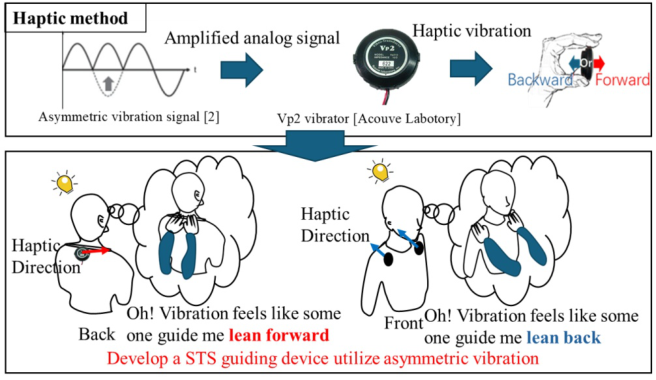
ASYMMETRIC VIBRATION METHOD By using the Vibro-Transducer (Vp210, Acouve Labotory, Inc.), the guiding role of a haptic device in STS rehabilitation training has been comes up (see Figure 1). From the previous study in our lab, we have chosen the 3:1 harmonic wave shape asymmetric wave type (Tanabe, 2016). The shoulders have rotational degrees of freedom during the standing motion. Therefore, the standing assistance device was designed with three vibration speakers: two placed on the chest and one on the back to facilitate motion control.
Figure 1: The STS guiding concept by using the asymmetric vibration method.
However, the acceptability of the asymmetric vibration is different on the upper body. The study recruited five male participants with an average age of 23 years and an average BMI of 24.9. Using the proximal ends of both
Wearable Sit-to-Stand Up (STS) Device Using Asymmetric Vibration Speaker 125
clavicles as a reference unit, the anterior region above the line connecting both nipples and the posterior region above the line connecting the scapulae were delineated. Through a voting process, the midpoint of the clavicles on the chest and the spinous process of the seventh cervical vertebra on the back were identified as optimal installation sites. Additionally, the experiment determined that the most sensitive vibration frequencies were 15 Hz for the chest and 20 Hz for the back.
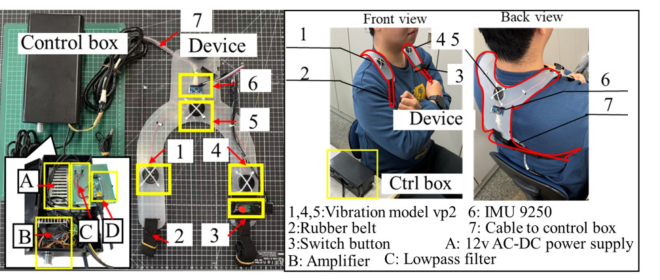
HARDWARE DEVELOPMENT The proposed STS guiding system hardware was developed according to the asymmetric vibration setup. In the device part, the vibration model vp2 was used for generate the asymmetric vibration, they were installed at the corresponding vibration-sensitive locations (see Figure 2). An IMU 9250 was utilized for the angular data detection (No. 6). In the control box part, the amplifier TDA 7297 (Label B) was used to drive the 3-vibration model (No. 1, 4, 5). A 110 V AC to 12 V DC power supply (Label A) drives the whole system. An Arduino Nano (Label D) was used for control the system. Between the Arduino Nano and the amplifier was a lowpass filter circuit (Label C) for noise avoid.
Figure 2: Hardware development of the proposed STS guiding device.
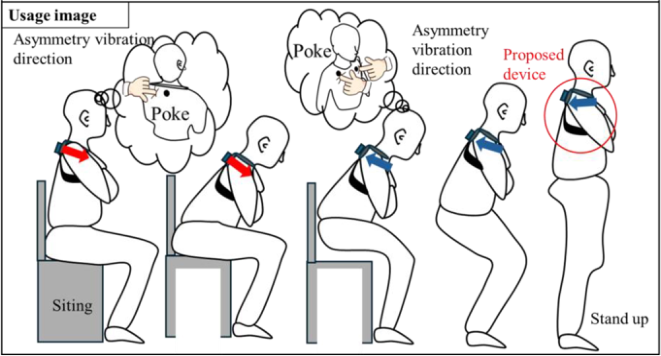
To assist elderly users in controlling the STS speed and lean posture, we developed targeted assistance strategies and interaction methods (see Table 1). The version with only asymmetric vibrators is being developed for elderly individuals with poor reaction ability, aiming to control the timing of forward-leaning and backward-tilting without considering the magnitude (see Figure 3). For healthy elderly individuals, a single IMU-equipped version guides both tilt amplitude and transition timing. For elderly individuals needing specific training for atrophied muscles, a 2-IMU version enables phase detection during standing up, allowing more precise STS training based on the physical therapist’s instructions.
Figure 3: Method of the proposed device guide the STS motion.Table 1: Assistance strategies for different target users.
Table available in the original PDF paper.
Types Guide Level/Accuracy User Description The asymmetric vibrator Low - Roughly Elderly with poor reaction only type
Vibrator with 1 IMU type Minimum - Normal Healthy elderly Vibrator with 2 IMU type High - Accurate Healthy elderly required target STS motion training from PT
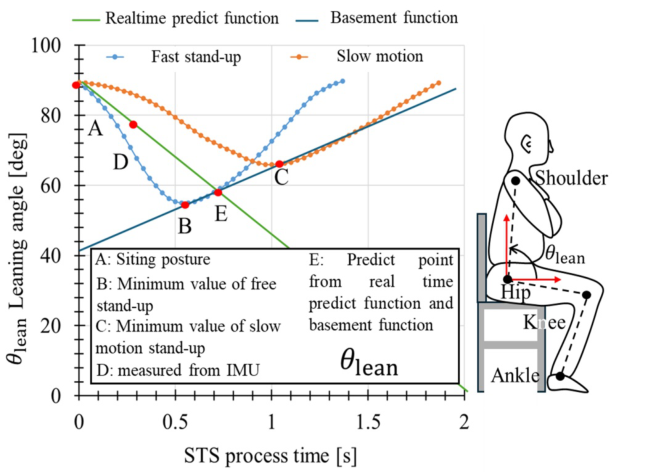
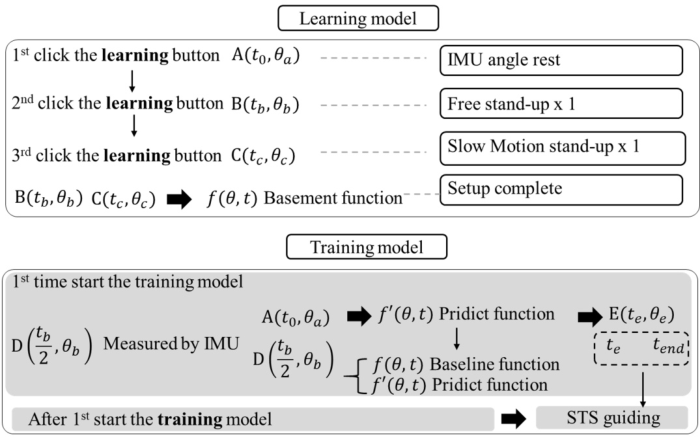
CONTORL METHOD The study hypothesizes that the optimal shifting timing and angle could be predict by measured twice motion which is free stand-up and slow motion of STS (see Figure 4). By using the minimum values recorded by the proposed device during free stand-up (Point B) and slow motion (Point C), a linear equation can be derived as the baseline for each participant. In actual training, at the midpoint of the normal minimum lean timing (Point B), the IMU measures the current angle at Point D. By calculating the real-time prediction linear equation from the sitting start Point A to D, the predicted lean amplitude and time can be determined (Point E). To achieve this functionality, the proposed device features two buttons, designated as the learning button and the training button. In learning mode, the user initiates the process by assuming a seated posture with the recommended seat height, ankle position, and sitting depth. Upon pressing the learning button for the first time, the system records the forward lean angle detected by the IMU as the initial value at point A (see Figure 5).
Following an auditory feedback signal, the user presses the learning button a second time and performs a stand-up motion at a normal speed. The system records the IMU data, identifying the minimum forward lean angle and its corresponding timestamp as point B. Upon receiving the next feedback signal,
Wearable Sit-to-Stand Up (STS) Device Using Asymmetric Vibration Speaker 127
the user presses the learning button a third time and executes a stand-up motion at the slowest possible speed. The system then records the minimum forward lean angle as point C. Based on these data points, a baseline equation is derived.
Figure 4: Example of shift timing calculation from the recorded fast and slow STS motion.Figure 5: Control flow of the proposed STS guiding device.
In training mode, activated by pressing the training button, the system engages the user via a countdown sequence. At the midpoint of point B
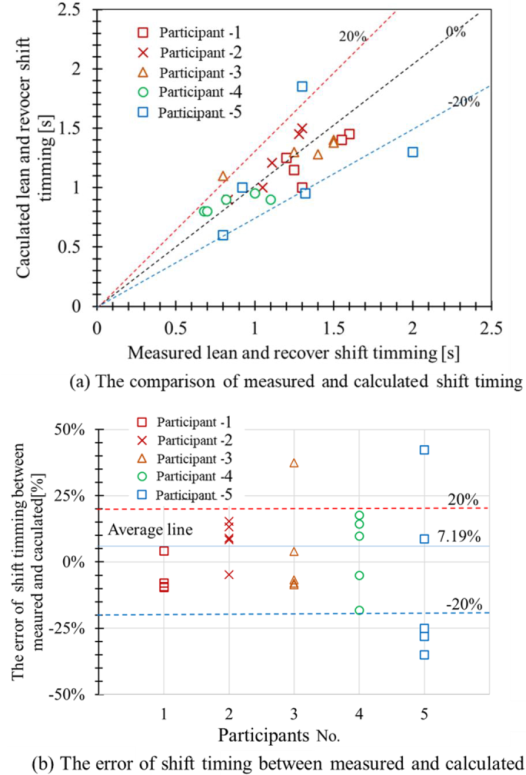
x-coordinate value (half of the time for fast stand-up peak value), the system records point D and formulates a real-time predictive equation. The intersection of this equation with the baseline equation defines point E, which serves as a reference for the optimal termination of the forward lean phase. The completion of the stand-up motion is determined based on the time corresponding to point E which means the calculated shifting timing. For verify the motion shift timing calculate method, the error of the calculated shift timing of STS motion with the free stand up recorded data has been compared. 5 participants do the experiment for evaluate the shift timing calculation method (see Figure 6a). The average error was 7.19% (see Figure 6b).
Figure 6: Experiment result of timing prediction compare with the free stand-up motion.
Wearable Sit-to-Stand Up (STS) Device Using Asymmetric Vibration Speaker 129
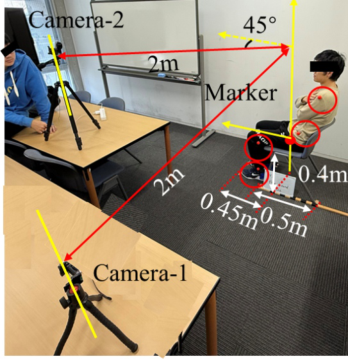
EXPERIMENT DESIGN A preliminary validation of the standing guidance device was conducted by recruiting five participants (four males and one female) with an average age of 23.5. Participants were instructed to adopt a standardized seated posture, maintaining an upright back, a sitting depth of 15 cm from the hip joint to the backrest, and ensuring contact between the back and the chair. The distance from the toes to the seat centre was set at 45 cm. During the standing motion, participants were required to cross their arms in front of their chest (see Figure 7).
Figure 7: Layout of the guiding training experiment.
To facilitate data collection, markers were placed at the ankles, knees, hips, and shoulders. The experimental procedure consisted of the following steps: participants first performed a fast-standing motion while wearing the device. After a 1-minute interval, they executed a slow-standing motion at the lowest possible speed to establish the learning model. Following an additional 1-minute interval, STS training was conducted, comprising five trials with 1-minute rest intervals between each trial. Each participant does the trial for five times.
RESULT AND DISCUSSION
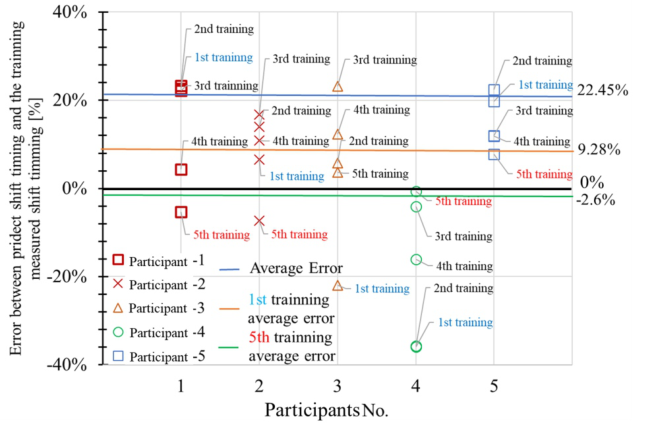
The experiment result shows from each participant’s training result compare with the calculated leaning shifting time, most of the participants could response to the asymmetric vibration at the first-time training (see Figure 8). The average error for 5 times STS guiding training was recorded. The average shift timing error was 22.25%. From the first time wearing the proposed guiding device and do the first-time training, the average error of the measured shift timing with the calculated shift timing is 9.28%. After five times of wearing the proposed guiding device. The error of the measured shift timing with the calculated shift timing was decreased to −2.6%.
Figure 8: Training result for 5 participants by the timing prediction method.
From this result we can notice that, 1) The proposed guiding device could calculate the perdition of the shift timing by using the learning model of the device to record the fast stand-up motion, and the as slow as possible motion. 2) The proposed guiding device could guide the user to adjust the leaning posture and recovering poster shifting time through the asymmetric vibration which was generated from the Vp2 attached on the proposed guiding device. 3) After 5 times of wearing the proposed device, training the STS motion match the calculated shift timing of the leaning recovering posture. The error was decreased under the training. But some participants can not follow the guiding when they first try to feel the asymmetric vibration and adjust their motion.
CONCLUSION
This study introduces a wearable device that facilitates the (STS) transition through asymmetric vibration cues. The proposed predictive equation for optimal forward and backward leaning timing demonstrates strong agreement with experimentally observed timings in participant trials. The system effectively delivers asymmetric vibration feedback to guide the STS movement. Moreover, training with the device results in a noticeable reduction in error, suggesting improved motion accuracy and adaptability.
REFERENCES
Duan, H.-Y., Wang, T.-Q., Lee, H.-H., & Tanaka, E. (2021). A wearable haptic system for rehabilitation based on the asymmetric vibration. In SII 2021 (pp. 815–816).
Wearable Sit-to-Stand Up (STS) Device Using Asymmetric Vibration Speaker 131
Hori, S. N., et al. (2022). Trends in outpatient rehabilitation practices in Japan: Analysis using the national database of health insurance claims open data. Journal of Rural Health, 125–130. Liao, Y.-T., Muramatsu, K., Watanuki, K., & Tanaka, E. (2017). Development and
evaluation of an assistive apparatus with pantograph mechanism for standing- up motion of elderly. Journal of Advanced Mechanical Design, Systems, and Manufacturing, 11(6), Paper No. 17-00375. Tanabe, T., Yano, H., & Iwata, H. (2016). Properties of proprioceptive sensation with a vibration speaker type non-grounded haptic interface. In IEEE Haptics Symposium (pp. 21–26). Tanaka, E., Osawa, K., Zhuang, J.-R., Wu, X., Hua, Y., Nakagawa, K., Lee, H.-H.,
& Yuge, L. (2011). Mechanical design of a standing-up assistance apparatus of leaning forward the upper body which can be transformed into a flat-lying posture. JSME, 712–727. Tanaka, E., Hatsukari, T., & Miyake, N. (2014). Development of a standing-up assistance apparatus dealing with body trunk motion and the center of gravity trajectory. In SICE2014. Tanaka, E., Duan, H.-Y., Osawa, K., Nakagawa, K., Lee, H., & Yuge, L. (2022).
Development of a walking promoter using vibration speaker. In LIFE 2022 (pp. 20–23). [In Japanese]. Tanaka, E., Osawa, K., Zhuang, J.-R., Wu, X., Hua, Y., Nakagawa, K., Lee, H.-H., & Yuge, L. (2023). Development of walking assistance devices considering the users’ psychological and physical status. In The 16th IFToMM World Congress (WC2023) (pp. 152–162).
LISTED IN THE AHFE DIGITAL BOOKSTORE CATALOGUE
Explore the complete digital volume
Healthcare and Medical Devices
Read this individual research paper free through the original publisher, or explore the full digital proceedings book.
ISBN 978-1-964867-47-2
Explore this ISBN in the AHFE Bookstore ↗Listed in the July 2026 bookstore catalogue; search by ISBN to confirm current availability · Digital book purchase optional