Rodrigo Dominguez, Evelyn Alfaro, Carlos Gomez, Francisco Ortiz (2025). Risk Analysis for optimizing cleaning processes in material transfer systems: Reducing cross-contamination in port operations. In: Human Factors in Design, Engineering, and Computing. AHFE Open Access, vol. 199, pp. 336–345. https://doi.org/10.54941/ahfe1006846
Port operations that simultaneously handle clinker, coal, and grains face complex challenges associated with cross-contamination. These issues directly affect operational efficiency, worker safety, and compliance with environmental regulations. Although advances in conveyor technology have improved material handling, there is still limited understanding of how cleaning processes mitigate contamination risks. Methods: This study applies a comprehensive qualitative risk analysis of cleaning systems in conveyor belts and hoppers, with emphasis on design and operational conditions that minimize contamination. Expert knowledge was gathered using HAZOP and SCAMPER techniques. Hazards were systematically evaluated through Fault Tree Analysis (FTA), Event Tree Analysis (ETA), and Bow Tie modeling. These methods allowed a structured identification of hazards, risk factors, and the effectiveness of preventive and mitigation barriers. Results: The analysis identified 27 design conditions (e.g., nozzle positioning, belt scraper optimization) and 21 operational conditions (e.g., cleaning frequency, inspection protocols, operator training) that contribute to reducing contamination. Failures in cleaning systems, conveyor operations, and dust collection were found to be key risk factors. A total of 34 preventive barriers, including high-pressure nozzles, automated washing systems, and pressurized air mechanisms, and 14 mitigation measures, such as vacuum trucks and dockside cleaning protocols, were assessed. Incorporating human factors into the risk framework underscored the role of operator awareness and structured decision-making in enhancing system reliability. Conclusions: The results demonstrate that integrating preventive and mitigation barriers significantly lowers the likelihood of cross-contamination events, strengthening both operational safety and environmental performance. This research provides practical guidance for port authorities and operators to optimize cleaning strategies, reduce material loss, and ensure regulatory compliance. Furthermore, it lays the groundwork for future quantitative risk analysis and highlights the potential of advanced technologies and automation to further improve cleaning effectiveness. By bridging a critical knowledge gap, this study supports safer, more efficient, and environmentally sustainable port operations. The insights presented are valuable for stakeholders across the maritime logistics chain who seek to balance productivity with environmental responsibility.
The wide range of significant accidents that have taken place in industrial activities in recent years, leading to catastrophic consequences such as financial losses, environmental impact, damage to company reputation,
Risk Analysis for Optimizing Cleaning Processes in Material Transfer Systems 337
injuries and deaths, highlights the importance of continuously preventing accidents. Risk assessments often fail to effectively prevent serious accidents (Muniz et al., 2018). For industry, the installation of conveyor belts is crucial to transport bulk materials from the point of production, through processing, to the point of storage (Martinetti et al., 2017). Risk management is a systematic process that includes identification, analysis and response to project risks. Its sub-processes may vary in name and order depending on the author, and some are combined, such as risk assessment (identification and quantification) and risk management plan (risk control and response plan) (Mazareanu, V. P. 2010). The grain clean standard for ships is defined as “Compartments must be completely clean, dry, odourless and gas-free”; all residues must also be removed. This process is especially relevant for the cargo of grain, cement, fertilizers, sugar, seed cake and sulphur. Cleaning must be carried out in compliance with the instructions of The International Maritime Solid Bulk Cargoes (IMSBC) Code and the shipper’s specifications, as well as with the local regulations of the ports where it operates (Britannia Loss Prevention, 2024). The International Code for the Safe Carriage of Grain in Bulk (International Grain Code), adopted by resolution MSC.23 (59), is mandatory under chapter VI of the SOLAS Convention since 1 January 1994. The International Grain Code applies to ships, regardless of size, including those of less than 500 gross tons, that are engaged in the carriage of grain in bulk and to which the International Grain Code applies. Part C of Chapter VI of the SOLAS Convention. The objective of the Code is to provide an international standard for the safe transport of bulk grains (International Maritime Organization, n.d.). There are several methodologies for risk and safety analysis that will be used in the process of cleaning belts and chutes (Lavasani et al., 2015). Bowtie analysis is a widely used tool in risk management to identify the causes and consequences of hazards and show the barriers that can prevent or mitigate the events that occur (Aust et al., 2020). The increase in the use of Bow Tie as a risk management tool in recent years is mainly due to the conceptual simplicity of the method and its visual representation, in addition to the availability of accessible and easy-to-use software tools (Ruijter & Guldenmund, 2016). Risk assessment can be performed or implemented in a qualitative or quantitative manner. The qualitative method assesses risk using an index system based on data from a system and the quantitative method assesses risk through numerical simulation, including a quantitative calculation of the probabilities and consequences of different accidents (Awang & A. M. N, 2014). The FTA is a logical and diagrammatic tool used to assess the probability or likelihood of an undesired final event occurring based on the occurrence or non-occurrence of other events. Depending on the available information and the objectives of the analysis, the risk factor analysis can be qualitative, quantitative, or both (Bahrami et al., 2024). FTA and ETA are two established techniques that individually assist in risk assessment by providing a qualitative analysis of hazard identification and a detailed quantitative assessment of the likelihood of undesired events (Shahri et al., 2012). In the area of risk analysis methods,
advances in quantitative risk analysis and reliability technologies are widely applied in operational industries to develop a preventive and mitigating strategy. For this same reason, it is essential to have precise tools that allow identifying, evaluating and quantifying the risks and uncertainty associated with each process in a rigorous manner, in order to make decisions based on concrete data. (Abimbola et al., 2015).
In port operations, cross-contamination during the simultaneous transfer of clinker, coal, and grains poses significant challenges, impacting efficiency and environmental safety. Despite advancements in conveyor technology, there remains a critical gap in understanding the effectiveness of cleaning processes in mitigating these risks. This study aims to address this gap by conducting a comprehensive qualitative risk analysis of the cleaning systems for conveyor belts and hoppers, focusing on design and operational conditions that can minimize cross-contamination.
METHOD AND MATERIALS Participants and Selection Criteria
The study engaged a panel of 14 experts in maritime logistics and risk assessment to conduct a comprehensive risk analysis of conveyor belt systems used in port operations. Participants were selected based on stringent criteria to ensure the relevance and depth of expertise. Each expert had a minimum of ten years of experience in maritime logistics and demonstrated proficiency in risk analysis methodologies such as Bow Tie, Fault Tree Analysis (FTA), and Event Tree Analysis (ETA). Furthermore, prior involvement in safety audits or operational assessments was mandatory. The panel included port managers, safety engineers, and risk analysts, ensuring a broad spectrum of insights into the operational and safety challenges associated with the simultaneous transfer of clinker, coal, and grains.
Data Acquisition and Description Data collection was conducted through a dual approach: expert judgment sessions and analysis of technical reports. Expert judgment data were gathered via structured brainstorming sessions utilizing the HAZOP (Hazard and Operability Study) and SCAMPER (Substitute, Combine, Adapt, Modify, Put to another use, Eliminate, and Reverse) methodologies. These sessions were held over a two-week period, with each session lasting approximately three hours, allowing for in-depth discussion and analysis. The technical reports, selected based on their relevance to conveyor belt operations and risk management, provided historical data and contextual information crucial for the analysis. Key environmental factors, such as the operational setting of the port, typical weather conditions, and the types of materials handled, were considered to ensure the data’s applicability to real-world scenarios.
Risk Analysis for Optimizing Cleaning Processes in Material Transfer Systems 339
Study Procedures and Tools/Instruments/Materials/Equipment The study’s methodological framework centered around the Bow Tie methodology, integrating FTA and ETA for comprehensive risk assessment. The following procedures were employed:
Fault Tree Analysis (FTA): The FTA was conducted to identify potential causes of adverse events related to the conveyor belt system. A fault tree diagram was constructed, comprising basic events (e.g., mechanical failures, human errors), intermediate events (e.g., subsystem failures), and top-level events (e.g., system shutdowns). Specific logic gates (AND, OR, INHIBIT) were used to model the relationships between events.
Event Tree Analysis (ETA): ETA was employed to evaluate the consequences of potential failures. The analysis began by defining an initiating event, such as a conveyor belt malfunction, followed by mapping out subsequent events that could lead to significant terminal events. An event tree diagram was developed, detailing the sequence of events and levels of consequences.
Bow Tie Analysis: The Bow Tie analysis (Li et al., 2023) synthesized the findings from FTA and ETA, providing a visual representation of risk pathways. The Bow Tie diagram included safety barriers on both sides, categorized as either preventive or mitigative based on their role in hazard control. The effectiveness of these barriers was evaluated using expert judgment and historical performance data.
Data Preparation Before analysis, the data underwent a rigorous cleaning process to ensure accuracy and consistency. Expert judgment data were transcribed verbatim and anonymized to protect participant confidentiality. Transcripts were reviewed for completeness, and any discrepancies were resolved through follow-up consultations with the experts. Technical report data were digitized and organized into a structured database, with metadata tags for easy retrieval and analysis. In summary, the study’s methodological rigor was ensured through detailed planning, execution, and analysis of the risk assessment procedures. By providing comprehensive descriptions of the methods and tools used, this section aims to facilitate replication and further exploration by other researchers in the field.
RESULTS DISCUSSION Description of Design and Operation Conditions
The study was designed to evaluate the performance and effectiveness of barriers in mitigating risks associated with the simultaneous transfer of clinker, coal, and grains using a conveyor belt system. The primary objectives were to identify significant barriers, assess their operational performance, and quantify their impact on preventing material accumulation and cross- contamination. To align the findings with these objectives, the analysis of design conditions began with the identification and categorization of barriers based on their significance in controlling material flow.
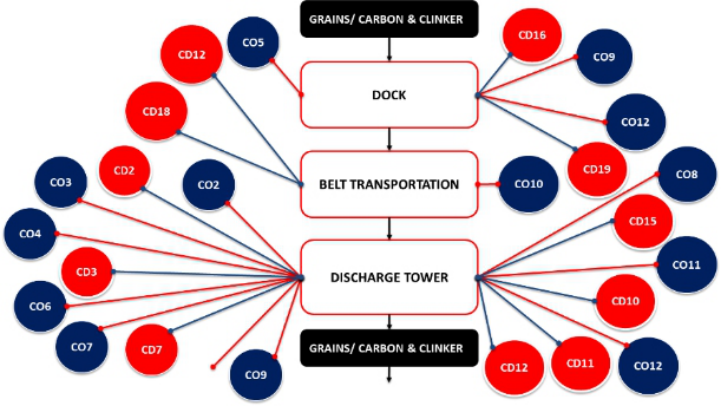
Figure 1 provides a comprehensive illustration of the spatial distribution of 11 critical barriers marked in red, which are predominantly located around the discharge tower. These barriers were identified as essential control points for maintaining operational flow and preventing material buildup. In addition to these critical barriers, the same figure depicts 16 additional barriers, marked in blue, representing operating conditions. These barriers are strategically located across the dock and conveyor belt, playing a crucial role in maintaining system integrity and preventing cross-contamination.
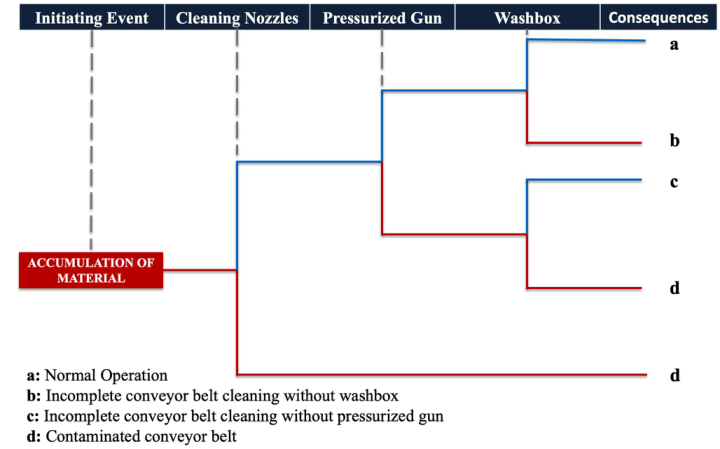
The event tree analysis of cleaning systems was conducted to identify initiating events and subsequent failures. The primary initiating event, “Buildup of material,” was dissected into intermediate events related to cleaning and transport systems. Figure 2 provides a detailed breakdown of these events, illustrating the hierarchical relationship between equipment failures and their impact on system operations. The analysis revealed that cleaning system failures, including blocked nozzles, pressurized gun malfunctions, and wash box inefficiencies, are critical factors contributing to material buildup. The consequences of these failures were qualitatively assessed, focusing on the risk of contamination, particularly affecting grains. The analysis underscores the critical role of cleaning nozzles, pressurized guns, and wash boxes in preventing excessive material adherence and ensuring effective cleaning.
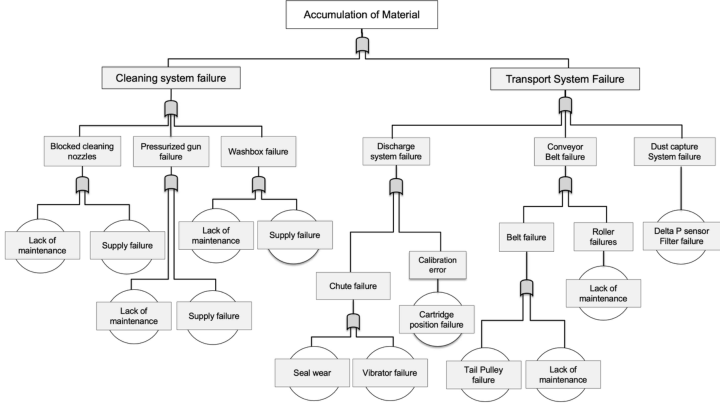
In parallel, the transport system analysis revealed significant risks associated with material accumulation and cross-contamination. Figure 3 illustrates the sequence of events leading to potential contamination, emphasizing the importance of precise discharge system calibration and conveyor belt integrity. The diagram suggest that maintaining robust barrier systems is essential to preventing operational disruptions and ensuring material purity.
Risk Analysis for Optimizing Cleaning Processes in Material Transfer Systems 341
Figure 2: Event tree analysis “cleaning system”.Figure 3: Fault tree analyses applied to accumulation of material.
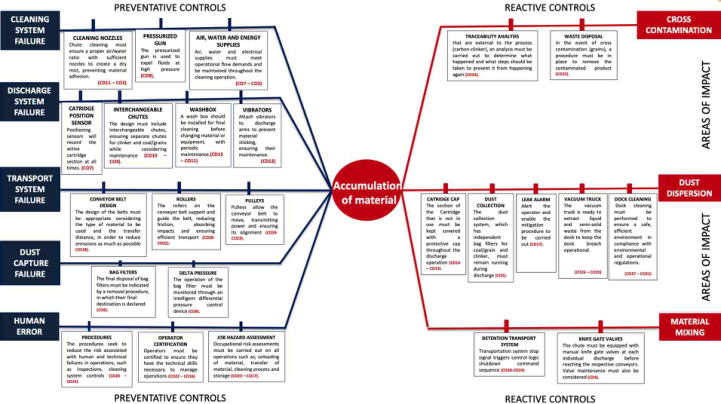
The examination of design conditions with Bowtie methodology for material accumulation involved an assessment of 20 preventive and 7 mitigation barriers. Figure 4 graphically represents the risk pathways associated with material buildup, providing a visual summary of barrier effectiveness based on Fault Tree Analysis (FTA) and Event Tree Analysis (ETA). The data reveal that cross-contamination risks are exacerbated by barrier failures, with irreversible consequences for grain purity.
Figure 4: Bow Tie method for accumulation of material.
Operating conditions were similarly scrutinized, with 14 preventive and 7 mitigation barriers evaluated for their impact on material accumulation. Table 1 provides a detailed account of operational incidents linked to specific barrier failures, reinforcing the necessity of continuous barrier monitoring and maintenance.
Table 1: Design conditions used on BT.
Table available in the original PDF paper.
Table 2 provides a detailed description of operation conditions, outlining the specific parameters influencing barrier performance. The results highlight the importance of strategic barrier placement and maintenance to optimize conveyor belt operations and ensure material purity. The findings suggest that a comprehensive understanding of barrier dynamics and system interactions is essential for optimizing conveyor belt operations and preventing cross- contamination.
Risk Analysis for Optimizing Cleaning Processes in Material Transfer Systems 343
Table 2: Operation conditions description used on BT.
Table available in the original PDF paper.
The qualitative data presented in this study, along with the graphical and tabular representations, provide a comprehensive overview of the effectiveness of barriers in preventing material accumulation and cross- contamination during the transfer of clinker, coal, and grains. The results highlight the importance of strategic barrier placement and maintenance to optimize conveyor belt operations and ensure material purity. The findings suggest that a comprehensive understanding of barrier dynamics and system interactions is essential for optimizing conveyor belt operations and preventing cross-contamination.
CONCLUSION In summary, our findings demonstrate that the implementation of preventive and mitigation barriers significantly enhances the efficiency and safety of material transfer systems, directly addressing the critical issue of material accumulation and cross-contamination. This study offers a novel contribution to the field by systematically identifying and evaluating the effectiveness of specific barriers within both cleaning and transport systems, thereby advancing our understanding of optimal material handling practices. The implications of these findings are substantial, suggesting that industries can adopt these barrier strategies to improve operational safety, reduce contamination risks, and ensure regulatory compliance, potentially informing policy decisions related to industrial material handling standards. Future research should focus on exploring the long-term effectiveness of these barriers under varying environmental conditions and integrating emerging technologies, such as real-time monitoring systems, to further enhance barrier performance and system resilience.
REFERENCES
Abimbola, M., Khan, F., Khakzad, N., & Butt, S. (2015). Safety and risk analysis of managed pressure drilling operation using Bayesian network. Safety science, 76,
133–144. Analouei, R., Taheriyoun, M., & Safavi, H. R. (2020). Risk assessment of an industrial wastewater treatment and reclamation plant using the bow-tie method. Environmental Monitoring and Assessment, 192, 1–16.
Ananth, K. N. S., Rakesh, V., & Visweswarao, P. K. (2013). Design and selecting the proper conveyor-belt. International Journal of Advanced Engineering Technology, 4(2), 43–49. Aust, J., & Pons, D. (2020). A systematic methodology for developing Bowtie
in risk assessment: Application to borescope inspection. Aerospace, 7, 86. https://doi.org/10.3390/aerospace7070086. Aven, T. (2015). Risk analysis. John Wiley & Sons. Awang Nazarudin, A. M. N. (2014). Framework of a Bow-Tie Based Quantitative Risk Assessment on an Offshore Oil and Gas Processing Unit. Büyük, N., & Bayer, D. (2022). Tanker gemilerinde kargo i¸slemleri esnasındaki
yangın risklerinin kök sebeplerinin tespiti ve Bow-Tie analizi. Deniz Ara¸stırmaları Dergisi: Amfora, 1(1), 1–20. Bahrami, M., Roghani, B., Tscheikner-Gratl, F., & Rokstad, M. M. (2024). A deep dive into green infrastructure failures using fault tree analysis. Water Research, 257, 121676. Britannia Loss Prevention. (2024). Cargo hold cleaning standards guidance. Recuperado de https://www.imo.org/es/OurWork/Safety/Pages/Grain-Code.aspx. Christopher Frey, H., & Patil, S. R. (2002). Identification and review of sensitivity
analysis methods. Risk analysis, 22(3), 553–578. Coleman, M. E., & Marks, H. M. (1999). Qualitative and quantitative risk assessment. Food Control, 10(4–5), 289–297. de Ruijter, A., & Guldenmund, F. (2016). The bowtie method: A review. Safety
science, 88, 211–218. Fedorko, G., & Ivanˇco, V. (2012). Analysis of force ratios in conveyor belt of classic belt conveyor. Procedia Engineering, 48, 123–128. Ferdous, R., Khan, F., Sadiq, R., Amyotte, P., & Veitch, B. (2011). Fault and event
tree analyses for process systems risk analysis: uncertainty handling formulations. Risk Analysis: An International Journal, 31(1), 86–107. Giraud, L., Massé, S., & Schreiber, L. (2004). Belt conveyor safety. Professional Safety, 11, 20–27. Ilic, D., & Donohue, T. J. (2015). On the design and analysis of transfer chute systems.
XXVI Encontro Nacional de Tratamento de Minérios e Metalurgia Extrativa, Poços de Caldas-MG, 18. Joy, J., & Griffiths, D. (2005). National minerals industry safety and health risk assessment guideline. Minerals Council of Australia. Version, 4. Kang, K., & Noh, H. (2024). Strategic risk mitigation in large scale CCS operations
through combined Bow-Tie and FMEA study. IEC, 60812, 2018. Khan, W. A., Mustaq, T., & Tabassum, A. (2014). Occupational health, safety and risk analysis. International Journal of Science, Environment and Technology, 3(4), 1336–1346. Kozłowski, T., Wodecki, J., Zimroz, R., Bła˙zej, R., & Hardygóra, M. (2020). A
diagnostics of conveyor belt splices. Applied Sciences, 10(18), 6259. Lavasani, S. M., Ramzali, N., Sabzalipour, F., & Akyuz, E. (2015). Utilisation of fuzzy fault tree analysis (FFTA) for quantified risk analysis of leakage in abandoned oil and natural-gas wells. Ocean Engineering, 108, 729–737. Leimeister, M., & Kolios, A. (2018). A review of reliability-based methods for
risk analysis and their application in the offshore wind industry. Renewable and Sustainable Energy Reviews, 91, 1065–1076. Lerher, T., Grum, Z., Motaln, M., & Zadravec, M. (2024). Wear simulation of the conveyor belt transfer chute using the DEM. International Journal of Simulation Modelling (IJSIMM), 23(1).
Risk Analysis for Optimizing Cleaning Processes in Material Transfer Systems 345
Li, J., Liu, J., Wu, T., Peng, Q., & Cai, C. (2023). Risk analysis of waterlogging in a big city based on a bow-tie Bayesian network model, using the megacity of Wuhan as an example. Frontiers in Environmental Science, 11, 1258544. Martinetti, A., van Dongen, L. A. M., & Romano, R. (2017). Beyond accidents:
a back-analysis on conveyor belt injury for a better design for maintenance operations. American Journal of Applied Sciences, 14(1), 1–12. Mazareanu, V. P. (2010). Risk management and analysis: Risk assessment (qualitative and quantitative). Available at SSRN 1549186. McLeod, R. W., & Bowie, P. (2018). Bowtie analysis as a prospective risk assessment
technique in primary healthcare. Policy and Practice in Health and Safety, 16(2), 177–193. Mulas, M., Larreta, E., Menoscal, M., Bravo, G., Rosado, V., Capa, D., et al. (2024).
A geological event tree on volcanic islands: case study of the Galápagos Islands. https://doi.org/10.21203/rs.3.rs-4670048/v1. Muniz, M. V. P., Lima, G. B. A., Caiado, R. G. G., & Quelhas, O. L. G. (2018). Bow tie to improve risk management of natural gas pipelines. Process Safety Progress, 37(2), 169–175. Özfırat, P. M., Özfırat, M. K., Yetkin, M. E., & Pamukçu, Ç. (2022). Risk evaluation
of belt conveyor accidents using failure modes and effects analysis and event tree analysis. ITEGAM-JETIA, 8(36), 24–31. Organización Marítima Internacional. (s.f.). The International Code for the Safe Carriage of Grain in Bulk (International Grain Code). Recuperado de https://www.imo.org/es/OurWork/Safety/Pages/Grain-Code.aspx. Parmar, P., Jurdziak, L., Rzeszowska, A., & Burduk, A. (2024). Predictive modeling of conveyor belt deterioration in coal mines using AI techniques. Energies, 17(14), 3497. https://doi.org/10.3390/en17143497. Roberts, A. W. (2001). Chute design considerations for feeding and transfer. In Proc.
BELTCON 11 International Materials Handling Conference. Rossow, J. (2020). DEM analysis of a conveyor transfer chute (Doctoral dissertation, Stellenbosch: Stellenbosch University). Ruijters, E., & Stoelinga, M. (2015). Fault tree analysis: A survey of the state-of-the-
art in modeling, analysis and tools. Computer Science Review, 15, 29–62. Shahriar, A., Sadiq, R., & Tesfamariam, S. (2012). Risk analysis for oil & gas pipelines: A sustainability assessment approach using fuzzy based bow-tie analysis. Journal of Loss Prevention in the Process Industries, 25(3), 505–523. Silvianita, S., Redana, F., Rosyid, D., Chamelia, D., & Suntoyo, S. (2017). Project
delay analysis on jacket structure construction. Applied Mechanics and Materials, 862, 315–320. https://doi.org/10.4028/www.scientific.net/AMM.862.315. Volk, M., Sher, F., Katoen, J. P., & Stoelinga, M. (2024). SAFEST: Fault tree analysis via probabilistic model checking. In 2024 Annual Reliability and Maintainability Symposium (RAMS) (pp. 1–7). IEEE.
LISTED IN THE AHFE DIGITAL BOOKSTORE CATALOGUE
Explore the complete digital volume
Human Factors in Design, Engineering, and Computing
Read this individual research paper free through the original publisher, or explore the full digital proceedings book.
ISBN 978-1-964867-75-5
Explore this ISBN in the AHFE Bookstore ↗Listed in the July 2026 bookstore catalogue; search by ISBN to confirm current availability · Digital book purchase optional