Kazuhiko Shinohara (2023). Ergonomic problems in surgical smoke control during surgery. In: Healthcare and Medical Devices. AHFE Open Access, vol. 79, pp. 261–265. https://doi.org/10.54941/ahfe1003495
Surgical smoke is the plume and air contaminants produced by energy devices such as electrocautery and laser scalpels during the surgery. Surgical smoke consists of fine particles containing pathogenic microorganisms and chemical substances from high-temperature carbonized tissues, and poses a health risk to medical personnel during the surgery. The COVID-19 pandemic has highlighted the importance of surgical smoke control. As a surgical smoke protection on the medical staff side, personal protective equipment such as N-95 high-performance masks are widely used. On the other hand, the surgical smoke exhaust system includes ventilation equipment for the entire operating room and a device that directly aspirates surgical smoke in the operative field. Wearing a mask for a long time poses problems such as fatigue, hypercapnia and loss of concentration. Increasing the smoke evacuation efficiency of a surgical instrument-mounted smoke evacuation device poses problems such as deterioration of operability and patient temperature maintenance. Surgical instruments equipped with smoke suction tubes suffer from deterioration in operability due to increased size and weight. Increased ventilation in the surgical environment may cause drying of organs and hypothermia. Surgical instruments with smoke exhaust devices require further reduction in weight, diameter, and ergonomic design. In addition, it is necessary to equip surgical instruments and the ventilation function of the operating room with an automatic maintenance function of body temperature and body cavity temperature and humidity.It is important to enlighten medical workers about the importance of measures against surgical smoke, and to improve the smoke exhaust system considering maintenance of physiological environment and solve ergonomic problems.
Surgical smoke is the plume and air contaminants produced by energy devices such as electrocautery, ultrasonic coagulating sears and laser scalpels during the surgery. Surgical smoke consists of fine particles containing pathogenic microorganisms and chemical substances from high-temperature carbonized tissues and dissected tissues, and poses a health risk to medical personnel during the surgery. The COVID-19 pandemic has highlighted the importance of surgical smoke control. We investigated the current status and ergonomic issues of the instruments currently used for surgical smoke countermeasures.
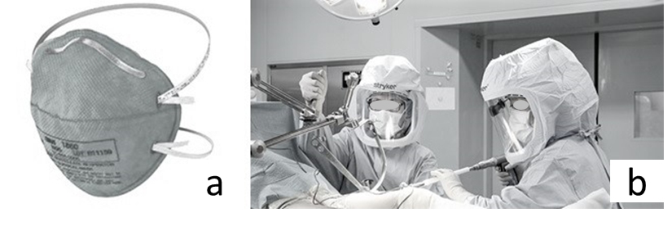
Status and Ergonomic Problems of Personal Protective Equipment Wearing a mask in the operating room has long been a routine, and N95 masks were also used when treating patients with infectious diseases even before the pandemic of COVID-19. Head and neck pain occur when wearing a mask. Furthermore, when wearing an N95 mask for a long time, the bur- den on medical workers is greater than that of wearing a conventional mask, such as an increase in hypercapnia and a decrease in concentration. There are also spacesuit-like surgical gowns that completely cover the upper body with a ventilated hood for surgeries that require a high degree of cleanliness, such
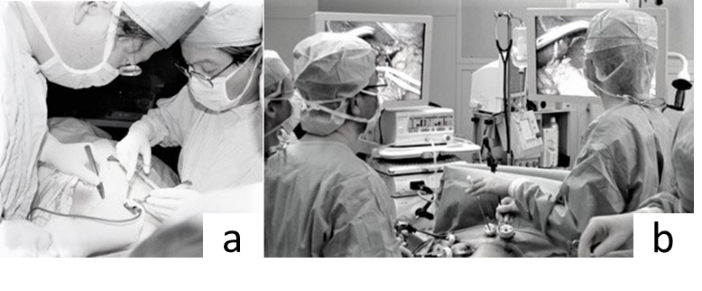
Figure 1: Scenes of open surgery (a) and endoscopic surgery (b).Figure 2: N95 mask (a) and Flyte personal protection systemTM, Styker (b).
as artificial joint replacement surgery. This is also effective as a countermea- sure against surgical smoke, but its use in all surgeries is not realistic due to complexity, fatigue and cost when wearing it (see Figure 1 and Figure 2).
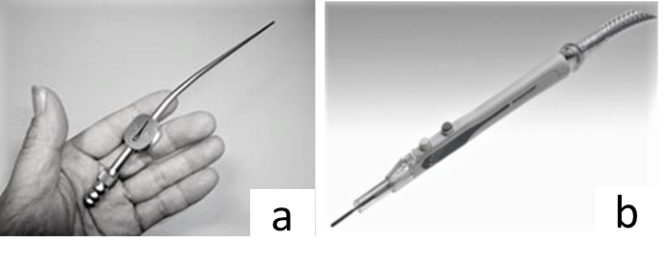
Status and Ergonomic Problems of Smoke Evacuation Equipment Many of the smoke evacuation devices for conventional open-surgery are made by integrating a conventional electric cautery with a smoke suction tube. The ergonomic issues of these devices include an increase in size and weight due to integration with suction system, and deterioration in operability (see Figure 3).
In current surgery, endoscopic surgery is rapidly increasing as well as conventional open-surgery. Endoscopic surgery is performed by inserting an endoscope and small-caliber surgical instruments into a body cavity through a small incision.
Endoscopic surgery creates a working space by insufflating carbon dioxide into a abdominal cavity. Its insufflation process is called pneumoperito- neum. Since endoscopic surgery is performed based on endoscopic visual information, smoke evacuation is essential to secure the field of view (Wu, 1997). The insufflation instrument (pneumoperitoneum system) which inte- grates the pneumoperitoneum function and the surgical smoke evacuation function is also in use. In endoscopic surgery, surgical smoke is expelled
Ergonomic Problem in Surgical Smoke Control During Surgery 263
Figure 3: Conventional suction device (a) and electric cautery with a smoke suction tube, PortaPlumeTM (b).
through the pneumoperitoneum system, so it is easy to evacuate surgical smoke without diffusing into the operating room. In the case of surgical smoke countermeasures in endoscopic surgery, there is little increase in wei- ght and size of surgical instruments. Also deterioration in operability due to smoke suction system is reduced compared to the open surgery. However, if the amount of suction from the abdominal cavity is increased, the amount of CO2-insufflation to maintain the operating space also increases, resulting in dryness of the abdominal cavity and hypothemia.
DISCUSSION
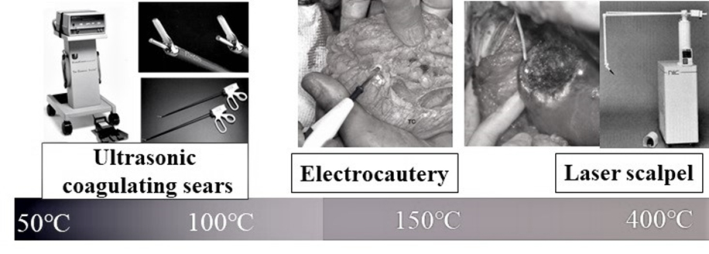
Energy devices such as electrocautery, laser scalpels and ultrasonic coagula- ting sears are indispensable medical equipment for modern surgery, but they generate surgical smoke from carbonized tissue and incised tissue during tis- sue incision and coagulation (see Figure 4). Surgical smoke contains toxic chemicals such as carbon monoxide, hydrogen cyanide, acrylonitrile and ben- zene (see Table 1). These toxic substances can cause both acute and chronic health effects such as pharyngitis, conjunctivitis, chronic bronchitis, asthma, emphysema etc., and also have carcinogenic effects (Barret, 2003). Also, it has been reported that viable bacteria and virus such as HIV, hepatitis B and
Figure 4: Operating temperature of energy device for surgery.
HPV in the tissue are dispersed as surgical smoke when tissue is incised by energy devices, and there is a risk of infection and carcinogenic virus transmis- sion (Okoshi, 2015). Surgical smoke is hazardous for the health of operating room personnel, so medical personnel in the United States have recognized the importance of surgical smoke control (NIOSH, 2015). In Japan as well, the importance of surgical smoke control has been reaffirmed as a result of the pandemic of COVID-19. There are various types of PPE such as N95 masks for medical workers to prevent surgical smoke. Since there is a trade- off between protective function and ergonomic load when worn, PPE itself needs further improvement.
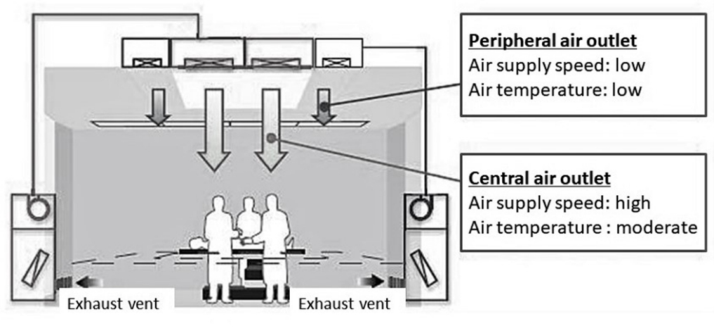
There are international standards for air conditioning in operating rooms, such as ventilation temperature, speed and frequency (see Figure 5). Howe- ver, since surgical smoke directly hits the medical personnel who are close to the patient, air conditioning system for operating room alone is not suffici- ent to prevent surgical smoke. Surgical smoke should be aspirated directly at the site of origin and properly evacuated out of the operating room. In the open-surgery, a suction tube is placed close to the source of the smoke and the surgical smoke is suctioned directly. However, an assistant person who
Figure 5: Air conditioning system for operation room.
Ergonomic Problem in Surgical Smoke Control During Surgery 265
manipulates a suction device is required for the smoke evacuation, and the suction device can interfere with the surgical operation. In the smoke exh- aust equipment attached to surgical instruments, there is a trade-off between smoke evacuation efficiency and ergonomic operability such as compactness and weight reduction.
In endoscopic surgery, increased suction volume causes hypothermia in the patient and tissue desiccation. As a countermeasure, the automatic control function of the temperature and humidity in the abdominal cavity is also important.
CONCLUSION
Current status and ergonomic issues of the instruments currently used for surgical smoke control were investigated. It is important to enlighten medical workers about the importance of surgical smoke control, and to improve the smoke exhaust system considering maintenance of physiological environments and ergonomic problems.
REFERENCES
Barrett WL, Garber SM, Surgical smoke: A review of the literature, (2003). Surg Endosc. 17:979–987. NIOSH, (2015). NIOSH Study Finds Healthcare Workers’ Exposure to Surgical
Smoke Still Common. (Nov 3, 2015): https://www.cdc.gov/niosh/updates/upd- 11-03-15.html. Okoshi K, Kobayashi K, Kinoshita K, Tomizawa Y, Hasegawa S, Sakai Y. (2015).
Health risks associated with exposure to surgical smoke for surgeons and opera- tion room personnel. Surg Today. 45(8):957–965. Wu JS, Luttmann DR, Meininger TA, Soper NJ, (1997). Production and systemic absorption of toxic byproducts of tissue combustion during laparoscopic surgery, Surg Endosc. 11:1075–1079.
LISTED IN THE AHFE DIGITAL BOOKSTORE CATALOGUE
Explore the complete digital volume
Healthcare and Medical Devices
Read this individual research paper free through the original publisher, or explore the full digital proceedings book.
ISBN 978-1-958651-55-1
Explore this ISBN in the AHFE Bookstore ↗Listed in the July 2026 bookstore catalogue; search by ISBN to confirm current availability · Digital book purchase optional