Elisabeth Ibenthal, Claus Backhaus (2022). Reducing Work-Related Stressors in the Care of People with Dementia through Music Intervention - What Factors Matter?. In: Human Factors in Aging and Special Needs. AHFE Open Access, vol. 38, pp. 34–41. https://doi.org/10.54941/ahfe1001661
The disease-related behavioral changes of people with dementia, such as depression, place a high burden on caregivers. Music interventions can alleviate these neuropsychiatric symptoms (NPS). However, little is known about which people with dementia benefit most from it. Therefore, it is difficult to efficiently integrate music interventions into caregivers’ work processes. This study aimed to investigate whether there are factors that can be used to predict the effect of a music intervention on people with dementia. For this, a controlled pre-post-study with 28 people with dementia were conducted. Participants listened to their favorite music played during personal care. Before and after the intervention period, their NPS severity were assessed using the Neuropsychiatric Inventory Questionnaire. The pre-post-differences in NPS severity were descriptively analyzed as a function of age, gender, dementia severity, need for care, and disease pattern. Finally, music intervention particularly improved the NPS of women and people with severe dementia or need for care. The findings enable caregivers to preselect people with dementia who are likely to respond positively to a music intervention. Thereby, a reduction in their stress can be expected because of the targeted alleviation of the stressor NPS and the elimination of ineffective applications.
Dementia caregivers severely suffer by stressors such as staff shortages, working conditions such as shift work, and poor pay (Costello et al., 2019, Foà et al., 2020). In addition, the disease-related behavioral chan- ges of people with dementia place a high burden on caregivers. Among others, these so-called neuropsychiatric symptoms (NPS) include irritabi- lity, sleeping disorders, depression, and aggression (Baharudin et al., 2019, Mukherjee et al., 2017). In particular, physical and verbal aggression severely burden caregivers (Cheng, 2017, Costello et al., 2019, Haze- lhof et al., 2016). These occur most frequently during personal care and impede interactions with those affected (Kovach and Meyer-Arnold, 1997, Sefcik et al., 2020).
Reducing Work-Related Stressors in the Care of People 35
One proven method for alleviating the stressor NPS is music intervention. Meta-analyses showed positive effects of music interventions on depression and anxiety disorders in people with dementia (Lam et al., 2020, Ueda et al., 2013, van der Steen et al., 2017). However, little is known about which people with dementia benefit most from music intervention. Only a few studies con- sidered the correlation with the characteristics of people with dementia, such as their dementia severity, when examining the effect of music (Gómez Gal- lego and Gómez García, 2017, Särkämö, 2018). Consequently, whether an affected person responds positively to a music intervention can only be deter- mined through trial-and-error, currently. Therefore, it is difficult to efficiently integrate music interventions into caregivers’ work processes because any use of a music intervention that does not achieve the desired effect unnecessarily increases the workload and thereby the stress of caregivers. However, espe- cially for care facilities, music interventions have a high potential to improve the health of people with dementia and their caregivers due to their safe and cost-effective application (Murphy et al., 2018, Scales, Zimmerman and Miller, 2018).
This study aimed to investigate whether there are factors that can be used to predict the effect of a music intervention on people with dementia. These could provide care facilities with guidance on the use of music intervention to systematically reduce NPS and thereby the burden on caregivers in the future.
METHOD
The study was conducted in 2019 from May to July in a cooperating demen- tia care facility in Germany. Following a cluster sampling, two spatially and organizationally separated living units of the care facility functioned as inte- rvention and control group, respectively. All residents of each living unit participated in the study. For this, written consent was obtained from the legal guardians of the people with dementia.
In the intervention group, 14 people with dementia listened eight weeks to their favorite music played from a playback device. The playback device has been developed participatively with and for people with dementia in previous studies (Ibenthal and Backhaus, 2019). The caregivers were responsible for the music to be played during every personal care task. The music playback ended automatically after 30 minutes or could be turned off manually after finishing the personal care task. People with dementia in the control group received no intervention during the same period (n = 14). For the interaction of the people with dementia and caregivers with the music system, a vote was approved by the Ethics Committee of the Medical Association of Westphalia- Lippe and the Westphalian Wilhelms University.
Before and after the eight-week intervention, caregivers assessed the seve- rity of the people with dementias’ NPS using the Neuropsychiatric Inventory Questionnaire (NPI-Q, Cummings, 1994). This questionnaire was specifi- cally developed for the quick assessment of the NPS of people with dementia in clinical practice and shows sufficient test-retest reliability (r = 0.80) and convergent validity (r = 0.91) (Kaufer et al., 2000). The changes in NPS severity from the baseline to post-intervention assessment were considered
36 Ibenthal and Backhaus
Table 1. Distribution of study participants among factors of gender, dementia severity, need for care, and disease pattern.
Table available in the original PDF paper.
Intervention Group (n) Control Group (n)
Gender male 6 4 female 5 8 Dementia Severity
mild dementia 0 1 moderate dementia 0 1 severe dementia 6 5 very severe dementia 5 5 Need for Care in need of selective help 0 2 in need of help 5 5 largely dependent on care 6 5 Disease Pattern
as a function of age, sex, dementia severity, and need for care of people with dementia. Dementia severity was classified on a 4-point scale from mild to severe using the Global Deterioration Scale (Reisberg et al., 1982). The need for care was classified on a 3-point scale using the Barthel Index (Mahoney and Barthel, 1965). The disease pattern of a person with dementia describes its most characteristic NPS, for example, whether a person has many or few NPS and whether emotional or physical behavioural disturbances prevail. To group the people with dementia according to general disease patterns, a hierarchical cluster analysis was performed with the baseline NPS severities (Hope et al., 1997, Vilalta-Franch et al., 2010). Outliers were identified using a cluster analysis with the Single-Linkage method. Thereupon, clusters of dis- ease patterns were formed with a cluster analysis using the Ward Linkage Procedure and dendrograms (Squared Euclidean Distance).
For evaluation, differences in NPI-Q from baseline to post-intervention assessment were calculated. Positive differences describe an increase in NPS severity, negative a decrease. Each difference was sorted into a category of gender, dementia severity, need for care, and disease pattern. For each cate- gory, the medians, first and third quartiles of the differences in NPS severity were determined and depicted in boxplots. To examine which of these factors influenced the changes in the NPS, the boxplots were compared descriptively. To estimate the effect of people with dementias’ age on their difference in NPS severity, linear regression was performed. Data were compared descriptively with the control group.
RESULTS
Table 1 shows the personal characteristics of the people with dementia whose data were evaluated. Data could not be collected from 5 persons
Reducing Work-Related Stressors in the Care of People 37
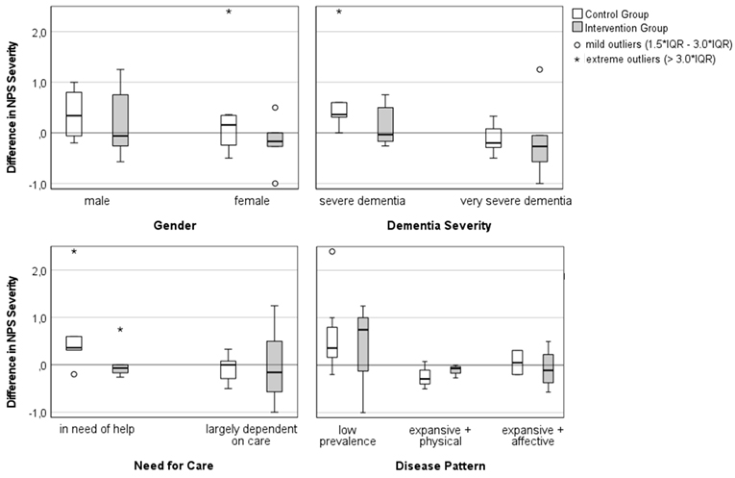
Figure 1: Differences in NPS severity as a function of gender, dementia severity, need for care, and disease pattern among people with dementia. IQR, Interquartile Range.
with dementia at one of the two time points, so they were excluded from the analysis.
Cluster analysis revealed that the baseline NPS severities sort people with dementia into three disease patterns (dp; Ward’s method, squared Euclidean distance). In the first one, people with dementia showed an average number of 3 (± 2) NPS (n = 10). Overall, people in this cluster show only a few and mild NPS (dp1: low prevalence). People with dementia in the other two dise- ase patterns showed expansive symptoms, such as aberrant motor behaviour (dp2: 1.4 ± 1.5; dp3: 1.3 ± 1.4), aggression (dp2: 1.9 ± 0.9; dp3: 1.5 ± 0.9), and irritability (dp2: 1.3 ± 1.0; dp3: 2.0 ± 0.9). People with dementia in the second disease pattern (n = 7) showed additionally physical symptoms, such as disinhibition (1.7 ± 1.3), apathy (1.4 ± 1.0), and appetite and eating disor- ders (2.3 ± 0.8). Overall, people with this disease pattern had 7 (± 1) NPS (dp2: expansive + physical). In turn, the people with dementia with dp3 sho- wed additional affective symptoms, such as anxiety disorders (1.8 ± 1.5) and depression (2.0 ± 0.9). These people showed 6 (± 1) NPS (dp3: expansive + affective).
Changes in the NPS severity of people with dementia as a function of their gender, dementia severity, need for care, and disease pattern are shown in Figure 1. Only the categories of a factor that were present in both study groups are plotted.
Regarding gender, NPS severity decreased in median in both men and women in the intervention group. However, NPS severity in males in the inte- rvention group showed a greater dispersion into the range of severity increase,
38 Ibenthal and Backhaus
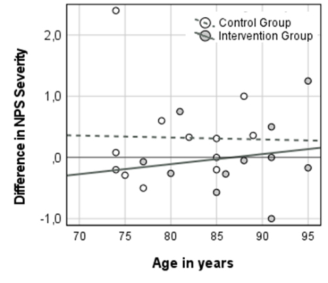
Figure 2: Differences in NPS severity as a function of people with dementias’ age.
comparable to the control group. NPS severity decreased most in women in the intervention group, by a median of –0.2.
People with very severe dementia showed comparable changes in the inte- rvention and control group. In people with severe dementia, NPS severity increased by a median of 0.4 in the control group, while the intervention group showed increases and decreases in the same proportion (median of 0.0). The differences in NPS severity in function of need for care followed the same pattern as the NPS severity in function of dementia severity. Also, in each category of disease pattern, the position and dispersion of the differences in NPS severity of the intervention and control group were comparable.
The scatter plot in Figure 2 shows the differences in NPS severity as a function of the age of people with dementia. In the intervention group, the correlation showed a weak effect (f = .18), since the differences increased slightly with age. In the control group, no effect was detected (R2 < .01). Whether changes in NPS of people with dementia following the music inte- rvention differ significantly as a function of the examined factors requires further investigation.
CONCLUSION
To summarize, a passive and personalized music intervention is not suitable for all people with dementia to the same extent. The severity of dementia or rather need for care as well as the gender of people with dementia seem to have an impact on their response to a music intervention. According to the results, personalized music intervention can particularly improve the NPS of women and people with severe dementia or need for care. In these catego- ries, people with dementia in the intervention group showed more positive changes in their NPS than people with dementia in the control group.
A possible reason for this could be the gender-dependent occurrence of NPS. Men primarily show aggression and apathetic behaviour, while women are often affected by anxiety disorders and depression (Zuidema et al., 2010, Resnick et al., 2020). While depression can be alleviated with music, meta- analyses have found no effects on aggression and agitation (van der Steen et al., 2017, Moreno-Morales et al., 2020).
Reducing Work-Related Stressors in the Care of People 39
The positive effects on people with severe dementia are in line with the findings of Gómez Gallego and Gómez García (2017). Furthermore, these results underpin the suitability of music interventions for long-term care faci- lities. Even in those facilities, that are home to people with and without cognitive impairment, 44% of residents exhibit moderate to severe dementia (Macdonald and Cooper, 2007). In turn, the effect of a music intervention probably does not depend on the age and disease pattern of the affected persons. However, the clustering of people with dementia into three dise- ase patterns is in accordance with the findings of Moran et al. (2004) and Lyketsos et al. (2001).
Some categories of the investigated factors were not sufficiently represen- ted in the sample. Therefore, a conclusion on how music interventions affect people with mild and moderate dementia or low need for care cannot be estimated. This should be considered in further research. Also, the interdepen- dencies of the examined factors still need to be quantified. Finally, it should be considered that the identified factors are applicable exclusively to passive, personalized music interventions. The effects of other types of therapy, such as active music therapy, may be influenced by other factors.
Nevertheless, for dementia care, the identified factors enable the targeted use of music interventions. The findings can support caregivers to prese- lect people with dementia who are most likely to respond positively to a music intervention. This eliminates the trial-and-error application of music interventions. If not every resident automatically participates in a music inte- rvention, the workload of caregivers will reduce and their work processes will be optimized. The expected, scheduled effectiveness of the music interven- tion can also increase caregivers’ acceptance of the intervention. By reducing behaviours that are particularly challenging, such as aggression, caregivers’ stress can be reduced. This will help to improve the work situation in demen- tia care by preventing absenteeism, mental overload, and associated illnesses among caregivers in the future and improving the quality of life of people with dementia.
REFERENCES
Baharudin, A.D., Din, N.C., Subramaniam, P. and Razali, R. (2019) ‘The associations between behavioral-psychological symptoms of dementia (BPSD) and coping strategy, burden of care and personality style among low-income care- givers of patients with dementia’, BMC Public Health, 19(Suppl 4), p. 447. doi: 10.1186/s12889-019-6868-0. Cheng, S.-T. (2017) ‘Dementia Caregiver Burden: a Research Update and Critical
Analysis’, Current Psychiatry Reports, 19(9), p. 64. doi: 10.1007/s11920-017- 0818-2. Costello, H., Walsh, S., Cooper, C. and Livingston, G. (2019) ‘A systematic review and meta-analysis of the prevalence and associations of stress and burnout among staff in long-term care facilities for people with dementia’, International Psychogeriatrics, 31(8), pp. 1203–1216. doi: 10.1017/S1041610218001606. Cummings, J.L. (1994) The Neuropsychiatric Inventory Questionnaire: Background
and Administration (npiTEST). Available at: www.npitest.net (Accessed: 20 April 2020).
40 Ibenthal and Backhaus
Foà, C., Guarnieri, M.C., Bastoni, G., Benini, B., Giunti, O.M., Mazzotti, M., Rossi, C., Savoia, A., Sarli, L. and Artioli, G. (2020) ‘Job satisfaction, work engagement and stress/burnout of elderly care staff: a qualitative research’, Acta Bio-Medica: Atenei Parmensis, 91(12-S), e2020014. doi: 10.23750/abm.v91i12-S.10918. Gómez Gallego, M. and Gómez García, J. (2017) ‘Music therapy and Alzheimer’s
disease: Cognitive, psychological, and behavioural effects’, Neurología, 32(5), pp. 300–308. doi: 10.1016/j.nrl.2015.12.003. Hazelhof, T.J.G.M., Schoonhoven, L., van Gaal, B.G.I., Koopmans, R.T.C.M. and Gerritsen, D.L. (2016) ‘Nursing staff stress from challenging behaviour of resi- dents with dementia: a concept analysis’, International Nursing Review, 63(3), pp. 507–516. doi: 10.1111/inr.12293. Hope, T., Keene, J., Fairburn, C., McShane, R. and Jacoby, R. (1997) ‘Behaviour
changes in dementia 2: Are there behavioural syndromes?’ International Journal of Geriatric Psychiatry, 12, pp. 1074–1078 (Accessed: 15 November 2021). Ibenthal, E. and Backhaus, C. (2019) ‘Ergonomic design of interfaces for people with dementia’, in Bagnara, S., Tartaglia, R., Albolino, S., Alexander, T. and Fujita, Y. (eds.) Proceedings of the 20th Congress of the International Ergonomics Associ- ation (IEA 2018): Volume VII: Ergonomics in Design, Design for All, Activity Theories for Work Analysis and Design, Affective Design. (Advances in Intel- ligent Systems and Computing, 824). Cham: Springer International Publishing, pp. 1483–1492. Kaufer, D.I., Cummings, J.L., Ketchel, P., Smith, V., MacMillan, A., Shelley, T., Lopez,
O.L. and DeKosky, S.T. (2000) ‘Validation of the NPI-Q, a brief clinical form of the Neuropsychiatric Inventory’, The Journal of neuropsychiatry and clinical neurosciences, 12(2), pp. 233–239. doi: 10.1176/appi.neuropsych.12.2.233. Kovach, C.R. and Meyer-Arnold, E.A. (1997) ‘Preventing agitated behaviors during bath time’, Geriatric nursing, 18(3), pp. 112–114. doi: 10.1016/S0197- 4572(97)90026-4. Lam, H.L., Li, W.T.V., Laher, I. and Wong, R.Y. (2020) ‘Effects of Music Therapy
on Patients with Dementia-A Systematic Review’, Geriatrics (Basel, Switzerland), 5(4) (14pp). doi: 10.3390/geriatrics5040062. Mahoney, F.I. and Barthel, D.W. (1965) ‘Functional evaluation: The Barthel Index’, Maryland State Medical Journal, 14, pp. 61–65. Moreno-Morales, C., Calero, R., Moreno-Morales, P. and Pintado, C. (2020) ‘Music
therapy in the treatment of dementia: A systematic review and meta-analysis’, Frontiers in medicine, 7. Mukherjee, A., Biswas, A., Roy, A., Biswas, S., Gangopadhyay, G. and Das, S.K.
(2017) ‘Behavioural and psychological symptoms of dementia: Correlates and impact on caregiver distress’, Dementia and Geriatric Cognitive Disorders Extra, 7(3), pp. 354–365. doi: 10.1159/000481568. Murphy, K., Liu, W.W., Goltz, D., Fixsen, E., Kirchner, S., Hu, J. and White, H.
(2018) ‘Implementation of personalized music listening for assisted living resi- dents with dementia’, Geriatric Nursing (New York, N.Y.), 39(5), pp. 560–565. doi: 10.1016/j.gerinurse.2018.04.001. Reisberg, B., Ferris, S.H., Leon, M.J. de and Crook, T. (1982) ‘The Global Deterioration Scale for assessment of primary degenerative dementia’, The American Journal of Psychiatry, 139(9), pp. 1136–1139. doi: 10.1176/ajp.139.9.1136. Resnick, B., Galik, E., Kolanowski, A., VanHaitsma, K., Boltz, M., Zhu, S., Ellis,
J., Behrens, L. and Eshraghi, K. (2020) ‘Gender differences in presentation and management of behavioral and psychological symptoms associated with dementia among nursing home residents with moderate to severe dementia’, Journal of women & aging, pp. 1–18. doi: 10.1080/08952841.2020.1735925.
Reducing Work-Related Stressors in the Care of People 41
Särkämö, T. (2018) ‘Music for the ageing brain: Cognitive, emotional, social, and neural benefits of musical leisure activities in stroke and dementia’, Dementia (London, England), 17(6), pp. 670–685. doi: 10.1177/1471301217729237. Scales, K., Zimmerman, S. and Miller, S.J. (2018) ‘Evidence-Based Nonpharmacolo-
gical Practices to Address Behavioral and Psychological Symptoms of Dementia’, The Gerontologist, 58(suppl_1), S88-S102. doi: 10.1093/geront/gnx167. Sefcik, J.S., Madrigal, C., Heid, A.R., Molony, S.L., van Haitsma, K., Best, I., Resnick, B., Galik, E., Boltz, M. and Kolanowski, A. (2020) ‘Person-Centered Care Plans for Nursing Home Residents With Behavioral and Psychological Sym- ptoms of Dementia’, Journal of Gerontological Nursing, 46(11), pp. 17–27. doi: 10.3928/00989134-20201012-03. Ueda, T., Suzukamo, Y., Sato, M. and Izumi, S.-I. (2013) ‘Effects of music
therapy on behavioral and psychological symptoms of dementia: A systema- tic review and meta-analysis’, Ageing Research Reviews, 12(2), pp. 628–641. doi: 10.1016/j.arr.2013.02.003. van der Steen, J.T., van Soest-Poortvliet, M.C., van der Wouden, J.C., Bruinsma, M.S., Scholten, R.J. and Vink, A.C. (2017) ‘Music-based therapeutic interventi- ons for people with dementia’, The Cochrane Database of Systematic Reviews, 5, CD003477. doi: 10.1002/14651858.CD003477.pub3. Vilalta-Franch, J., López-Pousa, S., Turon-Estrada, A., Lozano-Gallego, M.,
Hernàndez-Ferràndiz, M., Pericot-Nierga, I. and Garre-Olmo, J. (2010) ‘Syn- dromic association of behavioral and psychological symptoms of dementia in Alzheimer disease and patient classification’, The American Journal of Geriatric Psychiatry: Official Journal of the American Association for Geriatric Psychiatry, 18(5), pp. 421–432. doi: 10.1097/JGP.0b013e3181c6532f. Zuidema, S.U., Jonghe, J.F. M. de, Verhey, F.R.J. and Koopmans, R.T. (2010) ‘Environmental correlates of neuropsychiatric symptoms in nursing home patients with dementia’, International journal of geriatric psychiatry, 25(1), pp. 14–22. doi: 10.1002/gps.2292.
LISTED IN THE AHFE DIGITAL BOOKSTORE CATALOGUE
Explore the complete digital volume
Human Factors in Aging and Special Needs
Read this individual research paper free through the original publisher, or explore the full digital proceedings book.
ISBN 978-1-958651-14-8
Explore this ISBN in the AHFE Bookstore ↗Listed in the July 2026 bookstore catalogue; search by ISBN to confirm current availability · Digital book purchase optional