Meng-Cong Zheng, Chingi Chen, Iwen Yen (2022). Assessment of Flower Stand and the Sensory Experience in Horticultural Activities. In: Human Factors in Aging and Special Needs. AHFE Open Access, vol. 38, pp. 1–8. https://doi.org/10.54941/ahfe1001657
This study explored how the five senses can enhance the efficacy of activities in horticultural courses. In combination with a redesigned flower stand, the present study designed course content suitable for Taiwan's sensory gardens and horticultural activities. The study was conducted in three stages: (1) evaluation of the usability of the flower stand through non-participatory observation and interviews; (2) a plant–sense combination experiment conducted using plants recommended by a horticultural therapist, and the research participants were asked to evaluate the sensory stimulation of the plants; and (3) a sensory horticultural course experiment in which older adults with dementia used the redesigned flower stand. This study showed the sensory experience of older adults as affected by each plant in the horticultural class. The aged are satisfied with the new flower stands and matching plant combinations. Those can be widely integrated into community care in the future to achieve the goal of local aging.
The benefits of horticultural therapy are cognitive, social, psychological, and physiological (Azar and Conroy, 1989, Relf, 1973). Horticulture helped pati- ents construct a self-image and become able to continue their work (Airhart et al. 1987). A practical healing garden can reduce stress and generate motiva- tion (Eckerling, 1996). Horticultural activities would promote older adults’ psychological and physiological well-being through rest, relaxation, elderly care, and home care centers (Houseman, 1986). Lewis and Mattson (1988) demonstrated that horticultural therapy mitigated the arthritis of older adults and helped control their blood pressure and diet. In Taiwan, older adults aged 65 years and older account for 14.05% of the total population; Tai- wan is thus an aging society defined by the World Health Organization and is fast becoming a super-aged society. Taiwan is located on the subtropical belt, with many plants suitable for horticultural therapy. Therefore, in horti- cultural therapy, Plants can be used those older Taiwanese adults are familiar with, presenting an opportunity for delaying geriatric diseases like the wor- sening of dementia. Gardening could promote positive outcomes in social
inclusion concerning gender, social class, race, and ability and improve self- understanding, interpersonal and cooperative skills (Dyment and Bell, 2008, Robinson and Zajicek, 2005) are essential methods to promote local aging and sustainable community development.
This study investigates and designs the new hardware and related course planning supporting horticultural activities. As we know, older adults often find it difficult to bend or squat while planting plants during gardening acti- vities. Scholars have used video cameras to record older adults performing gardening activities without any help from others, and the observations reve- aled that reducing the physical burden on older adults should be prioritized in horticultural activities (Yuyama et al., 2012). Flower stands are indispen- sable tools in horticultural therapy. Most studies investigating flower stands have conducted evaluations based on the existing horticultural activities and tools in service centers for older adults (Zheng, 2018, Ho and Wu, 2017). The guidelines for flower stand design summarized in the previous study involve a stand’s function, size, structure, and operation. This study redesigned a previously designed flower stand (Zheng, 2018) by adjusting the material’s durability, weight, and height. The flower stand was introduced in subsequ- ent sensory experience horticultural courses. This study employed the five senses to enhance the efficacy of horticultural activities in related courses; this included using plant aromas to prompt memories, which can help miti- gate dementia. This study investigates how the five senses can be paired with plants in Taiwan. In combination with the redesigned flower stand, course content can be designed suitable for sensory horticultural activities in Tai- wan. We expected horticulture courses to use appropriate tools and plants to help the aged.
METHOD
The study was divided into three stages: (1) a review of the usability of the flower stand; (2) a plant–sense combination experiment; and (3) a sensory horticultural course experiment involving older adults with dementia and the new flower stand. This study was approved by the National Taiwan Uni- versity Behavior and Social Science Research Ethics Committee. The Taipei Private Aiai Nursing Home was the research location, a high-quality elderly care institution in Taipei City. It was the first long-term care institution in Tai- pei City to construct a healing concept fragrance garden. This study obtained the consent of AiAi Nursing Homes, from which all participants were recrui- ted, and written informed consent was obtained from all participants. On the other hand, to satisfy the requirements of outdoor horticultural courses, a new flower stand was designed based on a previous design (Zheng, 2018). The framework material was replaced with a waterproof and durable metal, and the height of the flower stand was made to be adjustable. In Stage 1 of this study, the usability of the new flower stand was evaluated. The Stage 1 experiment consisted of marking the expected hanging position and hanging an object, picking up fallen things, shoveling soil, transplanting potted plants, filling a watering can and watering plants, etc., nine steps in total. The subje- cts (N=16) had to complete all tasks while seated in a wheelchair, and they
Assessment of Flower Stand and the Sensory Experience in Horticultural Activities 3
completed the questionnaire after finishing the experiment. The entire process was recorded with a video camera. Eight women and eight men participated in the experiment.
Stage 2 consisted of the plant–sense combination experiment. Intervi- ews were conducted with a horticultural therapist, according to the plants recommended by the therapist were classified by their sight, smell, taste, and feel. The aged participants (N=30) had to evaluate the sensory sti- mulation offered by the plants. Eight common Taiwanese plants are used, including Mexican mint, fish mint, Oriental mugwort, Ghost plant, garlic, perilla, bok choy, and shallot. The experimental results were analyzed using three research methods: high sensory score subgrouping (extreme values), complementary sense subgrouping (ascending factors), and cluster analy- sis. The rankings of the plants in different sensory aspects were converted into grade point averages; the plants were then weighted according to how important and prominent each is, and suitable plant combinations were determined.
Stage 3 was the new flower stand and sensory combination experiment, which focused on the five participants with dementia in its discussion of whether the new flower stand conformed to their needs in horticultural cour- ses. One course was prepared for each plant, and in each period, questions regarding the overall course curriculum, flower stand, and five senses were answered by the participants. The course of the experiment was recorded using a video camera to enable subsequent analysis and discussion. Five new flower stands were employed with Mexican mint, fish mint, Oriental mugw- ort, and ghost plant. The horticultural therapist played background music before class to provide auditory stimulation. The therapist distributed the plants and materials to the participants, asked them to look at the plants, and then led the participants in observing and learning about the plants. In the smell study, the participants plucked a leaf from the plant and rubbed it to emit a scent, after which the participants were asked about their feelings. Once the participants had learned the plant’s appearance, name, and smell, volunteers gave the participants tea made from the plant to taste; the volun- teers also explained the benefits of the tea. The plant’s method was described at the beginning of the plant-growing class. After a plant had been plan- ted, another plant was introduced in the planting class. After all the plants had been planted, the participants were given fertilizer to spread over the soil and a tub of water to water the plants. Finally, the participants pla- ced their nameplates on the flower stand to indicate their completion of the horticultural therapy course. At the end of the period, the participants were interviewed.
RESULTS AND DISCUSSION
Stage 1: A Review of the Usability of the Flower Stand In 39.4% of the impact events, the wheelchair armrests hit the top left and right of the flower stand. Therefore, the proposed flower stand has adjustable height. However, for some of the participants, their head and shoulder area hit the flower stand when they bent to pick up objects. Additionally, this
study recorded whether objects placed on the stand’s platforms fell to the floor to ensure that the platforms were stable.
When the participants were asked about the convenience of the platforms on the two sides of the flower stand used for plant transplantation, 56.25% were satisfied, 6.25% were delighted, and 25% gave a neutral response. Regarding the usability of the two platforms onto which objects were pla- ced, 68.75% of the participants were satisfied, and 31.25% were delighted; no participants expressed dissatisfaction. Therefore, the two platforms on the side of the stand are helpful to the user. Regarding the ease of handling of flowerpots, 37.5% of the participants were satisfied, 31.25% respon- ded neutral, and 31.25% were dissatisfied. The interview findings revealed that the weight of the flowerpots made them difficult to pick up and thus not easy to use. Hence, handling flowerpots placed on the two platforms was difficult. Concerning the convenience of the hooks on the flower stand, 43.75% of the participants were satisfied, 25% were delighted, and 12.5% responded neutral. According to the interview data, most participants chose to place the hooks at the side, making them difficult to reach. Most of the participants who were satisfied with the design felt that the width of the flower stand was appropriate, and the proximity between the user and flower stand made a stand easy to use. Finally, regarding the convenience of placing objects on and retrieving them from the stand, 50% were sati- sfied, and 25% were delighted. Most of the participants thus gave a positive review.
The comprehensive experiment demonstrated that the participants were generally satisfied with the flower stand. However, items were identified that require special care during the use of the stand, such as the wheelchair hitting the flower stand when it moved in and out of the stand and the participant knocking the flower stand while bending down to pick up a fallen object. Because the flower stand was built using stainless steel, shaking, and falling over the stand were rare. Subsequent experiments can be conducted using this flower stand.
Stage 2: Plant–Sense Combination Experiment After interviewing the horticultural therapist, the recommended plants were classified according to their appearance, smell, taste, and feel and then emplo- yed in the visual, olfactory, taste, tactile, auditory (music) experiments. The participants evaluated their sensory preference for each plant using a 5-point Likert scale of “dislike extremely,” “dislike,” “indifferent,” “like,” and “like extremely.”
According to the experiment mentioned above, the following combina- tion of eight plants was optimal for the subsequent experiment: fish mint, Mexican mint, Oriental mugwort, bok choy, garlic, ghost plant, perilla, and shallot. In the sensory combination experiment, the rankings of the plants in various sensory aspects were weighted according to their proportion to deter- mine the most appropriate plant pairings. The three methods were employed: 1) high sensory score subgrouping, 2) complementary sense subgrouping, 3) cluster analysis.
Assessment of Flower Stand and the Sensory Experience in Horticultural Activities 5
Stage 3: A Sensory Horticultural Course Experiment Involving Older Adults with Dementia and the New Flower Stand An outdoor horticultural experiment was conducted using sensory and plant combinations and a redesigned flower stand. The eight plants identified in the experiment were used for a horticultural course. They were fish mint, Mexican mint, Oriental mugwort, bok choy, garlic, ghost plant, perilla, and shallot. Sensory experiences were arranged based on the plants’ characteri- stics during the course. Additionally, “Goldberg Variations Variation 2” was the best background music for providing auditory stimulation.
The visual experiment recorded the participants’ proportion of time loo- king at the plants and the teacher during each course session. The amount of time spent looking at a plant was then used to determine whether the participants were interested in the plant. The visual experiment results reve- aled that the participants concentrated on the plant 85.80% of the time during the ghost plant lesson, the highest percentage among all the plants used. The second highest percentage was obtained for shallot (85.70%), whereas the lowest percentage was obtained for Mexican mint (57.90%). Some plants’ unfamiliarity and unusual appearance may have been why some plants attracted more attention.
In the olfactory experiment, the number of times the participants took the initiative to pick up a plant to smell it during the course was counted. How many times they took the initiative to pick up represents how they were curi- ous about what plant they picked up. Fish mint, Mexican mint, and Oriental mugwort were picked up and smelled the most: 19 times for fish mint, 12 times for Mexican mint, and nine times for Oriental mugwort. Based on the frequency of scents during the course, Mexican mint, which was smelled once every 30 s on average, was concluded to be the optimal choice in the olfactory experiment. The experimental results revealed that the olfactory experience often accompanied the taste experience. Tasting of the perilla prompted the participants to seek the corresponding sensory stimulation; it was smelled seven times.
The taste experiment focused on plants that could be squeezed into a beve- rage or directly consumed. Bok choy and shallot did not facilitate a notable taste experience. The most attractive plant was discovered to be perilla, for which the reaction time ratio was only 3.72%. The least attractive plant was the ghost plant, for which the reaction time ratio was 32.00%.
The tactile experiment was divided into preparatory work, digging, and actual planting. Because the plant used in each class was different, the pro- portion of time spent on each step in each class was calculated. The time ratio of preparatory work was highest for garlic at 49.50%. Regarding dig- ging time, the participants were given four seedlings to plant in the bok choy class, resulting in the highest digging time ratio for bok choy at 24.10%. Actual planting was required for all plants, and the highest planting time ratio was that of bok choy at 34.00%, followed by shallot at 32.10%. These results can be used as a basis for adjusting the proportions of time within tactile experiences in future horticultural courses.
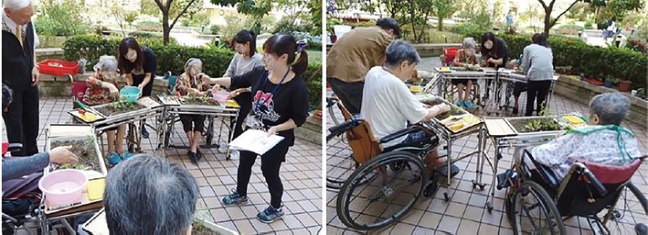
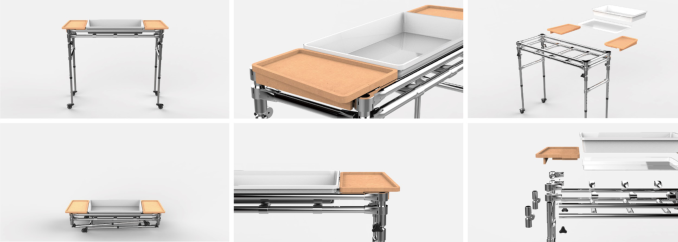
Figure 1: Photographs of the outdoor experience class in horticultural therapy.Figure 2: The flower stand was designed by the research team.
As revealed in the experimental results, the participants were mostly posi- tive about the usability of the flower stand. The lightweight mobile flower stand made the participants feel respected (Fig. 1). However, the taste activi- ties, which required eating or drinking, were rejected during the experiment because the participants felt uneasy. Although the participants were mostly positive about the other sensory experiences, individual differences betw- een older adults should be considered when designing sensory horticultural course curricula. An enormous variety of horticultural activities should be found.
A flower stand was designed for use by older adults in horticultural courses. The restrictions of wheelchair users were accounted for regar- ding the stand’s size and components, and the structure was designed to withstand the impact of a wheelchair. The flower stand was also befit- ted with shock absorber pads and universal wheels for enhanced stability. To accommodate various wheelchairs, the flower stand has adjustable hei- ght to ensure that the armrests of any wheelchair will fit under the flower stand. Thus, the wheelchair occupant can easily use the tabletop. Horticultu- ral therapy classes can be conducted indoors and outdoors; therefore, the flower stand was designed to adapt to the venue size by flexibly taking different combinations. The flower stand was constructed using stainless steel and modular components, which reduced its weight. It is also water- proof, moistureproof, and rustproof. Its foldable structure means mobile
Assessment of Flower Stand and the Sensory Experience in Horticultural Activities 7
and easy to store, reducing warehousing costs (Fig. 2). The course imple- mented in this study required a shovel, rake, and potted plants, which could be placed on the platforms on either side of the stand. The experi- mental results revealed that most participants were satisfied with the flower stand. If the flower stands can be arranged in concentric circles facing the teacher during a class, the concentration of the class students could be improved.
CONCLUSION
In this study, we evaluated the usability of the flower stand through non- participant observation, interviews, and a sense combination experiment to promote local horticulture and sustainable development. In evalua- ting the usability of the flower stand, participants were generally satisfied with stability, convenience, and ergonomics, which is in line with previ- ous studies that suggested that gardening activities should be prioritized to reduce the burden on the elderly. In terms of sensory experience, unfa- miliar and unusual plant appearances attract more attention. The olfa- ctory experience accompanying taste experiences can prompt participants to seek corresponding sensory stimuli, but there are individual differences among older adults. Therefore, in the future, the new flower stand can be used in horticultural therapy courses and the corresponding plant combi- nations for the curriculum to improve the course’s efficacy. Our findings help the aged people successfully age by horticulture activities in the local community.
REFERENCES
Airhart, D. L., Willis, T. and Westrick, P. (1987) ‘Training for Adolescent Special Education Students.’, Journal of Therapeutic Horticulture, 2, pp. 17–22. Azar, J. A. and Conroy, T. (1989) ‘The development of an empirical instrument
designed to measure the effects of horticultural therapy’, Journal of Therapeutic Horticulture, 4, pp. 21–28. Dyment, J. E. and Bell, A. C. (2008) ‘’Our garden is colour blind, inclusive and warm’: reflections on green school grounds and social inclusion’, International Journal of Inclusive Education, 12(2), pp. 169–183. Eckerling, M. (1996) ‘Guidelines for Designing Healing Gardens’, Journal of Thera-
peutic Horticulture, 8, pp. 21–25. Ho, Y. and Wu, J.-C. (2017) ‘Facility Design Study of Old Age Dementia Day Care Center Horticultural Therapy’, Journal of art and design of Huafan University, 12, pp. 82–97. Available Houseman, D. (1986) ‘Developing links between horticultural therapy and aging’,
Journal of Therapeutic Horticulture, pp. 9–14. Lewis, J. F. and Mattson, R. H. (1988) ‘Gardening may reduce blood pressure of elderly people. activity suggestions and models for intervention’, Journal of Therapeutic Horticulture, 3, pp. 25–37. Relf, D. (1973) ‘Horticulture: A therapeutic tool’, Journal of Rehabilitation, 39(1),
pp. 27–29.
Robinson, C. W. and Zajicek, J. M. (2005) ‘Growing minds: The effects of a oneyear school garden program on six constructs of life skills of elementary school children’, HortTechnology, 15(3), pp. 453–457. Yuyama, H. et al. (2012) ‘Analysis of the Requirements for Designing a Gardening
Product for a Group of Elderly People’, Bulletin of Japanese Society for the Science of Design, 58(6), pp. 6_95-6_100. doi: 10.11247/JSSDJ.58.6_95. Zheng, M.-C. (2018) ‘New Flower Bed Design and Verification Supporting Horticultural Therapy Classes Based on Behavioral Observation’, in Occupational Therapy-Therapeutic and Creative Use of Activity. IntechOpen.
LISTED IN THE AHFE DIGITAL BOOKSTORE CATALOGUE
Explore the complete digital volume
Human Factors in Aging and Special Needs
Read this individual research paper free through the original publisher, or explore the full digital proceedings book.
ISBN 978-1-958651-14-8
Explore this ISBN in the AHFE Bookstore ↗Listed in the July 2026 bookstore catalogue; search by ISBN to confirm current availability · Digital book purchase optional