Meng-Cong Zheng, Li-Jen Wang (2024). Slicer Deconstruction Training for Improving Students’ Three-Dimensional Modeling Ability. In: Training, Education, and Learning Sciences. AHFE Open Access, vol. 155, pp. 36–45. https://doi.org/10.54941/ahfe1005388
Existing higher education senior-year design courses have demonstrated that students are often limited by their ability to use three-dimensional (3D) software or are overly reliant on their two-dimensional (2D) abilities, affecting their performance for 3D modeling. Slicer deconstruction is a procedure of dismantling and unfolding models. Closed lines from three-view drawings of an existing model are converted into tangent planes that are then concatenated into a new model. This study aimed to enable students to understand the principle of converting 2D surfaces to 3D surfaces through slicer deconstruction training and to improve their spatial and 3D modeling abilities by combining physical models with 3D modeling. First-year college students in a 3D design course were selected as the experimental group, and the control group com-prised first-year college students who had not received slicer deconstruction training. In the spatial visualization test, the overall performance of the experimental group was superior to that of the control group. Specifically, question 29, which involved a test of rotating in two directions three times, saw a significantly higher correct response rate in the experimental group compared to the control group. Hence, we can infer that the training has enhanced students' three-dimensional modeling and spatial abilities.
Spatial ability is a complex cognitive behavior that is difficult to analyze and understand (Caplan & Romans, 1998). Tarte (1990) suggested that spatial ability is composed of two tasks: spatial visualization and spatial orienta- tion. Spatial visualization can be further subdivided into mental rotation and transformation. Carroll (1993) contended that spatial ability comprises five factors: spatial visualization, spatial relations, visuospatial perceptual speed, closure speed, and closure flexibility. Through factor analysis of 42 spatial visualization tests, Burton and Fogarty (2003) identified five factors of spa- tial ability, which are spatial visualization, spatial relations, visual memory, closure speed, and perceptual speed closure flexibility.
Spatial visualization is the ability to visualize the rotation of objects, fold- ing and unfolding of planar patterns, and changes in the position of objects
Slicer Deconstruction Training for Improving Students’ Three-Dimensional Modeling Ability 37
in space (Miller & Bertoline, 1991). Individuals with excellent spatial ability may also excel at inferring how objects would look when rotated. Spatial visualization tests are often used in intelligence quotient tests. Chen (1985) stated that a 3D image represents a depth transfer of a 2D picture plane. When representing a 3D image on a 2D plane, depth transfer should first be considered; that is, depth cues and surface perspective transformations should be used to convert 3D information into 2D information (McGraw, 2004). Individuals must first understand the information contained in a graphic and then imagine the depth cues to transform the perspective of the 3D image to a 2D image. Spatial visualization has been called the most fundamental and valuable part of engineering graphics education (Contero, Naya, Company, & Saorín, 2006, p. 472). Sorby (2007) noted that 3D spatial ability affects student per- formance in engineering graphics courses, and Sorby (2012) discovered in a later study that students who had the opportunity to improve their spatial visualization skills had greater self-efficacy, had improved mathematics and science scores, and were more likely to persist in engineering studies. Numer- ous related studies have demonstrated that spatial ability can be improved through instructional design (Potter & van der Merwe, 2001; Alias, Black, & Gray, 2002; Kwon, 2003; Lajoie, 2003; Woolf, Romoser, Bergeron, & Fisher, 2003). Similarly, Kwon (2003) and Woolf et al. (2003) confirmed that the use of web-based 3D visualization instruction can provide students with an adequate classroom experience that enhances their spatial abilities. Improving the spatial visualization ability of engineering students is a crucial part of technical education and a key challenge for educators (Ferguson, Ball, McDaniel, & Anderson, 2008, p. 2). Engineering students should focus on developing their spatial ability early in the course to ensure success in later studies (Sorby, 2009). According to Contero et al. (2006), educators work- ing in engineering graphics should emphasize spatial reasoning, which is a core competency for future designers. Studies have also demonstrated that design training improves student spatial performance (Workman et al., 1999; Martin-Dorta et al., 2008; Onyancha et al., 2009; Park et al., 2011). Design training has a positive effect on spatial ability (Lin, 2016). In product design education, the ability to understand spatial relations, spatial orientation, and spatial visualization are key factors influencing a designer’s performance for 3D product design (Liao, 2017). For beginners in design, graphics drawing ability, observation ability, and spatial imagination must be well-trained. If observation ability and spatial imagination of students are not well devel- oped, exclusive reliance on 2D images to teach professional knowledge by an instructor increases the communication gap between students and the instruc- tor (Mukai, Yamagishi, Hirayama, Tsuruoka, & Yamamoto, 2011; Guedes, Guimarães, & Méxas, 2012).
Maruni´c and Glažar (2014) emphasized the importance of spatial ability in engineering graphics education. For design beginners with poorly devel- oped observational ability and spatial imagination, exclusive reliance on plane images increases the communication gap between students and instruc- tors (Mukai, Yamagishi, Hirayama, Tsuruoka & Yamamoto, 2011; Guedes, Guimarães & Méxas, 2012). In general, spatial ability is closely related to
38 Zheng and Wang
3D modeling. Tzuriel and Egozi (2010) noted that children with higher men- tal rotation abilities tend to employ holistic strategies to solve rotation tasks. Compared with analytical strategies, holistic strategies are more effective for solving mental rotation tasks. Several relevant studies have demonstrated that spatial abilities can be improved through instructional design (Potter & vander Merwe, 2001; Alias, Black, & Gray, 2002; Kwon, 2003; Lajoie, 2003; Woolf, Romoser, Bergeron, & Fisher, 2003). The study recommended that design training sessions can be conducted to guide students in using holistic strategies to solve 2D and 3D problems.
In this study, slicer deconstruction training was adopted to improve teach- ing 3D modeling ability, and a 3D design curriculum plan was revised to improve the student training and deconstruction ability for handmade 3D modeling. Basic design courses focus primarily on training students’ form development ability. Through slicer deconstruction training, students could gradually come to understand the principle of converting 2D surfaces to 3D surfaces and could improve their 3D spatial ability by using both physical and 3D models.
METHODS
Course The first-year 3D design course at the Department of Industrial Design was used as the study object. This course is compulsory for first-year university design students. The original 3D design course was revised by introducing Slicer deconstruction training. After the course, a spatial visualization test was conducted to compare the spatial abilities of the students in the course with that of students from other years who had not received slicer decon- struction training. Slicer deconstruction is a procedure for dismantling and unfolding models. Closed lines in three-view drawing of an existing model are converted into tangent planes, the model is corrected plane-by-plane, and the planes are concatenated into a new model. The process enables evaluating an overall strategy for representing the 3D space. Applications enabling a simi- lar deconstruction are available online; however, most of these applications require users to first search for completed 3D models on the Internet. The application then converts the model into slices for laser cutting that enables easy assembly. Such applications are of limited use in teaching students that 3D models comprise continuous curves. Therefore, this study aimed to enable students to gradually understand the principles of converting 2D surfaces to 3D surfaces through slicer deconstruction training; actual models were combined with 3D modeling to improve their spatial and 3D abilities.
Experimental Process The instructional process was divided into four stages, and the course was conducted as a participatory workshop. The first stage introduced prerequi- site knowledge regarding basic and 3D modeling; in the second stage, slicer decon-struction training was conducted with solid modeling of a vehicle, in the third stage 3D modeling and laser cutting was used to construct a solid
Slicer Deconstruction Training for Improving Students’ Three-Dimensional Modeling Ability 39
model of the vehicle, and in the final stage the efficacy of the new course was verified with a spatial visuali-zation test.
Participant and Performance Measurement In this study, participants were industrial design students enrolled in 2019 (n = 35) and 2020 (n = 34). The experimental site was a classroom specifi- cally designated for first-year students. The experimental group consisted of first-year students admitted in 2020 who participated in a Slicer deconstruc- tion training course; the control group comprised students admitted in 2019 who had not received Slicer deconstruction training. We measured the two groups using the Purdue Spatial Visualization Test: Visualization of Rotations (PSVT:R; Guay, 1977). We assessed the control group of students admitted in 2019 who had not undergone Slicer deconstruction training. One year later, the experimental group of students admitted in 2020 was assessed. The spa- tial abilities of the two groups were compared. After completing the course, students from both the experimental and control groups were required to complete an assessment questionnaire to determine whether the new course improved their 3D spatial abilities while maintaining the teaching quality of the original course. Descriptive statistical analysis was utilized to analyze the learning outcomes and improvement in their spatial abilities, serving as a basis for future revisions of the teaching content.
RESULTS AND DISCUSSION
Instructional Process and Outcomes Before beginning the course, students were first informed regarding the planning and progress of the course. The students completed a warm-up assignment with origami to familiarize the students with the concepts of basic and 3D modeling. Participants referred to a book published by a Japanese professor Jun Mitani and folded 3D structures from 2D paper according to the instructions. Each participant was required to complete three origami works in the course. The goal of this stage was to enable participants to understand changes in a 2D surface if it is converted to a 3D surface, under- stand the continuous changes in the surface through connections by lines, and appreciate methods of attractive modeling.
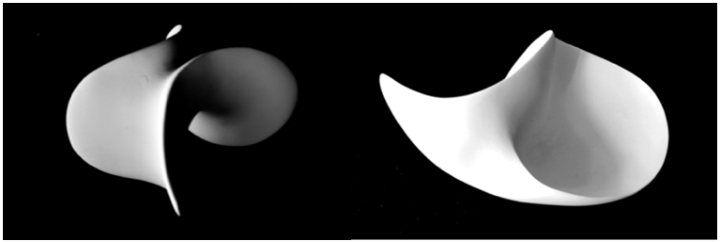
After the origami activity, participants handcrafted three example mod- els with air-dried clay in the classroom; the models were completed over a few weeks. The handmade models were required to have clear bound- aries between lines and surfaces, and the overall model should be smooth and perfect from all angles. After the pre-liminary modeling was com- pleted, participants waited for the clay to dry and could make moderate adjustments to the model. Finally, the students photographed their finished products in a studio (Figure 1). In addition to mastering basic modeling, this stage also enabled participants to become familiar with the material prop- erties of air-dried clay in preparation for the subsequent vehicle modeling task.
40 Zheng and Wang
Figure 1: 3D paper modeling outcomes of curved surface change training.
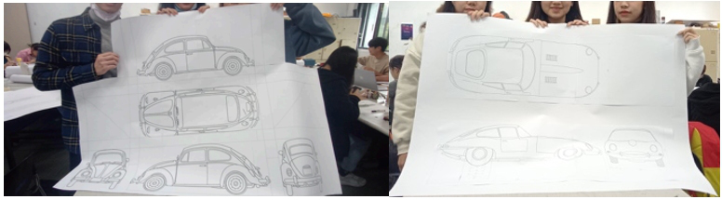
In the next stage, participants formed groups of two or three students for mutual learning, which may induce better outcomes (Attoe & Mugerauer 1991; McLaughlan & Chatterjee 2020). Participants either electronically or manually drew three-view planes of a chosen vehicle (Figure 2). In this stage, instructor assisted the participants in checking whether the three-view drawings were correct because these drawings were the foundation for the subsequent task. On the basis of the corrected three-view drawings, the stu- dents used foam boards fabricate models. The boards were placed in sequence from large to small and from the center line to the periphery. The instruc- tor reviewed the dimensions of the constructed models and assisted them in diversifying the shape of their framework model.
Figure 2: Three-view drawing of vehicles drawn by participants.
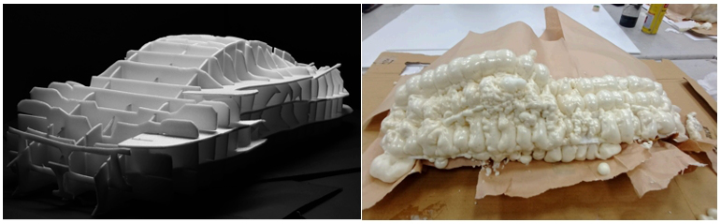
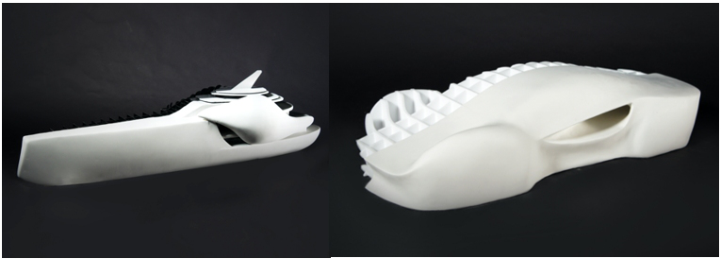
After confirming the correctness of the sketch model, each group con- structed a 3D sheet model and sent each sheet for laser cutting. The foaming agent was prepared during laser cutting, and filling with foam and clay was performed after the completion of the laser-cut product (Figure 3). Acrylic sheets were used as the model framework; the framework was half-filled with clay and polished, and another unfilled framework was used for comparing prepolished and postpolished shapes. The vehicle models were required to have at least one side with length >60 cm to ensure that the groups produced works with excellent visual tension and sufficient detail (Figure 4).
Slicer Deconstruction Training for Improving Students’ Three-Dimensional Modeling Ability 41
Figure 3: Constructing the vehicle exterior from the three-view drawing and filling the model with foaming agent.Figure 4: Slicer deconstruction of the final vehicle product.
The process and content of this study were captured in videos and uploaded to a public online video platform. In addition to providing a ref- erence for instructor in academia, the videos could also be used by future students of the course for preparation.
In the analysis of spatial abilities between the experimental and control groups, we observed significant trends. Among 30 questions, the experi- mental group scored higher on 17 questions. Notably, on question 29, the performance of the experimental group (mean = 0.79) was significantly bet- ter than that of the control group (mean = 0.57), with a mean difference of 0.22. Additionally, questions 24 and 25 also highlighted the experimental group’s exceptional performance, with mean differences of 0.17 and 0.16, respectively. For other items such as questions 8, 15, and 19, the experi- mental group’s mean scores were approximately 0.14 higher. These results suggest potential benefits from 3D slicer training on certain spatial ability tasks. Although the mean scores for most questions did not show significant differences between the two groups, 3D slicer training has the potential to significantly enhance spatial abilities under specific conditions. The perfor- mance on question 29 was particularly noteworthy, with a t-value of 2.02 and a p-value of 0.0475, indicating a positive impact of 3D training on judgments involving more than rotating in two directions three times (Table 1). These findings underscore the potential value of 3D slicer training in enhancing certain spatial abilities, albeit with limited impact on others. Future research
42 Zheng and Wang
should explore the specific effects of 3D training on various aspects of spatial ability and consider how training methods could be optimized to effectively enhance those spatial abilities that can substantially benefit from 3D training.
Table 1. Independent samples T-test between experimental and control groups.
Table available in the original PDF paper.
Participant Feedback The teaching assessment were scored from 1 to 5; and the participants gave the course an overall score of 4.56. Feedback provided in the assessment questionnaire was as follows: “I learned about model construction and 3D formation,” “It was time-consuming, but the end product was satisfactory,” “It increased my understanding of 3D modeling,” “The content was rich and
Slicer Deconstruction Training for Improving Students’ Three-Dimensional Modeling Ability 43
creative,” “I liked the instructional method,” “I felt that my 3D concepts and overall mastery have clearly improved,” “I could use my strengths in the group assignments. Although making a model was difficult, it was ful- filling and I loved it,” “Although the course was time-consuming, it was the one in which I learned the most. I liked it very much,” “The instructor was patient, kind, and skillful, and friendly,” “I could learn about problem solving and teamwork,” “In this course, I increased my sense of responsibility for my work and my teamwork, and I constantly learn how to tap into my potential,” “It was helpful to understand lines and curves,” “Multiple design abilities were trained simultaneously in the class,” “I learned various techniques for modeling,”“I understood the composition of 3D structures,”“It was the most time-consuming but also the most helpful course,” “This course enabled us to understand the subsequent development of product design,” “The instructor guided us attentively. We also learned a lot from this course. Although some- times I felt tired, I worked hard to complete the work,” “This course allowed me to learn different types of design and production skills,” “I felt the course was great,” “This course enhanced my understanding of 3D structure,” “I learned patience, concentration, 3D structural thinking, and teamwork,” and “Making models by hand greatly improved my design ability.” These feed- back indicates that participants felt that the course was beneficial and that they achieved their learning outcomes; no negative comments were received.
CONCLUSION
Based on previous experience with 3D design education, this study reorga- nized the content of a previous course and introduced slicer deconstruction training to enhance student spatial ability, improve teaching efficiency, and enable students to improve their spatial ability within a limited time, thereby enhancing their modeling performance. The goals of this study were to main- tain teaching quality and learning outcomes in an intensive curriculum and to not only produce 3D models but also train 3D spatial ability. Although various commercially available slicers on the market can facilitate producing sliced models, these applications are primarily a method of reverse engineer- ing rather than a method of understanding the changes in curved surfaces by deconstructing and constructing shapes. In this study, a combination of slicer deconstruction and computer modeling was used to fully practice the skills and knowledge required for 2D to 3D modeling. Not only could stu- dents understand the operation and drawing of the software, they could also complete a vehicle model by hand, which is conducive to future development of products and modeling. The students also mastered different 3D modeling transformations. Thus, the course can improve student modeling ability and enable students to implement model design in practice. The 3D design course is a core course in the design department. Although it has been developed over a long time, the 3D modeling performance of senior-year students still has room for improvement. This study has also been recognized by the Min- istry of Education Teaching Practice Research Program. Continued timely adjustments of this course are expected in the future, and the course can be used as a reference for the teaching community.
44 Zheng and Wang
ACKNOWLEDGMENT
Special thanks for all participants who generously shared their time and experience, for the purposes of this study sections.
REFERENCES
Alias, M., Black, T. R., & Gray, D. E. (2002). Effect of instructions on spatial visualization ability in civil engineering students. International Educational Journal, 3(1), 1–12. Retrieved. Attoe, W. & Mugerauer, R. (1991) Excellent studio teaching in architecture, Studies
in Higher Education, Vol. 16, No. 1, pp. 41–50. Burton, L. J., & Fogarty, G. J. (2003). The factor structure of visual imagery and spatial abilities. Intelligence, 31(3), 289–318. Chen, M. J. (1985). Young children’s representational drawings of solid objects: A
comparison of drawing and copying. In N. H. Freeman & M. V. Cox (Eds.), Visual order: The nature and development of pictorialrepresentation (pp. 157–175). Carroll, J. B. (1993). Human cognitive abilities: A survey of factor-analytic studies.
Cambridge University Press. Caplan, B., Romans, S. (1998) Assessment of spatial abilities. In Goldstein, G., Nussbaum, P., Beers, S. (Eds.), Human brain function: Assessment and rehabil- itation. Vol. 3. Neuropsychology. New York: Plenum. pp. 379–419. Contero, M., Naya, D., Company, P., & Saorín, J. L. (2006). Learning support
tools for developing spatial abilities in engineering design. International Journal of Engineering Education, 22(3), 470–477. Ferguson, C., Ball, A., McDaniel, W., & Anderson, R. (2008, November). A comparison of instructional methods for improving the spatial-visualization ability of freshman technology seminar students. Paper presented at the 2008 IAJC-IJME International Conference, Nashville, TN. Guay, R. (1977). Purdue Spatial Visualization Test: Visualization of Rotations.
W. Lafayett, IN: Purdue Research Foundation. Guedes, K. B., Guimarães, M., & Méxas, J. G. (2012). Virtual reality using stereoscopic vision for teaching/learning of descriptive geometry. In Proceedings of the Fourth International Conference on Mobile, Hybrid, and On-Line Learning (pp. 24–30). G. Maruni´c-V. Glažar (2014). Improvement and Assessment of Spatial Ability in
Engineering Education. Kwon, O. N. (2003). Fostering spatial visualization ability through web-based virtual-reality program and paper-based program. Lecture Notes in Computer Science, 2713, 701–706. doi: 10.1007/3-540-45036-X78. Lajoie, S. P. (2003). Individual differences in spatial ability: Developing technolo-
gies to increase strategy awareness and skills. Educational Psychologist, 38(2), 115–125. Liao, K. H. (2017). The abilities of understanding spatial relations, spatial orientation, and spatial visualization affect 3D product design performance: using carton box design as an example. International Journal of Technology and Design Education, 27(1), 131–147. Lin, H. (2016). Influence of design training and spatial solution strategies on spatial
ability performance. International Journal of Technology and Design Education, 26(1), 123–131.
Slicer Deconstruction Training for Improving Students’ Three-Dimensional Modeling Ability 45
McLaughlan, R. & Chatterjee, I. (2020) What works in the architecture studio? Five strategies for optimising student learning, International Journal of Art & Design Education, Vol. 39, No. 3, pp. 550–64. Martı’n-Dorta, N., Saorı’n, J. L., & Contero, M. (2008). Development of a fast
remedial course to improve the spatial abilities of engineering students. Journal of Engineering Education, 97(4), 505–513. Miller, C. L., & Bertoline, G. R. (1991). Spatial visualization research and theories: Their importance in the development of an engineering and technical design graphics curriculum model. Engineering Design Graphics Journal, 55(3), 5–14. Mukai, A., Yamagishi, Y., Hirayama, M. J., Tsuruoka, T., & Yamamoto, T. (2011).
Effects of stereoscopic 3D contents on the process of learning to build a handmade PC. Knowledge Management & E-Learning: An International Journal (KM&EL), 3(3), 491–506. Onyancha, R., Derov, M., & Kinsey, B. (2009). Improvements in spatial ability as a result of targeted training and computer-aided design software use: Analyses of object geometries and rotation types. Journal of Engineering Education, 98(2), 157–167. Park, J., Kim, D. E., & Sohn, M. H. (2011). 3D simulation technology as an effec-
tive instructional tool for enhancing spatial visualization skills in apparel design. International Journal of Technology and Design Education, 21(4), 505–517. Potter, C. & van der Merwe, E. (2001, August). Spatial ability, visual imagery and academic performance in engineering graphics. Paper presented at the Interna- tional Conference on Engineering Education, Oslo, Norway. Sala, N. (2017) Complexity and fractality in industrial design, in N. Sala &
G. Cappellato [Eds] Chaos and Complexity in the Arts and Architecture: Research in Progress. New York: Nova Science, pp. 155–69. Sorby, S. A. (2007). Developing 3-D spatial skills for engineering students. Australasian Journal of Engineering Education, 13(1), 1–11. Sorby, S. A. (2009). Educational research in developing 3-D spatial skills for engineering students. International Journal of Science Education, 31(3), 459–480. Sorby, S. A. (2012). ENGAGE strategy research brief: Spatial visualization skills. Tarte, L. A. (1990). “Spatial orientation skill and mathematical problem solving.”
Journal for Research in Mathematical Education. 21, 216–229. Tammy M. McGraw (2004) The Effects of Two-Dimensional Stimuli and Three Dimensional Stereoptic Stimuli on Spatial Representation in Drawings, Studies in Art Education, 45:2, 153–169. Tzuriel, D., & Egozi, G. (2010). Gender differences in spatial ability of young chil-
dren: The effects of training and processing strategies. Child Development, 81(5), 1417–1430. Workman, J. E., Caldwell, L. F., & Kallal, M. J. (1999). Development of a test to measure spatial abilities associated with apparel design and product development. Clothing and Textiles Research Journal, 17(3), 128–133. Woolf, B., Romoser, M., Bergeron, D., & Fisher, D. (2003, July). Tutoring
3-dimensional visual skills: Dynamic adaptation to cognitive level. In Proceed- ings of the 11th International Conference on Artificial Intelligence in Education, Sydney, Australia.
LISTED IN THE AHFE DIGITAL BOOKSTORE CATALOGUE
Explore the complete digital volume
Training, Education, and Learning Sciences
Read this individual research paper free through the original publisher, or explore the full digital proceedings book.
ISBN 978-1-964867-31-1
Explore this ISBN in the AHFE Bookstore ↗Listed in the July 2026 bookstore catalogue; search by ISBN to confirm current availability · Digital book purchase optional