Cheng Hsun Peng, I Wen Yen, Meng-Cong Zheng (2023). Using Virtual Reality to Explore the Effects of Feng Shui on Physiology and Psychology. In: Affective and Pleasurable Design. AHFE Open Access, vol. 71, pp. 140–149. https://doi.org/10.54941/ahfe1003253
Feng shui is an ancient Chinese subject that has been adopted by many architects and interior designers. However, the jury is still out on whether feng shui is a legacy of traditional experience or a design guideline that can be scientifically measured. There are a few studies that discuss the use of feng shui in indoor and outdoor decoration, but for its impact on the human body's psychological perception and physical comfort are still rarely to be discussed. Therefore, the purpose of this study is to investigate whether the living room decorated under different feng shui conditions will affect the physiological reaction and psychological feeling of the human body. This study created a virtual experimental scene, made the participants wear VR glasses, measured their physiological value of HRV simultaneously, and conducted semi-structured interviews after completing the POMS psychological measuring table. The results showed that: (1) The results of heart rate variability showed that the living room with better feng shui conditions could provide more stable physiological data for the subjects and make them feel comfortable and stable. However, the pattern with poor feng shui conditions reflects the unstable physiological data of the subjects, which makes people feel anxious and uneasy. (2) The results of the emotion measuring table showed that the living room with better feng shui conditions could provide the subjects with a more pleasant mental state, while the living room with poor feng shui conditions reflected the subjects' less pleasant mental state. (3) In the semi-structured interview, the subjects reported that they would judge their own needs in life and allocate the living room, and would not completely follow the principles of feng shui. The results showed that interior spaces with feng shui in mind generated more positive emotions, while also being perceived as a more comfortable environment.
Feng shui is an ancient Chinese wisdom. The fundamentals of Feng shui are based on three observations of astronomical phenomena, natural phenomena and human behavior. The philosophical basis of Feng Shui is to achieve har- mony between heaven, earth and human beings. Two experimental studies
Using Virtual Reality to Explore the Effects of Feng Shui on Physiology and Psychology 141
were conducted in Hong Kong and Sydney (Mak and Ng, 2005) to determine whether architects were able to design practical and comfortable living envi- ronments, and eventually listed five important feng shui elements. The results showed that many architects’ evaluation of the surrounding environment of buildings and ideal optimal results are in line with the feng shui formal school of thought, covering both eastern and western viewpoints. According to the ancient feng shui formal school of thought, it helps to explain that feng shui is the key element and how to integrate them into the ideal model. Most of China’s major cities meet the criteria for an ideal feng shui model. For exam- ple, Beijing has been described as the city with the best feng shui because it meets all the criteria for an ideal feng shui model (Ding et al., 1996). How- ever, it became known in the West in the late 19th century. Studies in two disciplines (environmental psychology and feng shui) have analyzed the the- oretical basis of feng shui, and compared it with basic human needs such as survival, safety, and development in behavioral psychology, and that the interior solution that is proposed by architects should be combined with the key theories of feng shui (Špela kryžanowski, 2019). At the same time, it was also pointed out that there are quite a few similarities in the items and usages between western environmental psychology and feng shui in the East. He compared the pattern language of feng shui with Alexander and the ele- ments in environmental psychology (Alexander et al., 1977), and found that among the three knowledge systems, more than half of the recommendations (57% of the 67 recommendations) were indirectly consistent, particularly with emphasis on water, natural light, air flow and the location of doors. In the study of interior feng shui (Wang et al., 2018), the application of feng shui in buildings is studied, including furniture arrangement, color mea- ning, pattern configuration, etc., as well as preventing the flow of negative energy and providing positive energy. Feng shui has important psychologi- cal value in determining our life, living in harmony with nature. In addition, in the study “Children getting their mother’s hug during sleep”, from the psychological level, mother’s hug is always the most comfortable, stable and the safest place to sleep (Ball, 2002; St. James-Roberts, 2008). The similar theory, “holistic encircling theory”, corresponds to the four marks (Black tortoise-North, Red bird-South, Azure Dragon -East, White Tiger- West) in the model of the formalism of feng shui, and its original idea can be tran- sformed into micro in the macro layout. The relationship between interior layout and sleeping was studied, and it was found that in the bedroom, the position of the bed, doors and windows all have an impact on sleepers (Hong et al., 2016). A research for virtual simulation modeling experiment for bedrooms, used physiological records of HRV(heart rate variability) and POMS (emotional state measuring table) for at least 5 minutes each time to measure the physiological and psychological changes in bedrooms of diffe- rent feng shui layouts. Prove that feng shui is not only a concept learned from the metaphysical Zi Kai Jin, Yi-Kai Jua, (2021). In this study, Set the scope in the living room where communication is more frequent, and explore how Feng Shui configuration affects people’s physical and psychological feelings.
Table 1. Interior feng shui items.
Table available in the original PDF paper.
15 items
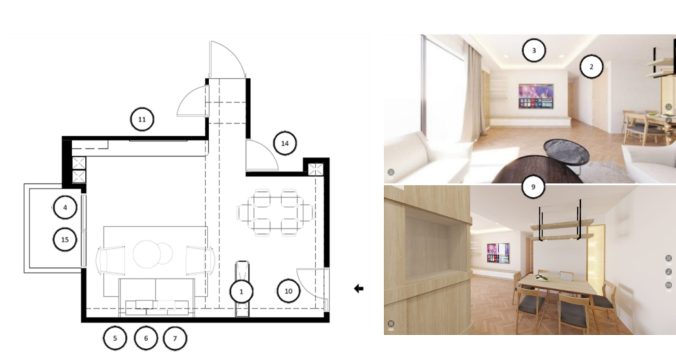
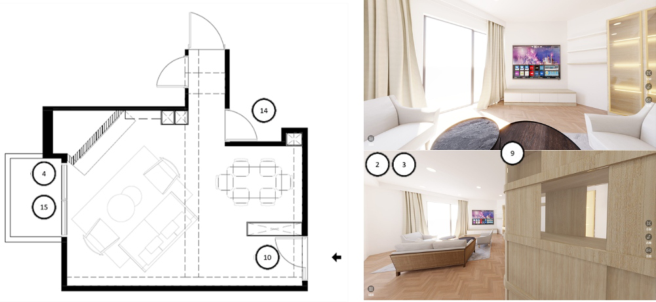
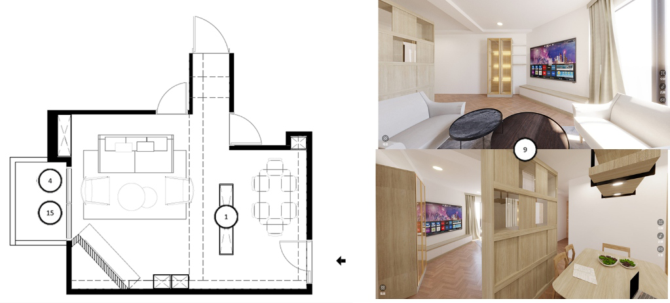
Q1 The living room door does not penetrate the front and back doors, and is provided with a screen or shelter wall Q2 Avoid beams on top of sofas and desks Q3 The ceiling is reasonably high Q4 Bright hall and dark room, good lighting (avoid lighting surface being too small) Q5 In the living room, there is no door behind the sofa Q6 In the living room, there is no corridor behind the sofa Q7 In the living room, the sofa is backed against the wall and wide enough Q8 Sitting on the sofa, you can see the door and see the comings and goings Q9 Use comfortable and bright warm colors in the living room Q10 In the living room, the vestibule is kept to separate the dust area Q11 In the living room, the overall pattern is square and the teratoid area is reduced Q12 In the living room, lower positive or acute angles appearance Q13 In the living room, the sofa is positioned to provide a panoramic view of the living room space Q14 The location of the sofa should be avoiding to face the toilet door Q15 Balcony and windows placed in the living room to help ventilation
METHODS
The experimental process:
1. Variables of interior feng shui: A total of ten experts were invited in this stage to provide advice on feng shui openness, most of whom have more than 10 years of experience in architectural and interior feng shui design. Expert opinions were collected from open responses, we re-organized the above-mentioned opinions into a questionnaire, and selected the following indoor feng shui items table with the Ricker scale. 2. VR interior modeling: The most important 15 variables were selected from the Ricke scale, and the living room model was established accor- ding to the list.according to the above interior feng shui evaluation standard, VR technology is used to construct three virtual living room scenes of A, B and C: A. Rest areas with more factors in line with the afo- rementioned questionnaire (60-80%) B. Half of the factors conform to the rest area of the aforementioned questionnaire (40-60%) C. Fewer factors conform to the rest area of the aforementioned questionnaire (20-40%). 3. A total of 36 subjects were recruited to answer 15 questions of the gene- ral spatial ability test through the test. Those who had three or fewer wrong answers are seen as high scores, and those who got five or more wrong answers are seen as low scores. A total of 24 subjects were invo- lved in the experiment, while those outside this range did not undergo follow-up experiments. The subjects were 12 males and 12 females with an average age of 31.67 years.
Using Virtual Reality to Explore the Effects of Feng Shui on Physiology and Psychology 143
Figure 1: (left) Living room plan of space A (right) VR scene Q1. Q2.Q3.Q4.Q5.Q6.Q7.Q9.Q10.Q11.Q14.Q15, 12 of the 15 items met the requirements, with the rate at 79.92%.Figure 2: (left) Living room plan of Space A (right) VR scene Q2.Q3.Q4.Q10.Q14.Q15, 7 of the 15 items met the requirements, with the rate at 46.62%.Figure 3: (left) Living room plan of Space A (right) VR scene Q1.Q4.Q9.Q15, 4 of the 15 items met the requirements, with the rate at 26.64%.
The experimental design:
1. The experiment was conducted in cross-group mode. Subjects were assi- gned to room A.B.C and room C.B.A in two orders, but they did not know their own order before the experiment. 2. After wearing the HRV heart rate instrument, the measurement was carried out for 6 minutes (the picture would be switched to the porch in the fifth minute), and the pictures in VR glasses were switched simultaneously. Then the experimenter conducted the POMS emotio- nal measuring table for 4 minutes (65 questions in total), and then conducted the semi-structured interview. After a rest of 5–10 minu- tes, the second model was conducted. The total test time was about 60 minutes. 3. If the subject had any uncomfortable reaction during the process, the experiment could be terminated at any time. And the subjects can drink water during their breaks.
RESULT & DISCUSSION Psychological and Semi-Structured Interview Can Be Discussed
After the analysis of the experimental data by ANOVA, three parts of physi- ological, (1) Physiological value
The three rooms were divided into groups in high and low spatial abili- ties, and conducted ANOVA analysis, showing that there were significant differences in HRV heart rate variability and HF parasympathetic feeling under different feng shui conditions: in the space with better feng shui conditions, the physiological feeling was more comfortable and relaxed; The worse the feng shui conditions, the less comfortable the physiolo- gical feeling would be. HF: In the space with poor feng shui conditi- ons, it is easier to get physiological feelings such as anxiety, anger and pressure.
The results of the T-test showed that there was no significant difference in the physiological values of the subjects with high and low abilities in the space of different feng shui conditions (p>0.05).
(2) Psychological evaluation The three rooms were divided into groups in high and low spatial abilities, and conducted ANOVA analysis, showing that there were significant differe- nces in TMD, tension, depression and confusion: in the space with better feng shui conditions, the TMD number is lower, the overall feeling is positive. The worse the feng shui conditions, people tend to feel more nervous, depressed and chaotic.
However, there was no significant difference in the psychological values of those with high or low abilities under different feng shui conditions (p > 0.05).
Using Virtual Reality to Explore the Effects of Feng Shui on Physiology and Psychology 145
H L H L H L
ficance A room B room C room
F P signi-
C
room
AVG
B
room
AVG
A
room
AVG
Table 2. Physiological results in different Feng shui scenarios.
Note*p<; 0.05; **p < 0.01; ***p < 0.001. H. and L. denote “high” and “low” abbreviations, respectively.
HRV: There is a direct correlation between depression and anxiety. The higher the value, the more comfortable and relaxed the physiological response in the environment
LF: Commonly recognized to be sympathetic in origin, low LF is due to fatigue, lack of energy, and depression.
HF: Often thought to be the origin of parasympathetic, low HF can be due to anxiety, high stress, sleep disturbances and other factors.
Table 3. Physiology changes for abilities in the different Feng shui scenarios.
(3) Semi-Structured Interviews After each space is completed, semi-structured interviews are conducted, and the results are as follows:
1. In the part of spatial perception, 96% of the subjects could feel the sequence of experimental conditions in ABC space, and only 4% of the subjects said that there was little difference between B and C, so they further inquired and explained that: Due to the innate topographic limitations of the house and the city where they live, it is difficult to tell the difference between B and C, but it is obvi- ous that A is the most orderly, and the change from B to C have also laid an impact on the physical and psychological values of the subjects. 2. In the part of pattern configuration, all the subjects have positive sta- tements about A, while they have their own ideas and configuration methods about B and C. (EX: Shoe cabinet position, ceiling height, and sofa placement).
As for the degree of recognition of house purchase, all the subjects were more interested in A, B was less interested, and C had received hate or dis- like thoughts. Further inquiry had led to the answer that if adjustments are made to change the feng shui of the space and personal preferences, the subjects will have the idea of purchasing. In the case that the pattern con- figuration can be adjusted: in space A, one subject said that the ceiling was too high and felt insecure and wanted to choose the ceiling of B. In space B, most of the subjects reported too much teratoid space (Q11). In space C, all the subjects reported that there was a door behind the sofa (Q6), a toilet next to the sofa (Q14), exposed ceiling beam and height (Q2.Q3.) and other preceding feng shui variables that they would like to change or adjust.
Using Virtual Reality to Explore the Effects of Feng Shui on Physiology and Psychology 147
H L H L H L
A room AVG B room AVG C room AVG F P significance A room B room C room
Table 4. Psychological evaluation in different Feng shui scenarios.
Note*p<; 0.05; **p < 0.01; ***p < 0.001. H. and L. denote “high” and “low” abbreviations, respectively.
TMD: The total value of the emotion measuring table,it is consisted of stress, frustration, anger, vitality, fatigue and confusion. The formula is T+D+A+F+C−V = total TMD score.
The higher the score, the more negative the mood.
Table 5. Psychology changes for genders in different scenarios.
By collecting HRV data and using POMS measuring tables and other scien- tific methods, this study studied the physiological and psychological effects of different feng shui conditions on living rooms in virtual space. The study found that the living room with different feng shui conditions had no signi- ficant difference in the physiological and psychological feelings of the people with high and low spatial ability. Overall, the HRV data reflected a better feng shui configuration would make the subjects feel more comfortable and relaxed. The POMS table showed that poor feng shui configuration would make subjects feel nervous, depressed and confused. In the semi-structured interview, 20.8% of the subjects responded that they would allocate the living room for their own needs, and would not fully comply with the principles of feng shui. However, the study has found that feng shui does affect physio- logy and psychology, but it is also influenced by preferences and lifestyles. The findings of this study are helpful to understand the relationship betw- een Feng Shui conditions and interior layout and configuration in interior design. Designers can make good use of feng shui conditions to effectively enable residents to obtain good positive emotions and feelings.
REFERENCES
Alexander, C., Ishikawa, S., Silverstein, M., Jacobson, M., Fiksdahl-King, I. & Angel, S. (1977) A pattern language. New York, Oxford University Press. Ball, H.L.(2002) Reasons to bed-share : Why parents sleep with their infants. Journal
of Reproductive and Infant Psychology, Volume 20 No. 4, 207–221. Chen Wang, Wan Thing Hong, Hamzah Abdul-Rahman (2018) Architectural examination on Feng Shui Bedroom’, Open House International, Volume 43 No. 2, 40–48. Michael Y. Mak, S. Thomas Ng (2005), The art and science of Feng Shui—a study
on architects perception, Building and Environment, Volume 40 No. 3, 427–434. Špela Kryžanowski, (2019) A comparative analysis of selected recommendations of the feng shui school of form, Alexander et al.’s pattern language, and findings of environmental psychology, Urbani Izziv, Volume 30 No. 2, 124–134. St. James-Roberts, I. (2008). Infant crying and sleeping: Helping parents to prevent
and manage problems. Primary Care: Clinics in Office Practice, Primary Care: Clinics in Office Practice, Volume 35 No. 3, 547–567. W. T. Honga, Hamzah Abdul-Rahmanb and Chen Wanga, (2016) The application of Form School Feng Shui model in a sleep environment: human preferences and subjective sleep quality evaluation; Architectural Engineering and Design Management, Volume 12 No. 6, 442–459.
Using Virtual Reality to Explore the Effects of Feng Shui on Physiology and Psychology 149
Yi, Ding, Yu, Lu and Hong, Yong (1996) Placement in Ancient China. Shi Jia Zhuang, Hebei Science and Technology Press, Geomancy and the Selection of Architecture [in Chinese]. ZiKai Jin, Yi-Kai Juan. (2021) Is Feng shui a science or superstition? Anew
approach combining the physiological and psychological measurement of indoor environments, Building and Environment, Volume 201.
LISTED IN THE AHFE DIGITAL BOOKSTORE CATALOGUE
Explore the complete digital volume
Affective and Pleasurable Design
Read this individual research paper free through the original publisher, or explore the full digital proceedings book.
ISBN 978-1-958651-47-6
Explore this ISBN in the AHFE Bookstore ↗Listed in the July 2026 bookstore catalogue; search by ISBN to confirm current availability · Digital book purchase optional