Wei Ding, Shanshan Sun (2022). Design Research of Elderly-oriented Cultural and Creative Products Based on User Analysis. In: Human Factors in Aging and Special Needs. AHFE Open Access, vol. 38, pp. 9–15. https://doi.org/10.54941/ahfe1001658
Research and analyse the development trend of cultural and creative product design in the context of active ageing, pay attention to the daily needs and emotional needs of the elderly, and study the characteristics of cultural and creative product design serving elderly users. The principles of elderly-oriented design for cultural and creative products are reasonably applied and appropriately grasped, and the age-appropriate design system is continuously improved. Combine the contents of user experience design science and other contents, propose an elderly-oriented design strategy for cultural and creative products that pays attention to the physical and mental health of the elderly, and provide new ideas for ageing cultural and creative design. The study shows that while developing the consumption market for middle and upper knowledgeable people, cultural and creative products can also turn to age stratification and focus part of their attention on the elderly who have a sense of affinity with traditional culture, contributing to the promotion of the process of active ageing.
The world is ageing. Population ageing is likely to become one of the most important social trends of the 21st century. In the coming decades, the consu- mer market will also make corresponding improvements in elderly-oriented strategies to accommodate the growing number of elderly people. In recent years, many countries have seen a boom in the development of cultural and creative industries. However, for many years, the popularity of cultural and creative products among older people has been low.
TRENDS OF THE TIME OF ELDERLY-ORIENTED INTEGRATION INTO CULTURAL AND CREATIVE PRODUCT DESIGN The Need for Elderly-Oriented Expressions of Cultural and Creative Culture
Nowadays, the development of cultural and creative industries in many coun- tries and cities has gradually become mature. However, there are still many problems. On the one hand, developed countries in Europe and America, which are mature in development, have reached a bottleneck in development
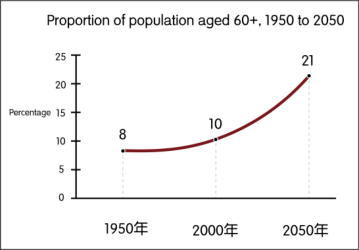
Figure 1: Chart of ageing trends and male/female ratio of elderly population.
and the scale of the consumer market has stabilised. To broaden the consumer market and seek new consumer groups in the future, elderly-oriented cultu- ral and creative product design is the first critical attempt in the reform. On the other hand, in an emerging country with a growing cultural and creative industry, there is still much to change in terms of cultural and creative product design. Firstly, deep-rooted cultural connotations lack integration with pro- duct characteristics. Secondly, the cultural and creative industry lacks macro development strategic planning and overall layout. Thirdly, similar produ- cts are frequent. Fourthly,it is scarce to make personalised improvements in terms of sales channels, sales venues, sales models and sales targets for cultu- ral and creative products. Fifthly, functional attributes of cultural and creative products are insufficient. Sixthly, ...
In the past two years, the boom for cultural and creative products has continued to develop, requiring transformation to maintain the consumer stickiness of existing consumers and develop new consumer groups, while elderly-oriented cultural and creative design is undoubtedly a new outlet for cultural and creative culture in the context of active ageing.
The Value of Elderly-Oriented Universality in Design The increasing ageing is prompting all industries to turn their consumer per- spective to the older age group (Lin Li et al. 2022). Firstly, the current and future trends of global ageing make the future market for older people very broad. Seizing the advantages of the future market is to seize the future of the cultural and creative industry, especially in developing countries where the economic level is lower but the ageing is faster (see Figure 1). Secondly, with the development of the times and education, the proportion of illiteracy among older people is getting smaller, which helps the development of cultu- ral and creative products. Thirdly, the proportion of women is higher in the older age group. Women themselves have more sensual genes than men and are more perceptive in culture and art, providing greater scope for market exploration for cultural and creative products (see Figure 1). Finally, Age- friendly design helps the development of a sense of atmosphere and rhythm in cultural and creative products, creating a meaning which can be universally perceived.
Design Research of Elderly-Oriented Cultural And Creative Products Based on User Analysis 11
The Quest for Age-Friendly Design Among Ageing Consumers of Cultural and Creative Products Over the past 30 years, the phenomenon of the digital divide has become increasingly evident, as has the cultural divide. Today’s rapidly evolving new culture is not easy for older people to accept. There is a need for society as a whole to consider the needs of older people in all industries to meet their cultural and communicative needs and to build bridges between them and modern culture (Shuya Pan and Yueling Qiu, 2021).
INNOVATION OF AGE-FRIENDLY DESIGN TECHNIQUES FOR CULTURAL AND CREATIVE PRODUCT DESIGN Aesthetic Value: Innovation of Visual Images
Physiological Characteristics In terms of cultural and creative Products, aging in humans primarily requires that the functional attributes of products must meet the needs of the elderly, and the safety properties of the functions must be ensured. The eyes are the main channel for perceiving cultural and creative products, and older people have lower levels of vision and colour discrimination. Older people are more likely to recognise warm colours than cold ones. Older people’s brains are less capable of functioning and storing information, and their memories are shorter. So it is most appropriate to focus on specific cultural attributes to optimise and disseminate the product (Langeveld, 2019).
Aesthetic Characteristics Some older people have the psychological phenomenon of following past aesthetic habits and experiences, and are conservative in their colour and shape needs. In addition, some older people have a conformity and are more concerned with the with the perception of others. Some older people also have their own unique views on aesthetics. Therefore, in age-friendly design, it is necessary to give targeted consideration to the diverse aesthetic psychology of the elderly (Hangyi Li et al. 2019).
Older people generally prefer lighter, brighter colours. In terms of form, they are more averse to excessive reductionism. Most elderly people are fond of traditional materials used in ancient China, such as wood, bamboo, porcelain and alabaster, which themselves have a certain cultural colour and undertones (Meiyuan Yun, 2015).
Humanistic Care and Emotional Temperature Older people can easily fall into the psychology of loneliness and depression. Firstly, after retirement, the sense of uselessness rise dramatically. Secondly, older people’s level of physical functioning decreases and they need to recupe- rate in a quiet and stable environment (Chao Zhang and Hao Zhang, 2021). Finally, older people actually want to integrate into the lives of younger peo- ple. As a result, most older people are repeatedly between movement and stillness. The design of cultural and creative products should also take into account the psychological needs of the elderly (Lin Li et al. 2022).
12 Ding and Sun
Appropriation and Grafting of Age-Friendly Elements Age-friendly elements have a sense of calmness and safety. And security pro- perties are necessary design points for all of humanity. The elements are likely to be transplanted to products for other consumer groups, resulting in age-friendly trends.
Spiritual Values: An Interpretation of the National Spirit With the rapid increase in the elderly population, the virtue of respecting and loving the elderly has become even more important. Ageing-friendly pro- ducts are not only a way of protecting and caring for the elderly, but also an inevitable requirement of the whole design process. Through emotional design, we can alleviate the loneliness of the elderly and enrich interpersonal communication, thus quickly crossing the silver hair divide.
Artistic Value: An Enrichment of Cultural and Creative Products Currently, most of the existing cultural and creative product designs do not take into account the specific design of the consumer group. Age-friendly cul- tural and creative product design is an effective tool to open the shackles of cultural and creative products and consumer groups. It leads to a new hiera- rchy of cultural and creative products, expanding the market and increasing its consumption power.
ATTRIBUTES OF AGE-FRIENDLY CULTURAL AND CREATIVE PRODUCT DESIGN BASED ON USERS’ PERCEPTUAL NEEDS Screening Samples of Cultural and Creative Products
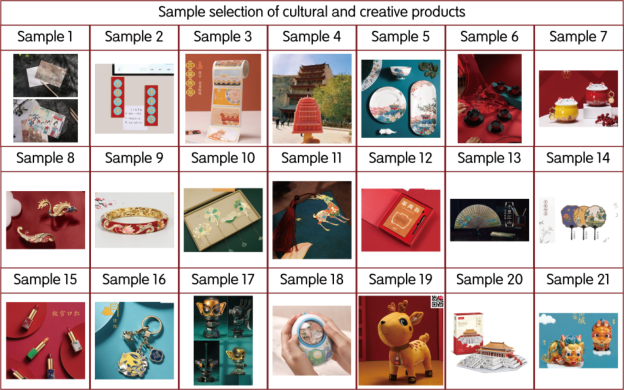
This study researched cultural and creative products, collecting samples according to different functions, categories, brands and materials. After four rounds of screening, from 43 initial samples, 21 samples of cultural and creative products were finally selected (see Figure 2) .
Identifying the Key Attributes of Age-Friendly Cultural and Creative Product Design Researching the perceptions of the attributes of age-friendly cultural and cre- ative products by relevant corporate designers, university students majoring in design, and students from the Xiajin County University for the Aged. KJ method was used to sort out users’ perceptions of the characteristics conve- yed by age-friendly cultural and creative products, so as to summarise and filter out seven attributes: practicality of life, affordability, design and fun, sense of history, quality, aesthetics and brands.
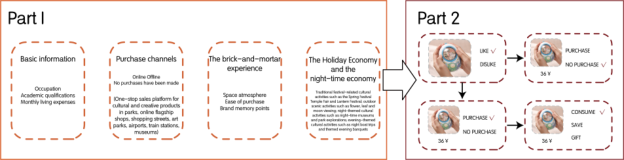
Interview Process and Results At the beginning of the research, considering the education level of the elderly, it was decided to select multiple locations to meet the interview information collection of the elderly with different levels of education, and finally decided on two locations, namely, Xiajin County University for the Aged and Xiajin County People’s Park. The interviews were divided into two main sections
Design Research of Elderly-Oriented Cultural And Creative Products Based on User Analysis 13
Figure 2: Chart of final screened sample.Figure 3: Chart of interview process and content.
(see Figure 3), and the results of these two sections were compared and analy- sed, resulting in a ranking of the importance of the attributes as practicality of life > affordability > quality > design and fun > sense of history > aesth- etic sense > brands. And 47.21 USD is the maximum price threshold. Older people also prefer the experience of brick-and-mortar stores, but they do not exclude online platforms. In the integration of holiday economy and cultu- ral creation, there is more interest in traditional holiday tours, temple fairs and flower and grass appreciation activities. The intergenerational spending power and maximum threshold for intergenerational consumption of older people is somewhat higher.
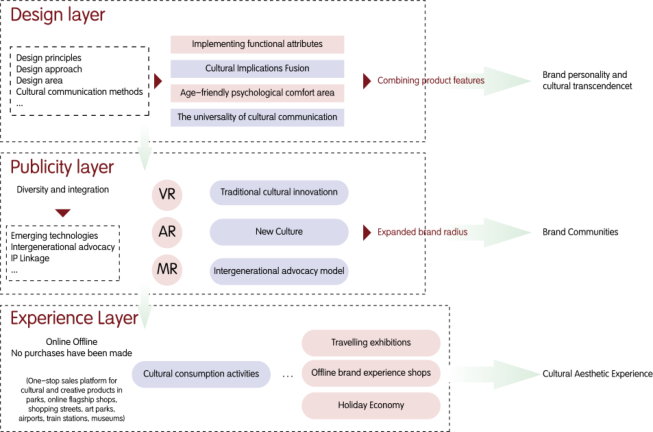
STRATEGIES FOR DESIGNING AGE-FRIENDLY CULTURAL AND CREATIVE PRODUCTS The following three aspects of design, promotion and experience are used to plan for age-friendly cultural and creative product design (see Figure 4) .
Design Layer: Combining Product Features and Seeking Cultural Transcendence Firstly, the product must have functional attributes, and on the basis of function, the product will be culturally integrated through colour, material,
14 Ding and Sun
Figure 4: Chart of design strategies for aging-friendly cultural and creative products.
form and other product elements. Secondly, the functional attributes of cul- tural and creative products are extended to the psychological field. Finally, the readability and universality of the product culture is enhanced, and the cultural flavour is enriched.
Publicity Layer: Integrating Emerging Technologies and the Attempt with Intergenerational Advocacy When it comes to the design and promotion of cultural and creative products, older people are very interested in traditional cultural areas such as theatre and tea art. Traditional and new cultures can give cognitive aids and new experiences for older people with the help of emerging technologies such as VR, AR and MR. Older people are more receptive to new cultures and high consumption thresholds in terms of intergenerational consumption, and we can incorporate intergenerational promotional models in our publicity.
Experience Layer: Combining Experiential Interactions to Create Brand Stickiness Through travelling exhibitions, the regional culture is brought to the older population. Inside the exhibition halls, different decorations or atmospheres are used to create the different charms of different regional cultures, thus creating a brand communication advantage. Offline brand experience shops still have a lot of room for improvement in terms of spatial atmosphere crea- tion, purchasing convenience and brand identity establishment. The holiday economy is the key activity driving a new round of great development in the cultural and creative industries.
Design Research of Elderly-Oriented Cultural And Creative Products Based on User Analysis 15
CONCLUSION
With an ageing society on the horizon, active ageing is a goal that all of our industries should actively respond to. In terms of creative product design we must continue to expand and actively respond to the trends of the times, making new creative product designs that are appropriate for today’s times.
REFERENCES
Chao Zhang, Hao Zhang. (2021) . A Review of Psychological Research on the Elderly in China inRecent 10 Years. The Guide of Science & Education, (07), 188–189+192. Hangyi Li, Zhuo Liu, Cheng Li, et al. (2019) . Research on the development of
cultural consumption services and cultural creation products for the elderly based on user experience. Art Science and Technology, (18). Langeveld, L. Design methodology for elderly: impact of aging and culture. Proceedings of ICoRD 2019. Smart Innovation,Systems and Technologies (SIST 134), 781–791. Lin Li, Fangyu Li, Zheng Liu. (2022) . Research on the Development Trend and
Oriented Design of Intelligent Kitchen under the Background of Active Aging. Packaging Engineering, 43(02) . Meiyuan Yun. (2015). A study of inclusivity in the application of art and design elements. Contention in Literature and Art, (05), 206–208. Shuya Pan, Yueling Qiu. (2021) . Exploring the Formation and Solutions of “Silver
Digital Divide ” —Literature Review and Theoretical Perspective Based on 2001– 2019. Journalism Evolution, (01), 27–33.
LISTED IN THE AHFE DIGITAL BOOKSTORE CATALOGUE
Explore the complete digital volume
Human Factors in Aging and Special Needs
Read this individual research paper free through the original publisher, or explore the full digital proceedings book.
ISBN 978-1-958651-14-8
Explore this ISBN in the AHFE Bookstore ↗Listed in the July 2026 bookstore catalogue; search by ISBN to confirm current availability · Digital book purchase optional