Sijia Wen, Wei Ding (2026). Integrating SOR and TAM Models to Explore Consumer Emotions and Preferences in Fur Fashion Design. In: Affective and Pleasurable Design. AHFE Open Access, vol. 204, pp. 94–104. https://doi.org/10.54941/ahfe1007335
This research examines how design perception, emotional experience, and technology acceptance jointly influence consumer preferences for fur and faux-fur clothing. By proposing an integrated SOR-TAM framework combining the Stimulus-Organism-Response (SOR) model and the Technology Acceptance Model (TAM), the study explains consumer attitudes toward fur clothing. Cultural-Aesthetic Value (CAV), Emotional-Experience Value (EEV), Functional-Applicability Value (FAV), and Innovative-Sensory Value (ISV) are defined as stimulus factors influencing Consumer Satisfaction (CS), which subsequently affects Purchase Intention (PI). Perceived Usefulness (PU) and Perceived Ease of Understanding (PEOU) are supplementary factors that affects Consumer Satisfaction and Purchase Intention. 11 hypotheses were made for further verification. A questionnaire was used to collect data, which were developed based on the SOR-TAM framework. 469 valid responses were analyzed using AMOS 25.0. The results showed that FAV has the strongest effect on consumer satisfaction, followed by CAV and EEV, while ISV has a weaker influence. Consumer satisfaction mediates the relationship between product perception and purchase intention. In addition, PEOU positively affects PU, which further strengthens this relationship. This study extends the SOR-TAM framework to fur clothing research and proposes design strategies integrating function, culture, and experience, offering insights for enhancing consumer satisfaction and supporting the cultural continuity of fur clothing design.
In frigid regions, fashion design serves not only as protection against low temperatures but also as a carrier of aesthetic expression, cultural significance, and emotional experience. In function-oriented clothing categories, consumer evaluation frequently adheres to a hierarchical pattern: Functional performance is prioritized, emotional response exerts a supportive influence, and aesthetic appeal further augments perceived value (Kodzoman et al., 2023). This pattern suggests that different value dimensions do not contribute equally and that their effects vary across product types.
Fur and faux-fur garments represent a distinctly context-dependent apparel category. Their superior thermal performance provides clear functional justification in cold environments. At the same time, their cultural symbolism, Received February 6, 2026; Revised March 27, 2026; Accepted April 16, 2026; Available online July 20, 2026
Integrating SOR and TAM Models to Explore Consumer 95 emotional associations, and social controversies require consumers to balance rational evaluation with emotional judgment. Consequently, fur garments provide an appropriate context for examining how functional, cultural, emotional, and sensory values coexist and interact within a single apparel category, making them suitable for investigating differences in consumer satisfaction and purchase intention.
A review of existing literature reveals several limitations. First, prior apparel studies have frequently emphasized emotional or aesthetic experiences, while offering limited empirical comparisons with function- oriented values. Second, research on fur garments has yet to systematically compared the effects of Cultural-Aesthetic Value (CAV), Emotional- Experiential Value (EEV), Functional-Adaptability Value (FAV), and Innovative-Sensory Value (ISV) on consumer satisfaction. Third, the integrated application of the Stimulus–Organism–Response (SOR) model and the Technology Acceptance Model (TAM) remains limited in the field of fur garment design research.
To address these gaps, this study develops an integrated SOR–TAM framework centered on the pathway of perceived value - consumer satisfaction - purchase intention. The framework evaluates the relative effects of different perceived value dimensions on consumer satisfaction and examines the mediating role of satisfaction between value perception and purchase intention. The study aims to provide a foundation for design decision-making based on consumer satisfaction in the fur garment industry.
THEORETICAL FRAMEWORK Applicability of the SOR Model in Apparel Design Research
The SOR model originates from environmental psychology and explains how external stimuli influence behavioral responses through cognitive and emotional states (Mehrabian, & Russell, 1974). In apparel design research, product-related attributes such as material characteristics, structural design, functional performance, and visual expression are commonly treated as stimulus variables. Consumer satisfaction and emotional experience are defined as organism variables, which then lead to behavioral responses such as purchase intention.
Recent studies have applied the SOR model to apparel consumption to examine how design attributes shape emotional and behavioral responses. However, in function-oriented apparel, the effects of different stimuli are not uniform. Functional stimuli often demonstrate a more direct and stable impact on consumer satisfaction. In contrast, the influence of sensory or formal innovation may be constrained by the context of use and specific product characteristics. While some studies highlight the role of sensory experience, evidence suggests that sensory novelty alone has limited explanatory power when detached from functional use and tactile interaction. These findings indicate the necessity of differentiating between the effects of different value dimensions rather than assuming that all stimuli exert equal influence.
While the SOR model links design stimuli to psychological responses and behavioral outcomes, it provides limited insight into how consumers cognitively interpret and accept design value. The influence of design stimuli on purchase intention is, therefore, not entirely direct but mediated by cognitive judgment. The Technology Acceptance Model (TAM) addresses this limitation by introducing perceived ease of understanding and perceived usefulness as key cognitive variables (Davis, 1989). TAM suggests that when a product is easy to understand, it is more likely to be perceived as useful, which consequently influences satisfaction and purchase intention (Venkatesh and Davis, 2000).
In the context of functional apparel, consumers’ judgments of whether a design is reasonable, useful, and easy to understand play a critical role in transforming perceived value into satisfaction. While SOR explains emotional reactions to design stimuli, TAM clarifies cognitive acceptance, and their integration provides a more robust explanation of how perceived value is transformed into consistent purchase intention.
Research Variables and Value Dimensions Perceived value theory suggests that consumer evaluation is multidimensional rather than unidimensional (Sheth et al., 1991). In apparel research, perceived value is commonly assessed through functional, emotional, and aesthetic dimensions (Sweeney and Soutar, 2001). Prior studies further indicate that aesthetic value in apparel is intrinsically linked to cultural meaning, identity expression, and symbolic interpretation (Crane,2012). Similarly, emotional experience has been shown to influence consumer attitudes during wearing and interaction. In apparel categories centered on thermal protection and performance, functional value often shows a more direct effect on consumer satisfaction (Sheth et al., 1991). Meanwhile, studies on sensory innovation indicate that novelty at the sensory level does not necessarily enhance satisfaction and is often constrained by product type and use context (Schifferstein and Desmet, 2007).
Based on these findings, this study extends the SOR model by incorporating a multidimensional perceived value perspective. Four design value dimensions are proposed as key stimuli influencing consumer satisfaction: Cultural-Aesthetic Value (CAV), Emotional-Experiential Value (EEV), Functional-Adaptability Value (FAV), and Innovative-Sensory Value (ISV). The TAM is integrated to address the cognitive mechanisms of design understanding and acceptance. This combined SOR-TAM framework enables a more comprehensive explanation of how different design values in functional apparel are transformed into purchase intention through consumer satisfaction. The specific definitions of four dimensions are presented in Table 1.
Table 1: Design value dimensional and definitions.
Table available in the original PDF paper.
4 Dimensions Definition
CAV Consumers’ perceived cultural narrativity, symbolic meaning, and aesthetic consistency conveyed through materials, silhouette, color, and cultural context.
EEV Consumers’ perceived emotional pleasure, playfulness, and participatory experience in fur clothing design, including feelings of curiosity, surprise, and interaction.
FAV Consumers’ perceived practicality and adaptability of fur clothing, including detachable structures, seasonal versatility, and warmth– fashion compatibility.
ISV Consumers’ perception of tactile, visual, and structural innovation in fur clothing, including patch work, reconstruction, and mixed-material integration.
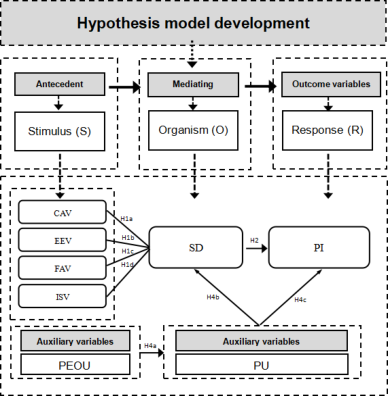
RESEARCH HYPOTHESES Prior studies indicate that emotional and functional-adaptability values are core predictors of consumer satisfaction, particularly in cultural and experience-oriented products where emotional experience often exerts a stronger effect than functional performance (Lee et al., 2011). Research on cultural creative products further shows that cultural symbolism, aesthetic design, and innovative experience positively influence purchase intention (Li et al., 2021). Based on these findings, the hypotheses are proposed: (1) H1a: CAV positively affects CS; (2) H1b: EEV positively affects CS; (3) H1c: FAV positively affects CS; (4) H1d: ISV positively affects CS.
Consumer satisfaction is a direct antecedent of purchase intention (Oliver, 1980). The hypothesis is proposed: (5) H2: CS positively affects PI. Previous research suggests that perceived product value influences purchase intention indirectly through consumer satisfaction (Li and Li, 2022). In general product contexts, both functional value and experiential value influence purchase intention through satisfaction as a key psychological evaluation mechanism (Sabir, 2020). Accordingly: (6) H3a: CS mediates the relationship between CAV and PI; (7) H3b: CS mediates the relationship between EEV and PI; (8) H3c: CS mediates the relationship between FAV and PI; (9) H3d: CS mediates the relationship between ISV and PI.
According to the Technology Acceptance Model, perceived ease of use positively influences perceived usefulness, which in turn affects satisfaction and behavioral intention (Venkatesh and Davis, 2000). The hypotheses are proposed: (10) H4a: PEOU positively affects PU; (11) H4b:PU positively affects CS; (12) H4c: PU positively affects PI.
Figure1: Development of a hypothesized model based on the SOR–TAM framework.
METHOD
Primary data were collected through a structured questionnaire administered via the Wen juan xing platform. A total of 469 valid responses were obtained and then analyzed using SPSS 27.0.
Following the SOR framework, stimulus variables represent consumers’ perceived design value, including CAV, EEV, FAV, and ISV. CAV captures perceptions of visual coherence, cultural symbolism, and aesthetic expression, adapted from (Tsai, 2005). EEV and FAV were adapted from the PERVAL scale (Sweeney and Soutar, 2001), with items adjusted to reflect emotional response, wearing comfort, and adaptability across use contexts. ISV was developed based on sensory stimulus theory within the SOR framework (Mehrabian, &Russell, 1974), focusing on visual texture, tactile experience, and perceived design novelty.
The organism variable CS was measured based on satisfaction theory (Oliver, 1980) and reflects overall evaluation of the balance between aesthetic expression and functional performance. The response variable, PI, was adapted from (Werner, 1991) and measures purchase likelihood, recommendation intention, and continued interest. To capture cognitive acceptance processes, PEOU and PU were adapted from the TAM (Davis, 1989), with items revised to fit the context of fur garment design comprehension and use.
All measurement items were reviewed by scholars in design and consumer research and pretested with a pilot sample. Minor wording adjustments were made to improve clarity. All variables were measured using a five-point Likert scale.
RESULTS
The questionnaire included eight variables and 34 measurement items. Reliability analysis showed that all constructs achieved Cronbach’s Alpha values above 0.80, with corrected item–total correlations exceeding 0.30, indicating good internal consistency. The KMO value was 0.896, and Bartlett’s test of sphericity was significant (χ² = 8508.081, df = 561, p < 0.001), confirming the suitability of the data for factor analysis. Confirmatory factor analysis was conducted using AMOS 25.0 with maximum likelihood estimation. The model demonstrated a good fit to the data (χ²/df = 1.153, RMSEA = 0.018, AGFI = 0.921, CFI = 0.991, IFI = 0.991, GFI = 0.933), indicating that the measurement model was reliable and structurally sound.
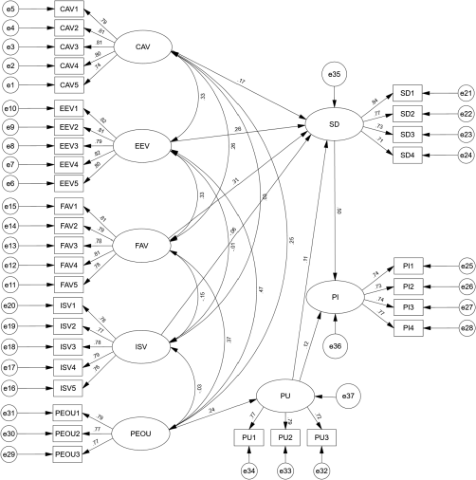
Structural Equation Modeling Structural equation modeling (SEM) was used to test the proposed model of factors influencing consumers’ purchase intention to ward fur clothing. The model was constructed and analyzed using AMOS25.0. Model fit and standardized path coefficients are presented in Figure 2 and Table 2. CAV, EEV, FAV, and ISV were specified as antecedent latent variables. SD served as the central mediating variable, while PI was the outcome variable. PU and PEOU were included as auxiliary variables, and represents the error terms. The results show that all model fit indices met the recommended thresholds, indicating that the structural model demonstrates a good fit with the survey data.
Figure2: Structural equation modeling ( SEM). Note: e1 to e35 represents the question numbers in the questionnaire.Table 2: Model fit.
Table available in the original PDF paper.
Fit Indices Fit Values Recommended Values Model Fit Evaluation Chi-square(χ²) 771.108 - -
Degrees of Freedom(df) 509 - - χ²/df 1.515 <3.0 Supported
Results of Hypothesis Testing Following the reliability and validity assessment, structural equation modeling was applied to test the proposed hypotheses. The hypothesis testing results are summarized in Table 3, where p-values below 0.05 indicate statistical significance (*** means P < 0.01). The results show that CAV, EEV, and FAV have significant positive effects on CS, supporting H1a, H1b, and H1c. In contrast, ISV does not show a significant effect on CS; therefore, H1d is not supported. CS has a significant positive effect on PI, confirming H2. In addition, PEOU significantly influences PU, and PU has significant effects on both CS and PI. As a result, H4a, H4b, and H4c are supported.
Table 3: Hypothesis testing results.
Table available in the original PDF paper.
Path Unstandardi Zed Estimate
Standardized Estimate
SE CR Statistical Significance
Hypothesis Result PEOU--->PU 0.262 0.238 0.063 4.166 *** Supported
PU--->PI 0.096 0.122 0.041 2.35 0.019 Supported The mediation effects were tested using a bootstrap procedure, and the results are reported in Table 4. Both Bias-corrected and Percentile methods were applied based on 5,000 bootstrap samples drawn from
Integrating SOR and TAM Models to Explore Consumer 101 361 original observations, with a 95% confidence level. The results show that the confidence intervals for H3a, H3b, and H3c do not include zero under either method (Bias-corrected: [0.034, 0.149], [0.075, 0.199], [0.096, 0.223]; Percentile: [0.032,0.147], [0.071,0.196], [0.096, 0.223]), indicating significant mediation effects. Therefore, H3a, H3b, and H3c are supported. In contrast, the mediation effect for H3d is not significant. Its indirect effect estimate is−0.031 (SE = 0.027), and the confidence intervals include zero for both the Bias-corrected method [−0.089, 0.017] and the Percentile method [−0.085, 0.019], with p-values of 0.205 and 0.251. Thus, H3d is not supported.
Table 4: Results of mediation role test.
Table available in the original PDF paper.
Path SE Effect Size
Bias-corrected 95%CI Percentile 95% CI Hypothesis Result Lower Upper P Lower Upper P 0.03 0.086 0.034 0.149 0.001 0.032 0.147 0.001 Supported
Design-Oriented Strategies for Fur Garment Innovation Based on Consumer Purchase Intention Based on consumer purchase intention, the following design strategies were proposed for fur garments design. These strategies translate empirical findings into practical design implications and align with the principles of affective design and product experience.
First, perceived Functional-Adaptability Value can be strengthened through modular and detachable structures. Consumers show strong concern for practicality and adaptability. Design solutions such as removable linings, sleeves, or collar components allow garments to respond to different seasons and usage contexts. This flexibility increases usage frequency and extends the functional lifespan of the product. When garments can adapt to multiple situations, consumers are more likely to perceive them as useful and worth their cost, which supports higher satisfaction.
Second, wearing comfort can be improved through material combination and structural optimization. The integration of fur with lightweight fabrics and functional fibers helps reduce overall weight and improves breath ability. At the structural level, ergonomic pattern cutting and optimized construction reduce bulkiness and movement restriction. These adjustments improve daily wearing comfort and support a positive physical experience. As a result, Functional-Adaptability Value is reinforced through direct bodily perception rather than visual appearance alone.
102 Wen and Ding Third, cultural aesthetic value should be communicated in a readable and interpretable way. Cultural elements are more effective when they are easy to recognize and understand. Simplified traditional patterns, reorganized motifs, or symbolic details embedded in local garment structures can improve clarity. Regional cultural symbols may be translated into decorative lines, panel constructions, or controlled color contrasts. This approach allows cultural meaning to be perceived naturally during use,rather than requiring explanation or interpretation, which supports aesthetic appreciation.
Fourth, emotional experience can be enhanced through wearing-context- oriented design. Design decisions may be guided by specific scenarios such as urban commuting, casual daily wear, or special occasions. Differences in silhouette, length, and detail arrangement help consumers associate garments with concrete situations. When users can clearly imagine where and how a garment will be worn, emotional engagement becomes more likely. This sense of contextual relevance supports product identification and increases satisfaction.
Fifth, the intensity of sensory innovation should be carefully controlled to avoid form-driven design. Strong visual stimulation, such as exaggerated shapes or overly complex surface treatments, does not necessarily enhance consumer response. Innovation may instead focus on subtle details, including tactile refinement, concealed functional structures, or restrained craftsmanship variations. This approach ensures that innovation supports the wearing experience and practical perception, rather than serving visual novelty alone.
Finally, product comprehensibility can be improved through virtual design presentation methods. Virtual fitting, three-dimensional visualization, and digital material simulation help consumers understand garment structure, function, and wearing effect more clearly. These tools reduce cognitive effort during evaluation and enhance perceived usefulness. By improving understanding at the presentation stage, virtual techniques contribute to higher satisfaction and stronger purchase intention.
Overall, these strategies emphasize user-centered design and experience- based value creation. By aligning functional performance, emotional perception, and contextual relevance, fur garment design can better respond to consumer expectations and support positive purchase decisions.
DISCUSSION
This study examines fur garment design from the perspective of consumers’ actual perceptions. By integrating the SOR-TAM model, multiple value dimensions in fur garment design were analyzed within a unified analytical structure. The results indicate that Functional-Adaptability Value (FAV) has the strongest influence on consumer satisfaction. Thermal performance, wearing comfort, and adaptability to daily use remain the primary criteria by which consumers evaluate product quality. This finding confirms that functional adaptability continues to be the core basis for consumer judgment in fur garment consumption.
Beyond functional considerations, Cultural-Aesthetic Value (CAV) shows a stable positive effect on consumer satisfaction. This result suggests that the
Integrating SOR and TAM Models to Explore Consumer 103 cultural meaning and aesthetic expression embodied in fur garments play a consistent role in shaping consumers’ overall evaluations. It extends the understanding of cultural value in fur garment design and provides empirical support for how cultural elements can be effectively integrated into products. At the same time, Emotional-Experiential Value (EEV) also has a positive effect on consumer satisfaction, indicating that emotional responses further enrich the evaluation process.
In contrast, Innovative-Sensory Value (ISV) does not show a significant effect on consumer satisfaction. This result provides space for reflection on current design practices that place excessive emphasis on sensory novelty. It suggests that strong visual or sensory stimulation alone does not necessarily enhance consumer evaluation. From an affective design perspective, this finding highlights the importance of avoiding form-driven innovation that is disconnected from actual use and experience.
Further analysis of consumer attitudes and behavioral relationships shows that consumer satisfaction plays a key mediating role across multiple paths. The results demonstrate that satisfaction is not an auxiliary outcome, but a central mechanism linking design-related values to consumer behavior. This empirical evidence clarifies how FAV, CAV, and EEV influence market response through satisfaction, and it provides a clear pathway for understanding how fur garment design affects purchase intention.
The analysis of TAM-related variables further deepens the understanding of the fur garment consumption process. Perceived ease of understanding has a positive effect on perceived usefulness, indicating that consumers’ ability to quickly comprehend product structure, function, and use directly shapes value judgment. Perceived usefulness not only enhances consumer satisfaction but also directly promotes purchase intention. By introducing TAM into the context of fur garment design, this study extends the application of the model beyond digital products and provides support for improving design communication and presentation strategies.
CONCLUSION
This study synthesizes consumer value perception, satisfaction, and purchase intention into a integrated framework. The findings conclude that FAV and CAV are the primary drivers of satisfaction, with EEV providing secondary support, while ISV’s limited influence suggests that designers should avoid excessive reliance on sensory novelty.
Ultimately, the results advocate for a strategic shift from a form-oriented approach toward user-centered perspectives focused on utility, comprehension, and experience. The six proposed design innovation strategies bridge the gap between empirical insights and practical application. These strategies provide clear reference paths for future research and design practice, offering a roadmap for future research in line with the goals of the 14th International Conference on Affective and Pleasurable Design (APD).
REFERENCES
Crane, D. (2012) Fashion and Its Social Agendas University of Chicago Press. Davis FD (1989) Perceived usefulness, perceived ease of use, and user acceptance of information technology. Mis Quarterly 13(3): 319–340. Kodzoman et al., 2023 (n.d.). Lee J-S, Lee C-K and Choi Y (2011) Examining the role of emotional and functional
values in festival evaluation. Journal of Travel Research 50(6): 685–696. Li Y and Li J (2022) The influence of design aesthetics on consumers’ purchase intention toward cultural and creative products: Evidence from the palace museum in China. Frontiers in Psychology 13: 939403. Li Z, Shu S, Shao J, et al. (2021) Innovative or not? The effects of consumer perceived
value on purchase intentions for the palace museum’s cultural and creative products. Sustainability 13(4): 2412. Mehrabian, A., & Russell, J.A. (1974) An Approach to Environmental Psychology. Mo X and Luh D-B (2023) Consumer emotional experience research on online clothing tactile attributes: Evidence from physiological polygraph. Journal of Fashion Marketing and Management: An International Journal 27(4): 648–664. Oliver RL (1980) A cognitive model of the antecedents and consequences of
satisfaction decisions. Journal of Marketing Research 17(4): 460. Sabir SS (2020) Does product design stimulate customer satisfaction? Mediating role of affect. Asia Pacific Journal of Marketing and Logistics 32(6): 1255–1268. Schifferstein HNJ and Desmet PMA (2007) The effects of sensory impairments on
product experience and personal well-being. Ergonomics 50(12): 2026–2048. Sheth JN, Newman BI and Gross BL (1991) Why we buy what we buy: A theory of consumption values. Journal of Business Research 22(2): 159–170. Sweeney JC and Soutar GN (2001) Consumer perceived value: The development of
a multiple item scale. Journal of Retailing 77(2): 203–220. Tsai S (2005) Utility, cultural symbolism and emotion: A comprehensive model of brand purchase value. International Journal of Research in Marketing 22(3): 277–291. Venkatesh V and Davis FD (2000) A theoretical extension of the technology
acceptance model: Four longitudinal field studies. Management Science 46(2): 186–204. Werner RO (1991) Legal development sin marketing. Journal of Marketing 55(3):
60–68.
LISTED IN THE AHFE DIGITAL BOOKSTORE CATALOGUE
Explore the complete digital volume
Affective and Pleasurable Design
Read this individual research paper free through the original publisher, or explore the full digital proceedings book.
ISBN 978-1-964867-80-9
Explore this ISBN in the AHFE Bookstore ↗Listed in the July 2026 bookstore catalogue; search by ISBN to confirm current availability · Digital book purchase optional