Wei Ding, Xinyue Yang (2022). Field Research of Environment Identity System Based on Corporate Identity System. In: Human Factors, Business Management and Society. AHFE Open Access, vol. 56, pp. 64–71. https://doi.org/10.54941/ahfe1002253
Since the 1980s, CIS has been a methodology for many enterprises to improve their brand image. The full English name of CIS is Corporate Identity System. CIS originated from the United States, then developed and perfected in Japan, and began to rise in China in 1980s. Because CIS developed earlier in Taiwan, it has reference value for the correct introduction of CIS in the mainland.On this basis, through continuous practice, MOMA design team put forward a new analysis of CIS. As one of China's top ten design companies and design innovation demonstration enterprises, MOMA design is committed to providing customers with comprehensive solutions from product prototype definition, concept design, structure design, supply chain integration and brand building. MOMA design in the field of nearly 20 years of groping, has been highly recognized by the industry, and the composition of CIS enterprise identification system has a new interpretation, thinks that CIS should include five subsystems: MIS(Mind Identity System), BIS(Behavior Identity System), VIS(Visual Identity System), PIS (Products Identity) System and Environment Identity System (EIS). CIS has been developing for more than 40 years in China, and countless entrepreneurs, practitioners and scholars have gradually perfected their ideas and continuously incorporated some new ideas. However, relatively few literatures can be retrieved in the research of EI. With the advent of sustainable design and digital economy, MOMA design in the long-term project practice that "environment" for the development of corporate image is a state of crisis and opportunity, to a certain extent, has played a key role, and the enterprise's demand for external environment is also growing. In this paper, EI of CIS five elements is taken as the research object and the concept of "field" is adopted. "Field" is derived from Bourdieu's field theory. Field refers to "network or configuration of objective relations between positions". Field, capital and habitus constitute the core of Bourdieu's sociological theory, which embodies the characteristics of relational thinking. Capital is the quantity and type controlled by actors, including economic capital, cultural capital, social capital and symbolic capital. Habitus is an actor's temperament of perception, judgment and action according to different fields. Bourdieu believed that each field should explore the special practical experience of the local nature, and be used as a general field theoretical analysis method, as the construction principle and reproduction mechanism of field practical space. Therefore, relevant scholars extend "CIS field" and "CIS field effect", considering the transverse field mutual relations among the five elements of CIS. This paper takes EI as the sub-field of CIS, considers the mining of EI vertical field to improve the overall integrity of CIS, uses field theory to analyze the macro field, meso field and micro field in environmental identification, subdivides the environment contained in each field, and sort out the overall logical framework of EIS. Then through the case of MOMA design, using capital and habitus as media to verify the cross relations between the three dimensions of the segmentation of environmental identity system. This paper aims to further improve CIS and put forward the importance of EI, hoping to promote the collaborative evolution of enterprises themselves, enterprises with enterprises and enterprises with the outside world in this field, and also hope to bring certain reference value to some practitioners and academic staff.
Every era needs design, designers are closely related to their environment when choosing trend elements and design direction. Now in the 21st century, large and small enterprises will set up design departments or outsourcing pro- fessional design companies, which shows that enterprises need to improve their competitive advantages according to specific environmental identifi- cation, form a unique corporate image, and attract consumers to generate purchasing power. This paper will further explore on the basis of the ori- ginal CIS research, focusing on the concept of EI environment identity, and expounding the multi-dimensional impact of environment on enterprises.
CIS CONCEPT AND NEW ANALYSIS Basic Concepts of CIS
The full English name of CIS is Corporate Identity System. CIS originated from the United States, then developed and perfected in Japan, and began to rise in China in 1980s. As the CIS in Taiwan developed earlier, it has refere- nce value for the correct introduction of CIS in the mainland. Professor Lin
Field Research of Environment Identity System Based on Corporate Identity System 65
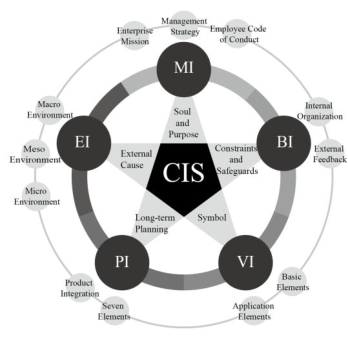
Figure 1: Corporate identity system.
Pansong (1994) from Taiwan has made some contributions to the academic exchanges of CIS across the Taiwan Strait. Professor Li Xingguo (2008) put forward the five elements of CIS as early as 1993. They are MI (Mind Iden- tity), BI (Behavior Identity), VI (Visual Identity), AI (Audio Identity), and EI (Environment Identity). CIS is a method to standardize the corporate image. Most references believe that CIS mainly contains three parts: MI, BI and VI, which are undoubtedly three elements, and there are different views on the remaining two elements. Some scholars (Sun, Q.X., 2010) believe that hea- ring and smell should be the remaining two elements in the five elements of CIS, respectively AI (Audio Identity) and SI (Sense of Smell Identity), accor- ding to the psychological experiment of “Through what channels do humans acquire information?”
A New Interpretation of CIS by MOMA Design In 2002, MOMA industrial product design Co., Ltd. (hereinafter referred to as “MOMA design”), founded in Shanghai, is one of the top ten design companies in China. MOMA design has been groping in this field for nearly 20 years, which has been highly recognized by the industry. There is a new interpretation of the composition of CIS enterprise identification system, and it is believed that CIS should include five subsystems: MIS (Mind Iden- tity System), BIS (Behavior Identity System), VIS (Visual Identity System), PIS (Products Identity System) and EIS (Environment Identity System) (see Figure 1).
Mind identity is the core of CIS. In the long-term development of an enter- prise, it will gradually form a unique cultural value, which is the inner driving force of spirit and will subtly affect the internal employees and external social environment (Wang, Z.G., 2007). MIS mainly includes three parts: enterprise mission, business strategy and employee code of conduct. The establishment of MIS is the first step in building the corporate image. It is the soul and pur- pose of the enterprise , and also paves the way for the formation of the other four elements.
66 Ding and Yang
BIS refers to the process of dynamically presenting MI to the organiza- tion, education, management, and system of an enterprise, and expanding it to market research, product development, service delivery, promotion, social welfare, sponsorship activities, and public relations outside the enterprise (Fan, G.Y., 2003). BIS includes two parts: internal organization and exter- nal feedback. It is the second step to build the corporate image. It is the constraint and guarantee of the enterprise, and also better consolidate the leading position of MI.
VI the development of relatively mature because it is the most easy to transform a part of the enterprise, through the systematic visual symbol design and effective information dissemination, the enterprise culture idea and service rules and regulations and other abstract language design into the infectious concept of visual symbol, and through the multi-dimensional mar- keting channels (Zhao, J.J., 2012). VIS with basic elements and application elements of the two systems. VIS is the third step in building the corporate image. It is the symbol of the enterprise and shows the unique image of the enterprise to the public.
PIS combines enterprise design management, marketing and industrial design related theoretical knowledge, its core is to integrate a variety of pro- ducts into a system image design with the connotation of enterprise culture concept (Yang, D.L., 2012). PIS is the fourth step to build the corporate image. It is a long-term and effective plan for the enterprise, so that the concept of the product gradually becomes popular.
EIS is an identification system that companies use to change public perce- ption and evaluation by creating a favorable environment. MOMA design believes that “environment” plays a key role in the development of corpo- rate image in the long-term project practice, and has organized a framework for EIS. This paper hopes to verify the theory on the basis of practice and elaborate new views on EI.
FIELD STUDY OF EIS Field Concept Analysis
“Field” is derived from Bourdieu’s field theory, which refers to “the network or configuration of objective relations between positions” (Wacquant, L.D., 1998). Field, capital and habitus constitute the core of Bourdieu’s sociologi- cal theory, which embodies the characteristics of relational thinking. Capital is the quantity and type controlled by actors, including economic capital, cultural capital, social capital and symbolic capital. Habitus is an actor’s temperament of perception, judgment and action according to different fields.
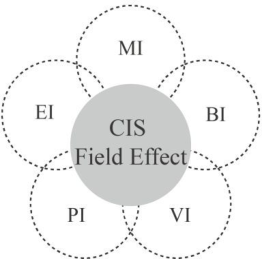
On the basis of this concept, Professor Li Xingguo (2008) proposed “CIS field” and “CIS field effect”, in which “field” is a kind of information field, referring to a specific space, and “field effect”represents the coupling effect of one plus one greater than two formed under the interaction of multiple fields. What Professor Li Xingguo considers is the cross-field relationship among the five elements of CIS (see Figure 2). EI is a sub-field of CIS, considering that the mining of EI vertical field has certain reference value in improving the overall integrity of CIS. MOMA design utilizes field theory, it is helpful to
Field Research of Environment Identity System Based on Corporate Identity System 67
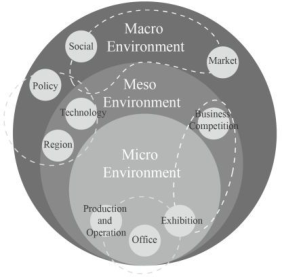
Figure 2: CIS field diagram.Figure 3: EIS field diagram.
analyze the logical structure among macro field, meso field and micro field, which is helpful to sort out the deep vein of EIS (see Figure 3).
Macro Field Concept The connotation of corporate social responsibility is constantly changing, which is affected by the political, economic, legal and social environment. Scholars in different periods have different understandings and views on corporate social responsibility. Nowadays, many scholars believe that envi- ronmental protection is one of the core contents of corporate social respon- sibility. (Li, G.P., Wei, X.X., 2014) The development of enterprises needs to be built on the basis of the changes in the social environment, and only by fully recognizing the trend of changes can we follow the trend in the development tide.
Policies belong to the national system management level, and enterprises will be restricted and affected by policies. For example, in the context of everyone advocating environmental protection, the government has issued a series of environmental policies and encouraged the development and use of new energy vehicles. At this time, new energy vehicle enterprises will face huge development opportunities. Through the development of new energy vehicles, we can save fuel, reduce exhaust emissions, and effectively protect the environment while developing the industry.
68 Ding and Yang
Market environment factors are closely related to the healthy development of enterprises. On the one hand, the market environment is uncertain, and competition intensity and demand uncertainty are two key factors (Guo, H., Shen, R., 2014). On the other hand, enterprises should gain consumers’ atten- tion and purchasing power through marketing. With the rapid development of the Internet, the increase of marketing channels, how to attract more atten- tion in the new market environment becomes more important. (Fu, Z.G., 2016)
Meso Field Concept China’s vast territory, the eastern, central and western regions have obvious differences in development, the regional environment is also very different. In order to achieve the goal of rapid national economic growth, China will implement special opening policies for some regions according to strategic needs, and promote the construction of several special economic zones (such as Shenzhen Special Economic Zone) and new areas (such as Xiongan New Area) successively, which also provide better strategic opportunities for the development of enterprises.
The pattern of commercial competition is changing rapidly, and the development paradigm of enterprises is also different. On the whole, manu- facturing enterprises are divided into four types: OEM- Original Equipment Manufacture, ODM- Original Design Manufacture, OBM- Original Brand Management, and OSM- Original Strategy Management. Different types of enterprises can be derived at different stages of industrial development. Enter- prises need to find their core capabilities in the competition and complete their evolution in the competitive environment.
Technological development often leads to industrial revolution, followed by subversion of the old economic order. As China enters an important period of economic transformation, high-tech enterprises need continuous investment in scientific research to cultivate their independent research and development capabilities (Li, W.Q., Liu, Y., 2017). At the same time, the con- struction of a scientific technology management system, the improvement of platform construction and the cultivation of technical talents can bring higher economic and social value to the enterprise, and become the superior in the commercial competition environment (Tang, Z.X., 2021).
Micro Field Concept In the construction of enterprise working environment, cultural environment will help enterprises to improve the overall competitiveness imperceptibly. A good internal environment of an enterprise can have a huge impact, and the normative behavior of employees in compliance with rules and regulations can improve work efficiency. The rules and standards of the enterprise to restrict employee behavior, so that employees can conduct effective activities in a controllable and reasonable environment, so as to ensure that employees’ behaviors meet the requirements of the healthy development of the company. (You, Y.Y., 2015)
Field Research of Environment Identity System Based on Corporate Identity System 69
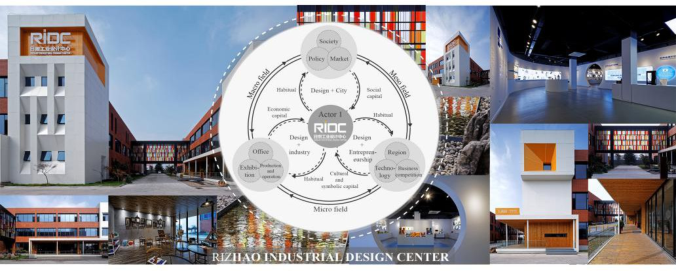
Figure 4: Rizhao industrial design center.
Exhibition space is a place for an enterprise to present its excellent cor- porate image to the public. Through integrated planning of information, publicity guidance and interactive feedback, the exhibition theme can be interpreted (Wang, J.H., 2015). How to reasonably divide the main space and auxiliary space, users can absorb from the organizers want to express the corporate culture content, this is the designer should focus on consideration.
Production and operation environment is the space environment for enter- prises to produce products and provide services. A good environment can effectively convey the spirit of enterprise, improve operational efficiency, and establish an effective communication platform with employees and custo- mers. For industrial enterprises, the consideration of factory environment design is conducive to the spiritual happiness of employees and the impro- vement of work efficiency, and the humanized factory environment is also conducive to the development of enterprises (Guo, L., 2017).
EIS CASE STUDY – A CASE STUDY OF MOMA DESIGN COLLABORATION Shandong Rizhao Industrial Design Center
Rizhao industrial design center (hereinafter referred to as the “center”) depends on the background of urban renewal, Rizhao Korea industrial park update practice, for example, put forward the rational use of urban stock assets to build urban creative synthesis, in order to design power driven indu- stry, business and city three systems common development, show the core values of creativity of regional development. Urban renewal is a concrete manifestation of environmental identification. Through comprehensive con- sideration of macro field, meso field and micro field, a new system with urban development contribution is constructed (see Figure 4).
At the beginning of the renewal, in order to conform to the development concept of Rizhao city, Shandong Province, to retain the traditional features of the city, and to highlight the cultural atmosphere of the center as a lea- dership, research and development and incubation institution. To a certain extent, it satisfies the requirement of building “landmark” proposed by the owner. The renovation of the landscape outside the park and the design of the
70 Ding and Yang
cafe and art gallery inside demonstrate the organic integration of the urban creative system and ecology of the new landmark.
CONCLUSION
In this paper, EI of the five elements of CIS is taken as the research object, and the macro field, meso field and micro field in EI are longitudially analyzed by field theory. The environment contained in each field is subdivided and the overall logical framework of EIS is sorted out. Through the MOMA design case, capital and habitus as the media to verify the intersection between the three dimensions of EIS segments. This paper aims to further improve CIS and put forward the importance of EI, hoping to bring some reference value to some practitioners and academic staff in this field.
REFERENCES
Fan, G.Y., (2003). On behavior identity system in CIS. Journal of Yunnan University of Finance and Economics, 05, 74–75. Fu, Z.G., (2016). Research on marketing Strategy of commercial Enterprises under
Internet environment. Economic Research Guide, 131–132+148. Guo, H., Shen, R., (2014). How to Transform entrepreneurial opportunities into Firm performance – the mediating role of Business model innovation and the moderating role of market environment. Economic Theory and Business Mana- gement, 03, 70–83. Guo, L., (2017). Environmental landscape design for industrial enterprises. Constru-
ction & Design for Project, 12, 9–10. Lin, P.S., (1994). Go Forward Hand in hand to Create a Better Future – a Comparison of CIS development across the Taiwan Straits. Art & Design, 4(04), 6–8. Li, X.G., (2008). Research on innovation of Chinese organization Identifica-
tion System (CIS).2008 China Advertising Association Academic Committee Annual Conference and National Advertising Academic Symposium Proceedings, 335–341. Li, G.P., Wei, X.X., (2014). Connotation, Measurement and Economic Consequences of corporate social Responsibility – A review of research based on foreign corporate social responsibility theories. Accounting Research, 08, 33–40+96. Li, W.Q., Liu, Y., (2017). Technological innovation, corporate social respon-
sibility and firm competitiveness – An empirical analysis based on the data of listed companies. Science of Science and Management of S.& T., 38(01), 154–165. Sun, Q.X., (2010). A new solution of CIS corporate identity system. Art Panorama, 4(02), 114–115. Tang, Z.X., (2021). Discussion on the upgrading path of enterprise technology
management ability. China Plant Engineering, 02, 61–62. Wang, Z.G., (2007). Analysis of the significance of corporate mind identity (MI) in CIS strategy. China Science and Technology Information, 16, 149–150. Wacquant, L.D., (1998). Towards a Reflexive Sociology: A Workshop with Pierre
Bourdieu. Sociological Theory, (07). Wang, J.H., (2020). The application of enterprise culture in commercial display design. Today’s Massmedia, 28(03):34–35.
Field Research of Environment Identity System Based on Corporate Identity System 71
Yang, D.L., (2012). Products identity system (PIS) construction context. Art & Design, 05, 133–134. You, Y.Y., (2015). Explore the potential impact of corporate culture on internal office
environment. Scientific Chinese, 15, 152–153. Zhao, J.J., (2012). On the basic elements and application elements in visual identity (VI) design. Journal of Puyang Vocational and Technical College, 25(05), 98–101.
LISTED IN THE AHFE DIGITAL BOOKSTORE CATALOGUE
Explore the complete digital volume
Human Factors, Business Management and Society
Read this individual research paper free through the original publisher, or explore the full digital proceedings book.
ISBN 978-1-958651-32-2
Explore this ISBN in the AHFE Bookstore ↗Listed in the July 2026 bookstore catalogue; search by ISBN to confirm current availability · Digital book purchase optional