Qian Wu, Wei Ding (2022). Analysis of Visual Information Accessibility Design Requirements for Phubbers in Traffic Scenes. In: Usability and User Experience. AHFE Open Access, vol. 39, pp. 475–481. https://doi.org/10.54941/ahfe1001744
In today's society, "phubbers" are flooding the corners of society. Phubbers are people who nowadays "look down at the screen" whenever and wherever they are, trying to fill up their fragmented time by staring at the screen. The increasing popularity of smartphones has made them an indispensable tool in the lives of phubbers, who rely on them to bring them a variety of needs to meet. The news of traffic accidents caused by immersion in cell phones is common. This is no longer an individual encounter, but a group rule, and phubbers do have visual information barriers in traffic scenarios. In addition, prolonged daily exposure to cell phones and over-stimulation of the brain can make concentration incomplete. The limit of forward flexion (the state where the chin touches the sternum) can only be 45° when the head is bowed. If the forward flexion reaches 30°, it can affect the cervical spine. If the cervical spine is in an abnormal stable state of extreme forward flexion for a long time, it can cause damage to the cervical spine. Therefore, it is of practical significance to propose corresponding design strategies for the safety hazards and visual information barriers that exist in the traffic scenes of the phubbers.This thesis adopts a combination of qualitative and quantitative research methods, firstly, based on the AEIOU analysis model and user behavior process, a specific analysis model is constructed for the behavior of phubbers crossing the road. It can make a more comprehensive analysis of the whole process of each contact point and crowd state and behavior in the scene, and the corresponding functional modules are derived. The functional modules mainly include the behavioral level, the physical and spiritual social level, and the environmental level. Among them, the behavioral level includes intersection reminder module, auditory reminder, remaining time reminder, and visual reminder within the line of sight of head down playing cell phone; the material and spiritual social level includes anxiety relief module, relief of unstable emotions, and personal safety module; the environmental level includes safe waiting area division, and obvious dynamic change stimulation. The Kano model was further applied to prioritize the functional modules, and the statistical analysis was used to determine the user-perceived importance and ranking of the listed functions, which finally led to the functional requirements of barrier-free crossing for phubbers. It provides a reference for future research on visual information accessibility design for phubbers and the development of accessible design for public transportation.
Phubbers refer to those who look down at the screen whenever and whe- rever they want to fill up their spare time. The word Phubbing is coined by Australia’s McCann and Macquarie dictionary to describe people who ignore their friends or family by looking down at their mobile phones (Yan and Wang, 2017). Looking down is a common characteristic of phubbers, who check their phones or pull out tablets or laptops to surf the Web, play games or watch videos. The phubbers are mainly seen on subways, buses and even streets in cities. Fast pace of life, long commuting routes in big cities, fragmentation of private time, eating alone, more opportunities to travel, entertainment through digital terminals, the popularity of social networks, information anxiety, lack of emotion, lack of spare time, etc., are the main reasons for Chinese people’s obsession with mobile phones (Jiang, 2015). The news of traffic accidents caused by immersion in cell phones is common. This is no longer an individual encounter, but a group rule, and phubbers do have visual information barriers in traffic scenarios. And information accessibility means that anyone can access information and use information equally, easily
and without barriers in any situation. Visual information accessibility design is a new concept in the field of accessibility design, building on the concepts of accessible design and universal design. The development of social welfare has made the design of public facilities more and more perfect, and accessi- ble design is applied to various public facilities including traffic lights and so on. Therefore, it is of practical significance to propose corresponding design strategies for the safety hazards and visual information barriers that exist in the traffic scenes of the phubbers.
VISUAL INFORMATION ACCESSIBILITY DESIGN Visual Information Accessibility
Information accessibility means that anyone (whether able-bodied or disa- bled, young or old) can access information and make use of it equally, easily and without barriers in all circumstances. Visual information accessibility design is a new concept in the field of accessible design (Zhang, 2007). The scope of application is as large as the signage indication information of road traffic, as small as the signs of public telephones and toilets, from map boards to elevator operation instructions, we are always getting all kinds of information. The core of the research lies in how to make the informa- tion can be communicated more effectively and without obstacles. According to statistics, 83% of human information is received visually, which shows that a good form of information expression is the basis of effective infor- mation dissemination. Visual information accessibility design is based on the concept of accessible design and universal design, and is a supplement and deepening of traditional accessibility design. It integrates the knowledge of different disciplines such as traditional architectural environment design, visual communication design, modeling design, multimedia design, as well as ergonomics, symbolic semantics and psychology.
Barriers Encountered by Phubbers in Traffic Scenarios Phubbers in traffic scenes face potential security threats and have visual infor- mation barriers. Prolonged exposure to television and computers every day and over-stimulation of the brain can make concentration difficult. When we lower our head, the limit of forward flexion (the state where the chin touches the sternum) can only be 45°. If the amplitude of forward flexion reaches 30°, it can affect the cervical spine. If the cervical spine is in an abnormal stable state of extreme forward flexion for a long time, it will cause damage to the cervical spine, and this harm is dozens of times higher than looking at the computer. Phubbers have been bowing their heads to play with mobile phones, and their attention is attracted by mobile phones, which leads to the decline of observation and control of the surrounding environment, and many potential safety hazards will occur. The phenomenon of falling into the pit due to bending head to play mobile phone, traffic accidents caused by immersion in mobile phone, eyesight, cervical vertebra and other diseases caused by long-term dependence on mobile phone warns us that excessive reliance on mobile phone has brought great influence on our body and life.
Analysis of Visual Information Accessibility Design Requirements for Phubbers 477
AEIOU ANALYSIS OF PHUBBERS CROSSING THE ROAD AEIOU Basic Model Introduction
AEIOU is an organizational framework for classifying activities, environ- ments, interactions, objects, and users, introducing researchers to observe, record, and edit the resulting information (Martin and Hanington, 2013). It involves the most comprehensive and fundamental elements, because where- ver there are events there will be people, environments, things, activities, and interactions with the environment, and this design analysis method allows for better integration for each target activity and the various elements it encom- passes. Many common problems are likely to be difficult to detect when the activities are fragmented, but when all the activities included in an event are brought together, common issues arise and even hidden factors associated with each issue become apparent (Wang, 2016).
The specific meaning of AEIOU is as follows: Activities are a series of goal- oriented behaviors. Environments include all scenarios in which activities take place. Interactions, the cornerstone of activities, are mutual commu- nications between people or between people and objects. Objects are the basic components of the environment and are sometimes the key elements in complex or unconscious use, whose function, meaning and overall con- text may change. Users are the people whose behavior, preferences and needs are observed. Each element of the framework does not stand alone, but is closely linked to other elements. The AEIOU framework can be applied in any ethnographic or observational approach to provide guidance on familiar collection techniques such as notes, photographs, and interviews. It can be used to record findings in separate activity, environment, interaction, object, and user worksheets before aggregating them into a larger group worksheet to synthesize the information and derive design ideas.
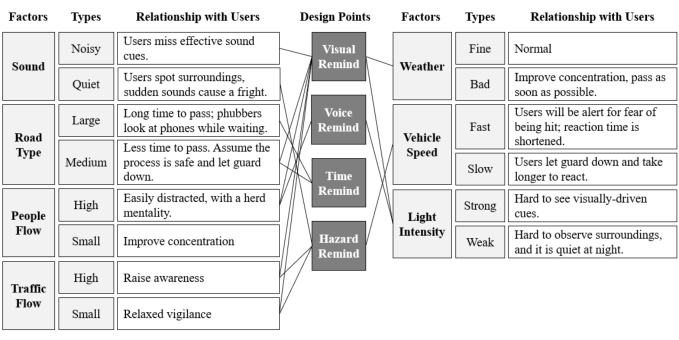
Analysis of the Environmental Characteristics of the Phubbers Crossing the Road The environmental factors are classified as sound, road type, traffic flow, weather, vehicle speed and light intensity, etc. Based on this classification, the relationship between environmental factors and users and design is discussed, and the four main needs of users are visual reminders, voice reminders, time reminders, and advance detection of vehicles and alarm reminders. Based on the four main needs, a connection between environmental factors and user needs is performed, as shown in Figure 1, which shows that visual reminders are in greatest demand.
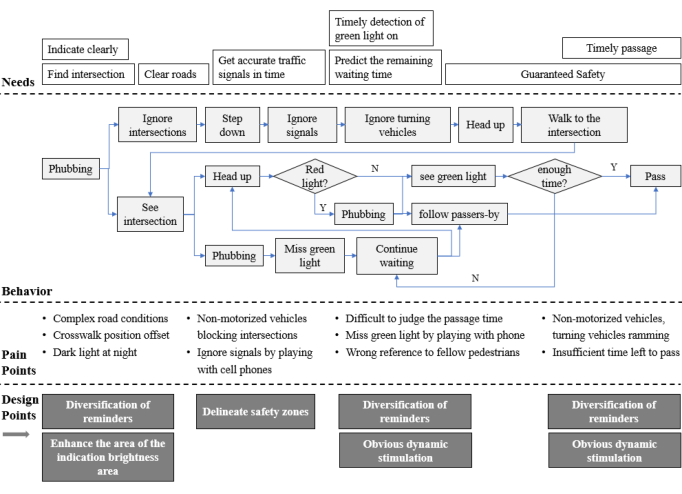
Analysis of Road Crossing Behavior of the Phubbers The road crossing behavior of phubbers is divided into three periods: prepa- ring to cross the road, crossing the road and ending the road crossing. Based on this, the user behavior is divided and the corresponding design points are obtained. Through the summary of the research and analysis, it is summa- rized as a user journey diagram of user behavior and pain point needs, see Figure 2, and through the decomposition of their actions and the analysis of pain point goals, the corresponding functional modules are derived. The
478 Wu and Ding
Figure 1: The connection between environmental factors and user needs.Figure 2: User journey map.
functional modules mainly include behavioral level, material spiritual level, and environmental level. The behavioral level includes intersection prom- pting module, voice reminder, remaining time reminder and visual reminder in the line of sight of the head down playing cell phone. Material spiri- tual level includes anxiety relief module and ensuring personal safety module (such as the product’s game interactive function, ground countdown device, a variety of sensory prompting methods, advance detection of vehicles, alerts). Environmental level includes safe waiting area division and obvious dynamic change stimulation.
Analysis of Visual Information Accessibility Design Requirements for Phubbers 479
Table 1. Statistics and analysis of respondents’ recognition of the listed functions.
Table available in the original PDF paper.
480 Wu and Ding
DEMANDS SEQUENCING OF PHUBBERS CROSSING THE ROAD Kano Model Introduction
Noriaki Kano, Tokyo Institute of Technology, Japan, proposed the Kano model in 1984, which can classify and prioritize user needs and show the nonlinear relationship between product functions and user satisfaction based on the analysis of the impact of user needs on user satisfaction. According to this relationship, product functions can be classified into five categories: must-be functions (M), one-dimensional functions (O), attractive functions (A), reverse functions (R), and indifferent functions (I) (Zhao et al., 2019). Must-be function means that if it is not available, user satisfaction will be significantly reduced, but no matter how it is improved, satisfaction will be within a certain range; one-dimensional function means that if the function is provided, then customer satisfaction will increase, and if the function is not provided, then customer satisfaction will decrease; attractive function means that the function surprises the user, and if the function is not provided, it will not reduce user satisfaction, and once it is provided, user satisfaction will increase significantly; indifferent function means that whether this fea- ture is provided or not, user satisfaction will not change, and users do not care about this feature at all; reverse type function means that users do not have this demand, and user satisfaction will decrease after it is provided. In order to evaluate the above features effectively, Kano model gives the eva- luation criteria. The criterion requires a questionnaire survey of users, and each functional requirement indicator consists of 2 questions for and against, in order to understand users’ attitude and demand for a certain functional feature of the product.
Survey Data and Analysis of Road Crossing Demand of Phubbers Phubbers ignore their own safety and cause problems to other pedestrians and vehicles. In order to change this phenomenon, this paper analyzes and finds some new functions that can be implemented in the crossing scenario. Based on the functional modules described in the previous section, this paper lists six functions: intersection reminder, enhanced signal reminder, enhanced count- down reminder, other ways to reschedule waiting time, hazard reminder, and safe waiting area. Therefore, the questionnaire design mainly considers the following two panels: The first panel considers the basic personal informa- tion of the respondents, which mainly includes whether the respondents have ever used cell phones while crossing the road and whether they have seen pedestrians who play with cell phones while crossing the road, in addition to the conventional contents such as age and gender; The second panel mainly considers the respondents’ acceptance of the six functional modules, so that the research and product design direction of barrier-free design for phubbers crossing the road can be clearer. In this paper, 12 possible functional designs are listed from 6 aspects, and for the purpose of analysis, 5 possibilities are designed for respondents to choose according to the Kano model, i.e. “1. like “, “2. must be”, “3. neutral”, “4. live with”, “5. dislike”. In response to the questionnaire designed above, the number of valid questionnaires returned was 20. 80% of the people had experienced using cell phones while crossing
Analysis of Visual Information Accessibility Design Requirements for Phubbers 481
the road, and only 20% rarely saw pedestrians playing with their cell phones while crossing the road.
According to the KANO model, we first satisfy “intersection reminder” and “safe waiting area” with the largest percentage value of the must-be attributes; remove “other ways to reschedule waiting time” with the largest percentage value of the reverse attributes; second satisfy “safe waiting area” with the largest percentage value of the one-dimensional attributes; finally satisfy “enhanced signal reminder” and “enhanced countdown reminder” with the largest percentage value of the charm attributes; and “safe wai- ting area” and “hazard reminder” with the largest percentage value of the indifferent attributes.
CONCLUSION
In view of the current situation of the phubbers crossing the road, this paper determines the functional modules of the design of barrier-free road crossing for the phubbers based on AEIOU analysis model, and designs a questionnaire for the functional modules according to Kano model. Through statistical analysis, the importance and ranking of the six functions listed by users are determined, which provides a reference for future research and development of barrier-free design of public transportation.
REFERENCES
Jiang, F. (2015). Research on the psychological causes and countermeasures of the phenomenon of “phubber”. Jiangsu Education Research, (27), 39–42. Jia, M. (2019). Research on Neck Fatigue Evaluation and Persuasion Design for
Phubber in the Subway. Martin, B., and Hanington, B. (2013). Universal Methods of Design. Beijing: Central Compilation & Translation Press. Wang, L., (2016). Commuter Scene Analysis Based on AEIOU Model. Design, (23),
45–47. Yan, L.F., and Wang, J.C. (2017). Current Situation and Reason Analysis of Phubbing’s Mobile Phone Addiction. Journal of North China University of Science and Technology (Social Science Edition), 17(01), 16–21. Zhang, M.M. (2007). Obstacle Free Design of Visual Information. ZHUANGSHI,
(09), 66–67. Zhao, Y.T., Gu, D.X., Zhao, S.P., and Liang, C.Y. (2019). Study on functional requirements of pension service robot based on Kano model. Journal of Hefei University of Technology (Natural Science), 42(10), 1419–1423.
LISTED IN THE AHFE DIGITAL BOOKSTORE CATALOGUE
Explore the complete digital volume
Usability and User Experience
Read this individual research paper free through the original publisher, or explore the full digital proceedings book.
ISBN 978-1-958651-15-5
Explore this ISBN in the AHFE Bookstore ↗Listed in the July 2026 bookstore catalogue; search by ISBN to confirm current availability · Digital book purchase optional