Mohsen Zare, Antoine Varret, Nicolas Bert, Hugues Baume, Thierry Rouxel (2022). Design of Painting Workstation for Disabled People. In: Human Factors in Aging and Special Needs. AHFE Open Access, vol. 38, pp. 107–117. https://doi.org/10.54941/ahfe1001670
Many people with disabilities, especially those with physical disabilities, could work, draw or produce art. However, very few workstations and tools are developed to meet their needs and conditions. The objective of this study is to evaluate the needs of an artist with a disability for an ergonomic workstation and to propose a prototype that increases the comfort and capabilities of people with physical disabilities to perform their tasks. First, we analyzed the tasks/activities, postures, and needs of an artist with a high level of disability while performing his drawing tasks in a real-life situation. Second, we simulated an art studio with the participation of six non-artist subjects with motor and mental disabilities to evaluate the user's experience and difficulties when painting in a similar real situation. Based on these studies, we proposed a specification for the design and prototyping of a painting workstation adapted for people with disabilities.Our analysis showed that very few workstations are adapted for people with disabilities and they must work on the floor with awkward postures, insufficient lighting and limited space. They have to make excessive efforts to perform most of their activities because the tools and workstations do not meet their needs. Based on the specifications extracted from our study, we propose a new design of painting workstation dedicated to disabled people to improve their comfort and performance.
People with disabilities (PWD) have less opportunity to choose their work facilities than the general population. Having desks, workstations and tools adapted to their needs and limitations are the main problems of many PWDs (Aleksandra & Królikowski, 2018). While many of them could perform pro- fessional activities and even create artwork such as painting, they struggle to find suitable equipment such as an adjustable workbench to carry out their activities in a comfortable situation. This form of exclusion that PWDs face every day affects all areas of their lives, including work, health, trai- ning, social participation and leisure (Crow, 2010). This lack of adapted equipment either prevents PWDs from carrying out their professional/daily activities or works in an uncomfortable situation, for example by working on the floor.
One explanation for the lack of disability-friendly products and assistive equipment could be the payback, since not many companies are investing in such products due to the small market. It may be within the purview of aca- demics to investigate customized design workstations and tools to facilitate the inclusion of PWDs in the workplace by ergonomically design products adapted to their needs (Martins & Cabral, 2012).
The design of work facilities and tools adapted to disabled users requires the involvement of all their functional, social and emotional dimensions in the design and a better understanding of the disability situation (Barcenilla & Bastien, 2009; Charrier, Bazzaro, & Sagot, 2014). User-centered approaches could be used for better accommodation of PWDs as it contributes to the usability of the product with effectiveness, efficiency and satisfaction, in a specific context of use (Brangier & Barcenilla, 2003). The User Centered Design (UCD) methodology, defined by the ISO 9241-210 standard, proposes technical points allowing: knowledge of the end-users (tasks, environments), active participation of the users (needs and requirements), an appropriate distribution of functions between the users and the technology, an iterative approach to design and the intervention of a multidisciplinary team.
In this study the UCD will be the core of our approach to develop a work- station adapted to PWDs. The purpose is to evaluate the needs of a disabled artist for an ergonomic workstation and to propose prototypes that increase the comfort and capabilities of people with physical impairments or reduced mobility to perform their tasks/activities.
METHODOLOGY
Two phases of study were carried out: the first phase consisted of analyzing the activities of PWDs while painting and obtaining the necessary specificati- ons to design and develop a painting table adapted to their limitations, then the second phase consisted of developing the new design of the painting table for PWDs.
Ergonomics Analysis of Painting Activity The ergonomic approach was implemented in order to design an ergono- mic painting workbench. First, an analysis of the need was carried out for one disabled artist who paint on the floor. The existing equipment and tools used in the painting activity were reviewed. Summary charts and a benchmark were created to show the hardware resources available today for painters. A user profile was created in order to determine precisely the physi- cal, cognitive, psychological and emotional characteristics of the painter with disabilities. This first step allowed to match the existing means (workbenches, tools, paint) with the artist’s needs.
The second phase involved an ergonomic analysis. The disabled painter (a tetraplegia due to problem during childbirth) was directly observed on the field and an analysis of his activity was carried out. A diagram was constru- cted to precisely determine the different stages of his activity and the materials used. The user’s conditions were identified and recorded using a workplace
Design of Painting Work-station for Disabled People 109
checklist. Finally, the Kinovea software allowed to measure the angles of the postures engaged by the artist during the painting activity.
From the whole of these data, a technical specification was established to specify all the functions expected during the use of an adjusted painting work- bench for PWDs. We wanted to explore this finding further by organizing a series of creativity and design thinking workshops to analyze the experiences of people with disabilities.
Design Thinking We also conducted some creativity sessions in order to better define the needs of the disabled users. Two creativity sessions were conducted with people with physical and mental disabilities, followed by a concluding session with experts in ergonomics and design. During the creativity sessions with PWDs, the assistants also took part in the reflection because they are constantly working with the target users and are therefore familiar with the problems they may encounter.
Two human factors engineers conducted the creativity sessions. A set of materials was needed: observation equipment including a camera and a tri- pod, a visual display of all the information collected during the ergonomic analysis with a summary of workbenches, tools, paint cans available on the market, the profile of the disabled artist studied and a video of his activity during the realization of the painting, as well as all the materials needed for the development of the idea including cardboard, post-it notes and A3 sheets.
The first session was conducted with three motor-impaired people and three assistants and the second session took place with three mentally handi- capped people and their 3 assistants. Each creativity session was divided into 5 steps: the first step consisted in introducing the leaders of workshop, the general topic of the session as well as the principles of a creativity session; the second step allowed the participants to introduce themselves and present their motivation to participate; the third step was to detail the project on the basis of the information obtained from ergonomics analysis phase particu- larly the video of the painting activity of reference disabled artist; the fourth step was devoted to creativity, the participants tested different positions (hei- ght and inclination) of a cardboard workbench, various choices of painting tools and painting containers; Finally, an assessment of the work was carried out and the needs, limitations and idea raised were reviewed during the fifth step.
A final creativity session was conducted by the two leaders of the above- mentioned sessions, an ergonomics expert and an engineering/ergonomics specialist, to discuss further the creative work done in previous sessions by PWDs and to define the specifications of painting table adapted to PWDs.
Design of Table The design and development of the table was made by a senior mechanical engineer in a team with 5 trainees on mechanical engineering and design. The project is planned on 12 weeks and the following steps were defined:
Technical note: In this step, we developed a general architecture drawing (main volumes, shapes, dimensions), and kinematics (range of motion) based on predetermined specifications and technical principles. A generic (simpli- fied) computer-aided design (CAD) model was developed to have a first ove- rview of general external shapes and motions. According to this preliminary study of the system, the following specifications were determined:
definition of the load cases corresponding to the use cases (usual or extreme)
a solid mechanical analysis (static or dynamic) to identify loads on structural parts and connections
dimensioning of the connecting parts (shafts size, bearings, gears, screws, belt drive…) Structural parts sizing: In this step, we used finite element analysis software. The approach was carried out through the following aspects:
Bibliography of similar parts: analysis of shapes, manufacturing processes and relative limits.
Topological optimization of the generic part with the different predeter- mined load cases.
Drawing of the synthesized part from the previous results including the fabrication restrictions of the selected processes. The CAD model develo- ped is parametric (geometric parameters identified as influencing factors on the strength of the part).
Parametric study of the part, based on an experimental design cou- pled with a finite element analysis, in order to improve the mechanical performance of the part.
Detailed design: This step consists in finalizing the complete CAD model of the product with all its details: connections with all the components deter- mined in step 1 (shafts with stops, bearings, gears...), additional functions, sealing, lubrication, disassembly solutions.
Drawing sets: In this step, all the information necessary for the complete definition of the product is elaborated: Bill of Materials (BOM), resolution of the functional dimensioning problems, technical drawing of the structu- ral parts including the dimension, the functional measurements, the surface condition, the adjustments, the geometrical specifications
RESULTS
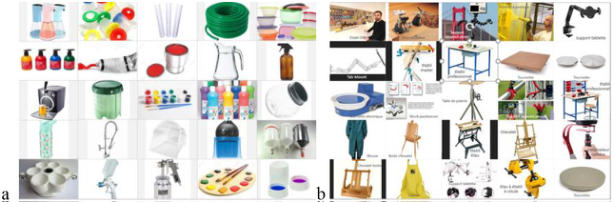
Ergonomics Analysis of Painting Activity Need analysis and benchmarking: Needs analysis was showed the design issues related to the target artist’s painting activity. Trend boards were cre- ated to identify elements of shapes, textures or colors that was used for the developing the idea in the creativity sessions (Figure 1a).
The existing equipment (workbench, tools, materials) on the market was determined using these trend boards. In addition to the standard painting tools (palette, brushes), a multitude of painting possibilities are available:
Design of Painting Work-station for Disabled People 111
Figure 1: a) Trend boards showing the elements of shapes, textures or color. b) Trend boards showing benchmark to specify technical, ergonomic and economic characteristics.
spraying, crushing, projecting, etc. These trend boards were presented during the creativity sessions to the participants so that they could discover all the possibilities available in the painting activity.
A benchmark was also carried out together with the trend boards (Figure 1b). This benchmark helped to specify some features such as tech- nical, ergonomic and economic characteristics to refine the list of existing equipment. These results showed that few tools and equipment adapted to PWDs are available in the market.
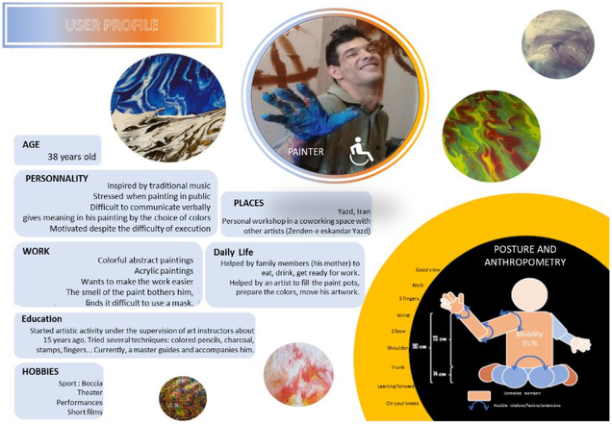
Users profile: Very few disabled subjects with painting ability were avai- lable to participate in our study. We focused on one severely disabled artist and tried to specify his needs and develop the specifications for a disability- friendly workbench. It is a 38 years old man who communicates through his paintings to compensate for the difficulty of oral communication. He is a tetraplegia with more than 70% motor disability. The artist works only with his right arm and hand. Only 3 motor fingers allow him to interact with the painting material (Figure 2).
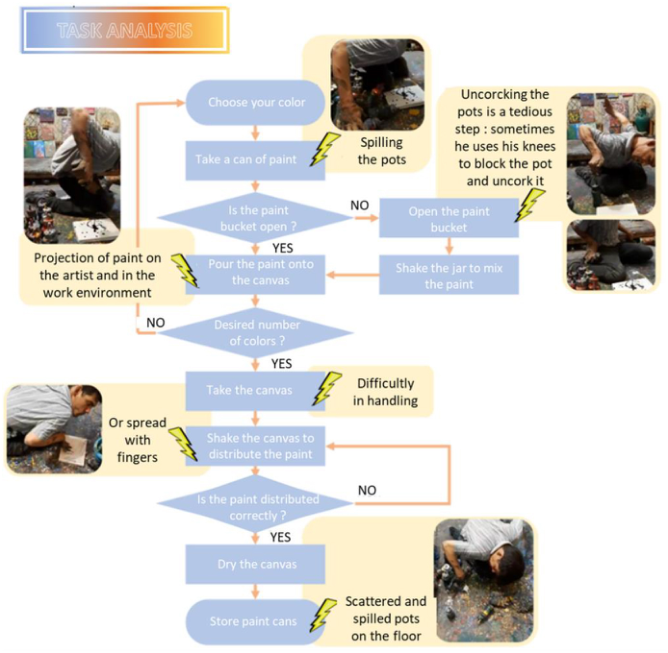
Activity analysis: The artist paints on his knees, completely bent over, tou- ching the ground. His dedicated studio is entirely stained with paint. Analysis of his activity has revealed the challenges he faces: From the beginning of his activity, some paint cans are spilled when he picks them up. The process of opening the cans is difficult, he sometimes must use his knee to block the can in order to open it. It is also a time-consuming action, taking up nearly 60% of the total time of the activity analyzed. When spraying on the canvas, the paint can spill heavily on the floor or on the artist. The subject faces difficulties to take the canvas to spread the paint or to spread the paint with his fingers or with his tools. He sometimes has to repeat the operation several times, or even start a new painting if the result does not meet his expectations. Storage of materials is also complicated because paint cans are often scattered and spilled on the floor (Figure 3). The work layout is not adapted to the artist. The current environment is insufficient to provide a well-organized space, with materials grouped together and well indicated. The future concept will have to allow the artist to organize his workspace as much as possible and to adapt to his characteristics.
Functional specification: A set of functional specifications was drawn up following the analysis of the activity to determine the specifications, the
Figure 2: Specification of artist under study.
required functions and the restrictions of the future workbench. The princi- pal functions were facilitate the use of painting equipment by the user; ensure the user’s safety; provide the user with good visibility; enable the user to listen to music. Some restriction functions have also been determined. For exam- ple, the function “resist to different environments”: the structure must be able to resist painting and occasional contact with water. The materials and assembly parts selected must resist chemical products contained in the acry- lic paint, the commands must be waterproof, and the electrical equipment isolated to avoid contact with water. This knowledge helps to organize the creativity sessions.
Design Thinking Creativity session with motor disabled people: In the first creativity session, three people with motor disabilities and three assistants participated. The par- ticipants tested different workbench positions, different types of paint cans and various painting tools. Three heights were tested for the positioning of the workbench: 99 cm (for a standing position), 73 cm and 68 cm (for sitting positions). The tilt of the workbench was therefore modified according to the height tested. The results suggest that the height adjustment must be designed with a significant range because people with disabilities are required to paint while standing or sitting on the wheelchair or even directly on the ground such as the target artist of this study. This adjustment was the most reque- sted by the participants while the tilt of the canvas holder was less sought after by the participants. In addition, the depth of the workbench has been highlighted: although users want a large workspace, they do not prefer a too deep workbench because they struggle to reach the objects at the edge of the
Design of Painting Work-station for Disabled People 113
Figure 3: Artist activity analysis diagram.
workbench. A workbench that is too deep will pose challenges for storing paints and other tools.
In general, participants with disabilities preferred to work and operate within a close reach area. One participant noted that it would be essential to have edges that prevent falling off the material during usage.
Regarding paint stocking, all paint cans that might spill unintentionally were excluded. Some participants with visual-spatial impairments preferred to label the paint to avoid mistakes in color. Several options for using and handling of paint were discussed: spray painting, a refillable flexible paint bag, a refillable paint brush, and a paint-on-demand distributor. The ideas were rich and varied, but the participants could not agree on one of these solutions.
Participants also discussed the positioning of paint cans and tools. The important thing is accessibility, not storage. For example, they are oppo- sed to drawers because the procedure for opening them is complicated with a wheelchair. They preferred to have all materials directly in their field of view and flexible access to materials rather than a restricted solution. The participants mentioned the ideas such as “fixed cans with adhesive strips”, “magnetized cans on the workbench”, or even “cans suspended by strings
that would bring down/raise as desired”. One participant also mentioned the possibility of using an arm belt that could be worn with any available painting equipment.
Creativity sessions with mentally disabled people: The second creati- vity session was conducted with three mentally disabled people and their assistants. The objective of this session was to specify the needs relating to painting materials and its accessibility. The specific characteristics of the participants helped to broaden the investigation around a more general population with disabilities, and not only of people with motor disabilities.
During this session, it emerged that users preferred larger sized objects (large brushes, paintbrushes, rollers) over finer objects (cotton swabs, colo- red pencils). The texture was another feature in their choice. Objects with a “satisfying feeling of touch” such as rags and sponges were preferred. Participants immediately shifted from physical cans to holding the paint in their hands. One participant also appreciated soft rubber containers, such as silicon containers.
Naturally, the participants placed their equipment on the side of the work- bench. The assistants stated that the position and accessibility of the painting equipment is important for people with mental disabilities. They also speci- fied that the workbench should be designed to be used in pairs: PWD and the assistant. The assistant staff reminds us that typical real-life painting activity sessions are always conducted with two participants, the disabled painter and the assistant.
Creativity session with experts: During the third session, the whole data collected was reviewed and discussed by the experts in ergonomics and design engineering. The proposed solutions, derived from the previous creative ses- sions, were discussed and judged. The reflection was focused around several subjects: the support of the canvas and its movements, the adjustment of the height of the work surface, the spraying/pouring of the paint, the drying of the paint, the materials used, and the technical feasibility. After this ses- sion, the specification for development of a workbench adapted to PWDs are proposed
Specification of New Design Workbench After ergonomic analysis and design thinking, the painting table and its components (cans and canvas holders) must meet the following needs and characteristics:
Workbench: The table must be adjustable in height and tilt, with wheels easily movable. Its settings need to be achieved without excessive effort, due to the reduced physical limitations of the future users. The table must be stable, with good balance, and must not vibrate when the user is painting. The table and its equipment must be light, dismountable, and portable in a car (station wagon). The workbench and its equipment must be suitable for use in a workshop without electricity. Table 1 shows the dimensions of the workbench Painting cans holder: The can holder must be able to hold six painting cans. It shall be designed in such a way that the can is grasped with one
Design of Painting Work-station for Disabled People 115
Table 1. Technical characteristics of painting workbench and its components (can and canvas holders).
Table available in the original PDF paper.
Workbench Dimensions of the table 1500 × 750 mm Adjustable height 300mm to 1200 mm Adjustable tilt 0° to 30° Weight >15 kg Can Holder Dimensions (diameter x height) 70 × 150 mm Canvas Holder Dimensions 160 × 300 mm Adjustable rotating support +/- 45° following one axis
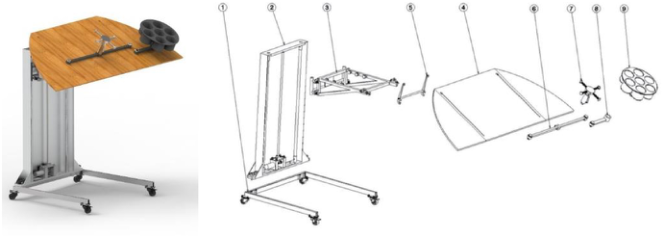
Figure 4: Overview of the painting table with its components (canvas and color cans supports).
hand. The holder should be swiveling and have a tip to unclog clogged pots with one hand.
Canvas holder: The internal dimensions of the wooden frame of the canvas holder shall be adjustable to accommodate different sizes of canvas. The hol- der shall have an adjustable rotating grip to allow manipulation of the canvas without touching the sides. It shall be easy to grasp and release the canvas with one hand. Table 1 shows the dimensions of canvas holder.
Design of the Table and its Components
Figure 4 shows an overview of the designed workbench. The different com- ponents of the workbench are: 1 - legs on wheels, 2 - pillar with height adjustment mechanism, 3 - table support with slide, 4 - table top, 5 - tilt stop, 6 - leg for canvas support, 7 - canvas holder 8 - leg for paint can holder, 9 - paint can holder. Disassembly: The painting table can be disassembled into 3 subsets: leg (1), pillar (2), table with mounting and tilting subsets (3) (4) (5) and legs for canvas and color cans holders (6) (8). The assembly of the legs, pillar, and table is made by threaded knobs (assembly without tools). Canvas support (7) and color cans support (9) are also dismountable.
Height adjustment: The technical solution is made of a gear and worm screw link. The pitch was selected to have the link irreversible. It avoids a supplementary flange system. The height adjustment is driven by a 30W 12V DC motor, the power is delivered by a 12V battery. Motor and battery are sized to move a 15 kg table (speed 1 mm/sec), which allows a safety factor of 2. Height adjustment is obtained from 250 to 1250 mm. Electrical control is made by a switch under the table.
Tilt adjustment: the solution designed is a 4 positions adjustment (0 – 10 – 20 – 30°) of the tilt stop on the table mount. This solution needs the access to the tilt stop by the rear of the table.
Materials and manufacturing processes: The materials and processes for the prototype were determined to allow a simple manufacturing operations in small workshop: High strength steel (25 Cr Mo 4), thin tubes and sheets, bending, bowing, tungsten inert gas, metal active aas welding, machining, and sintering polyamide powder (to replace and avoid casting or plastic injection).
Mechanical sizing of the table: material resistance of the chassis frame was calculated to support a 75 kg weight at the center of the table. All components (bearings, worm screw, screw connections, wheels…) were sized with this load case.
Color cans Holder: The holder is a single piece of polyamide with 6 slots for the cans. The central slot (same diameter but reduced depth) is reserved for the needle to unlock the dry cans. The needle is fixed in the center of the area to allow one-handed unlocking. The hollow area around the needle holds the paint in place. The holder is nested on a leg that can be rotated sideways on the table to adjust its position near the canvas. The connection between the holder and the leg is rotatable.
Canvas holder: It is composed of four telescopic arms that are flexibly connected to the central swivel. A trigger allows to retract the arms simul- taneously. This solution can accommodate all types of canvas from 160 to 300 mm in width/length. The swivel, with a threaded pressure knob, allows to maintain an inclined position of the canvas on +/- 45°. The ergonomic handle under the hinge can be easily inserted/removed from its holder with one hand. The holder can be moved laterally on the table. The structural parts are mainly made of sintered polyamide, the screws are made with metallic inserts if necessary
CONCLUSION
This study was conducted to develop a painting workbench adapted for peo- ple with disabilities. We studied a reference artist with disabilities and several non-artists people with disabilities to investigate their needs for a workbench. Our study showed that few solutions exist on the market for this population probably due to a small market that makes companies less interested in deve- loping disability-friendly equipment. The ergonomic analysis showed that the working conditions of the disabled artist need to be improved. He was working on the floor with very awkward postures. The creativity sessions with the disabled non-artists showed the need to develop a workbench with a large range of height and tilt adjustment. For the canvas holder, we needed
Design of Painting Work-station for Disabled People 117
to identify a solution with a wide range of adjustment, and a sturdy support to allow for the painter’s rapid movements (the technique used to spread the paint on the canvas).
The workbench and its components designed in this study appears to meet most of the needs of people with disabilities for painting or working. The next step in this study is to prototype this solution and test it with several subjects.
ACKNOWLEDGMENT
We would like to acknowledge all the students help us in this investigation. Special thanks go to Caroline Cauchy, Julie Leblanc, Sara Matyas, Enjia Wu, Emma Fermond, Margot Janvier, and Baptiste Mischler.
REFERENCES
Aleksandra, P.-S., & Królikowski, J. (2018). Ergonomics For People With Disabilities (Sciendo.). Poland. Barcenilla, J., & Bastien, J. M. C. (2009). L’acceptabilité des nouvelles technolo-
gies : Quelles relations avec l’ergonomie, l’utilisabilité et l’expérience utilisateur? Le travail humain, 72(4), 311–331. Brangier, É., & Barcenilla, J. (2003). Concevoir un produit facile à utiliser. Paris : Editions d’organisation. Charrier, M., Bazzaro, F., & Sagot, J.-C. (2014). Ergonomie et design industriel au
service de la conception pour tous : Étude exploratoire en contexte pédagogique. Ergonomie et développement pour tous (p. 120). 49ème congrès international de la SELF, La Rochelle. Crow, L. (2010). Including all of our lives : Renewing the social model of disability.
Equality, Participation and Inclusion 1 (p. 136–152). Routledge. Martins, L. B., & Cabral, A. K. P. S. (2012). Ergonomics and the inclusion of disabled people in the Brazilian job market. Work, 41, 5493–5499.
LISTED IN THE AHFE DIGITAL BOOKSTORE CATALOGUE
Explore the complete digital volume
Human Factors in Aging and Special Needs
Read this individual research paper free through the original publisher, or explore the full digital proceedings book.
ISBN 978-1-958651-14-8
Explore this ISBN in the AHFE Bookstore ↗Listed in the July 2026 bookstore catalogue; search by ISBN to confirm current availability · Digital book purchase optional