Dengchuan Cai, Hui-wen Hsiao, Chung-hsien Liu, Yuting Hsiao (2026). Musculoskeletal pain survey and bathing posture risk assessment for long-term care staff. In: Human Factors and Ergonomics In Design. AHFE Open Access, vol. 210, pp. 178–184. https://doi.org/10.54941/ahfe1007438
Long-term care staff often experience heavy workloads and physical and mental fatigue. Among caregiving tasks, bathing is particularly physically demanding, requiring repeated actions such as turning, transferring, washing, rinsing, drying, and dressing or undressing residents. Turning and transferring are especially strenuous. This study investigated musculoskeletal pain among long-term care staff and evaluated the postural risks they face during bathing to inform the design of work procedures and assistive devices in long-term care facilities.The Nordic Musculoskeletal Questionnaire (NMQ) was used to assess musculoskeletal pain in 10 caregivers from three long-term care institutions in Taiwan, while the Rapid Entire Body Assessment (REBA) was applied to evaluate postural risks during bathing. All institutions and participants joined the study voluntarily with prior consent.The results showed that the mean musculoskeletal pain score was 1.58 (SD = 1.43), indicating mild to moderate pain, with an average prevalence of 65%. The most severe pain was reported in the lower back (M = 2.1, SD = 1.64) and left elbow/forearm (M = 2.1, SD = 1.51). Lower back pain was more severe than upper back pain, and right-side pain was generally more severe than left-side pain. The mean REBA score during bathing was 11.4 (SD = 0.92), indicating a high-risk posture that requires immediate intervention and movement modification. The trunk (M = 4.2, SD = 0.6) and upper limbs (M = 3.7, SD = 0.46) showed the highest postural risk. These findings suggest that bathing is a high-risk caregiving task. Long-term care institutions should strengthen staff training and improve assistive device design to reduce the risk of occupational injury.
Many developed countries have entered super-aged societies, in which more than 20% of the population is aged 65 years and older, and are now confronting the challenges associated with population aging. Japan reached super-aged status in 2007, followed by Germany and Italy in 2008, Greece in 2013, Portugal in 2014, Finland in 2015, and France in 2018 (World Bank, 2026). Taiwan is projected to become a super-aged society in 2025 (Central News Agency, 2026). As the number of older adults requiring
Musculoskeletal Pain Survey and Bathing Posture Risk Assessment 179 care continues to increase, the shortage of caregivers has become more pronounced, substantially increasing the workload of care staff. In 2023, Taiwan had 420,821 individuals requiring care, compared with only 93,364 domestic caregivers and 327,669 foreign care workers (Ministry of Health and Welfare, 2026). These figures reflect a persistent gap between care demand and workforce supply.
Musculoskeletal pain is a common occupational health problem and is often associated with excessive workload, repetitive movements, and insufficient recovery time (Mishra et al., 2025; Park et al., 2021). Long- term care workers are particularly susceptible because their duties involve frequent manual handling and prolonged physical exertion.
Bathing is widely regarded as one of the most physically demanding tasks in long-term care facilities (Hui et al., 2001; Nevala et al., 2004; King et al., 2020). Assisted bathing is typically performed in slippery, confined environments and requires repeated bending, twisting, lifting, and transferring movements (Hsieh et al., 2021). These demands, combined with prolonged awkward postures, may place considerable stress on the musculoskeletal system and increase the risk of discomfort and chronic injury (Ogutu & Park, 2015).
Accordingly, this study focused on the assisted bathing process in Taiwan’s long-term care settings to investigate caregivers’ musculoskeletal discomfort and postural risk. A Musculoskeletal Pain Scale was used to assess physical discomfort, and the Rapid Entire Body Assessment (REBA) was applied to evaluate posture-related risk. The results may serve as a reference for improving caregiving procedures and designing assistive devices.
METHODS
Participants This study included 10 long-term care workers from long-term care institutions in central Taiwan. Participants were recruited from this region because a large proportion of long-term care institutions in Taiwan are located there. Basic demographic and ergonomic data, including gender, age, height, weight, and job tenure, were collected.
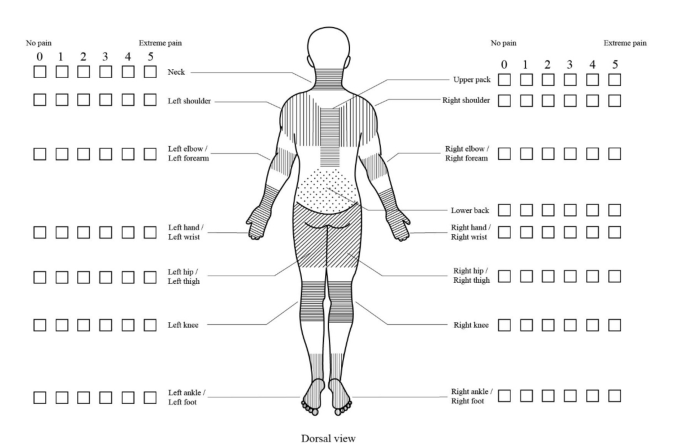
Nordic Musculoskeletal Questionnaire This study used a modified version of the Nordic Musculoskeletal Questionnaire (NMQ) (Dickinson, Campion, Foster, Newman, O’Rourke, & Thomas, 1992) to assess caregivers’ musculoskeletal pain symptoms. Fifteen body regions were evaluated, including the neck, upper back, lower back, shoulders, elbows/forearms, hands/wrists, hips/thighs, knees, and ankles/feet on both the left and right sides, as shown in Figure 1.
Pain severity and joint mobility were evaluated using a 6-point ordinal scale (0-5). A score of 0 indicated no pain and full mobility. A score of 1 indicated mild pain occurring only at the end range of motion, with minimal functional limitation. A score of 2 indicated moderate pain occurring after more than half of the range of motion, with some impact on work performance despite
preserved movement completion. A score of 3 indicated severe pain, with approximately half of the normal range of motion remaining and noticeable interference with work. A score of 4 indicated very severe pain, with only one- quarter of the normal range of motion remaining and substantial impairment in independent movement. A score of 5 indicated extreme pain and inability to move independently.
Figure 1: Nordic musculoskeletal questionnaire (Dickinson et al., 1992).
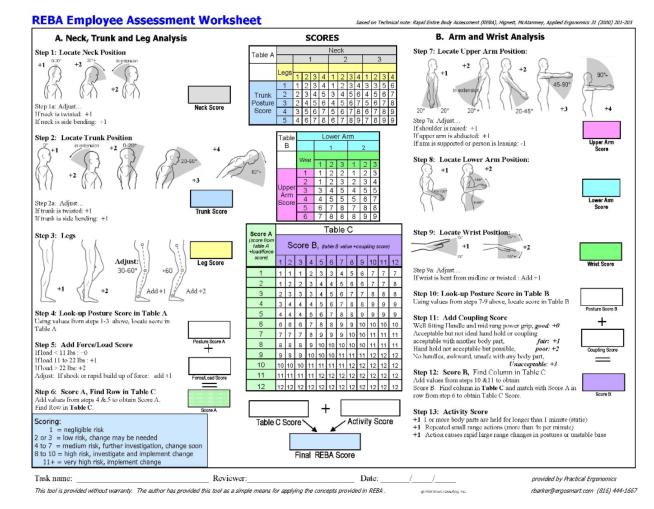
Rapid Entire Body Assessment (REBA) The Rapid Entire Body Assessment (REBA) worksheet was used to evaluate caregivers’ postures and joint angles during bathing tasks and to determine the corresponding level of musculoskeletal disorder risk (Hignett, 2000). During the assessment, caregivers assisted care recipients with bathing using the existing facilities and equipment provided by each institution. A reference illustration of the REBA assessment is presented in Figure 2.
REBA final scores range from 1 to 15 and correspond to different levels of postural risk: 1 indicates negligible risk and no action is required; 2-3 indicates low risk and change may be needed; 4-7 indicates medium risk and further investigation with corrective action is recommended; 8-10 indicates high risk requiring investigation and implementation of change; and 11 or above indicates very high risk requiring immediate intervention.
Before the REBA evaluation, caregivers were interviewed to identify their work tasks, task demands, habitual work patterns, and commonly adopted postures. The assessment focused particularly on (1) the most physically demanding tasks and postures, (2) the postures maintained for the longest duration, and (3) the postures associated with the greatest force exertion. Each participant was observed for at least three work cycles.
A total of 10 long-term care workers from three long-term care institutions in central Taiwan were recruited for this study: National Taiwan University Hospital Yunlin Branch, Chiayi Christian Hospital Long-term Care Center, and Hong-Ai Long-term Care Center.
Among the participants, 2 were male and 8 were female. Their ages ranged from 39 to 64 years, with a mean age of 51.8 years (SD = 9.13). Their height ranged from 148 to 172 cm (M = 157.4, SD = 7.07), and their weight ranged from 47 to 65 kg (M = 57.6, SD = 5.70). Job tenure ranged from 0.4 to 21 years, with a mean of 10.39 years (SD = 7.51).
Table 1: The basic ergonomic information of the subjects.
Results of the Nordic Musculoskeletal Questionnaire The survey results showed that the mean musculoskeletal pain score among the 10 participants was 1.65 (SD = 1.55), indicating mild to moderate pain. The average prevalence of musculoskeletal pain was 53.5%.
The body regions with the highest pain scores were the lower back (M = 2.1, SD = 1.64) and the left elbow/forearm (M = 2.1, SD = 1.51). These findings indicate that pain in these regions reached a moderate level, meaning that participants were still able to complete movements, although their work performance may have been affected.
As shown in Table 2, lower back pain was more severe than upper back pain (2.1 vs. 1.7), suggesting that the lower back may have been subjected to greater physical load during caregiving tasks. In addition, the mean pain score on the right side was slightly higher than that on the left side (1.58 vs. 1.50). This may reflect greater use of the right side during work tasks.
Table 2: The survey results of the nordic musculoskeletal questionnaire.
Table available in the original PDF paper.
Item N Min Max Mean SD Incidence Rate Neck 10 0 4 1.4 1.2 53%
Upper back 10 0 4 1.7 1.27 67% Lower back 10 0 4 2.1 1.64 67%
Left shoulder 10 0 3 1.5 0.92 73% Left elbow / Left forearm 10 0 4 2.1 1.51 67%
Left hand / Left wrist 10 0 5 1.9 2.02 47% Left hip / Left thigh 10 0 3 0.9 0.94 47%
Left knee 10 0 4 1.2 1.66 33% Left ankle / Left foot 10 0 4 1.4 1.56 40%
Left means 10 0 3.8 1.50 1.44 51% Right shoulder 10 0 3 1.8 0.98 73%
Right elbow / Right forearm 10 0 4 1.9 1.64 60% Right hand / Right wrist 10 0 5 1.7 1.79 60%
Right hip / Right thigh 10 0 3 0.8 0.98 47% Right knee 10 0 4 1.5 1.69 40%
Right ankle / Right foot 10 0 4 1.8 1.66 53% Right mean 10 0 3.8 1.58 1.46 56%
Total mean 10 0 3.9 1.65 1.55 53.5%
Musculoskeletal Pain Survey and Bathing Posture Risk Assessment 183 Results of the REBA Assessment
The results of the REBA assessment are presented in Table 3. The mean final REBA score for bathing was 11.4 (SD = 0.92), indicating a very high postural risk and the need for immediate intervention and movement modification. For Score A, the highest postural risk was observed in the trunk (M = 4.2, SD = 0.6). For Score B, moderate postural risks were identified in the upper arms (M = 3.7, SD = 0.46), lower arms (M = 1.5, SD = 0.5), and wrists (M = 2.1, SD = 1.54).
These findings indicate that bathing is a high-risk caregiving task. Long- term care institutions should strengthen staff education and training and improve assistive device design to reduce the risk of occupational injury.
This study examined 10 long-term care workers from three institutions in central Taiwan using the Nordic Musculoskeletal Questionnaire (NMQ) and the Rapid Entire Body Assessment (REBA) worksheet. The following conclusions were obtained: The NMQ findings indicated that participants experienced mild to moderate musculoskeletal pain overall, with a relatively high prevalence. The most severe pain was found in the lower back and left elbow/forearm. Lower back pain was more severe than upper back pain, and the right side showed slightly higher pain scores than the left.
The REBA results showed that bathing was a high-risk task with substantial postural demands. The trunk showed the highest risk in Score A, while the upper arms, lower arms, and wrists showed elevated risk in Score B. These findings highlight the need for improved training and assistive device design in long-term care settings.
Because the sample included unequal gender representation and wide variation in age and job tenure, these factors should be considered in future studies to reduce potential bias and improve generalizability.
ACKNOWLEDGMENT
The authors would like to thank the National Science and Technology Council of Republic of China (Taiwan) for financial support under project no. NSTC114-2637-H-224-007.
REFERENCES
Central News Agency (2026, January 9). Aging. Retrieved February 6, 2026, from https://www.ndc.gov.tw/Content_List.aspx?n=2688C8F5935982DC Dickinson, C. E., Campion, K., Foster, A. F., Newman, S. J., O’rourke, A. M. T., &
Thomas, P. G. (1992). Questionnaire development: an examination of the Nordic Musculoskeletal questionnaire. Applied ergonomics, 23(3), 197–201. Hignett, S., & McAtamney, L. (2000). Rapid entire body assessment (REBA). Applied ergonomics, 31(2), 201–205. Hsieh, P. L., Lee, Y. C., Yang, S. Y., Lin, Y. L., & Huang, Y. R. (2021). Association
between work content and musculoskeletal disorders among home caregivers: a cross-section study. Industrial health, 60(6), 514–524. Hui, L., Ng, G. Y., Yeung, S. S., & Hui-Chan, C. W. (2001). Evaluation of physiological work demands and low back neuromuscular fatigue on nurses working in geriatric wards. Applied ergonomics, 32(5), 479–483. King, E. C., Weiss, B. M., Boscart, V. M., Dutta, T., Callaghan, J. P., & Fernie, G. R.
(2020). Bathing frail seniors at home: Home care providers’ approaches. Work, 66(3), 499–517. Ministry of Health and Welfare (2025, March 20) (4) Long-term Care Ten-Year Plan 2.0—Long-term care service volume] [PDF]. Retrieved February 6, 2026, from https://www.mohw.gov.tw/dl-88609-617df627-fee7-4ddd-bb67-170797e9d6e5. html Mishra, S., Avinash, G., Kundu, M. G., Verma, J., Sheth, A., & Dutta, A. (2025).
Work-related musculoskeletal disorders among various occupational workers in India: A systematic review and meta-analysis. Journal of Occupational Health, 67(1), uiae077. https://doi.org/10.1093/joccuh/uiae077 Nevala, N., & Tamminen-Peter, L. (2004). Ergonomics and usability of an electrically adjustable shower trolley. International Journal of Industrial Ergonomics, 34(2), 131–138. Ogutu, J., & Park, W. (2015). The relationship between perceived discomfort of
static posture holding and posture holding time. Work, 52(1), 19–30. Park, S., Lee, J., & Lee, J. H. (2021). Insufficient rest breaks at workplace and musculoskeletal disorders among Korean kitchen workers. Safety and Health at Work, 12(2), 225–229. World Bank (2026) Population ages 65 and above. Retrieved February 6, 2026, from
Read this individual research paper free through the original publisher, or explore the full digital proceedings book.
ISBN 978-1-964867-86-1
Explore this ISBN in the AHFE Bookstore ↗Listed in the July 2026 bookstore catalogue; search by ISBN to confirm current availability · Digital book purchase optional