Jung Joo Sohn, Sundas Qaiser, Chia-Hsuan Lai, Yuhong Mo (2026). A Morphology and Ergonomics Informed Approach to Unobtrusive RFID Tagging in Hand Tools. In: Interdisciplinary Practice in Industrial Design. AHFE Open Access, vol. 222, pp. 177–187. https://doi.org/10.54941/ahfe1007757
Residential maintenance and home repair rely on timely access to appropriate hand tools, yet tool-related disruptions remain frequent, increasing cognitive load and leading to costly search-related time loss. While RFID (Radio Frequency Identification) based inventory systems have been proposed, their adoption in real maintenance contexts is constrained by the physical integration layer, where conventional rigid tags suffer from signal degradation near metal surfaces and intrude into ergonomically sensitive grip areas. This paper reframes tool tracking as a design and human factors problem and introduces a morphology and ergonomics grounded approach for integrating RFID tags into hand tools without compromising usability. We propose a three-type morphological taxonomy of axial, planar, and complex tools to structure placement decisions, an ergonomic neutral zone approach to avoid high pressure contact regions, and a flexible tag architecture utilizing silicone or rubber as a dielectric spacer. This flexible encapsulation improves conformability to various tool surfaces and RF (Radio Frequency) performance on metal tools. A multi-faceted evaluation, consisting of a formative survey and interviews with domain experts, suggests strong perceived value for multi-location and shared-tool accountability. However, results also highlight adoption constraints regarding attachment durability and onboarding effort. We discuss design implications for scalable, unobtrusive tool identification and outline future research to quantify the reduction in cognitive load and time loss.
Residential maintenance is a routine yet critical activity for both homeowners and skilled trades professionals. Tasks such as home repair, furniture assembly, and electrical or plumbing maintenance are fundamentally dependent on the availability and proper use of hand tools. In these contexts, tools function not only as physical artifacts but as essential mediators of task efficiency, safety, and cognitive workload. The ability to access the appropriate tool at the right moment is therefore central to maintaining uninterrupted workflow and effective task execution (Monsell, 2003).
However, tool-related disruptions are common in residential maintenance environments. When required tools cannot be readily located, work is delayed, task sequences are interrupted, and users are often forced to improvise with Received February 21, 2026; Revised April 9, 2026; Accepted April 29, 2026; Available online July 20, 2026
suboptimal alternatives. These interruptions not only increase task completion time but also elevate mental frustration and cognitive load. Prior work on interruptions and task switching shows measurable costs in performance and stress following task disruption, underscoring the impact of workflow breaks in tool-dependent work (Mark et al., 2008; Monsell, 2003).
In response to these inefficiencies, various digital inventory management and tool-tracking systems have been proposed. While such systems demonstrate promise at the software level, their effectiveness is fundamentally constrained by the reliability of the physical data capture layer. Specifically, conventional rigid RFID tags often fail in maintenance environments due to RF interference from metallic tools, vulnerability to impact, and intrusion into ergonomically sensitive grip areas.
This paper reconceptualizes the core limitation of existing solutions as the absence of a hardware integration strategy that aligns with the morphological and ergonomic characteristics of hand tools. Accordingly, we reframe tool tracking as a design and human factors problem rather than a purely computational one. We introduce ‘TRAKR’ (pronounced like “tracker”), a tool-tracking system centered on context-aware tag integration and verification workflows for residential maintenance. TRAKR combines RFID sensing with a software interaction layer for workflow support, but the focus of this paper is the hardware, specifically tag form factors and attachment strategies for durable, ergonomically neutral integration on hand tools.
TRAKR utilizes an adaptable RFID tag architecture, employing silicone or rubber as a dielectric spacer. This encapsulation ensures conformability to curved tool surfaces while providing the necessary stand-off distance to mitigate RF interference from metal components. Together, TRAKR contributes (1) a morphology-informed placement approach for diverse hand-tool geometries and (2) a tagging strategy designed to preserve tool usability while enabling reliable RFID-based verification.
BACKGROUND AND RELATED WORKS Tool Management Challenges in Residential Maintenance
Residential maintenance work is characterized by high variability in task location, duration, and tool usage. Tools in residential environments are frequently moved across multiple contexts and job sites, with travel between locations being typical across several maintenance trades (U.S. Bureau of Labor Statistics, 2025). However, unlike industrial settings, lack of professional management and organization increases the risk of tool misplacement. Consequently, users often expend additional cognitive effort searching for tools rather than performing actual maintenance. This inability to locate tools disrupts workflow and imposes significant cognitive demands. Workers must track inventories and adapt sequences when tools are missing. From a human factors perspective, these inefficiencies act as persistent sources of increased cognitive load, negatively affecting task performance and leading to redundant tool purchases. Interruption and task-switching research shows that workflow breaks measurably increase stress and reorientation costs, reinforcing why search-related disruption matters in practice (Mark et al., 2008; Monsell, 2003).
A Morphology and Ergonomics Informed Approach 179 RFID-Based Tool Tracking Systems
RFID technology is widely used for asset tracking due to its non-line-of-sight identification and has been repeatedly explored for tool and asset workflows in construction-like environments (Goodrum et al., 2006; Valero et al., 2015). However, most existing implementations rely on rigid, standardized tags that face severe limitations on metallic maintenance tools. Specifically, metal bodies interfere with radio-frequency performance, causing signal attenuation and detuning. Maintenance environments also expose tags to impact and contamination, and field-oriented RFID studies repeatedly identify read reliability and physical deployment conditions as key adoption barriers, rather than software functionality alone (Goodrum et al., 2006; Valero et al., 2015; Montaser et al., 2013). These findings are consistent with RFID-on-metal research indicating that near-metal placement often requires careful packaging and spacing to maintain reliable reads (Kim, 2020). Together, this motivates context-sensitive integration approaches that use protective materials to preserve durability and provide a practical stand- off from metallic surfaces.
Morphology and Ergonomics of Hand Tools Hand tools exhibit diverse morphological characteristics, such as axial, planar, or complex geometries, that determine grip posture and pressure distribution. Ergonomic studies have identified handle characteristics and contact conditions as key contributors to comfort and discomfort in hand tool use, including irritation and pain linked to localized pressure (Kuijt-Evers et al., 2004). Accordingly, introducing protrusions, seams, or rigid encapsulations within high-contact grip regions can increase localized pressure and discomfort, making long-term adoption less likely (Aldien et al., 2005).
Ergonomics research commonly defines a “neutral zone” as a range of near-neutral wrist excursions associated with lower biomechanical exposure (Hedge et al., 1999; Woods and Babski-Reeves, 2005). In hand-tool use, hand–handle pressure mapping shows uneven contact pressure, with lower- pressure regions that can guide less intrusive placement (Aldien et al., 2005). Building on these foundations, we use “neutral zones” to describe handle regions that support near-neutral wrist posture while avoiding peak-contact areas, making them promising locations for integrating hardware without disrupting usability (Hedge et al., 1999; Woods and Babski-Reeves, 2005).
Ergonomic hand-tool research has primarily emphasized handle comfort optimization through shape, force and pressure considerations, with comparatively limited attention to bridging tool morphology with hardware integration strategies (Aptel et al., 2002; Hokari et al., 2020). Addressing this gap requires a design-oriented approach that treats RFID integration not as an external add-on, but as an ergonomic and functional extension of the tool’s form.
RESEARCH QUESTIONS AND METHODOLOGY This study adopts a design-driven approach that integrates morphological analysis, ergonomic principles, and iterative prototyping to address the challenge
of physically integrating RFID tags into hand tools. We treat tool tracking as an industrial design and human factors challenge, coordinating three layers: tool morphology, ergonomic interaction zones, and tag form factor and its attachment. By aligning these layers, we derive attachment strategies that enable reliable hardware integration while preserving natural grip and tactile use.
Comparative Analysis of Tracking Technologies The first phase involved a comparative analysis of prominent tracking technologies currently available in the market to identify the technical and ergonomic gaps in existing solutions. We compared consumer tags (e.g., AirTag, Tile) and industrial tool systems (e.g., ONE-KEY, Tool Connect) using criteria summarized in Table 1. Analysis revealed that while consumer tags offer high-precision finding and compact form factors, they lack mounting flexibility across diverse tool geometries. Industrial tags emphasized durability but were often bulky and protrusive, increasing the risk of interfering with grip. These trade-offs motivate the need for a context-sensitive hardware integration strategy that balances technical reliability with ergonomic neutrality.
Table 1: Comparative analysis of existing tracking tags (as of August 2025).
Company / Brand
Apple Tile by Life360
A Morphology and Ergonomics Informed Approach 181 User Research and Pain Point Analysis
To establish a design baseline, we conducted a user survey with 56 participants comprising homeowners, maintenance professionals, and workshop-using students to identify current tool-management pain points. The data reveals that tool misplacement is a pervasive issue, with approximately 85.7% of respondents experiencing at least one “missing item event” in the last 30 days. The psychological and operational impact of these events is significant, as 71.4% of respondents agreed that searching for tools reduces their productivity, while 75.0% reported increased frustration or stress.
Participants also expressed resistance to attaching tracking hardware in primary grip areas (69.6%) and near moving parts (60.7%), citing comfort and performance concerns. Participants also reported that prior identification attempts (e.g., labels and stickers) frequently failed due to peeling, fading, or abrasion, reinforcing the need for a durable, low-profile attachment method suitable for high-wear tool surfaces.
RESEARCH QUESTIONS Based on gaps identified in the secondary research and user pain points, this study is guided by three main research questions:
(RQ1) How can RFID tags be physically integrated into hand tools without disrupting grip dynamics or task performance? (RQ2) How can the morphological classification of hand tools inform RFID
tag form factors and attachment strategies? (RQ3) Which regions of hand tools, defined as ergonomic neutral zones, are most suitable for embedding identification hardware?
Methodology
This study follows an iterative design process consisting of four stages: (1) tool sampling and morphological classification, categorizing commonly used residential-maintenance tools by geometry and material to develop the axial, planar, and complex taxonomy; (2) design exploration, generating placement and form-factor concepts through sketching while considering RF constraints and ergonomic impact; (3) prototyping and refinement, using flexible materials and encapsulation techniques to translate concepts into physical artifacts; and (4) evaluation planning and assessment, using a mixed- methods approach that combines expert critiques and user survey feedback to iteratively refine the design. This cycle keeps design decisions grounded in real maintenance contexts while progressively improving attachment durability, ergonomics, and verification usability.
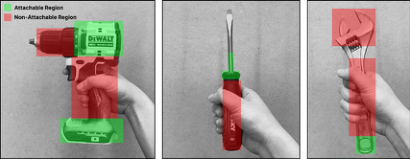
MORPHOLOGICAL TAXONOMY IN HAND TOOLS This section introduces a morphological taxonomy that guides where and how RFID tags can be integrated into hand tools while minimizing ergonomic disruption. Tool geometry constrains feasible attachment surfaces, while repeated hand contact patterns determine whether added thickness, seams, or
encapsulation will be perceived during use (see Figure 1). Based on recurring form patterns observed across common residential maintenance tools, we identify three morphological types and translate them into placement and packaging implications.
Figure 1: Possible tag attachment regions (green) and unsuitable regions (red) based on grip contact and functional constraints.
Axial Type: Handle-Centric Geometries Many hand tools are predominantly linear and handle-centric, with relatively consistent grip placement during use. In these geometries, the hand often contacts the same handle region, making tactile disruption more noticeable. Integration should avoid high-pressure grip areas and target ergonomic neutral zones, using low-profile, conformable packaging to preserve grip feedback.
Planar Type: Thin-Profile Geometries A second type includes tools with thin, broad forms and limited thickness available for recessed integration. Because depth is limited, integration should favor surface-conforming form factors over volumetric housings. Candidate regions include edges, transitions, or branding areas where sustained hand contact tends to be lower and where additional material can be introduced with minimal ergonomic impact.
Complex Type: Multi-Interface Geometries A third type includes tools with compound geometries and multiple interaction interfaces such as triggers, guards, housings, or secondary grips, where hand position frequently shifts during use. Exposed surface tags are more likely to be contacted, abraded, or peeled, so integration should favor protected placements such as recessed features, overmolded interfaces, or areas adjacent to housing seams.
DESIGN EXPLORATION Exploration generated a wide set of concepts for placement and form factors, with the goal of supporting reliable RFID identification without interfering with each tool’s primary functions. Across concepts, neutral zones and protrusion minimization guided placement and packaging.
A Morphology and Ergonomics Informed Approach 183 Ideation began by mapping each morphological type to feasible integration regions. For axial tools, the dominant constraint was repeated hand contact along a relatively stable grip posture. For planar tools, limited thickness constrained recessed integration, motivating surface-conforming strategies. For complex tools, shifting hand positions and exposed interaction features increased abrasion and peeling risk, elevating the need for protected, low- profile placements. This guided the sketching process to follow expected contact patterns, rather than generic attachment assumptions.
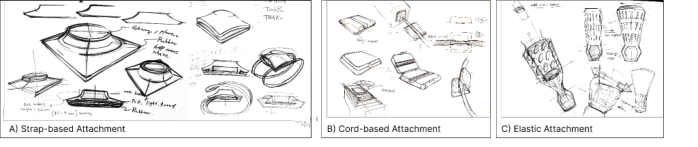
Concept Directions by Morphological Type For axial tools, exploration emphasized a flexible rubber or silicone case encapsulating a thin tag and supporting attachment across varying handle diameters. To preserve removability for cleaning or reconfiguration, sketches converged on a removable strap mechanism that secures the encapsulated tag around the handle while maintaining a low-profile surface. For planar tools, which often include power-corded equipment and broad faces with limited depth, exploration shifted away from mounting on the main body. Concepts instead prioritized cord-mounted identity, using clip-on or snap-fit attachments that attach the tag on the power cable. This direction avoids interference at primary grip locations and reduces exposure to impact-prone tool surfaces. For complex tools, exploration prioritized elastic sleeve- like architectures that conform to compound geometries without adding significant bulk (see Figure 2).
Figure 2: Strap-based wrap, Cord-based mount, and Elastic sleeve-style attachment.
EVALUATION We evaluated TRAKR through expert critique interviews to assess the system concept, the physical tagging strategy, and the proposed interaction model. This approach was selected to surface usability risks, adoption barriers, and feasibility concerns early, by eliciting domain-grounded judgments about fit within real tool-management routines.
Participants We interviewed three participants with dual qualifications combining professional design expertise and firsthand experience managing substantial tool inventories. Participant P1 is an industrial design professional with over ten years of experience managing a personal and work-related tool
set of approximately 100 tools. Participant P2 is a workshop technician with over three years of industrial design expertise responsible for a shared inventory of approximately 200–300 tools. Participant P3 is an industrial design professional with over twenty years of experience managing over 130 tools across multiple home locations. (All participants are anonymized as P1–P3.)
Procedure We conducted 60 minute semi-structured interviews in the format of expert critiques centered on a guided walkthrough of the TRAKR ecosystem. Participants were introduced to the overall concept including low-fidelity physical prototypes representing three morphology-aligned integration directions: a detachable rubber case with an elastic band for axial tools, a cord-mounted attachment for planar or corded equipment, and a slim- profile elastic wrap / sleeve for complex geometries. Sessions began with brief context-setting questions about each participant’s tool environment and typical breakdown moments. Critiques were then structured using scenario prompts spanning key transition moments, including arrival, setup, in-task retrieval, and end-of-task pack-up, to probe where verification and recovery behaviors would realistically occur.
Analysis Audio recordings were transcribed and analyzed using an iterative thematic synthesis. Concrete critique statements were clustered to identify recurring concerns, implicit decision rules, and adoption constraints. To keep findings actionable for design iteration, results were organized into themes such as attachment durability, grip interference, morphology-specific fit, and placement constraints.
Participants broadly supported the various tagging concepts but emphasized that adoption would depend on simple setup rules and default recommendations that reduce decision fatigue during initial configuration. They noted that users may need quick guidance on which tools warrant which tag style, rather than extensive customization from the outset.
Across interviews, attachment feasibility emerged as a central constraint for real-world adoption. Given routine exposure to impacts, dust, and frequent hand contact, participants stressed that durability and secure mounting matter more than a single universal solution. This directly informed the design shift towards a modular Core + Case architecture, where a consistent tag core can be paired with tool-appropriate carriers. Within the explored concepts, the detachable rubber case for axial tools was viewed positively for its flexibility across handle diameters and its removability for cleaning or reconfiguration, while the cord-mounted approach was valued for avoiding interference with the tool body on corded equipment. For complex geometries, slim-profile wraps or sleeve-like structures were regarded as necessary for conformity to irregular forms.
A Morphology and Ergonomics Informed Approach 185 Design Updates
Insights from the evaluation highlighted a core feasibility constraint: a single tag form factor is unlikely to achieve an optimal fit across diverse tool geometries and handling patterns. Participants emphasized that attachment durability, perceived bulk, and grip interference vary substantially by tool morphology and personal usage style. In parallel, concept evaluation was anchored to recurring transition moments in residential maintenance, including departure staging, arrival verification, and end-of-task recovery, prioritizing designs that remain unobtrusive during repetitive handling and enable quick verification without visual inspection of each tool. In response, we revised TRAKR’s physical tagging strategy from a single attachment direction to a modular Core + Case architecture.
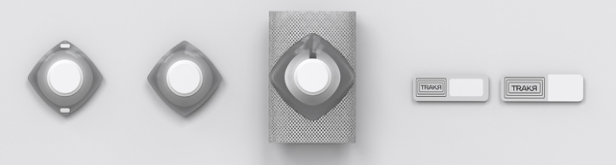
In the updated design, a standardized RFID core is shared across tools, and the outer carrier is selected to match tool geometry and interaction constraints. We developed three interchangeable case variants: (1) a flexible silicone case for surfaces where protrusion would be perceptible or uncomfortable, (2) a cord-mounted case for power-corded equipment that relocates the tag to the cable to reduce interference with the tool body and primary grip, and (3) an elastic sleeve-like case providing wraparound coverage for compound geometries where point attachments are prone to abrasion or peeling. This approach maintains a consistent RFID insert while allowing morphology-specific carriers to adapt attachment and packaging to different tools, establishing a shared internal architecture that can be adapted for conformity, durability, and everyday usability.
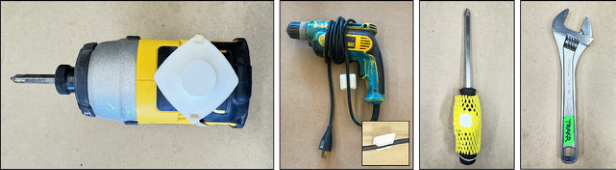
Evaluation feedback also indicated that many tools demand ultra-low profile identification to support bulk tagging at lower cost and reduce interference on small or restrictive geometries. We introduced a passive RFID tag option, implemented as a flat, sticker-like form that contains no battery and supports short-range identification. As passive RFID can be manufactured in very thin, customizable shapes, this option extends TRAKR to smaller tools and high-volume inventories where active tagging would be impractical (see Figure 3). Together, these additions enable a tiered tagging strategy: active tags for high-value tools or kits requiring longer-range detection, and passive tags for lightweight, low-profile coverage across the remaining tool set.
Figure 3: Representative tools illustrating the morphology-aligned tag variants.
Collectively, these updates establish a more scalable physical foundation for TRAKR (see Figure 4) and prepare the system for subsequent refinement of the end-to-end workflow and software experience.
Figure 4: Strap-based, Cord-based, Elastic sleeve-based, and Passive RFID tag.
CONCLUSION
This paper reframes tool tracking in residential maintenance as a design and human factors problem and presents TRAKR as a morphology- and ergonomics-grounded approach for integrating RFID-based identity into hand tools without compromising usability. By connecting recurring tool geometries to placement and packaging decisions, and prioritizing unobtrusive integration aligned with contact patterns, this work contributes practical design guidance for scalable, low-friction tool identification. The evaluation reinforced that adoption hinges on physical fit and durability across diverse tool forms rather than a single universal tag solution. In response, we refined the hardware integration strategy by transitioning to a modular Core + Case architecture with interchangeable carriers, providing a more adaptable foundation for real maintenance contexts.
At the same time, the findings indicate that sustained tool tracking requires system-level support beyond hardware. Future work will therefore extend TRAKR’s software and workflow layer to reduce onboarding burden, improve inventory organization and verification flows, and evaluate outcomes such as reduced cognitive load and search-related time loss through longitudinal, in-situ deployments.
REFERENCES
Aldien, Y., Welcome, D.E., Rakheja, S., Dong, R.G. and Boileau, P.-E. (2005) ‘Contact pressure distribution at hand–handle interface: role of hand forces and handle size’, International Journal of Industrial Ergonomics, 35(3), pp. 267–286. doi: 10.1016/j.ergon.2004.09.005. Aptel, M., Claudon, L. and Marsot, J. (2002) ‘Integration of ergonomics into
hand tool design: principle and presentation of an example’, International Journal of Occupational Safety and Ergonomics, 8(1), pp. 107–115. doi: 10.1080/10803548.2002.11076518. Goodrum, P.M., McLaren, M.A. and Durfee, A. (2006) ‘The application of active radio frequency identification technology for tool tracking on construction job sites’, Automation in Construction, 15(3), pp. 292–302. doi: 10.1016/j. autcon.2005.06.004. Hedge, A., Morimoto, S. and McCrobie, D. (1999) ‘Effects of keyboard tray geometry
on upper body posture and comfort’, Ergonomics, 42(10), pp. 1333–1349. doi: 10.1080/001401399184983. Hokari, K., Pramudita, J.A., Ito, M., Okada, K. and Tanabe, Y. (2020) ‘Computational method to optimize design of gripping part of products via grasping motion simulation to maximize gripping comfort’, Applied Sciences, 10(9), 3265. doi: 10.3390/app10093265.
A Morphology and Ergonomics Informed Approach 187 Kim, Y.D. (2020) ‘Design of an ultra-small UHF RFID tag for embedded applications
in metallic objects’, Electronics Letters, 56(3), doi: 10.1049/el.2019.3230. Kuijt-Evers, L.F.M., Groenesteijn, L., de Looze, M.P. and Vink, P. (2004) ‘Identifying factors of comfort in using hand tools’, Applied Ergonomics, 35(5), pp. 453–460. Mark, G., Gudith, D. and Klocke, U. (2008) ‘The cost of interrupted work: more
speed and stress’, in Proceedings of the SIGCHI Conference on Human Factors in Computing Systems (CHI ’08). New York, NY: ACM, pp. 107–110. doi: 10.1145/1357054.1357072. Monsell, S. (2003) ‘Task switching’, Trends in Cognitive Sciences, 7(3), pp. 134–140.
doi: 10.1016/S1364-6613(03)00028-7. Montaser, A., Azram, R. and Moselhi, O. (2013) ‘Experimental study for efficient use of RFID in construction’, in Proceedings of the 30th International Symposium on Automation and Robotics in Construction (ISARC), pp. 618–625. doi: 10.22260/ ISARC2013/0067. U.S. Bureau of Labor Statistics (2025) Occupational Outlook Handbook: General
maintenance and repair workers. Washington, DC: U.S. Bureau of Labor Statistics. https://www.bls.gov/ooh/installation-maintenance-and-repair/general- maintenance-and-repair-workers.htm Valero, E., Adán, A. and Cerrada, C. (2015) ‘Evolution of RFID applications in construction: a literature review’, Sensors, 15(7), pp. 15988–16008. doi: 10.3390/s150715988. Woods, M. and Babski-Reeves, K. (2005) ‘Effects of negatively sloped keyboard wedges
on risk factors for upper extremity work-related musculoskeletal disorders and user performance’, Ergonomics, 48(15), pp. 1793–1808. doi: 10.1080/00140130500292087.
LISTED IN THE AHFE DIGITAL BOOKSTORE CATALOGUE
Explore the complete digital volume
Interdisciplinary Practice in Industrial Design
Read this individual research paper free through the original publisher, or explore the full digital proceedings book.
ISBN 978-1-964867-98-4
Explore this ISBN in the AHFE Bookstore ↗Listed in the July 2026 bookstore catalogue; search by ISBN to confirm current availability · Digital book purchase optional