Zhāng Píng, Yu Zhou, Zheng Li (2025). Improving human‘s spatial information perception in virtual reality through distributed haptic stimulation. In: Human Factors and Wearable Technologies. AHFE Open Access, vol. 175, pp. 49–60. https://doi.org/10.54941/ahfe1006358
Uncertain and insufficient spatial information transfer is a problem with current virtual reality interactions, particularly for those who are hard of hearing and have trouble identifying sound sources. To enhance the interaction experience and foster the inclusive development of virtual reality technology, this article seeks to establish a theoretical design framework for wearable devices that facilitate the transfer of spatial information in virtual reality. First, the article analyzes interaction scenarios in virtual reality to identify the types of spatial data that need to be communicated through haptic feedback. Next, the relevant information is categorized by location, characteristics, and layers, forming the basis for design objectives and evaluation criteria. Finally, suitable haptic feedback methods and stimulation sites are selected, and both hardware and software are developed.
In a virtual reality experience, the interaction interface is fixed but dynamically appears in a specific location in the virtual space according to the task requirements. Therefore, timely delivery of spatial information to users is the key to virtual space interaction design. However, the user’s spatial awareness in virtual reality is weaker than that in real life, which is analyzed from two perspectives: first, the field of view of existing head-mounted all-in- one PCs is insufficient (Wang Shiming, 2018), and the maximum field of view of head-mounted all-in-one PCs on the market is only 120
, which is far lower than that of the human binocular field of view of 208
(head fixed, eyeballs rotating); second, the sound field effect of VR devices is inadequate, and the sound field effect is not good, and the vocalization is not good. The sound field effect is poor, and most sound-generating equipment is installed above the ears, which cannot effectively provide a stereo sound field. Therefore, in order to promote the barrier-free development of VR technology and enhance
the user’s sense of immersion, it is necessary to strengthen the efficiency of transmitting virtual reality equipment in spatial information.
Related Work
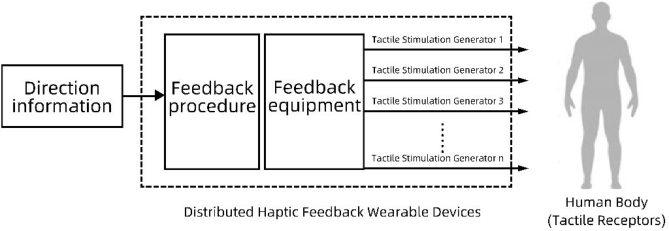
Literature combing has shown that using haptic feedback devices to enhance spatial awareness is an effective method. For evolutionary reasons, haptics and spatial information are closely related in the cognitive system (Alvaro Cassinelli, 2006). In addition, haptic feedback devices do not occupy the audiovisual channel, which aligns with the sensory compensation theory. Currently, various technological routes can realize haptic stimulation (Louise Devigne, 2020), among which distributed haptic stimulation is widely used for spatial information transfer (Shuchang Xu, 2020). Distributed haptic stimulation devices consist of a program and hardware that can produce haptic stimulation in multiple parts of the human body surface. It is programmed to convert spatial information into signals that control each tactile stimulation generator, adjusting the stimulation mode, intensity, and frequency to deliver spatial information to the wearer.
Figure 1: The process of generating stimulation in the human body through a distributed haptic feedback wearable (image credit: self-painted by the author).
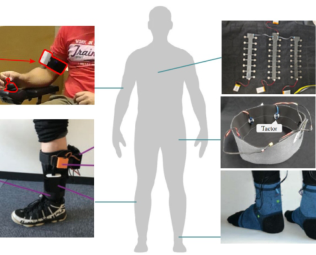
Previous research has focused on developing spatial perception devices with tactile stimulation around realistic scenarios to help different populations navigate and avoid obstacles in unknown environments. Scholars have explored the enhancement of spatial perception by tactile stimulation in several parts of the human body, as shown in Figure 2. Except for a few handheld tactile stimulation devices for hand experiments, most studies have used wearable, distributed tactile stimulation devices. This is mainly because the hand is often used for manipulation and contact and is not suitable as a carrier for haptic devices, whereas other parts of the body are susceptible to haptic sensation and are suitable for integration into wearable devices.
Although previous studies have demonstrated the feasibility of haptic feedback for spatial information transfer, the academic community still lacks systematic theoretical support. Most related research focuses on solving the spatial information transfer problem in the real world, and the research on
Improving Human’s Spatial Information Perception in Virtual Reality 51
orientation guidance strategies customized for virtual reality environments is weak and needs to be addressed urgently.
Figure 2: A case study of wearable spatial information transfer devices for different human body parts (image credit: self-painted by the author).
Research Overview Our research is mainly divided into two parts: theoretical construction and tactile feedback device design. Theoretically, we analyzed the differences in spatial perception between users in virtual reality and the real world, and we proposed a set of design processes and guidelines. Experimentally, we designed a prototype head-mounted haptic device and evaluated the spatial perception effect of the device paired with two feedback procedures in two virtual reality scenarios. We experimentally verified that the feedback strategy can effectively convey positional information and compared it with the stereo localization approach.
THEORETICAL SUMMARY Characterization of Spatial Awareness in Virtual Reality Spaces
Compared with real space, the virtual reality scene has different goals for the nature of “space awareness.” In the design process of wearable devices, the interaction characteristics of virtual reality need to be considered. For example, the user does not need to be exactly the same as the virtual character’s movements when operating and can enter the virtual space through more comfortable and safe postures (e.g., sitting position, lying position, or Fowler’s position). And when it is necessary to adjust the range of vision, the remote sensing of the operating handle can be used instead of turning around significantly. However, this type of control affects the user’s motion perception and participation. It may also lead to limb surface pressure due to the specific operating posture, thus reducing the comfort of the wearable device. In scene element design, some UI interfaces coexist with virtual characters in the virtual space (e.g., spatial UI and geometric UI) (Peacocke, 2018). The improperly designed position of UI interfaces can easily trigger users’ hesitation and confusion.
Analysis of Spatial Information Spatial perception capability refers to the effectiveness of the user’s reception of spatial information. According to previous research, haptic devices’ hardware and software design is usually based on the type of spatial information in the target environment and the task requirements. If the target position in a navigation task is compared to a coordinate point, the “obstacle”in an obstacle avoidance task is a dimensioned wall. Therefore, we divide spatial information into “what” (information content) and “where” (location information) and analyze it from the following three aspects.
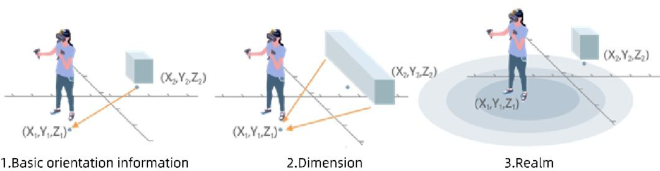
Target Location Target orientation is the most fundamental indicator of spatial information, including the world coordinate position of the target and its relative position to the user. In addition, information such as the volume of the target, its movement speed, and the range in which it is located can also help the user understand the environmental layout of the virtual space more comprehensively, as shown in Figure 3.
Figure 3: Target orientation characteristics (image credit: self-painted by the author).
Content and Type of Information There are differences between spatial information in terms of information content and type, active perception and passive informing, etc., which can be regarded as characteristics of spatial information. For example, in a vehicle following behavior, drivers can actively observe different types of vehicles behind them through rearview mirrors or passively obtain information about the position of vehicles behind them through flashing lights or honking horns. Based on this, we propose two key elements for characterizing information expressed with haptic feedback: first, uniqueness. Haptic stimuli should be sufficiently distinctive so that users can quickly and clearly recognize different types of information. The second is symbolism and anthropomorphism. The haptic feedback should allow the user to associate it with its counterpart easily.
Hierarchy of Information The hierarchy of information refers to the order in which users receive information (Zielasko, 2021). Designers should ensure that urgent information is prioritized through prominent tactile signals and maintain
Improving Human’s Spatial Information Perception in Virtual Reality 53
consistency in the hierarchy of equally important information as it is delivered to avoid confusion.
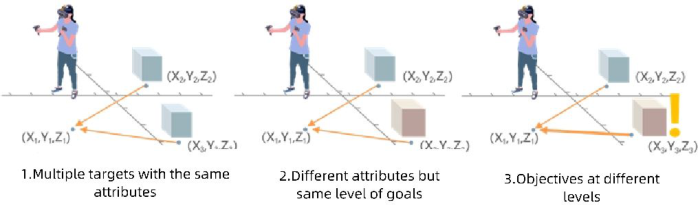
Combined with the above, we divide the design process of haptic equipment used to improve spatial perception in virtual reality into three significant parts: pre-analysis, spatial information analysis and equipment design, and haptic realization and coding. The pre-analysis part includes the study of users’ physiological and psychological characteristics in virtual reality and the selection of spatial information to be transmitted through haptic feedback according to the specific virtual space and task requirements. Regarding the relationship between spatial information analysis and device design, we believe that the three dimensions of spatial information analysis would affect the three design indicators of haptic devices. Still, the degree of closeness between the elements varies. Haptic realization and coding, on the other hand, primarily affect the representation of the type of information.
Figure 4: Types and levels of spatial information (image credit: self-painted by the author).
DESIGN AND EXPERIMENT Based on previous research, this paper designs and develops a haptic feedback wearable orientation information transfer device for virtual reality. This device can transfer spatial information through vibration to help hearing- impaired people “hear” the target position.
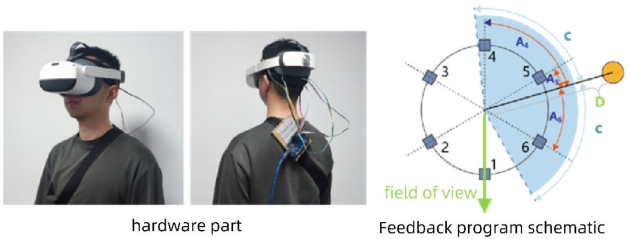
Wearable Device Development In this paper, a head-mounted haptic device is designed to convey spatial information about a virtual scene from a walking perspective. The device consists of a Mega2560 development board, six vibration motor modules, a breadboard, Dupont wire, and an elastic band (shown in Fig. 5). The control board part of this wearable device is fixed on the shoulder strap, which is easy to adjust and does not affect the head movement. By analyzing the target position in the virtual scene, the device converts the angle and distance into the signals of six motors so that the wearer can perceive the target position around the virtual environment through haptics (as shown in Fig. 6, right). Where A is the angle between the motor direction and the target direction on the horizontal plane, D is the camera coordinates and the target distance, and the motor vibration intensity is determined by the angle and distance
between the point motor direction and the target direction. The motors can only be activated when the angle c is less than a set threshold.
Equation reproduced from the original PDF.
where a, c, d, and f are constants used to adjust the feedback program.
Figure 5: Head-mounted haptic device (image credit: self-painted by the author).
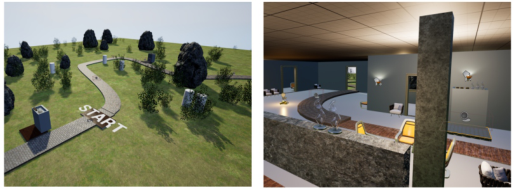
Experimental Station In order to improve the ecological validity of the experiment and bring it closer to the actual VR experience, this paper adds road walking and gesture- grasping tasks to the experiment. The classic walking perspective is chosen for the experiment, and the user can realize free and smooth movement on the horizontal plane through remote sensing. Both virtual scenes are designed to include a route through indoor and outdoor areas to test the feedback effect of the device in different spatial environments, as shown in Fig. 5. The visual elements in the scenarios are unified, with skylight as the light source outdoors and rocks and vegetation to enrich the image; indoors, a fixed light source is used, and furniture, lamps, doors, and windows are arranged to enhance the sense of realism.
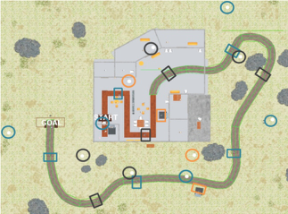
Experimental Flow and Task Planning Subjects could enter the virtual reality space to start the experiment after wearing the haptic feedback device and the head-mounted all-in-one machine. When the subjects travelled along the stone road, 11 task triggers were set up on the line (box position in the figure). When the subject passes the trigger, a white cylindrical target with a diameter of 0.5 m and a height of 2 m will appear nearby and, at the same time, trigger the feedback of orientation information and start timing. Subjects had to find the cylindrical target, point the laser at the target with the left handle, and pull the trigger button. The cylindrical target then turned black, the orientation feedback stopped, the target selection task was completed, and the elapsed time was recorded. At the end of the experiment, the total time spent on all single target-finding tasks was calculated.
Improving Human’s Spatial Information Perception in Virtual Reality 55
Figure 6: Virtual reality scene display (image credit: self-painted by the author).
In this paper, three types of representative virtual reality orientation selection tasks are designed: the essential orientation selection task, the orientation selection task in hand manipulation, and the orientation selection task with line-of-sight occlusion, as shown in Figure 7. The square in the figure indicates the task trigger point, and the task starts when the subject reaches the trigger point, while the circle indicates the target position to be selected.
Figure 7: Schematic diagram of the three types of typical orientation selection tasks (image credit: self-painted by the author).
(1) Essential orientation selection task: This task was designed to explore the effects of different feedback modalities on the effects of information transfer from each angle. Four types of tasks were designed for each scene, and the angles between the target and the subject were 30 degrees (in the field of view), 60 degrees, 120 degrees, and 180 degrees, which appeared randomly on the left and right sides of the subject. Each type of task was repeated twice, and the distance between the target and the subject in the same scene was kept the same, and the target distance in scene 2 was larger than that in scene 1.
(2) Orientation selection task during hand manipulation: Virtual reality experiences often involve gesture interactions between users and scenes, and this task aims to explore the effect of different delivery strategies in delivering orientation information in this context. Two manipulation platforms are set up on the line of each scene, and when the user arrives near the manipulation platforms, he/she needs to grab the glass sculpture with the handle and place it on the designated square. The cylindrical target would appear within a
few seconds during the placement task. At this point, the subject needs to pause the placement task and complete the target selection task. Only after successfully locating and selecting the target cylinder could they continue to complete the placement task.
(3) Orientation selection task with line-of-sight occlusion: This task aims to explore whether different delivery strategies can effectively guide users to discover the target when obstacles occlude the target. Three sets of unique scenarios were designed for this study: a static distance line-of-sight occlusion scenario, an indoor search scenario, and an indoor observing outdoor scenario.
RESULTS AND DISCUSSION
To validate the effectiveness of the device in delivering orientation information in different tasks and to compare the performance differences between the two haptic feedback procedures and auditory feedback, we evaluated the following two metrics: (1) the completion time of each target task and (2) the success rate of each task. Success rates were determined differently for different types of tasks.
Basic Orientation Selection Task For this experiment, task completion times of more than 6 seconds were defined as failures. Failure scenarios included subjects failing to perceive feedback or taking too long to find the target. The experimental success rates are shown in Table 1. The differences in success rates between the different feedback modes did not reach the level of significance, and the average success rate for all three feedback modes was 86.67% (F = 0, p = 1).
Although the difference in success rates between the different scenarios did not reach the traditional level of statistical significance (F = 6, P = 0.07), there is still evidence that the success rate of the haptic feedback experiments in Scene 2 was reduced compared to Scene 1. We attribute this to the fact that the target distance in Scene 2 was further away than in Scene 1, and that the increased distance significantly attenuated the haptic feedback intensity, causing some of the target stimuli to be ignored. In contrast, the success rate of auditory feedback remained stable and was not significantly affected by the scene change.
Table 1: Success rates of basic orientation selection tasks with different feedback modes.
Table available in the original PDF paper.
Feedback Mode Take 1 Take 2 Haptic feedback 1 93.33% 80.00% Haptic feedback 2 90.00% 83.33% Auditory feedback 86.67% 86.67%
Table 2 demonstrates the mean success rates of the three feedback modalities for different types of basic goal selection tasks in the two scenarios. A single factor analysis of variance (ANOVA) was performed on the success
Improving Human’s Spatial Information Perception in Virtual Reality 57
rates for the goal selection tasks from various perspectives, and the results showed a significant main effect of goals at different perspectives (F = 34.5, p < 0.05).
Table 2: Different perspectives on target selection mission success.
From the data, it can be seen that the success rate of the two haptic feedbacks in delivering orientation information at different angles was significantly higher for targets located at the front of the subject (30
, 60
) than for targets at the back (120
, 180
). This may be due to the fact that the skin in contact with the vibrator at the front of the head is more sensitive to vibration, whereas the back of the head may be interfered by the hair, which reduces the sensitivity to the haptic feedback. For auditory feedback, frontal targets were similarly more successful than posterior targets.
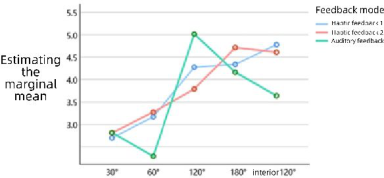
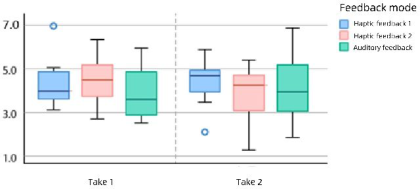
After excluding the failure cases, a double factor ANOVA was performed on the average completion time, as shown in Figure 8. The results showed a significant main effect of target angle (F = 9.434, p < 0.05). In contrast,the feedback mode’s main effect was insignificant (F = 0.498, p = 0.609), and there was no interaction effect between the feedback mode and the target angle. In addition, for the single factor ANOVA analysis of the target angle in the corresponding feedback modality, the main effect between different target orientations was significant in tactile feedback 1 (F = 4.195, P = 0.003); tactile feedback 2 (F = 5.385, P = 0.001); and auditory feedback (F = 6.630, P = 0.000). These results indicate that the effects of different target orientations on all three feedback modalities were statistically significant.
Data Analysis of Orientation Selection Tasks During Hand Manipulation The time taken by subjects in this task was longer, so the selection time of more than 7 seconds was regarded as a failure. The success rates of the task for the three feedback modes were 87.5%, 91.6%, and 100%, and the mean
time taken for the three feedback modes after removing the failed samples was 4.38, 4.14, and 4.06, respectively. A single factor ANOVA was conducted to analyse the time to complete the feedback modes in the different scenarios, and no significant main effect was found for the feedback modes in both Scenario 1 and Scenario 2. The mode’s main effects were not significant. (Scene 1F = 0.776, p = 0.469, Scene 2F = 0.485, p = 0.621).
Both tactile feedback modes were slightly lower than auditory feedback in terms of success rate and mean completion time. In this experiment, experimental observations indicated that subjects were more inclined to find the target by twisting their waist and neck than moving their feet to rotate their field of view compared to the basic choice task. This may be due to the subjects’ habit of keeping their bodies facing the direction that requires gesture interaction.
Figure 9: Box plot of task completion time for directional selection during hand operation under different feedbacks.
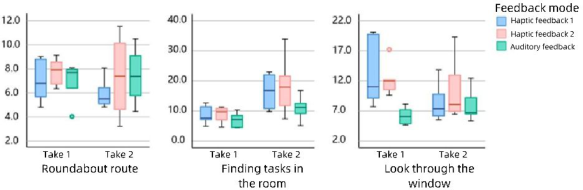
Analysis of Orientation Selection Task Data for Occluded Targets We designed three common types of virtual reality occlusion scenario tasks: finding a target bypassing a boulder, selecting a target inside a room in a living room, and finding a target through a window. In the first two tasks, we placed the target and the user in the same space (outdoor and indoor). The user had to move the field of view away from the original path to find the target based on the orientation information, while in the window selection task, the target and the user were in different scenarios, and the user had to select the target from the indoor room through the window. The average completion times and box plots of the three types of tasks are shown in Figure 10.
Figure 10: Box plots of selection task completion times for obscured targets.
Improving Human’s Spatial Information Perception in Virtual Reality 59
In the Around the Boulder task, a boulder separates the subject from the target. Subjects were required to perceive that the target was located behind the boulder through orientation feedback and move around the boulder to select the target. Averages were calculated after excluding exceptional samples, and the feedback mode’s main effect was insignificant for both Scene 1 and Scene 2 (Scene 1: F = 0.504, p = 0.615; Scene 2: F = 0.592, p = 0.566).
In the indoor room selection task, the target was placed in one of two similar rooms. Subjects were required to identify the room in which the target was located before entering the room to select the target. The room spacing was smaller, and the target location was more centered in Scenario 2. After excluding the special samples, a single factor ANOVA was conducted to analyse the time to complete the feedback mode in the different scenarios. The main effect of the time to complete the feedback mode was insignificant in both Scenario 1 and Scenario 2 (Scenario 1: F = 0.872, p = 0.438; Scenario 2: F = 1.591, p = 0.241). Most subjects were able to correctly determine that the target was in one of the two rooms, and even when they entered the wrong room for the first time, they were able to quickly correct and enter the correct room.
In the target selection through window task, subjects had to select an outdoor target indoors through a window. Compared to Scene 2, the window in Scene 1 was smaller and farther away. Data analysis revealed a significant main effect of feedback mode in Scene 1 (F = 6.193, p = 0.012), while Scene 2 was insignificant (F = 0.739, p = 0.494). From the average values and experimental observations, both haptic feedback modes were challenging for subjects to quickly understand that the target was located outdoors (especially in Scene 1). After receiving the haptic feedback, subjects turned their visual field toward the target but did not move further to the window to select the target through the window. In post-experimental interviews, most subjects reported that they could not immediately associate the target’s location outdoors when using haptic feedback.
CONCLUSION
Several experimental data sets strongly demonstrate that the two haptic feedback devices can effectively replace hearing in conveying orientation information, thus helping users to accurately recognize the target location. In addition, we are still thinking about the significance of haptic feedback in improving spatial perception, and replacing the binaural effect should not be the only goal. In the future, we will refine our experimental goals to improve the efficiency of spatial perception, enhance the sense of orientation, etc., and broaden the application scenarios and scope of haptic feedback to better utilize the advantages and potentials of haptic feedback in spatial perception.
This paper is supported by the 2020 Humanities and Social Science Research Foundation of the Ministry of Education of China, Title: Research on the Design Strategy of Elderly Products Based on Sensory Compensation (Item No. 20YJA760101).
REFERENCES
Alvaro Cassinelli, Carson Reynolds, Masatoshi Ishikawa. Augmenting Spatial Awareness with Haptic Radar [A]. 2006 10th IEEE International Symposium on Wearable Computers [C], 2006. Daniel Zielasko; Bernhard E. Riecke. To Sit or Not to Sit in VR: Analyzing Influences
and (Dis) Advantages of Posture and Embodied Interaction [J]. Computers, 2021, Vol. 10(73): 73. Louise Devigne; Marco Aggravi; Morgane Bivaud; Nathan Balix; Catalin Stefan Teodorescu; Tom Carlson; Tom Spreters; Claudio Pacchierotti; Marie Babel. Power Wheelchair Navigation Assistance Using Wearable Vibrotactile Haptics [J]. IEEE Transactions on Haptics, 2020, Vol. 13(1): 52–58. Peacocke, M.; Teather, R. J.; Carette, J.; MacKenzie, I. S.; McArthur, V. An empirical comparison of first-person shooter information displays: HUDs, diegetic displays, and spatial representations [J]. Entertainment Computing, 2018, Vol. 26: 41–5. Ryo Eguchi, David Vacek, Cole Godzinski, Allison M. Okamura. Between-Tactor
Display Using Dynamic Tactile Stimuli for Directional Cueing in Vibrating Environments [J]. IEEE Transactions on Haptics, 2023: 1–7. Shuchang Xu;Ciyuan Yang;Wenhao Ge;Chun Yu;Yuanchun Shi. Virtual Paving: Rendering a Smooth Path for People with Visual Impairment through Vibrotactile and Audio Feedback [J]. Proceedings of the ACM on Interactive, Mobile, Wearable and Ubiquitous Technologies, 2020, Vol. 4(3): 1–25. Wang Shiming. Design and development of high-resolution head-mounted display
with large field of view [D]. Beijing University of Technology, 2018.
LISTED IN THE AHFE DIGITAL BOOKSTORE CATALOGUE
Explore the complete digital volume
Human Factors and Wearable Technologies
Read this individual research paper free through the original publisher, or explore the full digital proceedings book.
ISBN 978-1-964867-51-9
Explore this ISBN in the AHFE Bookstore ↗Listed in the July 2026 bookstore catalogue; search by ISBN to confirm current availability · Digital book purchase optional