Yuting Hsiao, Dengchuan Cai (2026). Foot Aromatherapy Massager Design. In: Human Factors and Ergonomics In Design. AHFE Open Access, vol. 210, pp. 163–169. https://doi.org/10.54941/ahfe1007436
Foot therapy and Aromatherapy have been widely applied in complementary and alternative medicine. Because foot massage work is characterized by prolonged duration, high intensity, and repetitive force exertion, practitioners are prone to occupational injuries caused by excessive hand load, which may further affect treatment quality and their ability to sustain long-term practice. Therefore, this study aims to develop a foot massage tool that integrates foot therapy and Aromatherapy in order to reduce hand burden and enhance massage quality.This study was conducted in three stages: preliminary research, design development, and testing and validation. The preliminary research stage included the investigation of massage techniques and theories, analysis of existing tools, and the establishment of design specifications and objectives. The design development stage involved ergonomic, mechanical, and appearance design. Finally, prototype fabrication, ergonomic testing, and functional testing were carried out to evaluate the feasibility of the product.The product developed in this study has four main features: (1) a rolling mechanism that replaces direct finger pressure, thereby reducing the load on the finger joints; (2) a stainless-steel roller ball design that provides stable and even force application; (3) an integrated essential oil reservoir and automatic oil dispensing mechanism, combining the effects of Aromatherapy and massage; and (4) an ergonomically designed handle that enhances grip comfort, operational stability, and efficiency.
Foot massage is a common wellness practice that can promote blood circulation and lymphatic flow and enhance metabolic function (Embong et al., 2015). It also provides physical and mental relaxation, thereby reducing anxiety, stress, and pain (Stephenson et al., 2000). In addition, by improving peripheral circulation, foot massage can increase skin temperature and further induce psychological relaxation (Hun and Pack, 2010).
Aromatherapy is often regarded as a form of complementary and alternative medicine and is commonly used to relieve psychological stress. Essential oils are typically administered through inhalation or topical application during massage; after volatilization, they stimulate the olfactory system and produce corresponding regulatory effects (Kong, Evans, & Guevara, 2009). Compared with other types of massage, Aromatherapy massage has been reported to
164 Hsiao and Cai provide greater mental and physical relaxation (Wormwood, 1991). Studies have also suggested that combining Aromatherapy with foot massage may help reduce depression and anxiety and enhance overall relaxation (Kim and Kim, 2012).
According to Aslan and Altın (2022), aromatherapy combined with foot massage was more effective than foot massage alone in improving sleep quality and well-being and in reducing fatigue among stroke patients. Eguchi et al. (2016) reported that self-administered aromatherapy foot massage reduced mean systolic and diastolic blood pressure as well as anxiety, with a trend toward improved mental health and related quality of life. Wahyudin, Khasanah, and Kamil (2022) also found that blood pressure showed a marked decrease in patients with hypertension after receiving lavender Aromatherapy foot massage.
Foot massage techniques can be broadly divided into two types: manual therapy (MT) and tool-assisted methods using a massage stick. However, hand injuries are the second most common work-related musculoskeletal disorder among manual therapy professionals (Gyer & Inklebarger, 2018). Foot massage practitioners must repeatedly apply force for prolonged periods while maintaining sustained working postures, which increases the risk of musculoskeletal injuries to the wrist, thumb, shoulder, and lower back (Jang et al., 2006; Kruger et al., 2017; Busa et al., 2017). Albert, Currie-Jackson, and Duncan (2008) investigated musculoskeletal injury risks among 502 licensed massage therapists in Canada and found that pain and discomfort were most frequently reported in the wrist and thumb, followed by the lower back, neck, and shoulder. These occupational injuries not only compromise practitioners’ health but may also reduce service quality and long-term work capacity, increase staff turnover, and ultimately exacerbate workforce shortages in massage services.
To reduce hand workload, improve operational stability, and effectively lower the risk of musculoskeletal injuries, preventive strategies such as reducing reliance on manual therapy or developing new tools and devices should be considered (Sharan & Ajeesh, 2012). This study aims to develop a foot-massage tool that integrates foot therapy with Aromatherapy. The proposed tool is expected to reduce the operator’s hand strain and enhance overall massage quality.
METHODOLOGY
This study adopts a systematic design process for product design and development, including three stages: preliminary research, design development, and test verification. The preliminary research stage includes: research of massage method and reflection area, analysis of existing massage tools and setting design goals. The design development stage includes: human factor design, mechanism design and appearance design to develop a prototype. Test and verification stage: complete 3D modeling and model making, and conduct use and function tests.
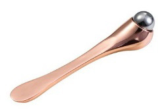
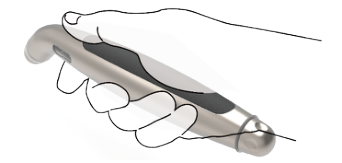
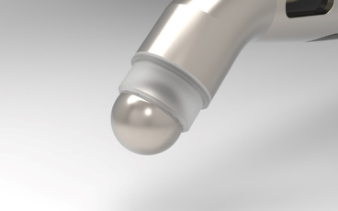
DESIGN RESULTS We collected, purchased, and comparatively analyzed a variety of massage tools currently available on the market. These products were evaluated in terms of function, structure, material, and appearance, and usability testing was also conducted. Figure 1 shows commercially available foot massage tools, which vary in form and method of operation and are mainly used for foot pressing and pushing motions. The analysis of existing products indicates that most of them focus primarily on basic massage functions, while there is still room for improvement in ergonomic design, force stability, and the integration of Aromatherapy. Based on these findings, the design objectives of this foot Aromatherapy massage tool were established as follows: (1) to replace the direct pressing contact between the finger joints and the foot with a rolling mechanism, as shown in Figure 6; (2) to adopt a stainless-steel roller ball at the tip of the massage tool to improve smoothness and durability, as shown in Figure 6; (3) to incorporate a built-in essential oil reservoir with an automatic oil dispensing mechanism to enhance convenience and continuity during massage, as shown in Figure 8; and (4) to apply an ergonomic handle design to improve grip comfort and operational stability, as shown in Figure 4.
Figure 1: Design of commercially available foot massage tools.
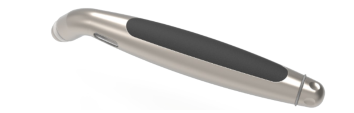
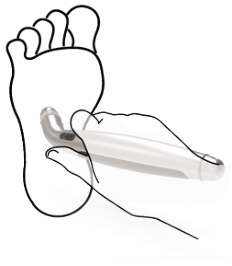
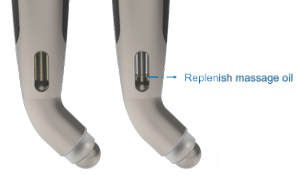
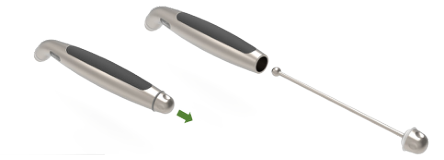
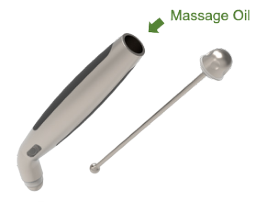
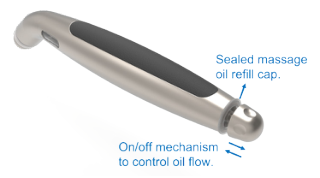
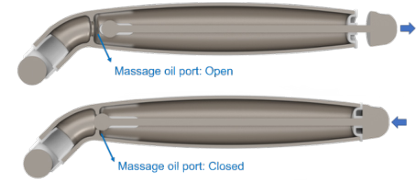
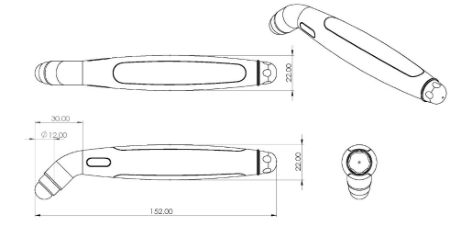
Figures 2 and 3 illustrate the overall appearance of the Aromatherapy foot massage tool developed in this study. Figure 5 shows the usage scenario. Figure 7 presents a transparent window for checking the remaining essential- oil level. Figure 9 illustrates refilling the reservoir with massage essential oil. Figure 10 shows the massage oil flow switch mechanism, allowing users to close it when oil is not desired and open it when needed. Figure 11 presents the essential-oil inlet open/close mechanism. Figure 12 provides the dimension drawing of the Aromatherapy foot massage tool.
Figure 3: Anti-slip grip design for the aromatherapy foot massage tool.Figure 4: Hand grip method for the aromatherapy foot massage tool.Figure 5: Use scenario of the aromatherapy foot massage tool.Figure 6: Stainless-steel rolling ball design.Figure 7: Transparent window to check remaining massage oil level.Figure 8: Built-in massage essential-oil reservoir.Figure 9: Refill the reservoir with massage essential oil.Figure 10: Massage oil flow switch mechanism.Figure 11: Essential-oil inlet open/close mechanism.Figure 12: Dimension drawing of the aromatherapy foot massage tool.
CONCLUSION
This study adopted a series of design methods and processes to produce design outcomes that met the intended expectations. The final design passed both human factors testing and functional testing and achieved the original design goals. The developed product has the following features: (1) This product uses a rolling mechanism to replace the contact and pressure between the finger joints and the feet, which can effectively reduce the load on the massage therapist’s finger joints and alleviate the problem of calluses on the finger joints caused by long-term force application. (2) The stainless- steel rolling ball at the tip of the massage tool provides stable and evenly distributed force, allowing smoother interaction with the massaged area of the foot. (3) This product is designed with a massage oil storage tank and an automatic oil replenishment mechanism, which can continuously release massage oil during rolling operation, combining the effects of aromatherapy and massage. (4) The ergonomic design of the handle can improve the comfort and stability of the massage therapist’s grip, improve the efficiency of operation, and reduce the hand load during long-term operation.
ACKNOWLEDGMENT
The authors would like to thank the National Science and Technology Council of Republic of China (Taiwan) for financial support under project no. NSTC 113-2410-H-224-022.
REFERENCES
Albert, W. J., Currie-Jackson, N., & Duncan, C. A. (2008). A survey of musculoskeletal injuries amongst Canadian massage therapists. Journal of bodywork and movement therapies, 12(1), 86–93. Aslan, K. S. Ü., & Altın, S. (2022). Aromatherapy and foot massage on happiness,
sleep quality, and fatigue levels in patients with stroke: a randomized controlled trial. European Journal of Integrative Medicine, 54, 102164. Busa, M., Ács, P., Boncz, I., & Molics, B. (2017). The Most Common Occupational Illnesses Of Medical-And Sports Masseurs. Value in Health, 20(9), A543. Eguchi, E., Funakubo, N., Tomooka, K., Ohira, T., Ogino, K., & Tanigawa, T. (2016).
The effects of aroma foot massage on blood pressure and anxiety in Japanese community-dwelling men and women: A crossover randomized controlled trial. PloS one, 11(3), e0151712. Embong, N. H., Soh, Y. C., Ming, L. C., & Wong, T. W. (2015). Revisiting reflexology: Concept, evidence, current practice, and practitioner training. Journal of traditional and complementary medicine, 5(4), 197–206. Gyer, G., Michael, J., & Inklebarger, J. (2018). Occupational hand injuries: a
current review of the prevalence and proposed prevention strategies for physical therapists and similar healthcare professionals. Journal of integrative medicine, 16(2), 84–89. Hun, S. J., & Pack, S. H. (2010). The effect of foot reflexology on changes of hand and foot temperature in middle-aged women. J Investig Cosmetol, 6, 233–7. Jang, Y., Chi, C. F., Tsauo, J. Y., & Wang, J. D. (2006). Prevalence and risk factors
of work-related musculoskeletal disorders in massage practitioners. Journal of Occupational Rehabilitation, 16(3), 416–429.
Foot Aromatherapy Massage Design 169 Kim, J. O., & Kim, I. S. (2012). Effects of aroma self-foot reflexology massage on
stress and immune responses and fatigue in middle-aged women in rural areas. Journal of Korean Academy of Nursing, 42(5), 709–718. Kong, E. H., Evans, L. K., & Guevara, J. P. (2009). Nonpharmacological intervention for agitation in dementia: a systematic review and meta-analysis. Aging & mental health, 13(4), 512–520. Kruger, H., Khumalo, V., & Houreld, N. N. (2017). The prevalence of osteoarthritic
symptoms of the hands amongst female massage therapists. health sa gesondheid, 22(1), 184–193. Stephenson, N. L., Weinrich, S. P., & Tavakolil, A. S. (2000, January). The effects of foot reflexology on anxiety and pain in patients with breast and lung cancer. In Oncology Nursing Forum-Oncology Nursing Society (Vol. 27, No. 1, pp. 67–76). [Pittsburgh, PA, etc.] Oncology Nursing Society. Sharan, D., & Ajeesh, P. S. (2012). Injury prevention in physiotherapists-a scientific
review. Work, 41(Supplement 1), 1855–1859. Wormwood, V. (1991). The Fragrant Pharmacy: A Complete Guide to Aromatherapy and Essential Oils. London: Bantam. Wahyudin, D., Khasanah, U., & Kamil, A. (2022). Literature Review: The Effect
of Foot Massage with Lavender Aroma Therapy on Lowering Blood Pressure in Hypertensive Patients. Budapest International Research and Critics Institute- Journal (BIRCI-Journal), 5(4), 29023–29030.
LISTED IN THE AHFE DIGITAL BOOKSTORE CATALOGUE
Explore the complete digital volume
Human Factors and Ergonomics In Design
Read this individual research paper free through the original publisher, or explore the full digital proceedings book.
ISBN 978-1-964867-86-1
Explore this ISBN in the AHFE Bookstore ↗Listed in the July 2026 bookstore catalogue; search by ISBN to confirm current availability · Digital book purchase optional