Nga Yin Dik, Wai Kei Tsang, Ah Pun Chan, Kwan Yu Lo (2024). Garment Fit Evaluation via Customer Feedback on Daily Wear. In: Human Factors for Apparel and Textile Engineering. AHFE Open Access, vol. 134, pp. 130–136. https://doi.org/10.54941/ahfe1004922
The apparel manufacturing sector is progressively employing virtual prototype demos to optimize the pre-production phase and augment correspondence with relevant parties. Connecting consumer demands with accessible sizes is still difficult, though. This paper suggests a methodology that uses natural language programming to understand customers' practical requirements through customer interactions. Customer perceptions can be incorporated into the research process to obtain important insights into the preferences of the target audience and guarantee that the clothing fulfils their expectations. This methodology facilitates precise evaluation of clothing fit, enhances client contentment, and pinpoints opportunities for enhancement. Customers' participation in research also fosters inclusivity and diversity in terms of body shapes and preferences. Through the integration of client feedback, brands can develop customized products that cultivate brand loyalty and enduring partnerships. The study used sentiment analysis and self-observation to gather extensive data for a virtual model of predicted clothing fit. The results emphasize the value of body positivity, self-acceptance, and a broad definition of beauty. Brands may challenge conventional beauty norms and increase customer happiness and confidence by providing a variety of sizes and styles. The study gathered information on factors pertaining to self-perception, personal preferences, and the assessment of garment fit. Correlations between the perception of body form and size and the choice of clothing were found using a logistic regression model. The findings offer insightful information that helps companies customize their offerings and marketing plans, outperform rivals, and retain a devoted clientele.
In recent years, garment manufacturing has been employing virtual pro- totype demonstrations to reduce the use of resources during the pre- production process and enhance the modernizing procedure with their con- sumers (i.e., retailers) and material suppliers. The supplementary hardware and software, such as body scanners and digital rendering systems, have boosted communication between the stakeholders in garment production
Garment Fit Evaluation via Customer Feedback on Daily Wear 131
(Porterfield & Lamar, 2017). Nevertheless, production remains relatively fixed for the manufacturers due to the limited information from customers and the rapid production requirements, especially for the fast fashion brands. Lacking flexibility and information flow are the major loopholes in connect- ing the actual needs of the customers and the availability of sizes. On the topic of flexibility, scholars have investigated the effect of ease allowances on the comfort of wearing the garment (Abtew et al., 2021; Mehtre et al., 2016; Otieno & Fairhurst, 2000). However, their methods focused on the adjustment of the garment’s physical attributes, for example, they targeted the garment sketch measurements and performed fit evaluation by human experts towards their designs. Customer perceptions were not involved in the research methodology, and we think this component is essential for fit eval- uation. Since the customers are the users of the garments, their opinions on the garment sizing and the portion of ease allowances are critical to measure. As a result, we propose that our method includes interactions with customers to understand their practical requirements using natural language program- ming. Incorporating consumer views into the research technique may provide useful insights into their preferences and ensure that the clothing satisfies their expectations. This approach will enable us to accurately assess the garment’s fit and make necessary adjustments based on real-world feedback, ultimately improving customer satisfaction and overall product quality. Additionally, by involving customers in the research process, we can also identify any potential issues or areas for improvement that may have been overlooked by traditional methods. As a result of feeling acknowledged and appreciated during the cre- ation of our clothing, consumers will create a sense of ownership and loyalty in addition to improving the accuracy of our measurements. Furthermore, involving customers in the research process allows for a more diverse range of body types and preferences to be considered, ensuring that our garments are inclusive and cater to a wider audience. By incorporating customer feedback, we can address any specific concerns or preferences that may arise, resulting in a more personalized and tailored product. Ultimately, this collaborative approach will lead to continuous innovation and an improved understand- ing of our customers, allowing us to stay ahead of the competition and build long-lasting relationships with our valued clientele.
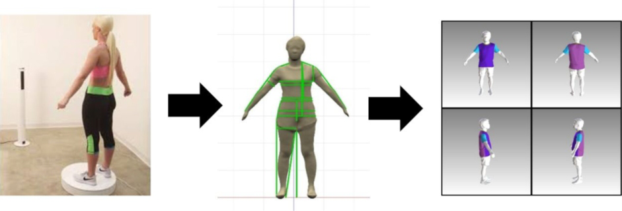
Figure 1: Anthropometric data collection and fitting body with virtual garments (Dik et al., 2023).
METHODS
The objective of this study is to acquire customers’ self-identification based on their own wearing style and/or preferences. By understanding how cus- tomers perceive their own style and inclinations, businesses can adapt their products and marketing tactics to better know the demands of their target customers. This data may also help organizations uncover trends and pat- terns in client preferences, helping them to remain ahead of the competition and retain loyal customers. We recruited 69 human subjects, aged 18 years and over, to conduct survey experiments. They were informed to complete a 3D body scan (to retrieve their body shapes and proportions) and two ques- tionnaire surveys (to obtain their perception of wearing style, purchase habits and evaluate the fitted 3D models with their preferred garment proportions). The measurements follow our previous research on the development of a vir- tual garment fitting prediction model (Dik et al., 2023), and with additional variables in this study, we invited that the subjects perform self-observation in their own body assessment. By incorporating self-observation into our study, we aimed to capture the most comprehensive and reliable data for our vir- tual garment fitting prediction model, which is the actual appraisal of the customers. In addition, by including self-observation, we hoped to gather insights into how individuals perceive their own body shape and size, as this can greatly impact their clothing choices and overall satisfaction with virtual garment fitting. This approach allowed us to better understand the subjective experience of customers and improve the accuracy of our prediction model.
The psychological theory known as “appraisal theory” states that feelings may be formed from our evaluations, or guesses, of the events that cause reactions in different people. In essence, our appraisal of a situation results in an affective, or emotional, reaction based on that judgment (Roseman & Smith, 2001). In our case, the subjects were asked to evaluate themselves according to their perception of body shape, size, and preference for wearing garments. For example, the subject may claim that he or she likes to wear oversized t-shirts and describe himself or herself as slim. These evaluations and perceptions of body shape and garment preference can then reflect cer- tain emotional reactions. For instance, if the subject perceives themselves as slim and prefers wearing fitted clothing, they may feel confident and comfort- able in their clothing choices. On the other hand, if they perceive themselves as overweight and prefer oversized clothing, they may feel self-conscious or unhappy with their body image. Ultimately, the appraisal theory suggests that our assessments of ourselves and our circumstances play a significant role in shaping our emotional experiences. This emphasizes the importance of encouraging body positivity and self-acceptance together with a broader, more inclusive definition of beauty. As a result, providing the right size for each customer based on their needs and preferences is valuable in enhancing satisfaction and rebuilding confidence against societal beauty standards. By providing a variety of sizes to accommodate different body forms, brands can help individuals feel more comfortable and confident in their own skin. Additionally, promoting diversity and inclusivity in advertising and media can help challenge societal beauty standards and promote a healthier body image for all individuals.
Garment Fit Evaluation via Customer Feedback on Daily Wear 133
In this study, we collected four variables for evaluating the garment fit, which are (1) anthropometric data, (2) personal preferences on wearing styles, (3) assessment on four garment types of preferred sizes, and (4) self- evaluative text on their perception of body shape, size, and preference for wearing garments. We employed sentiment analysis, which is a natural lan- guage processing technique, to understand whether the subject was positive or negative about his or her body and wearing style for the variable (4). This approach can understand customers’ practical requirements through customer interactions, incorporating their perceptions into the research pro- cess. We analyzed the received content by zero-shot classification, with the classes of “fat” and “slim,” to identify whether the subject claims himself or herself in terms of body shape and size. Variable (3) is relevant to the subjects’ intention in choosing their sizes since they were asked to choose the preferred garment images for different dummy and garment sizes in the experiment. A multiple logistic regression model was performed to show the relationship between these variables, and the model information is in Table 1. The logis- tic regression model revealed a significant relationship between the variables (3) and (4), indicating that the subjects’ intention in choosing their sizes was influenced by their perception of their body shape and size.
Table 1. Multiple logistic regression model in the study.
Table available in the original PDF paper.
Dependent Variables Independent Variables Purchase Intention (Yes / No) (from Experiment) Anthropometric Data (from 3D Body Scan) Personal Preference on Wearing Styles (from Questionnaire) Self-evaluative Text on the perception of Body Shape, Size, and Preference for Wearing Garments (from Questionnaire) Model Parameters Solver Stochastic Average Gradient (SAG): suitable for small datasets Train-Test Ratio 8:2
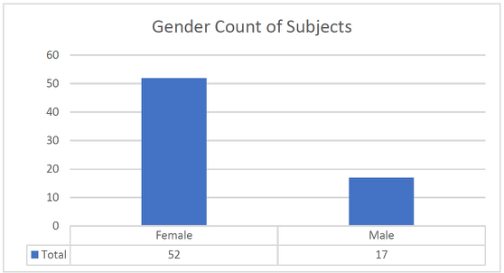
Figure 2: Gender count of subjects in the study.
The descriptions of the variables are as follows: We included four garment types (i.e., T-shirt, long pants, blazer, and long-sleeved shirt). The subjects were asked to identify their preference for the dummies wearing their sizes. For example, a subject who claimed to be wearing M-size would provide a dummy wearing the garment types of M-size. The subject can choose from three options (i.e., sizes of slightly smaller, normal, and slightly larger) when they inspect the garment. This will observe how the subject perceives the comfort of loose or tight garments. Anthropometric data was collected during the body scanning process, where necessary components for garment fitting (e.g., hip, waist, and chest sizes) were captured. The subjects also conducted two questionnaire surveys to observe their individual preferences for wearing styles and perceptions of their own body shape and size.
RESULTS AND DISCUSSION
In our sample, we had 69 subjects for the data analysis. We took four garment types (i.e., t-shirt, long-sleeved shirt, blazer, and long pants) and modelled a multinomial logistic regression model since we have three categories for the dependent variable “Assessment on Four Garment Types of Preferred Sizes.” The assessment involved the subjects’ perceptions of the garment fit of the four garment types in two genders. Table 2 shows the descriptive statistics of the regression model for predicting the preferred proportions (slightly smaller, normal, slightly larger) on behalf of the subject’s usual wearing size. The regression model also included covariates such as age, body mass index, and self-perceived body shape to account for potential confounding factors. These covariates were included to ensure that any observed relationships between the preferred proportions and the garment types were not solely influenced by these factors. Additionally, controlling age, body mass index, and self- perceived body shape allows for a more accurate understanding of the impact of the garment types on the subjects’ perception of fit.
Table 2. Descriptive statistics for multinomial logistic regression model.
The results from the regression model were outwardly lower in accuracy than the industry standard (i.e., >70%). It is aware that our data size is rel- atively small for a regression model, which could have contributed to the lower accuracy. However, it is important to note that the regression model still provided valuable insights and identified significant predictors. We can see that the predictions on men’s long-sleeved shirts, blazer, and T-shirt have
Garment Fit Evaluation via Customer Feedback on Daily Wear 135
a relevant accuracy greater than 50% with this small dataset. We can fore- see that increasing the data size by collecting more samples could potentially improve the accuracy of the model.
CONCLUSION
This study is to examine the effectiveness of using regression model to pre- dict the preferred wearing size of a customer using several indicators such as personal wearing style, anthropometric data, and self-described reflection on own body shape and size. It provides an insight into the considerations of customers’ psychological preferences on wearing a garment by evaluat- ing their perceptions of comfort, fit, and overall satisfaction. By analysing the regression model’s predictions, the study aims to identify key factors that significantly influence customers’ preferred wearing size and potentially improve the accuracy of size recommendations in the fashion industry. Addi- tionally, understanding these indicators can help designers and retailers tailor their offerings to better meet customer expectations and enhance their over- all shopping experience. Although the current model is in low acceptance as the accuracy is unsatisfactory, we believe that after adding more data and refining the algorithm, the model’s accuracy can be significantly improved. This would not only benefit customers by providing more accurate size rec- ommendations but also help fashion brands reduce returns and improve customer loyalty and satisfaction by better garment fit on both physical and psychological aspects.
ACKNOWLEDGMENT
The authors would like to acknowledge that the study is supported by a grant from the Research Grants Council of the Hong Kong Special Administrative Region, China (Project No. UGC/FDS25/H05/21).
REFERENCES
Abtew, M. A., Kuli´nska, M., Zeng, X., & Bruniaux, P. (2021). Determinations of 3D ease allowance in a virtual environment for customized garment design using fuzzy modelling. Computers in Industry, 133, 103552. Dik, N. Y., Tsang, P. W. K., Chan, A. P., Lo, C. K. Y., & Chu, W. C. (2023). A
novel approach in predicting virtual garment fitting sizes with psychographic characteristics and 3D body measurements using artificial neural network and visualizing fitted bodies using generative adversarial network. Heliyon, 9(7). https://doi.org/10.1016/j.heliyon.2023.e17916 Mehtre, A., Otieno, A., Mekonnen, H., Lema, O., & Fera, O. (2016). Developing Standard Size Charts for Ethiopian Men between the ages of 18–26 through Anthropometric Survey. Journal of Textile and Apparel, Technology and Management, 10. Otieno, R., & Fairhurst, C. (2000). The development of new clothing size charts for
female Kenyan children. Part I: Using anthropometric data to create size charts. Journal of the Textile Institute, 91(2), 143–152.
Porterfield, A., & Lamar, T. A. (2017). Examining the effectiveness of virtual fitting with 3D garment simulation. International Journal of Fashion Design, Technology and Education, 10(3), 320–330. Roseman, I. J., & Smith, C. A. (2001). Appraisal theory. Appraisal processes in
emotion: Theory, methods, research, 3–19.
LISTED IN THE AHFE DIGITAL BOOKSTORE CATALOGUE
Explore the complete digital volume
Human Factors for Apparel and Textile Engineering
Read this individual research paper free through the original publisher, or explore the full digital proceedings book.
ISBN 978-1-964867-10-6
Explore this ISBN in the AHFE Bookstore ↗Listed in the July 2026 bookstore catalogue; search by ISBN to confirm current availability · Digital book purchase optional