Nga Yin Dik, Wai Kei Tsang, Ah Pun Chan, Kwan Yu Lo (2023). Analysing the Effectiveness of a Generative Adversarial Network Model for the Creation of New Datasets of 3D Human Body and Garment Sizes in the Clothing Industry. In: Artificial Intelligence, Social Computing and Wearable Technologies. AHFE Open Access, vol. 113, pp. 297–303. https://doi.org/10.54941/ahfe1004202
Publisher statistics will load when you open Metrics.
AHFE OPEN ACCESS OPEN ACCESS CONFERENCE PROCEEDINGS PAPER
Analysing the Effectiveness of a Generative Adversarial Network Model for the Creation of New Datasets of 3D Human Body and Garment Sizes in the Clothing Industry
Apparel designers and manufacturers are now using virtual garment simulation technology to evaluate 3D prototypes in virtual environments, which reduces the waste of raw materials in the sampling process. With the immediate visualization of the 3D prototypes, designers and manufacturers can communicate with each other to adjust the virtual garments seamlessly, and thereby the production process has become simplified using simulation technologies. Nevertheless, there are several limitations to the current practice. Apparel companies do not have a universal sizing standard, which leads to problems because customers need to identify their sizes in different stores, and a high return rate is expected in this case. Additionally, the psychological preferences of the wearers are not taken into account when evaluating fit. Production teams in apparel companies are only concerned with the physical fit of their targeted customer groups; they neglect the actual will of a specific customer. For example, some may like to wear oversized garments, and a just-fit size is not what they want. It is valuable to find a method to adapt the psychographic orientations of the customers to the design and production process of a garment. Therefore, we had proposed our method for developing a virtual garment fitting prediction model to predict the garment pattern parameters with anthropometric data and psychographic orientations of subjects, and previous work had proven that the prediction model has high accuracy and stability. Nevertheless, a limitation was found in that the subject data was difficult to obtain. It would be advantageous if there were more data to test in the prediction model. Thus, this study proposes the build of generative adversarial network (GAN) models to generate new body dimension data and garment parameter data. The new datasets produced by the GAN models would be favourable for an improvement in the virtual garment fitting prediction model with more training and testing data to be processed. Moreover, the synthetic datasets can be employed by designers to do research in their garment evaluation process since they have more data on similar body dimensions and preferred garment sizes to assess. A more comprehensive appraisal of the garment fit can be attained by this approach, which accelerates the design process in the apparel production stage.
Apparel designers and manufacturers are currently using 3D technology to assist in the production of garments, where body scanners and digital render- ing software are employed in the process. Though technological innovations have benefited the apparel industry and customer satisfaction has also been enhanced with more efficient tools, some limitations are still observed. First of all, each garment brand has its own sizing system, which leads to confusion among customers when they purchase clothes in different stores and creates a high return rate at the end. Moreover, the sizing systems of the brands are only defined for physical fit. Customers’ psychographic orientations toward wear- ing a garment are neglected in this case; for example, customers have different tastes towards fashion. In a prior suggestion, we recommended employing an artificial neural network (ANN) model to forecast the parameters of cloth- ing pattern design for manufacturers and designers during the pre-production stage (Chan et al., 2022; Dik et al., 2023). By giving the final users the ideal fit, it facilitates mass customization and customized orientation, and eventu- ally, new sizing methods are delivered to enhance end-user satisfaction with clothing fit and create better ease preference charts. Nevertheless, a limita- tion was found in that the number of records was small (i.e., 120 records) due to the difficulty in finding subjects to participate in the body scan and survey sessions. Even though the coefficient of determination (R2) for the model’s effectiveness was significant, it is still preferable to add more records and some special cases for extremely large or small sizes. Over-training is also another issue that may happen in the previous algorithm with large training iterations due to the limited training data (Yin et al., 2003). Therefore, to come up with a solution, using the generative adversarial network (GAN) model seems to be effective to produce large tabular data synthesis from our obtained amounts. The data creation method in this study used a variety of open-source GAN models, notably the well-known CTGAN and Copula- GAN models. Those synthetic data would include anthropometric data and cognitive inclinations. Two ANN models were trained with the synthetic data generated by the two GAN models, respectively, and in contrast, the testing data would be using the real data from the respondents in the project (i.e., 50 sets). At the end, the performance and computational efficiency of the ANN model were evaluated to determine its significance.
METHODS
The objective of this study is to assess how well new synthetic datasets pro- duced using GAN models can be used to train an ANN prediction model for parameters relating to clothing patterns. Overall, there were three sec- tions to conduct the study. The first part piloted the synthetic data generation with the chosen GAN models. They produced anthropometric data, survey parameters for retrieving the psychographic orientations of a person in choos- ing garments and fitted garment pattern parameters for design sketching. Table 1 is a list of column headers for the data. The second part would apply the synthetic data from each GAN model to train two prediction models. The principle of the ANN models is to forecast the most-fit garment pattern
Analysing the Effectiveness of a Generative Adversarial Network Model 299
parameters for the garment designers when they obtain the data from their customers. With real data gathered from the body scan sessions with partic- ipants, the last phase would assess how well the synthetic data produced by the GAN models performed. In this study, short-sleeved shirts are the garment type to be considered in the development.
As in our prior work, we had 120 subjects who were 18 years of age or older for body scans and surveys to assess body dimension data and psy- chological orientation in fashion and clothing selection, respectively. Due to the GAN model’s potential to generate realistic data and the restriction on subject engagement, 70 sets of real data were used to build the 500 dummy records, while the remaining 50 sets were used for validation. Two GAN models for synthetic tabular data generation, which are CTGAN and Copu- laGAN, were available as open-sourced libraries. Many recent articles have indicated these algorithms for generating synthetic text data (An et al., 2021; Bourou et al., 2021; Gupta et al., 2021; Habibi et al., 2023; Han et al., 2022). CTGAN uses GAN to shape the dispersal of tabular data and choose the required number of sample rows (Huang & Wu, 2022; Xu et al., 2019), while CopulaGAN is a model variant that simplifies the CTGAN model train- ing by using Cumulative Distribution Function (CDF)-based transformation
Table 1. List of column headers for synthetic data (short-sleeved shirts).
Table available in the original PDF paper.
Anthropometric data Gender Height Weight Across Back Armscye Bicep Centre Back to Hip Centre Back to Waist Chest High Hip Hip High Point Shoulder to Bust Point High Point Shoulder to Hip High Point Shoulder to Waist Inseam Natural Waist Neck Outseam Pant Waist Pant Waist Height Rise Back Rise Front Rise Total Shoulder Back Sleeve Length Back Neck Sleeve Length HPS Sleeve Length Shoulder Thigh Under Bust
Survey Parameters to Obtain Psychographic Orientations in choosing garments Occupation Monthly Income Age Range Parameters related to Brand Consciousness
Parameters related to Sensational Parameters related to Practical Parameters related to Informational Garment Pattern Parameters for Design Sketching
Neck Drop- Back Neck Drop- Front Neck- Width Shoulder- Length Across Shoulder Front Length from HPS Back length from CB HPS to Underarm Across Chest Across Waist Side- Length Bottom Edge Opening (Sweep) Sleeve Length from CB (3 Point Measure)
(Bourou et al., 2021). The GAN and ANN models were developed using the Python language, where Synthetic Data Vault (SDV) and PyTorch packages were employed. Last of all, to evaluate the ANN model trained with the syn- thetic data, coefficients of determination (R2) for the 50 testing sets would be presented to show the effectiveness of the ANN model.
RESULTS AND DISCUSSION
Time Complexity in GAN and ANN Models Overall, the models’ time complexity for creating synthetic data and training with it was reasonable. CTGAN and CopulaGAN spent around 10 seconds producing synthetic records into two Excel files, while the training time for the ANN models for the two synthetic datasets was between 3 and 5 minutes. It is anticipated that time complexity won’t be an issue in the future, even if data size increases.
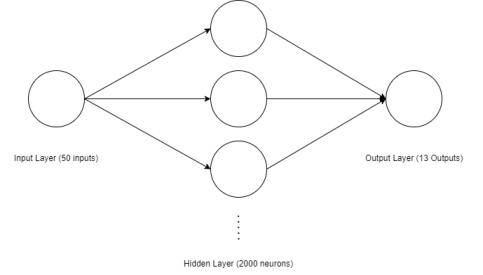
Option in Flattening ANN Structure In our prior work, the ANN structure was in 7 hidden layers to obtain high prediction accuracy since the model handled multiple inputs and outputs in the training process and the amount of data (i.e., 70 training sets) was not suf- ficient to train a high-quality model in a few epochs. Therefore, the proposed method of increasing the number of data points using the GAN model cre- ated 500 synthetic data points and helped reduce hidden layers in the ANN model. The current ANN model was found to be effective with only one hid- den layer. Despite a dramatic increase in hidden neurons as compared to the preceding ANN model, the training time remained relatively constant even as the data size grew. The structure of the ANN has improved and is eventually supportive of a larger dataset.
Figure 1: ANN structure in the model development.
Prediction Accuracy From ANN Model Using Synthetic Data The ANN model was employed to predict the garment pattern parameters for designers and manufacturers to apply in 3D prototype software. The
Analysing the Effectiveness of a Generative Adversarial Network Model 301 performance of the model was so effective that it had a significant R2 for both training (synthetic) and testing (real) data. The model parameters are indicated in Table 2. As mentioned before, two synthetic datasets were gener- ated by CTGAN and CopulaGAN, each producing 500 records. Five rounds of training and testing were performed for each dataset. R2 for the train- ing data generated using CTGAN were between 0.65 and 0.75, while that generated using CopulaGAN were between 0.6 and 0.8. On the other hand, when the ANN model was trained with CTGAN’s data, R2 for the testing were between 0.96 and 0.99, and in the opposite case, R2 for the testing data were between 0.87 and 0.99 when the ANN model was trained with Cop- ulaGAN’s data. The synthetic data generated by two GAN models did not differ much from one another when they were applied to the ANN training. Table 3 presents the findings from the training cycles.
Table 2. Model hyperparameters for the ANN model using synthetic data.
Table available in the original PDF paper.
Hyperparameters Values Activation function Rectified Linear Unit (ReLU) Input parameters Psychological Orientation of Consumers’ Options of Fitting Factors Anthropometric Data Output parameters Garment Pattern Parameters for Design Sketching Hidden layer 1 Hidden neurons in hidden layer 1500 Number of training rows 500 Number of testing rows 50 Learning rate 0.001 Loss function Mean Squared Error Optimizer Adaptive Moment Estimation (Adam)
Table 3. R2 Values from ANN training and testing.
Table available in the original PDF paper.
ANN Model Trained by CTGAN’s data ANN Model Trained by CopulaGAN’s data Round 1 Training Testing Training Testing 0.6753 0.9894 0.7383 0.9910 Round 2
Training Testing Training Testing 0.6514 0.9962 0.6766 0.8713 Round 3 Training Testing Training Testing 0.7478 0.9670 0.7879 0.9919 Round 4
Training Testing Training Testing 0.7405 0.9732 0.6041 0.9114 Round 5 Training Testing Training Testing 0.6862 0.9877 0.7834 0.9987
DISCUSSION FROM THE RESULTS The performance of the ANN model suggested that the synthetic text gener- ation models (CTGAN and CopulaGAN) had nothing in common when it came to ANN model training because the R2 values for both training and test- ing were significant. The advantage of CopulaGAN as a variation of CTGAN is said to be easier data learning (Anande et al., 2023; Bourou et al., 2021; Desai et al., 2022), though it has little impact in our case. There was no significant change from the control in this instance. Also, it was found that data generation for the tabular data synthesis was relatively simple for our study, and those produced data can be utilized if the number of participants is insufficient for training the ANN model.
CONCLUSION
This study has evaluated the potential of using GAN models to generate tabular data synthesis when the data is scarce to train or test the ANN pre- diction model. Our prior work has proposed developing a prediction model for garment pattern parameters based on consumers’ preferences for wear- ing apparel and their body dimensions. However, it was challenging to recruit subjects, and only limited real data were acquired. Therefore, CTGAN and CopulaGAN were assessed to produce 500 dummy data points to replicate the training data for the prediction model. Results indicated that synthetic training data were effective in training the model, and the prediction accura- cies were satisfactory for the five trials. When the real data is insufficient, it is encouraged to use the approach of multiplying tabular data. Given that the current progress primarily focuses on short-sleeved shirts, in future work we will adapt the training data synthesis to the four apparel types (long-sleeved shirts, short-sleeved shirts, blazers, and long pants) when subject shortages continue to exist.
ACKNOWLEDGMENT
This paper was fully supported by a grant from the Research Grants Coun- cil of the Hong Kong Special Administrative Region, China (Project No. UGC/FDS25/H05/21).
REFERENCES
An, C., Sun, J., Wang, Y., & Wei, Q. (2021). A K-means Improved CTGAN Oversampling Method for Data Imbalance Problem. 2021 IEEE 21st International Conference on Software Quality, Reliability and Security (QRS). Anande, T. J., Al-Saadi, S., & Leeson, M. S. (2023). Generative adversarial networks
for network traffic feature generation. International Journal of Computers and Applications, 1–9. Bourou, S., El Saer, A., Velivassaki, T.-H., Voulkidis, A., & Zahariadis, T. (2021).
A review of tabular data synthesis using GANs on an IDS dataset. Information, 12(09), 375. Chan, A.-P., Chu, W.-C., Lo, K.-Y., & Cheong, K. Y. (2022). Improving the Apparel Virtual Size Fitting Prediction under Psychographic Characteristics and 3D Body
Analysing the Effectiveness of a Generative Adversarial Network Model 303
Measurements Using Artificial Neural Network. Human Factors for Apparel and Textile Engineering, 32, 94. Desai, R., Shah, A., Kothari, S., Surve, A., & Shekokar, N. (2022). TextBrew: Automated Model Selection and Hyperparameter Optimization for Text Classification. International Journal of Advanced Computer Science and Applications, 13(9). Dik, N. Y., Tsang, P. W. K., Chan, A. P., Lo, K. Y., & Chu, W. C. (2023). Predicting
Virtual Garment Fitting Size with Psychographic Characteristics and 3D Body Measurements Using Artificial Neural Network and Visualizing Fitted Bodies Using Generative Adversarial Network 14th International Conference on Applied Human Factors and Ergonomics (AHFE 2023). Gupta, A., Bhatt, D., & Pandey, A. (2021). Transitioning from Real to Synthetic data: Quantifying the bias in model. arXiv preprint arXiv:2105.04144. Habibi, O., Chemmakha, M., & Lazaar, M. (2023). Imbalanced tabular data mod-
elization using CTGAN and machine learning to improve IoT Botnet attacks detection. Engineering Applications of Artificial Intelligence, 118, 105669. Han, G., Liu, S., Chen, K., Yu, N., Feng, Z., & Song, M. (2022). Imbalanced sample generation and evaluation for power system transient stability using ctgan. Intelli- gent Computing & Optimization: Proceedings of the 4th International Conference on Intelligent Computing and Optimization 2021 (ICO2021) 3. Huang, G.-L., & Wu, P.-Y. (2022). CTGAN: Cloud Transformer Generative Adver-
sarial Network. 2022 IEEE International Conference on Image Processing (ICIP), Xu, L., Skoularidou, M., Cuesta-Infante, A., & Veeramachaneni, K. (2019).
Modeling tabular data using conditional gan. Advances in Neural Information Processing Systems, 32. Yin, C., Rosendahl, L., & Luo, Z. (2003). Methods to improve prediction performance of ANN models. Simulation Modelling Practice and Theory, 11(3-4), 211–222.
LISTED IN THE AHFE DIGITAL BOOKSTORE CATALOGUE
Explore the complete digital volume
Artificial Intelligence, Social Computing and Wearable Technologies
Read this individual research paper free through the original publisher, or explore the full digital proceedings book.
ISBN 978-1-958651-89-6
Explore this ISBN in the AHFE Bookstore ↗Listed in the July 2026 bookstore catalogue; search by ISBN to confirm current availability · Digital book purchase optional