Nga Yin Dik, Wai Kei Tsang, Ah Pun Chan, Kwan Yu Lo, Wai Ching Chu (2023). Predicting Virtual Garment Fitting Size With Psychographic Characteristics and 3D Body Measurements Using Artificial Neural Network and Visualizing Fitted Bodies Using Generative Adversarial Network. In: Human Factors for Apparel and Textile Engineering. AHFE Open Access, vol. 86, pp. 10–19. https://doi.org/10.54941/ahfe1003635
Publisher statistics will load when you open Metrics.
AHFE OPEN ACCESS OPEN ACCESS CONFERENCE PROCEEDINGS PAPER
Predicting Virtual Garment Fitting Size With Psychographic Characteristics and 3D Body Measurements Using Artificial Neural Network and Visualizing Fitted Bodies Using Generative Adversarial Network
3D virtual garment simulation technology is widely used in apparel industry nowadays with computer-aided manufacturing systems for the earlier stages of apparel design and product development process. The technological advances have brought convenience in garment product fitting procedures with virtual fitting environment, and eventually enhance the supply chain in the aspects of social, economic, and environmental aspects. Many studies have addressed the matters related to non-standardized selection on garment sizing, ease allowance for different selected groups, and use of 3D avatars for virtual fitting in the design and pre-production stages. Nevertheless, the current practice for designers is difficult for them to recognize the customers’ motivation and emotions towards their preferred fit in the virtual environment, leading to a hard time for the designers to determine the appropriate ease allowances for the end users. The present study is to investigate the variations on the ease preferences for the apparel sizes according to the body dimensions and psychological orientation of the subjects by developing a virtual garment fitting prediction model using artificial neural network (ANN). One hundred and twenty adult subjects were recruited to conduct 3D body scans and questionnaire survey for retrieving their body dimensions and psychographic characteristics. Segmentations were performed and each cluster was asked to evaluate the fitting preferences in a co-design interview on virtual garment simulation with a commercial software called Optitex. The results demonstrated that the ANN model is effective in predicting ease preferences from the body measurements and the psychological orientation of the subjects with high correlation coefficients, showing that a non-linear relationship is modelled among pattern parameters, body dimensions and psychographic characteristics. The results were visualized using generative adversarial network (GAN) to generate 3D samples. This new approach is significant to predict the garment sizes and pattern parameters with a highly accurate ANN model. Visualization of the predicted size with the implementation of GAN model is valuable to envision the garment details from 2D to 3D. The project has achieved the conception of mass customization and customer orientation by providing the perfect fit to the end users. Eventually, new size fitting data is generated for improved ease preference charts and augments end-user satisfaction in garment fit.
In recent years, an increasing number of designers and apparel companies are employing 3D virtual garment simulation technology in their early stages of product development process. The combination of 3D virtual simulation prototyping software and computer-aided manufacturing systems enables realistic 3D full-view prototypes to be visualized in pre-production evalua- tion. Variables such as patterns, fabrics and sewing methods which are often modified during the product development process can therefore be imme- diately adjusted. Not only does the 3D simulation software reduces waste of redundant samples and materials, but it also includes interactive consu- mer involvement for mass customization (Apeagyei, 2010). Physical garment properties including fabrics, texture effects, stress and stretch features, and sewing patterns, are taken into consideration during the virtual prototyping process.
Flexibility of using 3D virtual garment simulation software has been a great benefit for designers and manufacturers. The software simulates the typical practice into virtual environment with 2D pattern editing, 2D pat- tern grading, 3D virtual simulation, and 3D sewing functions, where the users can adjust the garment physical properties (Sayem et al., 2010; Spa- hiu et al., 2014). Virtual 3D prototypes can be visualized for evaluation, and thereby consumers can inspect the draping effects of the garment in full views before confirming their orders (Sayem et al., 2010). According to a review done by Hwang Shin and Lee (2020), employing virtual samples can “reduce production lead time up to 50% and save 70% in costs of the pat- tern development”. This improvement in sample review has led to efficient communication, development and production between technical designers and manufacturers. Also, it has restructured the apparel design and fitting procedures, along with enhancing the industry supply chain from garment manufacturing to retails sales in the aspects of economy, society, and envi- ronment. With the efficient performance and effectiveness in garment fitting, professionals in fashion industry will be more enthusiastic in using 3D virtual simulation software (Porterfield & Lamar, 2017).
The 3D simulation software requires designers to create or import 2D pat- tern sketches to modify garment physical properties in real time. Afterwards, designers can fit and shape their design collections onto an appropriate male or female 3D avatar for prototype demonstration. Three significant elements for creating the fitted 3D prototypes are: i) garment dimensions and measu- rements, ii) ease allowances among each size of the garment, and iii) the size selection of the 3D avatar in the software (Chan et al., 2022). An accurate and efficient sizing system should be built with comprehensive understan- ding on garment fit and body shapes to improve garment fit and promote positive effects on sustainable development in apparel industry. As a result, data for body measurements are important for developing the sizing system. Body scanning technology plays a major role in obtaining the data, where it helps defining sizes in the ready-to-wear clothing market (Apeagyei, 2010; Ashdown & Loker, 2010). Many fashion companies take 3D body scan- ners to identify the body shapes and proportions of their customer groups,
so that they can produce custom-fitted clothing and improve their sizing charts at the same time (Petrova & Ashdown, 2008; Song & Ashdown, 2013). By now, there is no universal standard for garment grading due to the demographic differences and different companies have their own rules or principles for their products. Variations of ease allowance will affect gar- ment fit and comfort (Hernández et al., 2018), and many previous studies have been conducted to find the best ease allowances for different garment types, genders, demographics and cloth textures (Mehtre et al., 2016; Otieno & Fairhurst, 2000). Recent studies have also evaluated the ease allowance in using virtual garment fitting technologies (Abtew et al., 2021; Lage & Ancutiene, 2017), nevertheless, their methods may not be adaptable to diffe- rent consumer groups and require extra efforts from design experts to verify the fit evaluation. Furthermore, earlier studies did not explore the influence of consumers’ psychographic characteristics on garment fit and satisfaction. Physical attributes, such as the human body dimensions and the garment sketch measurements, are considered in fitting procedures, but it is also important to consider the consumers’ preference on wearing style, for exam- ple some may like to wear oversized garments while some would like to wear tight garments such as leggings. This study evaluated both physical fit and psychographic characteristics of consumers to recommend ease preference charts in terms of their garment fit satisfaction.
A conceptual framework has been proposed in our preliminary work (Chan et al., 2022). Referring from the proposed framework, this study con- sisted of two stages of data collection of a total of 120 participants. Their anthropometric data were retrieved by body scanning, and a questionnaire survey was conducted to obtain their psychological orientation. A 3D sam- ple model generation system, trained with Generative adversarial network (GAN) framework, was presented to visualize a fitted 3D prototype after the predicted pattern parameters were retrieved from the artificial neural network (ANN) model.
METHODS
This project examined apparel sizes for virtual fitting with two major factors: body measurements and psychographic characteristics of subjects on their ease preferences to enhance the size prediction of 3D garments, with more participant data and garment types to generate wide-ranging ease preference charts. ANN developed a prediction model with the body dimensions and the psychographic characteristics to obtain the crucial parameters for genera- ting the best fit garment sketches. GAN was employed to visualize a sample 3D model wearing the garment based on the predicted results from ANN model. We recruited 70 new subjects aged 18 years old or above to conduct 3D body scans and a questionnaire survey to determine their physical and psychological dissections correspondingly. They were requested to evaluate fitting preferences by adjusting the parameters in a co-design process using a commercial 3D garment simulation software called Optitex. The ease pre- ferences from the respondents were personalized against the predetermined values, where the criteria were mainly based on the participants’ responses.
Predicting Virtual Garment Fitting Size 13
Body Measurement Collection and Pre-Processing Procedures Anthropometric data, such as chest, hip, waist, body length etc., was collected from the participants by 3D body scanning (Styku) Classification of body shapes and sizes was executed to allocate subject data according to the four foremost garment sizes: Small, Medium, Large and Extra Large.
Instruments for Psychographics Categorization A structured questionnaire survey based on the lifestyle orientation i.e., Acti- vities, Interests and Opinions (AIO) was used. The survey included two sessions: i) demographic information (which are age, occupation, and income level); ii) 15 fashion lifestyle statements (Dahana et al., 2019) and activities- related AIO items. AIO items are necessary to measure the lifestyle of people and assess the subjects’ preferred activities (Kara et al., 2006; Lee et al., 2009).
Mechanisms for 3D Garment Fit Simulation In co-design session, participants evaluated the garment design and fit for each 3D model using Optitex. Respondents adjusted the garment physical properties to their preferred garment fit in the drape simulation, where the virtual avatar and clothes were visualized in real time (Guan et al., 2012).
Co-Design Process of Virtual Fit Evaluation With Subjects As a virtual body was created after each body scan with the Styku, each sub- ject had their equivalent avatar in accordance with their body scan data and point cloud data. For each subject, his/her virtual avatar was imported into Optitex to digitalize the drape performance. The subject was asked to co- design the garment fit for the four garment items (i.e., blazer, long-sleeved shirt, short-sleeved shirt, and trousers). Speedy, reliable and real-time forma- tion of fit simulation by Optitex permits users to examine the garment sizes and forms for justification.
Hyperparameters for Artificial Neural Network to Develop Prediction Model A virtual garment fitting prediction model was developed with the applica- tion of ANN to predict the critical factors to create a custom 2D pattern sketch. In our garment fitting prediction model, the input units are P (Perce- ption of Fitting Factors by Consumers’ Psychological Orientation) and B (Body Measurements) and the output unit is R (Pattern Parameters for Sketch Drafting). The hyperparameters for the ANN prediction model are shown in Table 1. The activation function at hidden and output layers are the leaky rectified linear activation function (ReLU), and it was chosen because the form of the data was continuous and it has higher computational efficiency with small ranges of input values in [0,1], where the normalized input values can have fewer fluctuations in training process.
Python language was employed to develop a program for the ANN training and application model. We have four garment types i) Blazer; ii) Long-sleeved Shirt; iii) Short-sleeved Shirt; iv) Trousers. Data of each garment type was used in program training and validation. All data were normalized into the
Table 1. Hyperparameters for artificial neural network prediction model.
Table available in the original PDF paper.
Hyperparameters Values Activation function at hidden layer ReLU f(x) = max(0, x) Activation function at output layer ReLU f(x) = max(0, x) Input parameters P (Perception of Fitting Factors by Consu- mers’ Psychological Orientation) B (Body Measurements) Output parameters R (Pattern Parameters for Sketch Drafting) Number of hidden layers 6 Number of hidden nodes in each layer
Layers 1 & 2: 70 Layers 3 $ 4: 140 Layers 5 & 6: 50 Number of training rows 70 Number of testing rows 50 Learning rate 0.001 Loss function Mean Squared Error Optimizer Adaptive Moment Estimation (Adam)
format of [0,1] and the learning rate was set to the comparative effective value 0.001 (Kumar et al., 2020). The aim to train the dataset was to reduce the losses between the predicted and the actual values and produce high accuracy with the evaluation of squared correlation coefficient (R2) for the trained model.
Generative Adversarial Network Model for Generating Prediction Visualization With the inputted body measurements and the predicted pattern parameter values from the ANN model, a 3D sample production model could be deve- loped using GAN method and PIFuHD (Pixel-aligned Implicit Function in High Resolution) as proposed by Saito et al. (2020a). The collected body scan data from the 120 subjects would be the thematic data for the GAN model to produce relatively realistic samples according to the user body dimensions. The system retrieves similar dataset with the user data and generate a 3D model with the garment for visualization. The hyperparameters in controlling the sample image generation from the thematic data are shown in Table 2. The GAN model follows the structure proposed by Goodfellow et al. (2020) and Saxena and Cao (2021), which is a Deep Convolutional Generative Adversarial Network.
The 2D front-view images, acquired from the GAN model, would be inserted into a modified version of PIFuHD to generate 3D human models. Open-source code for PIFuHD is available online (Saito et al., 2020b). Howe- ver, the current source codes only allow per image reconstruction. To generate thousands of 3D geometry with one run, modified version is employed to input all images for each cluster and return the 3D models in.obj format.
Predicting Virtual Garment Fitting Size 15
Table 2. Hyperparameters for generative adversarial network generation model.
Table available in the original PDF paper.
Hyperparameters Values Training Data 5000–15000 front-view images of each garment type (applied with data augmentation) Batch Size and Image Size 128 Channel 3 for colour images Number of training epochs 50 Generator Layers 15 Discriminator Layers 17 Learning rate for optimizer 0.0002 Optimizer Adaptive Moment Estimation (Adam) Loss function Binary Cross Entropy Loss
RESULTS AND DISCUSSION
Factual Data for Psychographic Characteristics K-means clustering analysis was performed to divide 120 participants into 5 groups by their psychographic characteristics. The group with the high- est AIO involvement on spending their spare time for lifestyle is P5, while the group with the lowest AIO involvement is P1. From the table, the mean score of psychographic characteristics for P5 is 4.57 (out of 7), while for P1, it is 3.37.
Artificial Neural Network Prediction Model for Four Garment Types’ Pattern Parameters In the ANN prediction model, pattern parameters of four garment types would be anticipated for sketch drafting on behalf of the body measurements and psychological orientation of each respondent. Two major elements B and P were inputted into the model for evaluating the output elements R, and the model was established with non-linear relationship between the inputs and outputs. The pattern measurement predictions of the four garment types, which are blazer, long-sleeved shirt, short-sleeved shirt, and trousers, were achieved with the evaluation of the actual pattern parameters from the 120 subjects. In general, most of the training and testing data fit the 45
trend line for regression. The close-to-1 R2 scores mean that the predictions were nearly close to the actual values. The segmentation of participants by psychological orientation had raised the R2 scores in all garment types, compared with the results reported from the overall data. With the improved R2 scores from the 5 different psychographic clusters, the ANN prediction model is establi- shed to be an effective method for garment pattern sketch drafting when the designers have body measurements and psychographic characteristics of their consumers. Customized individual fit is achieved, and the predicted data is practical for virtual fitting.
Preferences on Ease Allowances for Four Garment Types with Body Measurements and Psychographic Characteristics Using Artificial Neural Network With the identified clusters of psychographic characteristics from the 120 subjects and the developed ANN virtual fitting preference prediction model, ease preference charts for each garment type can be associated with the cor- responding psychological segments. Overall, P2 has a relatively larger ease allowances on the pattern parameters in each garment type, while P3 pre- fers smaller ease allowances at the described pattern parameters. Different ease allowances were found in each garment type, though the correlated relationships among the AIO groups were positive (> 0.99) for all garment types.
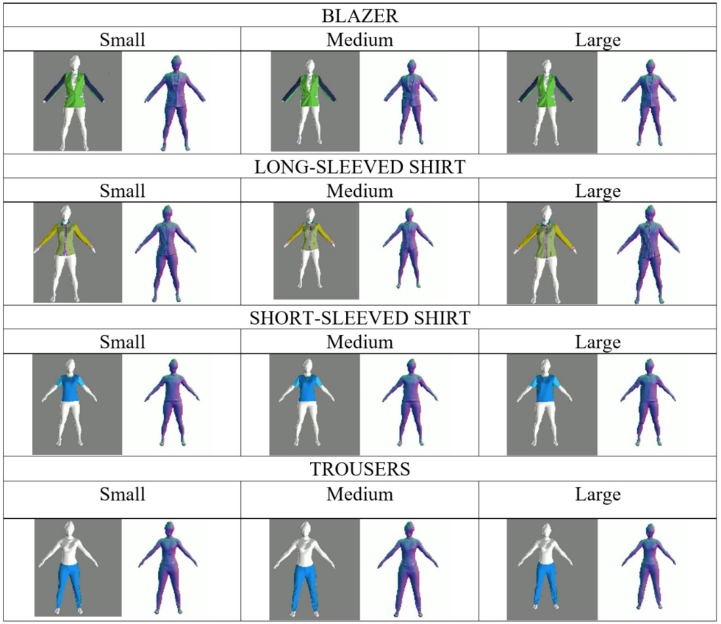
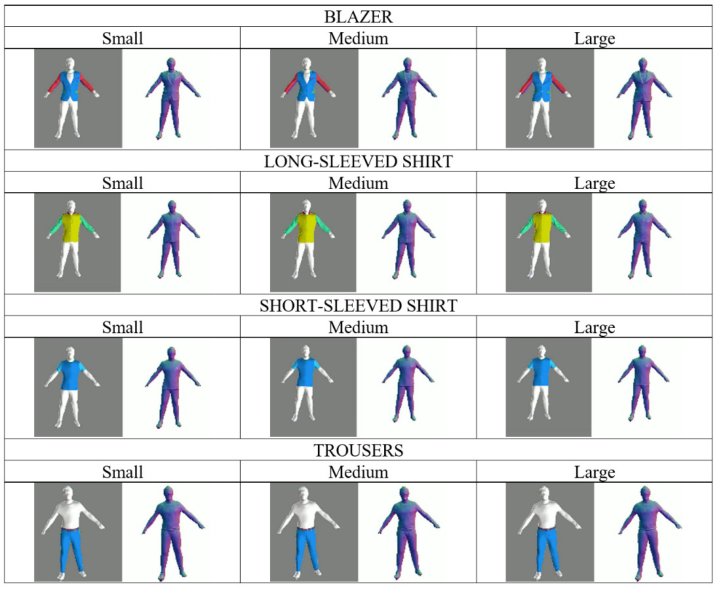
Generating 3D Model Sample by Generative Adversarial Network for Four Garment Types In the GAN model, repetitive front-view images of fitted 3D models were produced for each garment type to present immediate 3D samples in diffe- rent garment sizes and genders. Figures 1 and 2 are representative overviews for the sizes of Small, Medium, and Large by garment types and genders.
Figure 1: 3D Visualisation for small, medium, large sizes (female).
Predicting Virtual Garment Fitting Size 17
Figure 2: 3D Visualisation for small, medium, large sizes (male).
Draping features were easily observed and the generation speed was fast to obtain a high-quality prototype for demonstration.
CONCLUSION
This study proposes a systematic approach in identifying ease allowance pre- ferences with the perspectives of 3D body measurements and psychological orientation of the consumers for four garment types, which are blazer, long- sleeved shirt, short-sleeved shirt, and trousers. The results demonstrated the ease preferences of the subjects were notably different from the prescribed values in the 3D virtual simulation software, and Artificial Neural Netw- ork (ANN) is effective in modelling the non-linear relationship among body measurements, psychographic characteristics, and pattern parameters. The predicted pattern parameters were accurate in the ANN model with a rela- tively high squared correlation coefficient (R2), while the coefficients had improvements when the subjects were clustered by their psychographic cha- racteristics. The ANN pattern parameter prediction model is proven to be an effective technique to draft garment patterns. Furthermore, the quantita- tive correlation among 3D body dimensions, psychographic characteristics and sketch pattern measurements achieves mass customization with indivi- dual fit in apparel industry and is beneficial for the virtual fitting technology. The prediction accuracy of the ANN model is significant, and the model has
provided an effective communication among manufacturers, merchants, and consumers by recommending the “perfect fit” garments with a more finetu- ned ease preference chart for the four tested garment types. The visualization of 3D fitted samples would be ideal for the stakeholders to interpret the garment fit and draping effects for the garments. The DGGAN model, sup- ported with the PIFuHD method, has envisioned immediate prototype with the options of garment sizes, ease preferences, genders, and garment types with high-quality features. In conclusion, the project has achieved to enha- nce communication in the supply chain, where the stakeholders would have advanced instrument to reach comfortable fit for customers with their body dimensions and psychographic characteristics by generating new size-fitting data. Designers can also evaluate their designs easily with the 3D developed samples. A new level of end-user satisfaction from mass customization and a more efficient design process with the sense of customer orientation can be obtained.
ACKNOWLEDGMENT
This paper was fully supported by a grant from the Research Grants Cou- ncil of the Hong Kong Special Administrative Region, China (Project No. UGC/FDS25/H05/21).
REFERENCES
Abtew, M. A., Kuli´nska, M., Zeng, X., & Bruniaux, P. (2021). Determinations of 3D ease allowance in a virtual environment for customized garment design using fuzzy modelling. Computers in Industry, 133, 103552. Apeagyei, P. R. (2010). Application of 3D body scanning technology to human mea-
surement for clothing Fit. International Journal of Digital Content Technology and its Applications, 4(7), 58–68. Ashdown, S., & Loker, S. (2010). Mass-customized target market sizing: Extending the sizing paradigm for improved apparel fit. Fashion Practice, 2(2), 147–173. Bowles, C., Chen, L., Guerrero, R., Bentley, P., Gunn, R., Hammers, A., Dickie,
D. A., Hernández, M. V., Wardlaw, J., & Rueckert, D. (2018). Gan augmentation: Augmenting training data using generative adversarial networks. arXiv preprint arXiv:1810.10863. Chan, A.-P., Chu, W.-C., Lo, K.-Y., & Cheong, K. Y. (2022). Improving the Apparel Virtual Size Fitting Prediction under Psychographic Characteristics and 3D Body Measurements Using Artificial Neural Network. Human Factors for Apparel and Textile Engineering, 32, 94. Dahana, W. D., Miwa, Y., & Morisada, M. (2019). Linking lifestyle to customer
lifetime value: An exploratory study in an online fashion retail market. Journal of Business Research, 99, 319–331. Goodfellow, I., Pouget-Abadie, J., Mirza, M., Xu, B., Warde-Farley, D., Ozair, S., Courville, A., & Bengio, Y. (2020). Generative adversarial networks. Communi- cations of the ACM, 63(11), 139–144. Guan, P., Reiss, L., Hirshberg, D. A., Weiss, A., & Black, M. J. (2012). Drape:
Dressing any person. ACM transactions on graphics (TOG), 31(4), 1–10. Hernández, N., Mattila, H., & Berglin, L. (2018). A systematic model for improving theoretical garment fit. Journal of Fashion Marketing and Management: An International Journal.
Predicting Virtual Garment Fitting Size 19
Hwang Shin, S.-J., & Lee, H. (2020). The use of 3D virtual fitting technology: comparison between sourcing agents contractors and domestic suppliers in the apparel industry. International Journal of Fashion Design, Technology and Education, 13(3), 300–307. Kara, A., Campus, Y., Rojas-Méndez, J. I., Kucukemiroglu, O., Harcar, T.,
& Campus, B. (2006). An empirical analysis of store brand purchase beha- vior using structural equation model. Enhancing Knowledge Development in Marketing, 181. Kingma, D. P., & Ba, J. (2014). Adam: A method for stochastic optimization. arXiv preprint arXiv:1412.6980. Kumar, S., Mishra, R. K., Mitra, A., Biswas, S., De, S., & Karmakar, R. (2020).
A Relative Comparison of Training Algorithms in Artificial Neural Network. 2020 IEEE 1st International Conference for Convergence in Engineering (ICCE), Lage, A., & Ancutiene, K. (2017). Virtual try-on technologies in the clothing industry.
Part 1: investigation of distance ease between body and garment. The Journal of the Textile Institute, 108(10), 1787–1793. Lee, H.-J., Lim, H., Jolly, L. D., & Lee, J. (2009). Consumer lifestyles and adoption of high-technology products: A case of South Korea. Journal of International Consumer Marketing, 21(2), 153-167. Mehtre, A., Otieno, A., Mekonnen, H., Lema, O., & Fera, O. (2016). Deve-
loping Standard Size Charts for Ethiopian Men between the ages of 18–26 through Anthropometric Survey. Journal of Textile and Apparel, Technology an d Management, 10. Otieno, R., & Fairhurst, C. (2000). The development of new clothing size charts for female Kenyan children. Part I: using anthropometric data to create size charts. Journal of the Textile Institute, 91(2), 143–152. Petrova, A., & Ashdown, S. P. (2008). Three-dimensional body scan data analysis:
Body size and shape dependence of ease values for pants’ fit. Clothing and Textiles Research Journal, 26(3), 227–252. Porterfield, A., & Lamar, T. A. (2017). Examining the effectiveness of virtual fitting with 3D garment simulation. International Journal of Fashion Design, Technology and Education, 10(3), 320–330. Saito, S., Simon, T., Saragih, J., & Joo, H. (2020a). Pifuhd: Multi-level pixel-aligned
implicit function for high-resolution 3d human digitization. Proceedings of the IEEE/CVF Conference on Computer Vision and Pattern Recognition, Saito, S., Simon, T., Saragih, J., & Joo, H. (2020b). PIFuHD: Multi-Level Pixel- Aligned Implicit Function for High-Resolution 3D Human Digitization (CVPR 2020). In https://github.com/facebookresearch/pifuhd Saxena, D., & Cao, J. (2021). Generative adversarial networks (GANs) challenges,
solutions, and future directions. ACM Computing Surveys (CSUR), 54(3), 1–42. Sayem, A. S. M., Kennon, R., & Clarke, N. (2010). 3D CAD systems for the clothing industry. International Journal of Fashion Design, Technology and Education, 3(2), 45–53. Song, H. K., & Ashdown, S. P. (2013). Female apparel consumers’ understanding
of body size and shape: Relationship among body measurements, fit satisfaction, and body cathexis. Clothing and Textiles Research Journal, 31(3), 143–156. Spahiu, T., Shehi, E., & Piperi, E. (2014). Advanced CAD/CAM systems for garment design and simulation. 6th International conference of textile.
LISTED IN THE AHFE DIGITAL BOOKSTORE CATALOGUE
Explore the complete digital volume
Human Factors for Apparel and Textile Engineering
Read this individual research paper free through the original publisher, or explore the full digital proceedings book.
ISBN 978-1-958651-62-9
Explore this ISBN in the AHFE Bookstore ↗Listed in the July 2026 bookstore catalogue; search by ISBN to confirm current availability · Digital book purchase optional