Sunisa Chaiklieng (2023). Effectiveness of Ergonomics Management on Risk Reduction of Work-Related Musculoskeletal Disorders Among Textile Export Industrial Workers. In: Human Factors for Apparel and Textile Engineering. AHFE Open Access, vol. 86, pp. 29–38. https://doi.org/10.54941/ahfe1003637
This quasi-experimental study aimed to measure the effectiveness of ergonomics management on risk reduction of work-related musculoskeletal disorders (WMSDs). The study was conducted among industrial workers in one small textile-export enterprise. The 13 workers who met the inclusion criteria were found by screening with a risk matrix of WMSDs and had a risk outcome of WMSDs which was at least at the moderate level (level 3 from five levels). The participants were subjected to an ergonomics program according to the risk levels of WMSDs and the effectiveness was measured by individual comparison between before and after the ergonomics program intervention, which consisted of 1) ergonomics training for improving work posture by using guidance with brochures for self-practice; and 2) using equipment designed for improving workstations, i.e., a chair and footstool designed for the sewing section, and foot support designed for the hand weaving section and quality control section. After ergonomics management implementation, the discomfort scores of workers significantly decreased and the scores of WMSDs risk significantly decreased (p-value <0.001). Therefore, these ergonomics management measures, which could be used as a guideline to reduce WMSDs risk among textile workers, suggest that the organization follows up with long-term screening and surveillance of musculoskeletal diseases to enable industrial workers to work efficiently.
The textile industry is one of the important industries in Thailand. According to the data of the Department of Industrial Works in 2018, the textile industry had a number of factories and workers across the country which was ranked fourth out of 21 industries. Industrial textile production relies on work with industrial tools and industrial sewing machines that have a rhythm of wor- king that leads to repetitive work, static standing or prolonged standing, and eye focusing work that causes the workers to have work-related musculoske- letal disorders (WMSDs). The impact of WMSDs has meant the productivity of workers has been reduced. Chronic accumulated back pain may affect the
workers’ health in such a severe way that they quit work. From previous reports on the different regions of muscular discomfort, such as one report on Bangladesh garment manufacturing, it was found that the most preva- lent muscular discomfort was shoulder pain, followed by pain of the lower back, neck and knee, respectively (Shazzad et al., 2018). In addition, among informal garment workers in the north-east of Thailand, it was also found that shoulder pain was the most prevalent muscular discomfort (Chaiklieng et al., 2014). It is a chronic condition that is difficult to treat if the root cause remains uncorrected. The main cause was ergonomic problems at the workstation (Chaiklieng, 2019).
The occupational risk assessment of WMSDs has been used for health surveillance of musculoskeletal disorders in many occupations or types of industrial work, such as in the potato chip processing industry (Chaiklieng, 2019) and electronics industry (Chaiklieng and Pannak, 2017). The results of the risk assessment have been applied, leading to ergonomics management for preventing and reducing the WMSDs risk among workers.
Ergonomics management refers to the application of ergonomics mana- gement programs to improve the working conditions of workers to reduce WMSDs risk. Previous studies have found that the ergonomics management used in many industries has been able to reduce the WMSDs risk among wor- kers. A study in the electronics industry in Iran found that using magnifying loupes to improve visibility of the parts in an electronics assembly pro- cess had reduced discomfort in different body regions and the whole body (Aghilimejad et al., 2016), and an electronic board holder had been desi- gned for usage in the board inspection process. The electronic board holder reduced ergonomic risk scores (Deshmandi et al., 2018). An ergonomics trai- ning program was implemented with call centre workers in Thailand based on ergonomic principles, and after implementation, the score and level of risk related to neck, shoulder and back pain were decreased (Chaiklieng and Poochada, 2016).
Until the present study, the results of the WMSDs risk matrix for the ergo- nomics management of a small textile-export enterprise had not been applied. Therefore, it was interesting to study this group of workers and assess the effectiveness of ergonomics management based on the principle of whether WMSDs risk can be reduced or not, and use the information for guidance of musculoskeletal disease surveillance in textile industry workers.
MATERIALS AND METHODS
This study was designed as a quasi-experiment. The studied population were workers from a small industrial textile-export enterprise who had WMSDs risk (Chaiklieng, 2019). There were 27 participants who were screened for meeting the inclusion criteria and they were considered eligible if 1) they had a WMSDs risk which was at least level 3, a moderate risk level, out of five levels; and 2) they could be monitored to obtain consistent results on ergonomics management for the month following their participation. There were 13 workers who met the inclusion criteria. The data collection of this research was divided into two phases of process, as described below:
Effectiveness of Ergonomics Management on Risk Reduction 31
Phase I: Baseline measurement of WMSDs risk, workstations, anthropo- metric parameters Phase II: Ergonomics management program included ergonomics training and newly designed equipment (chair, foot support and footstool) was con- ducted and the effectiveness of ergonomics management was assessed after implementation.
Materials for Baseline Measurement and Effectiveness Evaluation
1) Musculoskeletal disorders severity and frequency questionnaire (MSFQ) of Chaiklieng (2019) was used for workers in 10 regions of the body of pain report, i.e., neck, shoulder, upper back, lower back, lower arm, wrist and hand, hip, knee, lower leg, and foot and ankle. 2) Sitting work posture ergonomic risk assessment applied from Rapid Upper Limb Assessment (RULA) (McAtamney and Corlett, 1993). Assessment was done on the parts of upper limb (hand and wrist) and on the parts of neck, trunk and leg. 3) Standing work posture ergonomic risk assessment applied from Rapid Entire Body Assessment (REBA) (Hignett and McAtamney, 2000). In this assessment, several parts were assessed: neck, trunk, upper limb, and leg. With regard to workloads that are considered as lifting loads or holding weight, the upper limb (arm and wrist) coupling was assessed. 4) Matrix of health risk assessment following the model of Chaiklieng (2019). A health risk assessment matrix (Table 1) was created to classify WMSDs risk assessment by using the scores resulting from multiplying the row scores of discomfort level by the column scores of ergonomic risk levels in the risk matrix. The researchers derived the final scores and ranked the health risk levels, i.e., Level 1 (Score 0) = acceptable, Level 2 (Score 1-2) = low risk, Level 3 (Score 3-4) = moderate risk, Level 4 (Score 5-8) = high risk and Level 5 (Score 9-16) = very high risk. 5) Steel measuring tape was used for workstation measurement and plastic measuring tape was used for anthropometric parameters.
Table 1. Matrix of the combined self-reported discomfort levels and the RULA levels used to derive the WMSDs risk scores.
Table available in the original PDF paper.
Applied from Chaiklieng (2019), Colours simply refer to the risk level according to the calculated scores of the matrix: green is an acceptable risk, yellow is low risk, orange is a medium risk, brown is high risk, and red is very high risk.
32 Chaiklieng
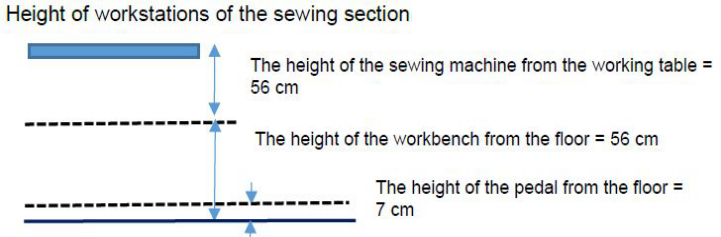
Phase I: Baseline Measurements Before the Ergonomics Management Participants were interviewed by using a structured questionnaire (MSFQ) on musculoskeletal disorders. Ergonomic risk assessment was performed by observations and a recorded video was used for ergonomic risk assessment, for standing work posture, and sitting work posture. The anthropometric parameters of the sitting posture of the sewing section were measured for eight postural parameters which were sitting erect height, mid-shoulder sit- ting height, shoulder breadth, hip breadth, knee height, popliteal height, buttock-popliteal length and buttock-knee length. The workstations of the sewing section were measured for the height of the sewing machine from the working table, the height of the working table from the floor and the height of the foot pedal from the floor. WMSDs risk was assessed by using the matrix of occupational risk assessment and prepared guidelines of ergo- nomics management according to the level of WMSDs risk for the workers who had a WMSD risk which was at least moderate level.
Phase II: Ergonomics Management by Implementation Program The subjects participated in the management pattern depending on the level of WMSDs risk was as follows:
Level 3 (moderate risk): ergonomics training was performed by distribu- ting brochures to workers for learning and practice by themselves, which should be part of a surveillance plan for WMSDs done every six months. There were four titles of brochure, which were “ergonomics management for WMSDs risk reduction”, “muscular exercises for workers who stand or sit for work”, “stretching postures for relieving back and leg pain” and “eye exercise for preventing eye fatigue”.
Level 4 (high risk): ergonomics training was performed by distributing bro- chures to workers for learning and practice by themselves, which should be part of a surveillance plan for WMSDs done every six months, as with level 3. In addition, equipment should be designed or prepared in a way that is appropriate to workers’ anthropometry and working posture for improving working posture or reducing muscular fatigue in those who stand for prolon- ged periods, such as in the hand weaving section, where a softener was used for foot support, and the sewing section, where a specially designed chair was used.
Level 5 (very high risk): ergonomics training was performed by distribu- ting brochures to workers for learning and practice by themselves, which should be part of a surveillance plan for WMSDs done every six months, as with level 3. In addition, designed equipment or an appropriately organized working environment based on the principles of ergonomics was used, such as a footstool designed for the sewing section, foot supporting material for the quality control section and an increase in the thickness of foot mats for the ironing section.
After one month of ergonomics implementation, participants were reas- sessed for the musculoskeletal disorders using MSFQ, ergonomics risk asses- sment of sitting/standing posture, the health risk from WMSDs risk matrix assessment.
Effectiveness of Ergonomics Management on Risk Reduction 33
Statistical Analysis All analyses were performed using STATA version 10.0. Descriptive statistics were used, and for effectiveness of implementation program, WMSDs risk, ergonomic risk level before and after the ergonomics implementation were compared by using a paired t-test.
RESULTS
Workers and Work Characteristics In this study, most workers were women (81.40%). The mean age was 40.33±8.62 years (min-max: 22-55) and the majority had an educational level of the primary school level (62.79%). Regarding work experience, the highest proportion of workers had 10–20 years’ experience (46.51%). When compared to the BMI standard, most workers were classified as nor- mal (18.5-22.9 kg/m2). Most of the workers did not exercise (88.37%), had a working time of six days per week; 58.14% of workers worked eight hours a day and 95.35 % of workers had repetitive movement while working.
There were 4 work processes which were sewing, weaving, quality control and ironing sections. The workers in the sewing section had prolonged sit- ting posture at work of over two hours per day and inappropriate working postures, such as leaning forward, trunk bending and raised shoulders. The workers in the weaving section worked in a prolonged standing posture for over two hours per day. They used a hand for holding the loom lever and swi- ping left and right to produce the fabric pattern. Workers in quality control check products before packing. The workers in this section must inappropri- ately raise their arms high all the time when handling products for inspection with a lamp. The working posture in this step resulted in a standing posture at work of over two hours per day. Workers of the ironing section must lift or hold an iron to iron the clothes.
Anthropometry and Workstation Anthropometric parameters were recorded for designing workstations of the sewing section (Figure 1). The results of anthropometry of five sewing wor- kers were analysed for average, standard deviations (S.D.), 5th percentile and 95th percentile (Table 2).
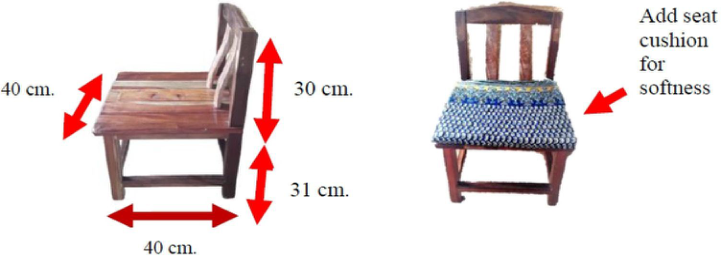
Details of the Designed Workstations in the Implementation Stage a. The chair height calculated by using the 5th percentile of the popliteal height was 33 cm but when volunteers were measured, they were using about 2 cm of seat cushioning, so the chair height was 31 cm. In order to adjust the seat height according to body size and the increase in the softness of chair, this study used a 2-cm-thick cushion. b. The chair depth calculated using the 5th percentile of the buttock- popliteal length was 35 cm. Because the chair was designed to have a backrest, the depth of chair was increased by 5 cm to 40 cm.
34 Chaiklieng
Figure 1: Height of workstations of the sewing section.Table 2. Anthropometry of female workers in the sewing section (n = 5).
Table available in the original PDF paper.
Item Anthropometric parameter Dimension of anthropometry (centimetres) Average S.D. 5th percentile (P5) 95th percentile (P95)
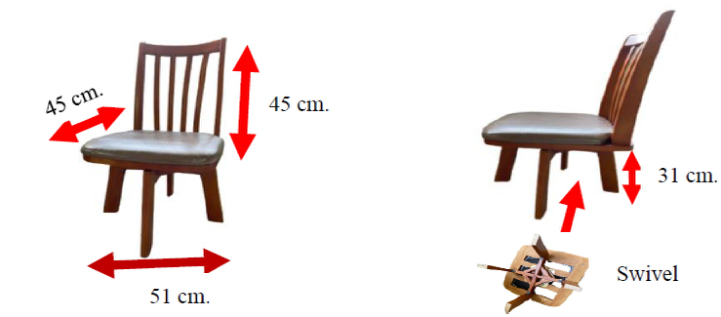
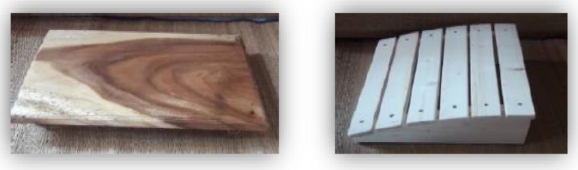
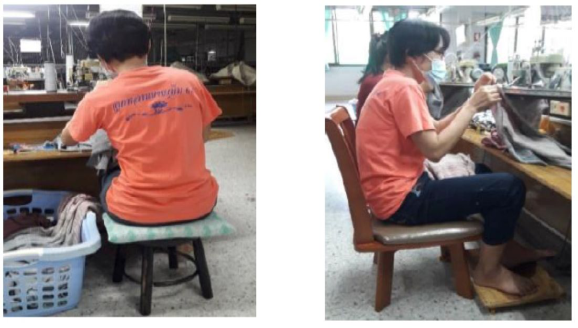
c. The chair width designed using the 95th percentile of hip breadth was 34 cm. In order to be convenient for changing the posture, 3 cm more was then added on each side, so the width of the chair was 40 cm. d. The height of the chair backrest calculated using the 95th percentile of mid-shoulder sitting height was 59 cm. However, the backrest designed to relieve fatigue required only half of the mid-shoulder sitting height, which was 29.5 cm. Therefore, the height of the chair backrest was 30 cm and it had a curved shape. e. The size of the designed chair was 40*40*31 cm. (width*depth*height). The backrest height was 30 cm and the chair was used with a 2-cm- thick cushion (Figure 2). This chair was used with workers who had a high risk level (Level 4) of WMSDs and a swivel chair was used with workers who had a very high risk level (Level 5). The swivel chair was more convenient for putting work pieces together with a sewing machine (Figure 3 and Figure 5). f. The designed footstool was used with the workers who had a very high risk level (Level 5) of WMSDs. The footstool height was less than the height of the sewing machine pedal and the footstool could be moved to support the workers in changing working posture. The size of the foot support was 30*40*6 cm. (width*length*height) and it had a small castor (Figure 4 and Figure 6).
Effectiveness of Ergonomics Management on Risk Reduction 35
Figure 2: Chair for the sewing section (non-swivel chair).Figure 3: Chair for the sewing section (swivel chair).Figure 4: Footstool in the sewing (left) and footrest in the quality control (right).
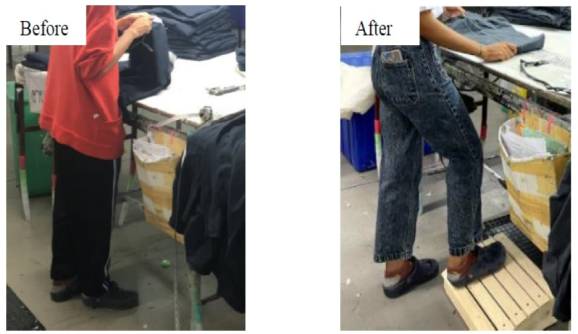
g. Footrest support for the quality control section, ironing section, and weaving section. The foot support was designed to reduce fatigue, be comfortable for the workers to use, and allow easy movement. For the workers of the quality control section, the footrest was changed from rubber to wood, which was curved for better foot support. For the iro- ning section, the foot support was improved by increasing the thickness from 1.9 cm to 3.8 cm to increase the softness of the rubber footpad. For the weaving section, softness was added to the foot support, and for the footrest of the weaving section, a synthetic-fibre-wrapped steel sheet that secured the structure of the weaving machine was used as a footrest.
36 Chaiklieng
Figure 5: A worker sitting at a workstation in the sewing section before (left) and after (right) implementation.Figure 6: Footrest support for the workers in the quality control section (right).
Effectiveness of Ergonomics Implementation Regarding the severity of WMSDs, the highest proportion of workers before implementation had a moderate pain (38.46%), followed by a severe pain (30.77%) and after implementation, almost workers had mild symptom (92.31%).
Before ergonomics management, workers had risk of WMSDs as the fol- lowing: moderate level (46.15%), high level (30.77%), and very high level (15.38%). After implementation, it was found that the vast majority of workers had a moderate risk of WMSDs (92.31%), and low risk (7.69%).
Considering the area of WMSDs, before ergonomics management, it was found that the top three areas of WMSDs risk were shoulder (92.31%), neck (84.62%) and foot and ankle (61.54%), respectively. After implementation, the same areas were found, but in the lower proportion as the following: neck (53.85%), shoulder (53.85%), lower leg (35.71%), and foot and ankle (30.77%) (Table 3).
Effectiveness of Ergonomics Management on Risk Reduction 37
Table 3. WMSDs risk level reduction after implementation, classified according to part of the body (n = 13).
Table available in the original PDF paper.
Part of body WMSDs risk level Acceptable level; n (%) Level 2 - level 5; n (%)
Before After Before After Neck 2 (15.38) 6 (46.15) 11 (84.62) (2) 7 (53.85) (1) Shoulder 1 (7.69) 6 (46.15) 12 (92.31) (1) 7 (53.85) (1)
Upper back 9 (69.23) 9 (69.23) 4 (30.77) 4 (30.77) (3) Lower back 6 (46.15) 11 (84.62) 7 (53.85) 2 (15.38) Lower arm 12 (92.31) 10 (76.92) 1 (7.69) 3 (23.08) Hand and wrist 9 (69.23) 11 (84.62) 4 (30.77) 2 (15.38) Hip 7 (53.85) 9 (69.23) 6 (46.15) 4 (30.77) (3)
Knee 9 (69.23) 10 (76.92) 4 (30.77) 3 (23.08) Lower leg 7 (53.85) 8 (61.54) 6 (46.15) 5 (35.71) (2) Foot and ankle 5 (35.71) 9 (69.23) 8 (61.54) (3) 4 (30.77) (3) (1) (2) (3) The first-, second- and third-ranked among all parts of the body which showed WMSDs risk.
Table 4. Discomfort, postural ergonomics risk, and WMSDs risk levels (before and after) improved by ergonomics management (n = 13).
The analyses show the ergonomics management program reduced the musculoskeletal pain scores and WMSDs risk scores with statistical signi- ficance. The scores of ergonomic risk evaluated the sitting or the standing posture were non-significant of ergonomic risk evaluated by RULA or REBA (Table 4).
CONCLUSION
This study evaluated the effectiveness of ergonomics management by using a health risk matrix considering the severity levels of muscular discomfort and the ergonomics risk levels. After implementation by ergonomics training and newly designed equipment (chair, foot support and footstool), the signi- ficant differentiations of the scores of discomforts and the WMSDs risk were observed. The levels of ergonomic risk had decreased non-significantly after improvement.
This research had limitations regarding the period of time for ergonomics risk improvement because of the situation of COVID-19. However, the rese- archer did give suggestions to the organization for improving ergonomics management and carrying out continuous surveillance, such as provision
38 Chaiklieng
of ergonomics training every month by the organization and evaluation of WMSDs risk every six months by a third party.
A further investigation should be carried out on risk factors that impact neck and shoulder pain in textile industrial workers, and a matrix of WMSDs risk should be developed for neck and shoulder pain by including the factors of light and eye usage for continuous surveillance over at least three mon- ths. In addition, there should be a further study on working posture for the overall design of workstation equipment, like designing armrests for sewing workers and designing multiple chairs (sitting and standing) for weaving, iro- ning and quality control workers. The self-assessments done by workers for improving workstations or equipment are advantageous for surveillance of WMSDs risk.
ACKNOWLEDGMENT
This research was supported financially by the National Research Council of Thailand (NRCT 6200101).
REFERENCES
Aghilimejad, M., Azar, N., Ghasemi, M., Dehehan, N., Mokamelkhan, E. (2016). An ergonomic intervention to reduce musculoskeletal discomfort among semicondu- ctor assembly workers. IOS Press, 54, 445–450. Chaiklieng S. (2019). Health risk assessment on musculoskeletal disorders among
potato-chip processing workers. PLoS ONE 14(12): e0224980. DOI: https://doi. org/10.1371/journal.pone.0224980. Chaiklieng S. (2019). Work physiology and ergonomics. 2nd Ed. Khon Kaen: Khon Kaen University printing house. Chaiklieng, S., Pannak, A. (2017). Health risk assessment of shoulder pain among
electric workers. J Public Health 2(47), 212–221. Chaiklieng, S., Poochada, W. (2016). The effectiveness of ergonomics implemented program among call center workers. Srinagarind Med J. 31(5), 325–331. Chaiklieng, S., Suggaravetsitri, P., Puntumetakul, R. (2014). Prevalence and
risk factors for work-related shoulder pain among informal garment workers in the northeast of Thailand. Small Enterprise Res, 21(2), 180–189. DOI: 10.1080/13215906.2014.11082086. Deshmandi, H., Keeb, D., Kamaliniac, M., Oliaeic, M., Heidar, M. An ergonomic intervention to relieve musculoskeletal symptoms of assembly line workers at an electronic parts manufacturer in Iran. IOS Press, 61, 515–521. Hignett, S., McAtamney, L. (2000). Rapid Entire Body Assessment (REBA) in the
health care industry. In: IEA’97 Proceedings of the 13th Triennial Congress of the International Ergonomics. McAtamney, L., Corlett, E. N. (1993). RULA: a survey method for the investigation of work- related upper limb disorders. Appl Ergon, 24, 91–99. Shazzad, N., Ahmed, S., Haq, S. A., Islam, N., Shahin, A., Choudhury, M. R.
(2018). Musculoskeletal symptoms and disorders among 350 garment workers in Bangladesh: A cross sectional pilot study. Int J Rheum Dis 21, 2063–2070.
LISTED IN THE AHFE DIGITAL BOOKSTORE CATALOGUE
Explore the complete digital volume
Human Factors for Apparel and Textile Engineering
Read this individual research paper free through the original publisher, or explore the full digital proceedings book.
ISBN 978-1-958651-62-9
Explore this ISBN in the AHFE Bookstore ↗Listed in the July 2026 bookstore catalogue; search by ISBN to confirm current availability · Digital book purchase optional