Uchenna Okoro, Kenneth Lawani, Billy Hare (2026). Assessment Of Road Construction Workers’ Exposure To Ergonomic Risk Factors Using The Discomfort Survey And Postural Assessment (DiSPA) Tool. In: Human Systems Engineering and Design (IHSED2026): Future Trends and Applications. AHFE Open Access, vol. 237, pp. 364–375. https://doi.org/10.54941/ahfe1008176
The construction industry has been identified as one of the top industries with higher-than-average self-reported work-related musculoskeletal disorders (WRMSDs). Construction workers develop musculoskeletal disorders (MSDs) due to continuous exposure to ergonomic risk factors such as awkward posture, repetitive tasks, prolonged working duration, vibration, insufficient breaks or recovery, physical and mental stress, psychosocial and environmental factors. The Discomfort Survey and Postural Assessment (DiSPA) tool was developed to assess construction workers' exposure to ergonomic risk factors. The DiSPA tool combines a discomfort survey with postural assessment, assesses a range of risk factors and reviews the whole body for a comprehensive assessment. This study assesses the exposure of road construction workers to ergonomic risk factors using the DiSPA tool through self-reporting and observations. A cross-sectional assessment of 72 road construction workers, comprising labourers, masons, ironworkers, carpenters, operators, and drivers, was conducted, and quantitative data analysis was carried out. The results suggest a prevalence of MSDs among road construction workers. 83% of participants reported at least one form of musculoskeletal symptom. Carpentry was the trade with the highest musculoskeletal symptoms at 93%, and the lower back was identified as the body part most associated with MSDs. Although self-reporting is crucial for evaluating musculoskeletal symptoms, this research advocates a complementary approach to MSD assessment. An integrated method combining self-reporting and observations has been presented to achieve robust, comprehensive outcomes that enable appropriate interventions. The DiSPA tool meets the need for this complementary approach and has been applied to achieve the study aim.
Several studies and reports support the premise that the construction industry is highly hazardous (Jazari et al., 2018; ILO, 2015; BLS, 2026; HSE, 2025a). A significant contributor to this status is the prevalence of musculoskeletal disorders (Jazari et al., 2018; Egwuonwu et al., 2016). According to the Health and Safety Executive (2025b), construction workers experienced
Received June 15, 2026 Revised July 12, 2026 Accepted July 24, 2026 Available online September 25, 2026
Assessment of Road Construction Workers’ Exposure to Ergonomic Risk Factors 365 work-related MSDs at significantly higher rates than workers in other industries, such as manufacturing and transportation.
HSE (2022, 2025b) reported the prevalence of MSDs in the UK construction industry. In China, Lee et al. (2023) documented the prevalence of MSDs among construction workers. Boschman et al. (2012) demonstrated MSD prevalence in the Netherlands. These studies validate and support the assertion of MSD prevalence among construction workers. Similar reports apply to developing economies such as India (Chakraborty et al., 2018) and Nigeria (Adedoyin et al., 2022; Ekpeyong & Inyang, 2014; Egwuonwu et al., 2016), all reporting a prevalence of MSDs among construction workers. Wang et al. (2016) found a decline in the number of WRMSDs in the United States construction industry (1992-2014); however, Wang et al. (2015) agree that the industry has a preponderance of MSDs.
Musculoskeletal Disorders (MSDs) are injuries to soft tissues caused by sudden or prolonged exposure to repetitive motions, force, vibration, and awkward postures (NIOSH 2024). Work-related musculoskeletal disorders (WMSDs) are MSDs that develop or worsen due to work activities (Egwuonwu et al., 2016). These disorders negatively affect workers, causing pain and discomfort and leading to serious outcomes such as absenteeism, decreased productivity, job dissatisfaction, reduced quality of life, legal threats, and disability (Lemaster et al., 2006; Crawford et al., 2021). The cost of treating and managing MSDs is enormous (Ali et al., 2019; Gorasso et al., 2023; Dieleman et al., 2020).
Ergonomic tools have been developed over the years to evaluate MSD risk factors in the workplace, which is essential for preventing musculoskeletal disorders. Examples of the ergonomic tools include the Ovako Working Posture Analysing System (OWAS), Rapid Entire Body Assessment (REBA), Nordic Musculoskeletal Questionnaire (NMQ), Cornell Musculoskeletal Discomfort Questionnaire (CMDQ), Quick Exposure Check (QEC), and Workplace Ergonomic Risk Assessment (WERA) (Karhu et al., 1977; Mcatamney & Hignett, 1995; Kuorinka et al., 1987; Hedge et al., 1999; David et al., 2008; Rahman et al., 2011). Each tool is designed with unique features and strengths (David, 2005).
The Discomfort Survey and Postural Assessment (DiSPA) tool developed by Okoro et al., (2026) as part of an on-going study, is a comprehensive, whole-body ergonomic tool designed specifically for the construction industry and could be adapted for other industries with high prevalence of MSDs. DiSPA comprises a discomfort survey (DiS) and a postural assessment (PA) component. It includes features such as a body map, a risk matrix, a workers’ questionnaire, and an observers’ questionnaire. It evaluates various MSD risk factors such as vibration, environmental conditions, recovery/ rest time, grip, psychosocial factors, work stress, posture, frequency, weight/ force, and duration (Okoro et al., 2025; Okoro et al., 2026). By combining discomfort perception with posture observations, DiSPA adopts a more holistic approach to assessing MSD risk exposure.
SELF-REPORTING QUESTIONNAIRE/SURVEYS Ergonomic risk assessment methods are designed to assess workers’ exposure to ergonomic risk factors. They could be self-reporting, observational assessment, direct measurement or remote sensing methods (Wang et al., 2015). These methods have been used in epidemiological research and ergonomic studies for data collection, pain assessment or risk assessment (Gao et al., 2025; Gambatese & Jin, 2021; Brauer et al., 2003).
The self-reporting questionnaire or body discomfort survey is a unique risk assessment tool for musculoskeletal disorders, relying on workers’ personal experiences and perceptions to provide insights into MSD symptoms (David, 2005; Wang et al., 2015). Usually, it contains a set of questions that relate retrospectively to the worker’s experience of pain, discomfort, fatigue, tenderness, and numbness, or a combination thereof. Further questions regarding the severity, likelihood/frequency, and work interference of pain may be included (David, 2005; Wang et al., 2015; Kuorinka et al., 1987; Okoro et al., 2026). Body maps, which aid workers in expressing their experiences of pain or discomfort, may also be included. While critics point out its subjectivity, potential imprecision, the influence of worker literacy, and the disruption caused by self-reporting (David, 2005; Tang, 2020) as weakness, its advantages such as ease of use, cost-effectiveness, broad applicability across various work settings, suitability for large populations, worker engagement, and the capacity to identify health issues that might only be detectable through medical examination (David, 2005; Wang et al., 2015), have sustained its widespread adoption. Some examples of self-reporting questionnaires include the Nordic Musculoskeletal Questionnaire (Kuorinka et al., 1987), the Cornell Discomfort Musculoskeletal Questionnaire (Hedge et al., 1999), and the Dutch Musculoskeletal Questionnaire (Hildebrandt et al., 2001).
OBSERVATIONAL ASSESSMENT Observational or postural assessment involves evaluating workers’ tasks by a trained observer, assessor, or facilitator using a pre-designed checklist. The evaluation reviews the worker’s posture in a particular body region (e.g., back, wrist), the frequency of movement in that region, and the severity of action and/or duration while performing a task. The checklist or ergonomic tool would normally contain a set of structured questions that the assessor would use to rate and analyse the worker’s ergonomic risk exposure based on observation (David, 2005; Wang et al., 2015; Karhu et al., 1977; Okoro et al., 2026). According to David (2005), observational methods yield more precise data than self-reporting methods. Observational methods are largely inexpensive and could be applied to a range of tasks and workplaces, especially as they don’t directly interrupt work (David, 2005; Wang et al., 2015). Their practicability (how well the method could be used in varying work circumstances) remains a key strength (Widyanti, 2018). Conversely, the observational method requires that the observer be sufficiently trained in using the selected ergonomic tool, and the assessment outcome relies on the observer’s judgment (Wang et al., 2015), which may be imprecise or biased. Another challenge with this method is that only a
Assessment of Road Construction Workers’ Exposure to Ergonomic Risk Factors 367 limited number of observations can be conducted by the facilitator. Some examples of observational tools are the Ovako Working Posture Analysing System (OWAS) (Karhu et al., 1977), Rapid Entire Body Assessment (REBA) (McAtamney & Hignett, 1995), Quick Exposure Check (QEC) (David et al., 2008), Work Ergonomic Risk Assessment (WERA) (Rahman et al., 2011).
COMBINED METHOD OF ASSESSMENT Various studies have combined ergonomic assessment methods to achieve deeper insights into MSDs or ergonomic risk factors. Habibi et al. (2012), Anwar & Putri (2017), Adiyanto et al. (2022), Akuma and Abdullah (2025), Gambatese & Jin (2021), among others, adopted a mixed-method approach to assessing MSDs by combining self-reporting surveys of workers with observational tools. According to the authors, combining a survey questionnaire with an observational assessment yielded a comprehensive outcome, enhanced validity, and reduced the likelihood of missing risk factors. Other benefits of a combined approach include enhanced data, expanded data and robust findings.
Despite the advantages of combining self-reporting with observational techniques, an underlying challenge remains. These ergonomic tools are designed to meet different needs; therefore, there is a risk of discrepancies in the final results, which may affect the validity of the research. For example, combining an observational tool designed only for the upper body with a self-reporting tool that assesses the whole body (including the lower limbs) can lead to such discrepancies. On this basis, and more, the Discomfort Survey and Postural Assessment (DiSPA) tool was developed to integrate a discomfort survey with an observational assessment, covering a range of risk factors for a comprehensive whole-body assessment (Uchenna et al., 2024; Okoro et al., 2025; Okoro et al., 2026). This paper assesses road construction workers’ exposure to MSD risk factors using the DiSPA tool.
METHODS
To investigate the prevalence of MSDs among road construction workers in south-south Nigeria, 100 workers were selected from a construction site using stratified random sampling. Participants included drivers, operators, masons, carpenters, iron fitters, and labourers.
Inclusion criteria: Workers who had been active in the selected construction site and performing the same task over the preceding 3 months.
72 workers, including 4 drivers, 20 operators, 14 carpenters, 10 iron fitters, 12 masons, and 12 labourers, met the inclusion criteria and were assessed in a cross-sectional survey using the DiSPA tool to assess their exposure to MSD risk factors. Two facilitators who had completed 2 hours of training in using the DiSPA tool conducted the assessment. The two components of DiSPA were applied to the participants. Data from the DiSPA tool were then collated, and quantitative analysis was conducted using Excel to determine MSD prevalence.
Ethical approval for this research was obtained from the Research Ethics Committee of the University. Organisational approval was also obtained from the selected company’s designated manager and supervisor before conducting the study.
FINDINGS The findings of the study are illustrated in Tables 1, 2, 3, and 4. The per cent pain experience for each trade is shown in Table 1.
Table 1: Pain count by trade.
Table available in the original PDF paper.
Trade Number of Workers per Trade
Number of Workers Reported no Pain in any Body Part
Percent of no Pain Experience per Trade
Number of Workers Reported Pain in at Least one Body Part
Percent of Pain Experience per Trade Driver 4 2 50% 2 50%
Operator 20 5 25% 15 75% Carpenter 14 1 7% 13 93%
10 2 20% 8 80%
Iron Worker Mason 12 1 8% 11 92%
Labourer 12 1 8% 11 92% Total 72 12 17% 60 83%
The percentage pain count for each body region reveals the body region mostly symptomatic to MSDs among the participants as seen in Table 2.
Table 2: Pain count per body part.
Table available in the original PDF paper.
Body Part Pain Count Percentage Pain Count Upper Back 5 4%
Lower Back 45 32% Left Shoulder/Arm 20 14%
Right Shoulder/Arm 24 17% Left Wrist/Hand 6 4%
Right Wrist/Hand 9 6% Neck 4 3%
Left Leg/Knee 11 8% Right Leg/Knee 12 9%
Left Feet/Ankle 2 1% Right Feet/Ankle 2 1%
Total 140
Table 3 further breaks down Table 2, showing the percentage of workers per trade reporting pain in each body part.
Table 3: Percentage of workers per trade reporting pain in a body part.
Table available in the original PDF paper.
Per Cent Pain Count - Operator 20
Per Cent Pain Count - Carpenter 14
Per Cent Pain Count - Iron Worker 10
Per Cent Pain Count - Mason 12
Body Part Per Cent Pain Count - Driver 4
Per Cent Pain Count - Labourer 12
Upper Back Pain
0 0 1 (7%)
2 (20%)
0 2 (17%)
Lower Back Pain
2 (50%)
10 (50%)
7 (50%)
7 (70%)
10 (83%)
9 (75%)
0 5 (25%)
5 (36%)
3 (30%)
2 (17%)
5 (42%)
Left Shoulder/ Arm Pain 1 (25%) 7 (35%)
8 (57%)
3 (30%)
1 (8%)
4 (33%)
Right Shoulder/ Arm Pain
0 0
Left Wrist/ Hand Pain
0 2 (10%)
1 (7%)
3 (30%)
0
Right Wrist/ Hand Pain
0 3 (15%)
2 (14%)
3 (30%)
1 (8%)
0
Neck Pain 0 2 (10%)
1 (7%)
0 1 (8%)
Left Leg/ Knee Pain
1 (25%)
3 (15%)
3 (21%)
1 (10%)
1 (8%)
2 (17%)
Right Leg/ Knee Pain
1 (25%)
3 (15%)
3 (21%)
2 (20%)
1 (8%)
2 (17%)
0
Left Feet/ Ankle Pain
0 0 0 0 2 (17%)
0 0 0 0
Right Feet/ Ankle Pain
1 (25%)
1 (5%)
6 36 31 24 19 24
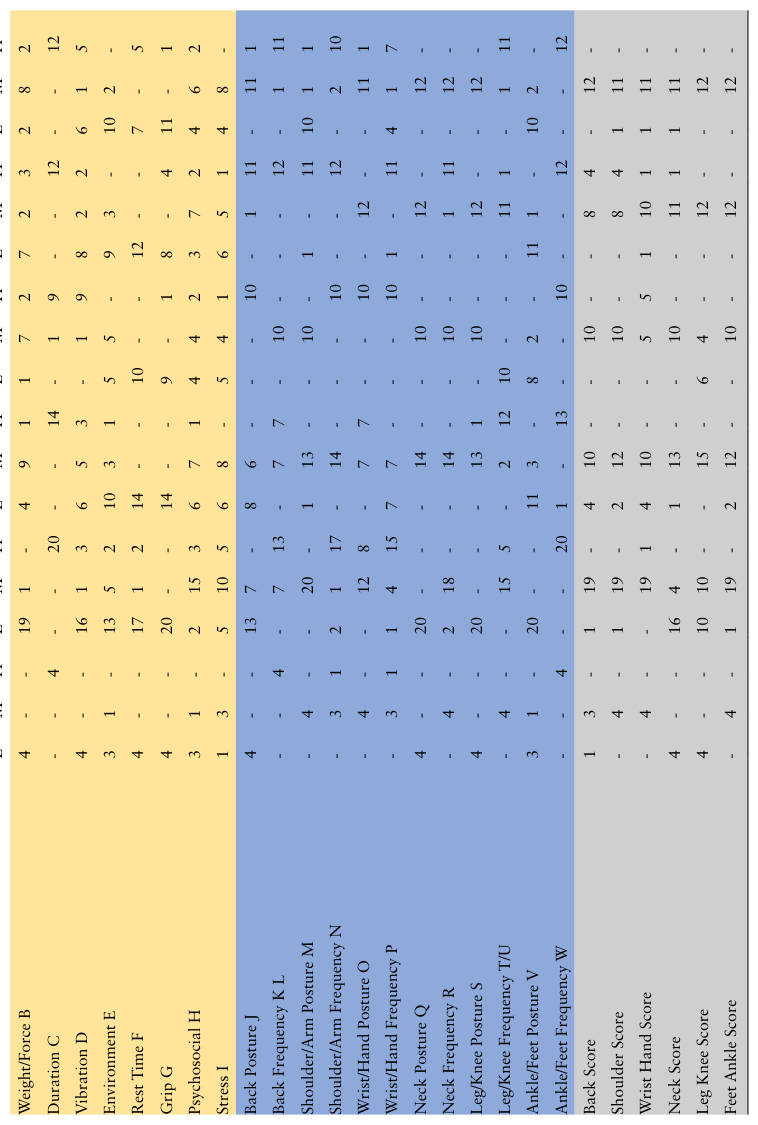
Total Pain Count The risk factors and posture scores for each body region evaluated with DiSPA are presented as low (L), medium (M), or high (H) as classified in the DiSPA tool (Okoro et al., 2026). Table 4 summarises the risk rating and final posture scores for each risk factor and body region. In table 4, the region in gold colour represents additional risk factors (weight, vibration, etc.), the section in blue represents the core risk factors (posture and frequency of each body region), and the grey-coloured section represents the final scores for each body region.
L M H L M H L M H L M H L M H L M H
Table 4: DiSPA postural assessment ratings and scores.
Variables from Postural Assessment Drivers Operators Carpenters Iron Workers Masons Labourers
DISCUSSION
The results of the test (Table 1) establish that 60 out of the 72 workers (83%) reported at least one form of musculoskeletal pain. More carpenters (93%) reported pain experience than any other trade, followed by masons and labourers (92%) and iron workers (80%). Drivers were the least at 50%. 83% of participants identified at least one part of the body in which they experience MSD Symptoms and which they perceive to be work-related. These symptoms of pain and discomfort have been used by several authors to estimate work-related musculoskeletal disorders (Grzywinski et al., 2016; Anton and Weeks, 2016; Egwuonwu et al., 2016). Egwuonwu et al. (2016), for a similar study in south-east Nigeria, recorded an MSD prevalence of 66%. Table 2 illustrates the pain count per body region. From the table, more workers (32%) experienced pain in the lower back, followed by the right shoulder/arm and left shoulder/arm, 17% and 14%, respectively. Fewer workers (1%) suffered pain in the feet/ankle.
For the percentages recorded per body region in Table 2, the trades contributing to these percentages are displayed in Table 3. Some highlights include, Lower Back Pain: 83% (10 out of 12) of Masons experienced lower back pain, followed by labourers 75% (9 out of 12), and iron workers 70% (7 out of 10).
Neck Pain: More operators (2 out of 20) 10%, reported neck pain when compared to other trades.
Left Feet/Ankle Pain: Only Masons (2 out of 12), 17%, reported left feet/ ankle pain.
Virtually every assessed body region had pain reports, with the low back reporting the most.
Table 4 highlights the risk factors more associated with particular trades in the study. Below are some highlights from the table.
Weight/Force: More masons experienced heavy lifting or high force in the discharge of their tasks.
Duration: Nearly all workers were rated high in the evaluation of task duration Vibration: Vibration is an additional or external risk factor (according to the categorization of the DiSPA tool), which was assessed as high following Duration.
Psychosocial Factors: Medium-to-high psychosocial factors were common across all trades except drivers.
Back Posture and Frequency: Back posture rating was predominantly high among iron workers and masons. However, back frequency was medium for iron workers, medium-to-high for operators and carpenters, and high for drivers, masons and labourers.
Back Score: Final back score was low-to-medium for drivers and carpenters, medium score for operators, iron workers and labourers, and medium-to-high score for masons.
Neck Posture and Frequency: Neck posture rating was generally low among drivers and operators, but medium among carpenters, iron workers,
masons, and labourers. Neck frequency was medium for drivers, carpenters, iron workers, and labourers, medium for operators and high for masons.
Neck Score: Final neck score was low for drivers, low-to-medium for operators, carpenters and labourers, medium for iron workers and medium- to-high for masons.
Leg/Knee Posture and Frequency: The data show a low leg/knee posture rating for drivers and operators. For carpenters, iron workers, masons and labourers, it was predominantly medium rating. Leg/Knee movement frequency rating was medium for drivers and masons, medium-to-high for operators and carpenters, low for iron workers and predominantly high for labourers.
Leg/Knee Score: Leg/knee final score was low for drivers, low-to-medium for operators and iron workers, and medium for carpenters, masons and labourers.
Having identified the body regions most susceptible to MSDs and the risk factors to which workers are exposed, appropriate interventions to improve workers’ well-being could then be applied. These interventions could take the form of administrative, engineering, or personal protective equipment (PPE) measures (Wang et al., 2015). Improved worker well-being is expected to lead to higher productivity.
CONCLUSION
This study revealed a high prevalence (83%) of musculoskeletal disorders (MSDs) among road construction workers, with carpenters recording the highest prevalence among the occupational trades assessed. The lower back emerged as the body region most affected by MSDs, while prolonged work duration, exposure to vibration, and psychosocial factors were identified as additional risk factors requiring attention.
The application of the Discomfort Survey and Postural Assessment (DiSPA) tool, which integrates self-reported discomfort data with observational postural assessment, provided a comprehensive evaluation of MSD risk factor exposure. The complementary nature of this assessment method generated enriched data, offering detailed insights into trade-specific MSD prevalence, affected body regions, ergonomic risk factors, and postural risk scores.
The findings of this study highlight the trades and body regions most vulnerable to MSDs and identify the key ergonomic risk factors prevalent among construction workers. These outcomes provide valuable evidence for the development and implementation of targeted ergonomic interventions aimed at reducing MSD risks and improving workers’ health, safety, and quality of life. Furthermore, the results can support ergonomic practitioners, researchers, managers, supervisors, and other stakeholders in making informed decisions and implementing effective workplace improvement strategies.
REFERENCES
Adedoyin, A.R., Mbada, C.E., Ajayi, O.K., Idowu, O.A., Oghumu, S.N., Oke, K.I., Moda, H.M. & Fatoye, F. (2022) Prevalence and pattern of work- related musculoskeletal disorders among Nigerian bricklayers., 2022. Work. IOS Press Adiyanto, O., Effendi, M., Jaafar, R., Razak, J., Faishal, M., Mulaicin, M., Mohamad, N. (2022). Integrated self-report and observational risk assessment for work-related musculoskeletal disorder in small and medium enterprises. Engineering and Applied Science Research 2022;49(1): 73–80. Akuma, H., Abdullah, N., (2025). Mixed methods approach to ergonomic risk
assessment in Malaysian railway maintenance operations. Jurnal Optimasi Sistem Industri, Vol. 24, No. 2 (2025) 213–233. Ali, N., Qadery, S., Narle, G. (2019). Musculoskeletal Health: A 5 Year Strategic Framework for Prevention Across the Lifecourse. Department of Health and Social Care working with Public Health England and Department for Work and Pensions. Ali, N., Qadery, S., Narle, G. (2019). Musculoskeletal Health: A 5 Year Strategic
Framework for Prevention Across the Lifecourse. Department of Health and Social Care working with Public Health England and Department for Work and Pensions. Anwar, S., Putri, A. (2017). Application of the Occupational Repetitive Actions (OCRA) Index to Assess Ergonomic Risks of Corn Seed Production Workers. Universitas Gadjah Mada National Seminar on Industrial Engineering. Boschman, J.S., Van Der Molen, H.F., Sluiter, J.K. & Frings-Sen, M.H., 2012.
Musculoskeletal disorders among construction workers: A one-year follow-up study. BMC Musculoskeletal Disorders. 13(1), p. 196. Brauer, C., Thomsen, J. F., Loft, I. P., & Mikkelsen, S. (2003). Can We Rely on Retrospective Pain Assessments? American Journal of Epidemiology, 157(6), 552. Bureau of Labour Statistics (BLS) (2026). National Census of Fatal Occupational
Injuries in 2024. USDL-26-0230 U.S. Department of Labour. Cakraborty, T., Das, S., Pathak, V., & Mukhopadhyay, S. (2018). Occupational stress, musculoskeletal disorders and other factors affecting the quality of life in Indian construction workers. International Journal of Construction Management 18:2. Crawford, J., Giagloglou, E., Davis, A., Graveling, R., Copsey, S. (2021). Working
with chronic musculoskeletal disorders: Good practice advice report. EU-OSHA https://osha.europa.eu/sites/default/files/Chronic_MSDs_Report.pdf David, G., Woods, V., Li, G. & Buckle, P. (2008) The development of the Quick Exposure Check (QEC) for assessing exposure to risk factors for work-related musculoskeletal disorders.Applied Ergonomics. Elsevier BV. David, G.C. (2005) Ergonomic methods for assessing exposure to risk factors
for work-related musculoskeletal disorders. Occupational Medicine. Oxford University Press. Dieleman J. L., Cao J., Chapin, A., Chen, C., Li Z., Liu, A., Horst, C., Kaldjian, A., Matyasz T., Scott, K.W., Bui, A.L., Campbell, M., Duber H.C., Dunn, A.C., Flaxman, A.D., Fitzmaurice C., Naghavi, M., Sadat, N., Shieh, P., Squires, E., Yeung, K., Murray, C.J.L. (2020). US Health Care Spending by Payer and Health Condition, 1996-2016. JAMA 2020; 323 (9): 863–884. Egwuonwu, A.V., Mbaoma, C.P. & Abdullahi, A (2016). Prevalence and associated
risk factors of work-related musculoskeletal disorders among road construction workers in a Nigerian community. Ergonomics SA. African Journals Online.
Ekpeyong, C., Inyang, U., (2014). Associations Between Worker Characteristics, Workplace Factors, and Work-Related Musculoskeletal Disorders: A Cross- Sectional Study of Male Construction Workers in Nigeria. International Journal of Occupational Safety and Ergonomics 2014, Vol. 20, No. 3, 447–462. Gambatese, J.A. & Jin, Z (2021). Identification and Assessment of Musculoskeletal
Disorders (MSDs) Risk for Concrete Formwork Systems. , 2021. Available from: 10.13140/RG.2.2.14720.15367. Gao, G., Ng, S., Man, S., So, B. (2025). Ergonomic risk assessment methods for work-related musculoskeletal disorders among healthcare workers: A systematic review. Journal of Safety Research 95 (2025) 189–196. Gorasso, V., Van Der Heyden, J., De Pauw, R., Pelgrims, I., De Clercq,
E.M., De Ridder, K., Vandevijvere, S., Vansteelandt, S., Vaes, B., De Smedt, D., Devleesschauwer B. (2023). The Health and Economic Burden of Musculoskeletal Disorder in Belgium from 2013 to 2018. Population Health Metrics. Habibi, E., Zare, M., Haghi, A., Habibi, P., Hassanzadeh, A. (2012). Assessment of physical risk factors among artisans using occupational repetitive actions and Nordic questionnaire. International Journal of Environmental Health Engineering Vol. 1, Issue 8. Health and Safety Executive (HSE) (2022). Health and safety at work: Summary
statistics for Great Britain 2022. Health and Safety Executive (HSE) (2025a). Work-related fatal injuries in Great Britain, 2025. Great Britain. Health and Safety Executive (HSE) (2025b). Construction statistics in Great Britain,
2025. https://www.hse.gov.uk/statistics/assets/docs/construction.pdf Hedge, A., Morimoto, S., Mccrobie, D. (1999). Effects of keyboard tray geometry on upper body posture and comfort. Ergonomics 1999, Vol. 42, No. 10, 1333–1349. Hildebrandt, V. H., Bongers, P. M., Van Dijk, F. J. H., Kemper, H. C. G., &
Dul, J. (2001). Dutch Musculoskeletal Questionnaire: description and basic qualities. Ergonomics, 44(12), 1038. 10.1080/00140130110087437. International Labour Organization (ILO) (2015). Construction: A hazardous work. Available at: https://www.ilo.org/resource/construction-hazardous-work [Accessed: 07 June 2026]. Jazari, M.,Jahangiri, M., Khaleghi, H., Abbasi, N., Hassanipour, S., Shakerian,
M., Kamalinia, M. (2018). Prevalence of Self-Reported Work-Related Illness and Injuries Among Building Construction Workers, Shiraz, Iran. EXCLI Journal 2018. Karhu, O., Kansi, P. & Kuorinka, I., (1977). Correcting working postures in industry: A practical method for analysis. Applied Ergonomics; Appl Ergon. 8(4), pp. 199–201. Kuorinka, I., Jonsson, B., Kilbom, A., Vinterberg, H., Biering-Sorensen,
F., Andersson, G., & Jorgensen, K. (1987). Standardised Nordic questionnaires for the analysis of musculoskeletal symptoms. Applied Ergonomics 18.3, 233–237. Lee, Y., Hong, X., Man, S. (2023). Prevalence and Associated Factors of Workrelated Musculoskeletal Disorders Symptoms among Construction Workers: A Cross-Sectional Study in South China. Int. J. Environ. Res. Public Health 2023, 20, 4653. Lemasters, G., Bhattacharya, A., Borton, E. & Mayfield, L (2006). Functional
Impairment and Quality of Life in Retired Workers of the Construction Trades. Experimental Aging Research. Informa UK Limited.
Assessment of Road Construction Workers’ Exposure to Ergonomic Risk Factors 375 Mcatamney, L., & Hignett, S. (1995). REBA: A rapid entire body assessment
method for investigating work related musculoskeletal disorders. Proceedings of Ergonomics Society of Australia Conference. Glenelg, 13–15 December. National Institute for Occupational Safety and Health (NIOSH) (2024).
Musculoskeletal Health Program. Available at: Musculoskeletal Health Program | Research Programs | CDC [Accessed 21st May 2026]. Okoro, U., Lawani, K., Hare, B. (2025). The reliability of the discomfort survey component within the Discomfort Survey and Postural Assessment (DiSPA) tool, applied on construction workers. Proceedings of the 16th International Conference on AHFE and the Affiliated Conferences. Vol. 187, pp. 57–64, Orlando, Florida, United States, 26/07/25. https://doi.org/10.54941/ahfe1006560 Okoro, U., Lawani, K., Hare, B., (2026). Development of the DiSPA Tool for Whole-
body MSD Risk Factors Exposure Assessment. Proceedings of the Institution of Civil Engineers – Management Procurement and Law. Rahman, M., Rani M., Rohani J., (2011). WERA: An Observational Tool Developed to Investigate the Physical Risk Factors Associated with WMSDs. Journal of Human Ergology 40:19–36. Tang, K.H.D. (2020). Abating Biomechanical Risks: A Comparative Review of
Ergonomic Assessment Tools. Journal of Engineering Research Reports 17 (3). Uchenna, O, Lawani, K & Hare, B 2024, Whole-body assessment tool for musculoskeletal disorders risk factors among road construction workers. International Conference: Kumasi, Ghana, 8/10/24. Wang, D., Asce, S.M., Dai, F., Asce, M. & Ning, X. (2015). Risk Assessment of Work-
Related Musculoskeletal Disorders in Construction: State-of-the-Art Review. Available from: 10.1061/(ASCE)CO.1943–7862.0000979. Wang, X., Dong, X., Choi, S., Dement, J. (2016). Work-related musculoskeletal disorders among construction workers in the United States from 1992 to 2014. CPWR. Widyanti, A. (2018). The Agreedness between Observational and Self-report
Methods in Work Posture Analysis. Scientific Journal of Industrial Engineering.
FIND THE COMPLETE VOLUME IN THE AHFE DIGITAL BOOKSTORE
Explore the complete digital volume
Human Systems Engineering and Design (IHSED2026): Future Trends and Applications
Read this individual research paper free through the original publisher, or explore the full digital proceedings book.