Michael Jorgensen, Kermit Davis, Sean Gallagher, Susan Kotowski, Aditya Ahire, Mostafa Taheri, Hai Nguyen, Dickson Rungere, Amour Dondi, Ryan Bellacov, Mercy Omoifo-irefo (2025). To Rotate or Not to Rotate – How Does Job Rotation Impact Musculoskeletal Disorder Risk?. In: Human Factors in Design, Engineering, and Computing. AHFE Open Access, vol. 199, pp. 2384–2394. https://doi.org/10.54941/ahfe1007051
To address work-related musculoskeletal disorders (WMSDs; e.g., carpal tunnel syndrome), some companies utilize job rotation, systematically rotating workers through different jobs within a workday. Prior research suggests that while job rotation may decrease WMSD risk for some workers, other workers may see their risk increase. There is a lack of evidence from actual worksites that utilize job rotation on the impact on WMSD risk for all workers involved in job rotation. The objective was to compare WMSD risk for job rotation schemes to jobs not involved in job rotation. Workers from U.S. manufacturing companies involved in rotation schemes with four jobs (N=42) that rotate within a workday were evaluated for WMSD risk factors for the hand/wrist, shoulder and low back at each job. WMSD risk was determined for each worker and each rotation scheme utilizing validated fatigue failure tools (DUET for hand/wrist, LiFFT for low back, The Shoulder Tool (TST) for shoulders) and estimated WMSD risk for each job in the rotation scheme assuming the job was performed for the whole workday (not involved in rotation). Job rotation resulted in increases in DUET risk probabilities of approximately 10% compared to not rotating for the right (p<0.0002) and left (p<0.0002) hand/wrist, and an approximate 6% increase in LiFFT and TST risk probabilities compared to not rotating (LiFFT: p<0.0002; right shoulder: p=0.0004; left shoulder: p=0.0028). Job rotation also resulted in 3 or 4 of the jobs in rotation schemes increasing in risk for 67% of the schemes for DUET, 43% of the schemes for LiFFT, and approximately 50% of the schemes for TST. The results demonstrated job rotation resulted in modest (6% to 10%) but significant increases in WMSD risk across multiple body regions compared to working in jobs that don’t rotate. Additionally, rotating workers through four-job rotation schemes resulted in the majority of jobs in these schemes increasing upper extremity risk compared to not rotating. The decision to rotate or not may in part depend on the WMSD risk levels for jobs being considered for inclusion in the rotation schemes. Inclusion of jobs that have elevated risk (e.g., moderate or high risk) may decrease the risk for those workers who otherwise would work the full workday in those jobs, but will likely increase the risk to workers in jobs that have lower risk.
To Rotate or Not to Rotate – How Does Job Rotation Impact 2385
INTRODUCTION
Work-related musculoskeletal disorders (WMSDs; e.g., tendinitis, low back pain) have long imposed a burden on the working population, resulting in lost time from work and elevated costs. The proportion of WMSD cases involving days away from work in the U.S. ranged from 27.7% to 34.7% between 2000 and 2022 (AFL-CIO, 2025). Conservative estimates of the annual economic burden (direct plus indirect costs) for low back pain in the United States ranged from $19.6 to $118.8 billion (Dagenais et al., 2008), whereas upper extremity WMSDs such as carpal tunnel syndrome alone was estimated to cost (direct plus indirect) approximately $240 million in 2007 (Bhattacharya, 2014). In response, some companies utilize job rotation, or rotating workers through different jobs or workstations within a given time period (e.g., work shift), to increase the variety of tasks and presumably reduce the risk of WMSDs. The practice of job rotation is not new, and in fact has been described in personnel management literature as a method to motivate and increase skills of employees in addition to other benefits such as productivity improvement, improved worker retention, morale building, and the ability to enhance career development (Farrant, 1987, Cheraskin and Campion, 1996, Gittleman et al., 1998).
From a WMSD prevention and control perspective early guidance by the U.S. Occupational Safety and Health Administration (OSHA, 1993) indicated that implementation of engineering controls is the preferred method of control, whereas administrative controls such as job rotation should be used cautiously and designed such that the same muscle-tendon groups are not used in the different jobs in the rotation. Furthermore, the U.S. National Institute for Occupational Safety and Health (NIOSH) identifies administrative controls, such as job rotation, to be less effective than and a lower priority than engineering controls (NIOSH, 2024).
For manufacturing companies in the U.S., it appears that the use of job rotation is quite prevalent. A survey on job rotation practices found that 42.7% of manufacturing companies utilized job rotation, with top perceived benefits of increased employee skill, and decreased injury incidence/symptoms (Jorgensen et al., 2005). This survey also found that companies had been using job rotation for several years (median 5.0 yrs) and the most common rotation practice was rotating to another job every 2 hours (i.e., rotate through four jobs within an entire work shift).
However, despite the popularity and perceived benefits of job rotation, questions remain regarding the effectiveness of job rotation and its impact on workers in an effort to control/reduce WMSD risk. A review of the job rotation literature by Padula et al. (2017) indicated some studies observed improvements in job satisfaction as a result of job rotation, however, there was weak evidence for the effectiveness of job rotation when implemented in manufacturing industries to prevent or control WMSDs. Padula et al. (2017) further concluded that almost all studies reviewed found an increase in exposure to physical load doing job rotation. Consistent with the conclusions from Padula et al. (2017) two studies that simulated variations in WMSD
risk across jobs included in a job rotation scheme found workers originally in lower risk jobs saw their risk increase whereas workers in higher risk jobs saw their risk decrease as a result of job rotation, and inclusion of jobs with higher risk elevated the risk even more to those workers that were originally in lower risk jobs (Frazer et al., 2003; Mehdizadeh et al., 2020).
Although most studies reviewed by Padula et al. (2017) indicated increased exposure due to job rotation, it is unclear of the impact on WMSD risk across multiple body regions as these studies typically measured exposure (not risk) using metrics such as posture or perceived exertion levels. Furthermore, when WMSD risk assessment methods were used, they were typically limited to one body region (e.g., OCRA for hand/wrist) and not multiple body regions. If the objective of job rotation is to vary exposure in an effort to balance WMSD risk across different body regions by rotating through different jobs, then it is important to understand the risk level of the different body regions in each of the jobs considered for inclusion in the job rotation scheme, as well as the overall job rotation scheme. Furthermore, as echoed by Rasmussen (2017) these assessments need to be measured by valid, objective, and reliable methods.
While prior research has found a general increase in exposure to workers involved in job rotation compared to not rotating, we do not have a clear understanding of the WMSD risk across multiple body regions in current job rotation schemes. As such, there were two objectives of this research: using validated WMSD risk assessment tools, 1) quantify the WMSD risk across multiple body regions in current job rotation schemes, and 2) compare the overall WMSD risk from job rotation to the WMSD risk of jobs in the rotation schemes assuming they were not part of the rotation scheme.
METHODS
Manufacturing companies that utilized job rotation participated in this research, where WMSD risk factor exposure and subsequent WMSD risk was quantified using validated WMSD risk assessment methods for each of the jobs in the job rotation schemes. Probability of high-risk for WMSDs for each job rotation scheme was determined and compared to the probability of high- risk for each job in the rotation scheme assuming each job was performed for the entire work shift, ultimately determining the number of workers that may be at increased or decreased overall risk while working in a job rotation scheme.
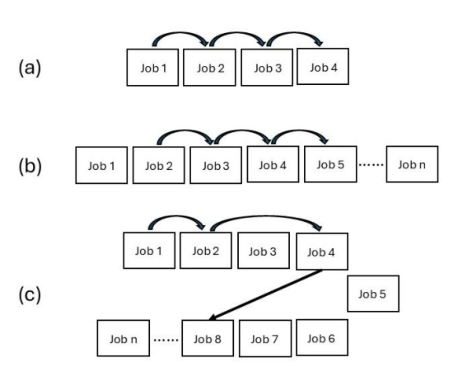
The job rotation schemes analysed in this study were a subset of a larger study which assessed the impact of current job rotation schemes in manufacturing in the U.S. on WMSD risk, body part discomfort, and psychosocial outcomes. The current study focused on four-job rotation schemes, which comprised 51.2% (42 of 82) of all rotation schemes evaluated, consistent with observations that rotating approximately every 2 hours was the most common rotation pattern (Jorgensen et al., 2005; Padula et al., 2017). Various four-job rotation patterns were observed across the participating companies. The most common four-job rotation patterns are shown in Figure 1, consisting of a four-job cell/line with four workers rotating
To Rotate or Not to Rotate – How Does Job Rotation Impact 2387
through all four jobs (Figure 1a), a work cell/line where workers rotate sequentially to adjacent jobs/workstations (Figure 1b), and a work cell/line where workers rotate non-sequentially to jobs/workstations (Figure 1c).
Four manufacturing companies from the Midwest U.S. participated in the study. The first company was an automotive assembly plant (24 participants, rotated at set times), the second company was a surgical instrument manufacturing facility (5 participants, batch driven rotation), the third company was an endoscopy device assembly facility (5 participants, 2- hour rotations), the fourth company was a piping manufacturing company (8 participants, rotated at set times, approximately every 2 hours). Demographic and experience characteristics of the participants are shown in Table 1.
Figure 1: Various four-job rotation patterns evaluated: (a) a worker rotates sequentially through all jobs in a four-job work cell; (b) a worker rotates sequentially through four jobs in a cell/line with more than four jobs; (c) a worker rotates non-sequentially through four jobs in a cell/line with more than four jobs.Table 1: Characteristics of participating companies (products), number and demographics of participants (age and experience on current job), and job rotation schedule.
Table available in the original PDF paper.
Rotation Timing
Company Products Participants Mean (sd) Age/Experience Set time Automotive assembly 22 Male, 2 Female 34.3 (13.1)/5.1 (3.8) yrs
Upon arrival at the participating company employees who worked in job rotation schemes were recruited to voluntarily participate in this study. Study objectives and procedures were described to those who agreed to participate, and informed consent was obtained utilizing forms approved by institutional review boards from the respective universities (i.e., Wichita State University, University of Cincinnati). After completion of the informed consent process, demographic information was obtained from the participants, which included age, gender, and years of experience in current job.
Prior to collection of input data for the WMSD risk assessment methods all tasks were documented for all jobs in the job rotation scheme, through observation of workers performing the jobs, interviews with the workers/su- pervisors, and/or standard operating procedures. Thus, a complete list of tasks for all four jobs in the job rotation scheme was developed. Upon determination of the tasks in each of the four jobs of each rotation scheme, exposure data necessary for inputs into upper extremity and low back fatigue failure WMSD risk assessment tools were then collected. These fatigue failure WMSD risk assessment tools consisted of the Distal Upper Extremity Tool (DUET; Gallagher et al., 2018) for the hand/wrist, The Shoulder Tool (TST; Bani Hani et al., 2020) for the shoulders, and the Lifting Fatigue Failure Tool (LiFFT; Gallagher et al., 2017) for the low back. These risk assessment methods utilize material fatigue failure theory to estimate the cumulative damage to tissues that accrues over a workday and can evaluate exposures associated with multiple tasks such as in job rotation (Gallagher and Schall, 2020). Each of these methods has been validated against multiple WMSD outcomes in epidemiology studies. The output for DUET is an overall probability (0%–100%) of a distal upper extremity outcome (e.g., carpal tunnel syndrome). Similarly, the output for TST is an overall probability (0% to 100%) of an adverse shoulder outcome (e.g., bicipital tendinitis). Finally, the output for LiFFT is an overall probability (0%–100%) that the collective manual handling tasks is a high-risk job for low back injury.
Exposure data for each task involving a grip exertion were collected to allow assessment of the right and left hand/wrist using DUET. Inputs into DUET included the repetitions per day and the perceived grip exertion intensity using OMNI-RES scores (Table 2). To obtain the OMNI-RES scores workers were instructed to perform maximum exertions on pinch grip and/or power grip dynamometers and were then asked to relate the maximum grip perceptions as a 10 on the OMNI-RES scale, and tasks with very little grip exertion as a zero. Subsequently, a chart of OMNI- RES scores and interpretations were shown to the worker and they were asked to provide an OMNI-RES score for each task involving a grip exertion. The repetitions for each task were determined based on units produced per hour.
To Rotate or Not to Rotate – How Does Job Rotation Impact 2389
Table 2: OMNI-RES scores and intensity interpretations.
Table available in the original PDF paper.
OMNI-RES Score Intensity Interpretation
0 Very easy 1 2 Easy 3 4 Somewhat easy 5 6 Somewhat hard 7 8 Hard 9 10 Very hard
For each task that involved a use of the shoulder, input data into TST included the type of task (i.e., handling load, horizontal push/pull, vertical push/pull), horizontal distance from the shoulder to the load, the weight of the load or push/pull force, and repetitions per day. The horizontal distance was obtained using a tape measure to measure the horizontal distance from the acromion process to the mid-point between the hands. The weight of the load was measured using an on-site industrial scale whereas push/pull forces were measured using a handheld push/pull dynamometer, and the repetitions for each task were determined based on units produced per hour.
For each task that involved a lift of product or material input data into LiFFT included the horizontal load moment arm, weight of the load and repetitions per day. The horizontal load moment arm length was obtained using a tape measure to measure the horizontal distance from the approximate L5/S1 intervertebral disc location (hip) to the mid-point between the hands. The weight of the load was measured using an on-site industrial scale, and the repetitions per day for each task were determined based on units produced per hour.
To address the first research objective (i.e., quantify WMSD risk in current job rotations across multiple body regions), the data for each task in all four jobs for each rotation scheme was input into the appropriate WMSD risk assessment method (i.e., DUET, TST, LiFFT). The output from each the assessment methods ranges from 0% to 100%, indicating the probability of high risk for a WMSD. Thus, the fatigue failure WMSD risk assessment methods determined a probability of high risk for the hand/wrist, shoulder and low back for each four-job rotation scheme. The probability values can also be categorized into various risk categories as follows: <25% - low risk; 25%–50% - moderate risk; >50% - high risk. To address the second research objective (i.e., compare WMSD risk from overall job rotation schemes to jobs that do not rotate), it was necessary to estimate the probability of high-risk values for each job in a rotation scheme assuming each job was performed for an entire shift (i.e., not rotating). This would allow for an understanding of the proportion of workers who would experience an increase in risk and a decrease in risk due to rotating through
the four-job rotation pattern as opposed to working at a particular job for the entire work shift. To determine the entire shift WMSD risk for each of the body regions the number of repetitions of each task at each job was extrapolated to represent the number of repetitions that would be completed if the job was performed for the entire shift. This was calculated to determine the entire shift WMSD risk probabilities using DUET, TST and LiFFT.
Descriptive statistics (mean, standard deviation) were generated contrasting the mean job rotation scheme WMSD probability values compared to mean of the entire shift WMSD probabilities for each job in the job rotation scheme, using DUET, TST and LiFFT. A z-test (α=0.05) was performed to determine if the four-job rotation schemes resulted in more increases in individual job risk compared to decreases in individual job WMSD risk. Finally, the number of job rotation schemes that resulted in an increased WMSD risk for zero, one, two, three or four jobs in the rotation scheme was quantified and assessed using a chi-square test to determine if the WMSD risk across the jobs was evenly distributed (α=0.05).
RESULTS
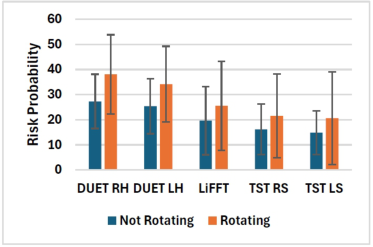
As shown in Figure 2, job rotation resulted in increased mean WMSD risk probabilities compared to working in the jobs when not rotating for both right and left hands (DUET), the low back (LiFFT), and the right and left shoulders (TST). There were significant increases in mean DUET risk probabilities of approximately 10% compared to not rotating for the right (z = 6.0, p<0.0002) and left (z = 5.9, p<0.0002) hand/wrist, and an approximate 6% increase in mean LiFFT and mean TST risk probabilities compared to working in jobs for the entire shift and not rotating (LiFFT: z = 5.8, p<0.0002; TST right shoulder: z = 3.4, p = 0.0004; TST left shoulder: z = 2.8, p = 0.0028).
Figure 2: Mean WMSD risk probabilities for jobs that do not rotate (work entire shift) compared to the four-job rotation schemes for DUET (RH: right hand; LH: left hand), LiFFT, and the shoulder tool (TST; RS: right shoulder; LS: left shoulder).
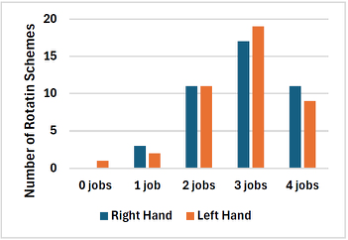
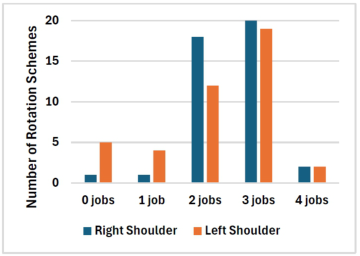
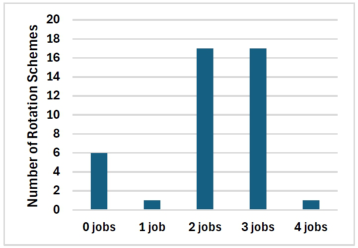
The impact of job rotation on whether the WMSD risk increased or decreased compared to working in a job that doesn’t rotate are shown in Figure 3 for the hand/wrist (DUET), Figure 4 for the shoulder (TST) and Figure 5 for the low back (LiFFT). Chi-square tests indicated the number of jobs that saw increases in WMSD risk were not proportionally distributed (all p<0.005) between number of jobs that saw increases for the right
To Rotate or Not to Rotate – How Does Job Rotation Impact 2391 (χ2=22.3) and left (χ2=25.6) hands, right (χ2=44.9) and left (χ2=23.5) shoulders and the low back (χ2=31.3). Rotating workers through four jobs as opposed to not rotating resulted in 3 or 4 of the jobs in rotation schemes increasing in WMSD risk for 67% of the schemes for the hand/wrist (Figure 3), approximately 50% of the schemes for the shoulders (Figure 4), and 43% of the schemes for the low back (Figure 5).
Figure 3: Number of rotation schemes that resulted in increases in DUET WMSD risk for 0 jobs, 1 job, 2 jobs, 3 jobs, or all 4 jobs.Figure 4: Number of rotation schemes that resulted in increases in The Shoulder Tool WMSD risk for 0 jobs, 1 job, 2 jobs, 3 jobs, or all 4 jobs.Figure 5: Number of rotation schemes that resulted in increases in LiFFT WMSD risk for 0 jobs, 1 job, 2 jobs, 3 jobs, or all 4 jobs.
DISCUSSION
This study compared the WMSD risk for multiple body regions using validated WMSD risk assessment methods for four-job rotation schemes and compared to the WMSD risk when not rotating and working in those jobs an entire shift. The two main findings are 1) the mean WMSD risk significantly increased for the different body regions when rotating through the four jobs within a work shift compared to not rotating those jobs, and 2) the majority of job rotation schemes resulted in increases in WMSD risk to three or four of the jobs in the four-job rotation scheme.
Although LiFFT (low back) and TST (shoulders) mean WMSD risk increased as a result of job rotation the WMSD risk mean probabilities typically remained in the low-risk category (<25%). Additionally, only 43% and approximately 50% of the job rotation schemes resulted in increases in risk for three or four of the jobs for the low back (LiFFT) and shoulders (TST), respectively. Thus, the increase in WMSD risk to the low back and shoulders may not be too much of a concern in these job rotation schemes evaluated given the WMSD risk probabilities generally remained mainly in the low-risk categories. This may also be reflective of the structure of the tasks in these jobs as there typically was very little lifting or handling heavy parts.
Concern arises, however, with the DUET probability scores (e.g., hand/wrist WMSD risk) when rotating. The mean DUET probabilities for the jobs without rotation were right at or slightly above the low-risk category (∼25%) for both hands/wrists. However, including these jobs in the four-job rotation schemes increased the mean DUET probabilities into the moderate-risk category when rotating (25%–50%). Additionally, rotating also increased the WMSD risk in three or four of the jobs in 67% of the rotation schemes evaluated in this study. This increase in WMSD risk for many workers as a result of job rotation is consistent with observations from prior research (Padula et al., 2017, Mehdizadeh et al., 2020). Padula et al. (2017) concluded that almost all studies they reviewed found an increase in exposure to physical load doing job rotation, whereas Mehdizadeh et al (2020) found through simulation that including higher risk jobs will result increasing the risk for more of the jobs to be included in the rotation scheme. Given that more jobs saw an increase in DUET hand/wrist probabilities due to job rotation (67% of rotation schemes) it is possible that there were more higher risk jobs/tasks to the hand/wrist than for the low back or shoulders. Thus, it may be necessary to utilize control strategies to reduce the higher risk jobs prior to including them in job rotation schemes, which would reduce the increase in risk to other workers rotating through those jobs.
The results of this study should be viewed considering several methodological limitations. First, the sample of job rotation schemes evaluated was limited to four companies, however, the companies produced diverse products. Second, this was a short-term study where only one entire work shift was evaluated. As such, extrapolating these findings to long-term job rotation practices should be done with caution. Finally, this study only evaluated four-job rotation schemes rotating within a workday, and many
To Rotate or Not to Rotate – How Does Job Rotation Impact 2393
other rotation patterns exist such as rotating every hour or 30 minutes, or rotating on a daily basis (different job every day) rather than within a day. However, as prior research has indicated the 2-hour rotation duration (or four-job rotation scheme) is the most common.
CONCLUSION
Consistent with prior research, this study found that four-job rotation schemes were the most common, and that job rotation typically increased WMSD risk for workers compared to if the workers didn’t rotate and worked in a job for an entire shift. These findings suggest that higher risk jobs should be addressed with engineering controls to reduce the risk before they are included in job rotation schemes.
ACKNOWLEDGMENT
Partial funding was provided by the Ohio Bureau of Workers’ Compensation, along with the National Institute for Occupational Safety and Health (NIOSH) sponsored University of Cincinnati Education and Research Center Grant #T42/OH008432.
REFERENCES
AFL-CIO, 34th Edition, April 2025. American Federation of Labor and Congress of Industrial Organizations (AFL-CIO). Report on ‘Death on the Job: The Toll of Neglect’. [AFL-CIO]. Available at: https://aflcio.org/reports/dotj-2025. Bani Hani D, Huangfu R, Sesek R, Schall MC, Davis GA, Gallagher S. (2021).
Development and Validation of a Cumulative Exposure Shoulder Risk Assessment Tool Based on Fatigue Failure Theory, Ergonomics, Vol. 64, 39–54. Bhattacharya A. (2014). Costs of Occupational Musculoskeletal Disorders (MSDs) in the United States. International Journal of Industrial Ergonomics, Vol. 44, 448–454. Cheraskin L, Campion MA. (1996). Study Clarifies Job-Rotation Benefits. Personnel
Journal, Vol. 75, 31–38. Comper MLC, Dennerlein JT, dos Santos Evangelista G, da Silva PR, Padula RS. (2017). Effectiveness of Job Rotation for Preventing Work-Related Musculoskeletal Diseases: A Cluster Randomized Controlled Trial, Occupational and Environmental Medicine, Vol. 74, 545–552. Dagenais S, Caro J, Haldeman S. (2008). A Systematic Review of Low Back Pain
Cost of Illness Studies in the United States and Internationally. The Spine Journal, Vol. 8, 8–20. Farrant AW. (1987). Job Rotation is Important, Supervision, Vol. 49, 14–16. Frazer MB,Norman RW,Wells RP,Neumann WP.(2003). The Effects of Job Rotation on the Risk of Reporting Low Back Pain, Ergonomics, Vol. 46, 543–560. Gallagher S, Schall, MC. (2020). Musculoskeletal Disorders as a Fatigue Failure
Process: Evidence, Implications and Research Needs. In New Paradigms in Ergonomics (pp. 105–119). Routledge. Gallagher S, Schall MC, Sesek RF, Huangfu R. (2018). An Upper Extremity Risk Assessment Tool Based on Material Fatigue Failure Theory: The Distal Upper Extremity Tool (DUET), Human Factors, Vol. 60, 1146–1162. Gallagher S, Sesek RF, Schall MC, Huangfu R. (2017). Development and Validation
of an Easy-To-Use Risk Assessment Tool for Cumulative Low Back Loading: The Lifting Fatigue Failure Tool (LiFFT), Applied Ergonomics, Vol. 63, 142–150.
Gittleman M, Horrigan M, Joyce M. (1998). ‘Flexible’ Workplace Practices: Evidence from a Nationally Representative Survey, Industrial & Labor Relations Review, Vol. 52, 99–115. Jorgensen MJ, Davis KG, Kotowski S, Aedla P, Dunning K. (2005). Characteristics
of Job Rotation in the Midwest U.S. Manufacturing Sector, Ergonomics, Vol. 48, 1721–1733. Mehdizadeh A, Vinel A, Hu Q, Schall MC, Gallagher S, Sesek RF. (2020).
Job Rotation and Work-Related Musculoskeletal Disorders: A Fatigue-Failure Perspective, Ergonomics, Vol. 63, 461–476. National Institute for Occupational Safety and Health (NIOSH), (2024), Elements of Ergonomics Programs. Website: http://medbox.iiab.me/modules/en-cdc/www. cdc.gov/niosh/topics/ergonomics/ergoprimer/step4.html. Occupational Safety and Health Administration (OSHA), U.S. Department of Labor,
(1993). Ergonomics Program Management Guidelines for Meatpacking Plants, Publication 3123. Website: https://www.osha.gov/publications/OSHA3123. Padula RS, Comper MLC, Sparer EH, Dennerlein JT. (2017). Job Rotation Designed to Prevent Musculoskeletal Disorders and Control Risk in Manufacturing Industries: A Systematic Review, Applied Ergonomics, Vol. 58, 386–397. Rasmussen CDN. (2017). Is Job Rotation Effective for Prevention of Work-Related
Musculoskeletal Disorders and Sick Leave? Occupational and Environmental Medicine, Vol. 74, 543.
LISTED IN THE AHFE DIGITAL BOOKSTORE CATALOGUE
Explore the complete digital volume
Human Factors in Design, Engineering, and Computing
Read this individual research paper free through the original publisher, or explore the full digital proceedings book.
ISBN 978-1-964867-75-5
Explore this ISBN in the AHFE Bookstore ↗Listed in the July 2026 bookstore catalogue; search by ISBN to confirm current availability · Digital book purchase optional