João Nuno Oliveira, Luani Costa, Ana Ramôa, Ricardo Silva, Aureliano Fertuzinhos, Bruno Vale, Inês Estudante, João Pinheiro, André Pilastri, Paula Dias, Arthur Matta, Rosane Sampaio, Dário Machado, Paulo Cortez, Marta Costa, Ana Roças, Pedro Madureira, Juliana Moreira, João Pereira, Carla Pereira, Fernando Pereira (2023). Worker 4.0: A Textile Exoskeleton to Support Apparel Industry. In: Human Factors for Apparel and Textile Engineering. AHFE Open Access, vol. 86, pp. 20–28. https://doi.org/10.54941/ahfe1003636
STVgoDigital project aims the transition of the textile and apparel industries to the new Industry 4.0 paradigm promoting the digitalization to increase productivity and efficiency of the entire value chain. Specifically the PPS4 - Worker 4.0, aims to develop disruptive solutions based on sensing and active components within a garment to support repetitive movements that may cause injuries and/or pain in apparel workers. Textile Industry employs 1.7 million people in Europe [1]. Seamstress’s activities are among the most prone to develop pain and fatigue symptoms along time, mainly on the neck, shoulders, and wrists, facing higher musculoskeletal risks caused by precision handwork and static, low-level work postures [2-3]. In Europe, 50% of workers’ absences to work are due to work-related musculoskeletal disorders (WRMSDs) that last for longer periods than absences caused by any other health issue. WRMSDs are responsible for 60% of their permanent incapacity [4]. In a study performed by Oo, 93.8% of the analyzed seamstress’ work experienced WRMSDs [5].In this sense, a textile-based exoskeleton with ergonomic concerns and a challenging textile-based implementation was developed to reduce the physical efforts required to perform different sewing operations in industrial processes. Besides, it would correspond to essential biomechanical specifications to adapt to the human body and avoid common trade-offs related to human-device interfaces. The textile-based exoskeleton that will support the transition to Worker 4.0 generation integrates: a) a sensing system for the detection of movements in real-time, to make it possible to identify the ergonomic posture of the worker, as well as the risk associated with the execution of repetitive working tasks; b) an actuation system to increase body strength and support the upper limb segments correctly, reducing physical efforts and fatigue, eliminating unnecessary movements, and contributing to develop a better ergonomic assessment of the working postures and layout; c) learning and actuation algorithms, with some degree of variability, focused on several movement natures, such as the abduction and elevation of the upper limbs, and finally d) a global integration of the solutions in a wearable, light and flexible garment capable to ensure comfort and adequate execution of the sewing operations while adequately resisting active sensing and actuation systems.Using prototypes, the developed textile-based exoskeleton will be tested in a laboratory and real environment to study and evaluate digital interfaces; measure muscle load and the impact of using the exoskeleton; and evaluate and classify the usability and comfort. A testing protocol was submitted to an ethics committee. AcknowledgmentThis work was developed in the framework of STVgoDIGITAL project (no 46086), which was co-financed by Portugal 2020, under the Operational Program for Competitiveness and Internationalization (COMPETE 2020) through the European Regional Development Fund (ERDF).
Worker 4.0: A Textile Exoskeleton to Support Apparel Industry 21
INTRODUCTION
The textile and clothing industry is one of the most important for the Por- tuguese economy, representing approximately 20% of the manufacturing industry’s employment (Statistics of the Textile and Clothing Industry, ATP). In Europe, Textile Industry employs 1.7 million people (Textiles in Europe’s circular economy, EEA). Despite the high national and international repre- sentation of this industry, it is one of the sectors where workers are more affected due to repetitiveness and precision work performed by seamstres- ses in their daily activities and little has been done to improve the working conditions of seamstresses.
Sewing machine workers are among the most prone to develop pain and fatigue symptoms over time, mainly on the neck, shoulders, and wrists, facing higher musculoskeletal risks caused by precision handwork and static, low- level work postures and long work duration ((Bevan 2015) (Kalkis et al. 2020)). There are many studies showings that sewing workers present seve- ral risks for the development of occupational diseases, as it often involves performing repetitive activities. Examples include a study carried out on the prevalence of musculoskeletal resistance in sewing machine workers in the leather industry (Kanniappan et al. 2020); study of the prevalence of muscu- loskeletal disorders related to work and ergonomic risk assessment among garment workers in Bangladesh (Hossain et al. 2018); a study carried out among workers in the garment production line of a textile factory in nor- thern Ethiopia (Abraha 2018); a study carried out with sewing workers in Kermanshah, Iran (Kazemi et al. 2019); and a study of musculoskeletal sym- ptoms in women sewing workers in the garment industry (Rahman Khan, A. et al. 2018). Working in faulty posture for a long time increases the chance of developing a work-related musculoskeletal disorder (Kanniappan, V. et al. 2020). Work-related musculoskeletal disorders (WRMSDs) are the commonest cause of disability worldwide. According to Bevan (2015) around 44 mil- lion workers in the UE are affected by WRMSDs, resulting in annual costs higher than 240 billion euros. WRMSDs are responsible for 60% of wor- kers’ permanent incapacity (Govaerts et al. 2021). Studies have shown that internationally there is a high incidence of WRMSDs and related physical problems in the textile and apparel industries (Sealetsa et al. 2011). In a study performed by Oo (2022), 93.8% of the analyzed seamstress’ work experienced WRMSDs.
Currently, to achieve market competitiveness, companies must combine technological development with the well-being and motivation of their wor- kers. Even with the growth of automation levels in the execution of industrial operations, there are still many necessary manual tasks, which are associated with risks that can compromise the health and safety of workers. Developing new solutions that provide well-being, motivation, and captivation for sewing professionals is of extreme relevance and an urgent need. In other industries, robots and artificial intelligence are seen as the future of the manual work- force in an industrial environment and this is possible with the rise of IoT technologies (Internet of Things) applied to exoskeletons for the trunk and
upper limbs. This is already a reality in manufacturing lines of the automotive industry, e.g., EksoVest (Eksobionics 2022) by Ford, where robotic systems such as exoskeletons have been implemented with the goal of minimizing the effort of operators, thus reducing injuries associated with repetitive human working tasks.
In this context, Worker 4.0 proposes a disruptive exoskeleton solution using sensing and active components within a garment to support repetitive movements and to reduce the physical efforts required to perform different sewing machine operations in industrial processes by the apparel workers increasing safety, comfort, and performance. Besides, it corresponds to essen- tial biomechanical specifications to adapt to the human body and avoid common trade-offs related to human-device interfaces. This research and development are part of the STVgoDigital project that aims to promote the transition of the textile and clothing industries to Industry 4.0 paradigm promoting digitalization to increase productivity and efficiency of the entire value chain and making the Portuguese sector an international reference.
METHODOLOGY
Ergonomic Risks Study As a way of identifying the risks associated with the seamstress’s work and the position of the sensing and actuation systems for the Worker 4.0 solution, an ergonomic and biomechanical study with a target group consisting of a total of 11 healthy seamstresses was performed in a factory environment to determine the ergonomic risks related to movements caused in operations on flatlock, lockstitch, sewing, and tapping machines. The main objectives of this study were to observe the characteristic movements of each operation and its kinematics; analyze the type of actuation required; analyze the nature of the actuation (active/passive) and which body segments are involved; and select the critical segments from an ergonomic point of view. Critical segments from an ergonomic point of view were identified by applying ISO 11226 and REBA standards.
From observations of the posture and movements performed by the seam- stresses of the target group in the factory environment and considering the complaints reported through individual interviews, a set of movements was defined to be recorded and analysed by collecting movements with VICON system and the muscles measured using electromyography sensors (EMGs). VICON movement tracking system was used in combination with the EMGs in the target group in a controlled environment. The seamstresses performed a set of sewing operations. Angles, duration, frequency, and muscle effort were variables considered in the analysis.
The values measured by the EMGs with the movements performed by the seamstresses allowed identifying the associated risks and which muscles and/or muscle groups exerted the most muscle effort during the sewing ope- rations. The determinations were needed to define the positioning of the actuation system in the shoulder and lumbar regions to assist seamstress movements correctly. The maximum force intensity of the shoulder muscles during seamstress activities was calculated from 9 eligible participants.
Worker 4.0: A Textile Exoskeleton to Support Apparel Industry 23
These values correspond to the required forces to hold the arm in the exten- ded abduction position. In the case of the lumbar region, it was defined by the constant presence throughout the target group of the execution of trunk flexion during the observed sewing operations.
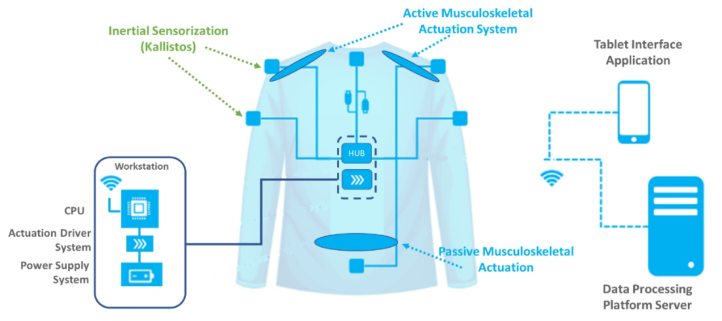
Architecture Based on the ergonomic and biomechanical study, and the consequent defi- nition of the actuation system in the shoulder and lumbar regions an archi- tecture of the system was defined (see Figure 1) to correspond to a wearable, light, and flexible upper body garment, capable not to interfere with the freedom of movement required throughout the seamstresses’ work.
The textile-based exoskeleton Worker 4.0 solution integrates: a) a sen- sing system for the detection of movements in real-time, to make it possible to identify the postures assumed by the worker, as well as the risk associa- ted with the execution of repetitive working tasks; b) an actuation system to reduce the muscle tension exerted and support the upper limb segments correctly, reducing physical efforts and fatigue, eliminating unnecessary movements, and contributing to develop a better ergonomic assessment of the working postures and layout; c) learning and actuation algorithms, with some degree of variability, focused on several movement natures, such as the abduction and elevation of the upper limbs, and finally d) a global integration of the solutions in a wearable, light and flexible garment capable to ensure comfort and adequate execution of the sewing operations while adequately resisting active sensing and actuation systems.
Figure 1: Proposed architecture of the textile-based exoskeleton solution.
the relationship between a sensor, the movement execution plan, movement direction, and the corresponding active actuator was planned considering the sensors as an information source and the actuators as an information destination.
Data related to worker movement and position is collected and communi- cated to the data processing platform. The data processing platform consists in a local mini-CPU that is responsible for collecting data from the sensing system and processing it locally to generate outputs (based on dedicated algo- rithms) to activate the actuation system according to the worker’s current needs. The second stage of the data processing platform is the development of specific risk assessment algorithms (Machine Learning algorithms) based on the sensing data collected during the work process. With the previous algorithm’s orientation measurements, an open-source platform for model- ling, simulating, and analysing the neuromusculoskeletal system can simulate the movements performed and record the respective angles for each body part at each time frame. The machine learning algorithms use this data to predict future movements and anticipatedly signal the actuators if they represent a possible risk to prevent it.
Definition of Actuation Parameters Considering the analysis of amplitude, frequency, and duration of the move- ments, along with the theoretical information taken from the identified standards, angular and temporal parameters were defined to determine the activation of the exoskeleton actuation system for mitigation of injuries by ergonomic risks. The activation parameters are defined depending on the angles of abduction, flexion, rotation, and elevation of the shoulders (see Figure 2). The data obtained from the sensing system about each movement and its duration will determine whether the risk is high or intermediate, and if there’s need to activate the sensing system to support the activity of the worker.
Figure 2: Proposed architecture of the textile-based exoskeleton solution.
PROTOTYPING Artificial Muscles Actuators
For the actuation system, pneumatic actuators (solutions applied in soft- robotics systems) were developed to be used in four active actuators integra- ted into each exoskeleton. The pneumatic artificial muscles (PAMs) applied in this research are called McKibben’s muscles. These muscles consist of a balloon and an inelastic mesh with constricted endings. These constrictions
Worker 4.0: A Textile Exoskeleton to Support Apparel Industry 25
enwrap the balloon expanding, with compressed air, only radially, and the mesh transposes this motion into axial motion. Also, the pneumatic actuator provides an increased proprioceptive stimulation of muscle’s action (they are actuated on the muscle site), ensuring greater compliance with movement and can even be dimensioned to follow the seamstresses’ operating movements, as well as a good relationship between the force and the low weight. The PAMs are controlled using electrovalves, activated by electrical impulses.
For the passive actuator, a 3D semi-rigid structure printed directly on the 3D knitting textile that consists of a passive articulation was developed to actuate during the inclination of the trunk and head, helping users to return to its anatomical reference position reinforcing its lumbar region.
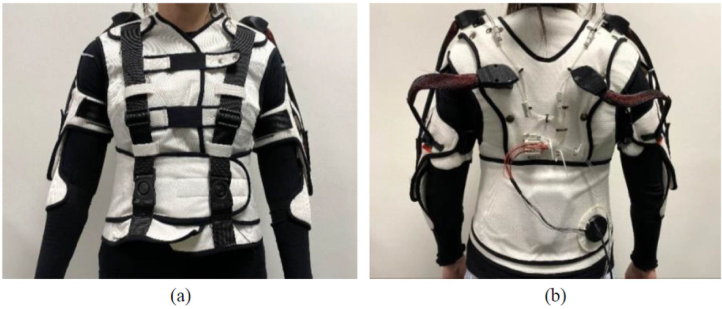
Garment Construction Based on the use of the different components described above and following the architecture of the proposed exoskeleton system, this solution was stu- died and developed to result in a wearable and flexible solution. Constructed with a 3D knitting structure and a first layer knit for its interior, both tech- nical knits with moisture management capacity, the prototype consists of a vest adjustable through a system of elastic fasteners and springs to ensure its adaptability to use on people with different anthropometries and body wei- ghts. Both knitting structures were used with the purpose of obtaining user’s comfort, with the 3D knitting structure serving as cushioning and protection for the semi-rigid elements of the solution on the user’s body, and the first layer knit (next to the body) with a soft touch and a dri-release® capacity (see Figure 3).
For the construction of the proposed arms elements, two semi-rigid ele- ments covered with the same knits as the vest were used. Those elements fix to the arm and to the forearm and are connected to each other through a screw creating a dynamic joint (located at the axis of the elbow) to follow the natural movements of the arm. The element attached to the arm is adju- stable through an adhesive tape system to adapt to the different measures,
Figure 3: (a) Frontal view of the developed prototype; (b) Posterior view of the developed prototype.
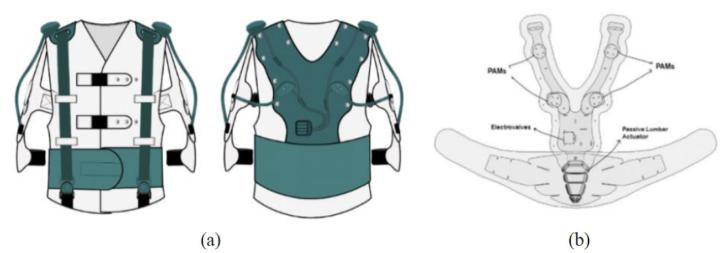
The lower end of the Y is connected to another semi-rigid structure - the passive actuator - that helps correct the posture, reinforcing the lumbar area, reducing the impact of the inclination of the trunk and head, and helping the user to return to its anatomical reference position (see Figure 4b). In addition, this semi-rigid passive actuator is also composed of a belt that fits around the lumbar and abdominal region to improve the exoskeleton’s staticity. Since the elements in green (see Figure 4a) are removable from the vest, the vest is capable of being cleaned/hygienized.
Figure 4: (a) In green, the removable components of the solution: Y-shaped structure, the pneumatic actuators, and the belt with the passive articulation; (b) the semi-rigid Y-shaped structure designed.
RESULTS
Despite still being in the prototype phase and focusing on the global inte- gration of components and construction of a wearable textile exoskeleton, promising results can be highlighted. As for the construction of the wearable and flexible exoskeleton, the goal of developing a lightweight piece contai- ning all the aforementioned components and functionalities was achieved. The piece presents a weight of approximately 2,5 kg, configuring an exoske- leton solution with a weight much lower than the existing solutions in the market.
Worker 4.0: A Textile Exoskeleton to Support Apparel Industry 27
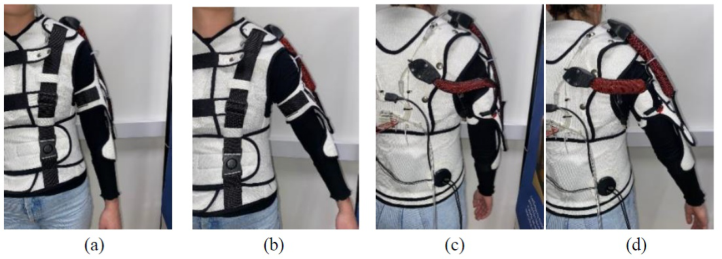
Figure 5: (a) supraspinatus actuators off; (b) supraspinatus actuator on; (c) supraspina- tus and infraspinatus actuators off; (d) supraspinatus and infraspinatus actuators on.
Through tests in the laboratory environment, with three volunteers using the prototype developed, it was possible to observe that by decreasing the shoulder elevation angle in relation to the trunk, there is also a reduction in the force needed to support the arm, ensuring that the actuators support a percentage of the effort promoted by the employee (see Figure 5).
Regarding impact assessment of the usability and comfort of the exo- skeleton solution, the volunteers found it comfortable while wearing the prototype, in both the activated and deactivated exoskeleton situations, during the sewing operations. It is easy to wear individually, after being assembled with the Y-shaped semi-rigid structure.
As for the communication of the active systems present on the part - sensing and actuation systems - the electrovalves located in the Y-structure inten- ded for feeding the pneumatic actuators are interconnected by a quick and simple electronic connection system through magnetic contact wiring, toge- ther with a pneumatic connector, allowing the sewing operator to disconnect the exoskeleton whenever necessary. The modularity of the actuation system proposed at the Y-shaped structure makes muscle replacement a simple and intuitive task since each actuator was submitted to continuous lifting and releasing of 2 kg free load to analyse its life cycle and the actuators present a resistance up to 370 cycles.
Plus, with the sensing system (sensors and HUB) integrated into the textile vest fully encapsulated, it is possible to detach the entire Y-shaped structure with the actuators in order to hygienize the textile layers of the vest, making it easier to wash and maintain the exoskeleton.
FUTURE WORK
The developed textile-based exoskeleton will also be tested by other three seamstresses’ volunteers with different anthropometries and body weights in a real environment (factory) to study and evaluate digital interfaces; mea- sure muscle load using EMGs and the impact of using the exoskeleton; and evaluate and classify the usability and comfort. Optimized prototypes will be developed based on observations made in testing in the laboratory environment. A testing protocol was submitted to an ethics committee.
The future work also relies on the integration of all information of moni- toring and control, with established hardware and firmware communication, and a mobile app to resume user’s output.
ACKNOWLEDGMENT
This work was developed in the framework of STVgoDIGITAL project (no 46086), which was co-financed by Portugal 2020, under the Operational Program for Competitiveness and Internationalization (COMPETE 2020) through the European Regional Development Fund (ERDF).
REFERENCES
Abraha, T. H., Demoz, A. T. Moges, H. G. and Ahmmed, A. N. (2018). Predictors of back disorder among Almeda textile factory workers, North Ethiopia. BMC Res. Notes 2018 111, Volume 11 No. 1. pp. 1–7. ATP - Textile and Clothing Association of Portugal (n.d.) Statistics of the Textile and
Clothing Industry. Available at: Caraterização - ATP. Bevan S. (2015). Economic impact of musculoskeletal disorders (MSDs) on work in Europe. Best Pract Res Clin Rheumatol. 29(3):356–73. EEA - European Environment Agency (n.d.) Textiles in Europe’s circular economy.
Available at: https://www.eea.europa.eu/publications/textiles-in-europes-circular- economy last accessed 2022/10/29 Eksovest – EVO (2022) Available at: EksoWorks - Ekso Bionics. Govaerts, R. Tassignon, B. Ghillebert, J. Serrien, B. De Bock, S. Ampe, T. and De Pauw, K. (2021) Prevalence and incidence of work-related musculoskeletal disorders in secondary industries of 21st century Europe: a systematic review and meta-analysis. BMC musculoskeletal disorders, Volume 22 No. 1. pp. 1–30. Hossain, M. D et al. (2018) Prevalence of work related musculoskeletal disorders
(WMSDs) and ergonomic risk assessment among readymade garment workers of Bangladesh: A cross sectional study. PLoS One, Volume 13 No. 7. Kalkis, H., Roja, Z., Vaisla, G., & Roja, I. (2020). Causes of Work Related Musculoskeletal Disorders in the Textile Industry. In International Conference on Applied Human Factors and Ergonomics. Springer, Cham. pp. 63–70. Kanniappan, V. and Palani, V. (2020) Prevalence of Musculoskeletal Disorders
among Sewing Machine Workers in a Leather Industry. J. Lifestyle Med., Volume 10 No. 2. pp. 121–125. Kazemi, S. Asgari, A. Khatib, M. Poyafar, L. and Mohammadi, M. (2019). Determining the Prevalence of Musculoskeletal Disorders in Tailors in Kermanshah, Iran Using the Nordic Questionnaire. Int. J. Heal. Life Sci. Volume in Press No. In Press. Oo, T. W. and Taneepanichskul, N. (2022). Work-related musculoskeletal disorders,
psychosocial factors, work productivity, and work ability among garment factory workers in Myanmar. Int J Multidiscip Res Publ. Volume 4 No. 8. pp. 1–7. Rahman Khan, A. and Khan, J. (2018) Musculoskeletal Symptoms among Female Garments Worker: Working Environment Abbreviations. Sealetsa, O. J. and Thatcher, A. (2011) Ergonomics issues among sewing machine
operators in the textile manufacturing industry in Botswana. IOS Press, Work 38. pp. 279–289.
LISTED IN THE AHFE DIGITAL BOOKSTORE CATALOGUE
Explore the complete digital volume
Human Factors for Apparel and Textile Engineering
Read this individual research paper free through the original publisher, or explore the full digital proceedings book.
ISBN 978-1-958651-62-9
Explore this ISBN in the AHFE Bookstore ↗Listed in the July 2026 bookstore catalogue; search by ISBN to confirm current availability · Digital book purchase optional