Sonia Seixas, Gianni Montagna, Maria João Felix (2023). There is no Planet T in Portugal - Designing a bachelor’s degree in Textile Design for Portugal. In: Human Factors for Apparel and Textile Engineering. AHFE Open Access, vol. 86, pp. 1–9. https://doi.org/10.54941/ahfe1003634
CIAUD, Research Centre for Architecture, Urbanism and Design, Lisbon School of Architecture, Universidade de Lisboa, Rua Sá Nogueira, Polo Universitário do Alto da Ajuda, 1349–063 Lisboa, Portugal ↗
This exploratory study is part of design research and aims to understand and reflect on Portuguese higher education in textile design and to make recommendations for the different actors involved – academia, industry, and designers. The textile industry is undergoing a process of change in its production processes and business models to minimize the environmental impact caused. New forms of teaching are needed that go beyond the traditional approach and train the ability to apply theoretical knowledge to real-world problems. A non-interventional study was conducted, based on reviewing the literature and focus group, to stimulate reflection and bring new perspectives on the object of study. The study concludes that Portuguese higher education in textile design is limited and should be complemented with a specialized offer in this field in a close relationship between academia and industry to allow shared education, thus contributing to weave a textile economy of the future.
In Portugal, there is no bachelor’s degree in textile design only. Of the seven Portuguese bachelor’s degrees in Textile and Fashion Design (DGES, 2022), only two deal with the universe of textile design: the bachelor’s in Fashion and Textile Design of the Higher School of Applied Arts, Castelo Branco Polytechnic Institute (ESART), and the bachelor’s in Fashion and Textile Design and Production of the Higher Institute Manuel Teixeira Gomes (ISMAT); which leads us to the question, which textile designers does Portugal train?
The textile industry is undergoing a process of change with the integration of more sustainable practices in its production processes and business models to minimize the environmental impact caused (Ellen MacArthur Foundation, 2020; ATP, 2021; Duhoux et al., 2022). This change occurs throughout the production chain, from the selection of fiber to the disposal of the textile pro- duct (Fletcher and Grose, 2012; Gwilt, 2020 [2014]; Seixas, Montagna and Félix, 2021). The role of the textile designer is fundamental in the decisions made during the creative process, as a large part of the environmental impact
of textile products is determined in the design phase (European Commission, 2021). In the search for sustainable solutions to the relationship between pro- duction and consumption, a new mind-set focused on the circular economy must be encouraged. This requires a set of new skills, new ways of thinking and new approaches among industry professionals, including textile desi- gners (Manzini, 2009; Meyer and Norman, 2020; Swanson, 2020; Seixas, Montagna and Félix, 2022). The field of design is either interdisciplinary and multifaceted, designers do not create isolated solutions, nor are soluti- ons necessarily tangible (Davis, 2017), the answers to problems have changed significantly as economic, social and technological challenges become more complex. New forms of teaching are needed that go beyond the traditional approach and train the ability to apply theoretical knowledge to real-world problems through a closer connection between academia and industry in a multidisciplinary, interdisciplinary, and transdisciplinary vision that includes formal and non-formal learning (European Commission, 2020; Muratovski, 2020; D’Itria and Vacca, 2021; Kirschner and Norman, 2021). Through the literature review and data collection, it was possible to verify that Portuguese higher education in textile design is limited and must be com- plemented with a specialized offer in this area in a close relationship between academia and industry to allow shared training with formal and non-formal learning strategies, to weave a textile economy of the future.
THEORETICAL CONSIDERATION Higher Education in Design
The higher education system is evolving in response to cultural, technological, and economic change and sweeping global transformations. New individuali- zed forms of learning are emerging based on what students learn rather than how much time they spend in the classroom. However, education systems still rely on passive learning methods that focus on direct instruction and memorization, rather than interactive methods that foster the critical and individualized thinking that the innovation-driven economy requires. It is essential to rethink learning and education to meet the demands of the chan- ging world and actively shape our own future. With digitalization, learning can happen anywhere, making students key players in their own learning. The field of design has become interdisciplinary and multifaceted, designers do not create isolated solutions, nor are solutions necessarily tangible (Davis, 2017). Responses to problems have changed significantly as economic, social, and technological challenges become more complex. Design problems are becoming less defined and difficult to delineate in their contours (Buchanan, 1992), requiring more rigorous and systematic analysis to work with inte- grating multiple strategies to solve them and using a wider range of tools and methods (Meyer and Norman, 2020; Norman, 2020; Muratovski, 2022 [2016]). Solution-focused designers act with creativity to respond to pro- blems, relying on data analytics as the fundamental empathy to respond positively to challenges by incorporating the real needs of individuals, as well as their contexts, while considering the interconnected reality to under- stand the impact of solutions on a global scale. One can respond not only
There Is No Planet T in Portugal - Designing a Bachelor’s Degree 3
to corporate and stakeholder interests, or even to political and governmental demands, but more importantly to the interests of human ecosystems and cul- tures, biodiversity, and major planetary challenges such as natural resource management, pollution, and climate change (Design Council, 2020). In turn, the profile of today’s university students is shaped by the exponential adva- ncement of technologies that have shaped and continue to shape our present, leading to the search for new, more student-centred models of learning. The role of teachers must also change and become facilitators of learning (World Economic Forum, 2020), teaching students how to learn by teaching critical thinking (reasoning and analytical skills) and creative thinking (the ability to invent or create something new) as essential skills (Muratovski, 2022 [2016]). Design activity requires multidisciplinary collaboration to manage complexity and should be done in close collaboration and interaction with other knowledge domains. New forms of teaching are needed that go beyond the traditional approach and train the ability to apply theoretical knowledge to real-world problems through a closer connection between academia and industry in a multidisciplinary, interdisciplinary, and transdisciplinary vision that includes formal and non-formal learning (European Commission, 2020; Muratovski, 2020; D’Itria and Vacca, 2021; Kirschner and Norman, 2021). Designers must be educated to be culturally aware, socially responsible, and proactive. Pedagogical approaches are sought that can teach tex- tile designers how to manage these changes-from society, industry, and the planet.
Portuguese Textile Industry Portugal has a centuries-old history, with the textile industry being one of the oldest. It is still one of the largest and most important sectors of the country’s economy, representing one of the most important spheres of the national economy due to the creation of wealth and employment (DGAE, 2018). In 2021, this industry has increased its export volume by 16% com- pared to 2019, demonstrating its importance to weave the Portuguese social and economic (ATP, 2022). The textile industry is undergoing a process of change due to its less than positive impact on the environment and the amount of waste generated, and is seeking to incorporate more sustaina- ble practices into its production processes and business models (UNECE, 2018; Ellen MacArthur Foundation, 2020; ATP, 2021; Duhoux et al., 2022). The textile designer plays an important role in this change because the decision made in the creative process of a textile product, from the sele- ction of the fiber to its disposal (Fletcher and Grose, 2012; Gwilt, 2020 [2014]; Seixas, Montagna and Félix, 2021), determines much of its envi- ronmental impact. Given this scenario, it is almost incomprehensible that there is no textile design-focused higher education in Portugal that trains textile designers with a mentality oriented towards the circular economy (Seixas, Montagna and Félix, 2022, 2023a, 2023b), in order to support and contribute to the construction of a promising textile ecosystem with a promising future.
METHODOLOGY
Focus Group Based on the literature review that allowed us to understand that the textile industry is in a process of change and that the profile of current students in higher education has changed, leading to the search for new learning models more focused on the student due to the exponential progress of technolo- gies, a focus group was held in May 2022, attended by experts from the sector - textile industry; home textile industry; fashion industry; technologi- cal center of the portuguese textile and clothing industry; portuguese textile cluster; portuguese textile associations; and teachers of higher and techno- logical education in the field of design - to hear their opinion on building an academic curriculum for textile design that can address the emerging and future needs of the textile sector, academia and textile designers.
The results lead us to conclude that such education should include a large practical component through hands-on and experimental learning, learning by doing, and the incorporation of traditional techniques and digital textiles. To this end, it is important to create a closer relationship between acade- mia, interface centers and industry to provide students with experience in a real environment, and collaborative strategies such as workshops, immersive weeks, innovation competitions and the realization of concrete projects can be used to help students understand the technological frontiers through a collaborative dialog between creativity and production. At the level of edu- cation, it is important to consider new forms of teaching and new ways of teaching to get out of the current conservative and traditional model. New teaching formats with more innovative, avant-garde and differentiated stra- tegies and methods should be sought and proposed. They emphasized that academia must contribute to the transformation of the economy and society through innovation and research.
RESULTS
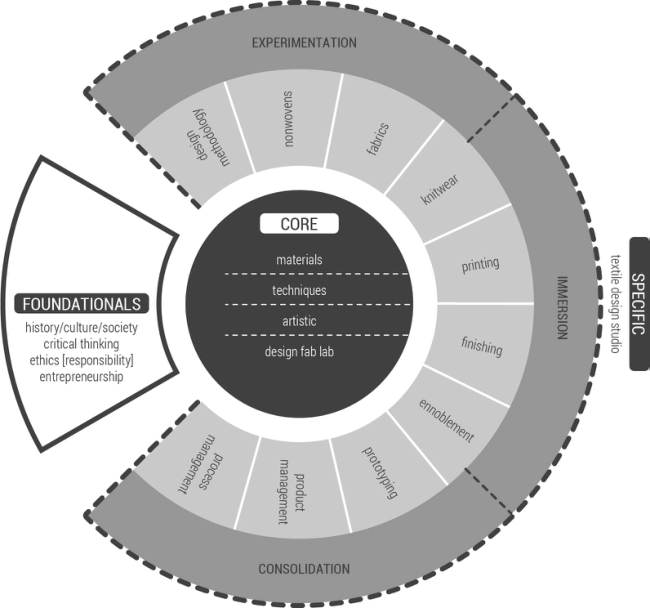
In light of this feedback, we have designed a script of a teaching model for learning textile design that focuses on active teaching and learning strategies. A learning based on practice, ‘learning by doing’, trial and error, exchange of ideas, collaboration that includes exploration, interaction, experimentation and ‘reflection-action’, since in the field of design the problems are never cle- arly defined, a process of interpretation is also necessary for understanding (Rittel and Webber, 1973; Schön, 1983; Buchanan, 1992). Learning focuses on real-world problems by increasing student engagement and motivation (Glasser, 1999; Bender, 2014), allowing them to acquire cross-cutting skills such as teamwork, communication, creative and critical thinking, among oth- ers, in addition to theoretical and practical content. Skills that are increasingly important to meet the challenges of the twenty-first century (Muratovski, 2022 [2016]; OECD, 2021; World Economic Forum, 2020). The model is divided into three major blocks of learning: foundational, to fill possible gaps that affect their training or practice, being more oriented to the specific philosophy and culture of design; core, to develop essential
There Is No Planet T in Portugal - Designing a Bachelor’s Degree 5
skills associated with the universe of textile design with textile materials and techniques; and specific, to develop their own skills in the different areas of intervention of textile design (Figure 1). This model is structured to expose students to a range of critical topics while allowing them the flexibility to tailor their learning through the integration of elective disciplines so that they can tailor their academic and professional profiles according to their interests.
The 1st year focuses on experimentation where students are exposed to a range of skills in the various areas of textile design: nonwovens, woven, kni- twear, printing, finishing, and embellishment. With an emphasis on applied teaching, textiles are studied in their broader universe, allowing for the acqui- sition of fundamental knowledge about the textile design universe. The textile designer transforms sensory perceptions and experiences into aesthetic and material forms. Therefore, his skills must also integrate tacit knowledge (Schön, 1983; Polanyi, 2009 [1966]), because the process of textile design is often experimental and based on the constant testing of processes and techniques. By exploring and experimenting with materials, it will be pos- sible to gain the essential knowledge of different techniques and production processes, materials, and properties that is so important to the textile design profession. The goal is not to train students to become masters of weaving (or any other specific technique), but to become designers who also under- stand production processes and are able to evaluate and compare different
Figure 1: Scheme of the teaching model learning in textile design (Author, 2022).
options and their consequences. To become a textile designer, one must learn and practice to deal with the processes. The 2nd year focuses on immersion, allowing students to direct their learning to the area of textile design with which they most identify and deepen their knowledge. Materials and surfa- ces are designed for a variety of objects, with an understanding of the user and the context in which the surface will be used, as well as the emotio- nal potential of the profession, as prerequisites. It’s not just about creating something aesthetically pleasing. As a textile designer, he must be passionate about understanding and questioning systems, forms of production and con- sumption. Be aware of the designer’s responsibility to promote a more just society and create a more sustainable future. The 3rd year is dedicated to con- solidation in what has been learned with the development of an individual project according to interests. By acquiring creative, specific, professional and entrepreneurial skills, the student will be able to face the challenges of the creative textile industry. This approach assumes that, in addition to acqui- ring specific skills, students will learn to communicate, work in teams, share ideas, be independent and responsible, and link design knowledge to other areas of knowledge.
A curriculum of this type must respond in some way to the vision of inter- face centers, industry, and academia while attempting to develop solutions to unidentified needs arising from the context of digital transformation by inte- grating pedagogical approaches that can teach textile designers to deal with changes in society, industry, and the planet. Given the evolution of society and the textile industry, it is expected that this outcome will help define some indispensable guidelines for textile design education.
CONCLUSION
The aim of this article was to understand and reflect on portuguese higher education in textile design and to provide recommendations for the different actors involved - academia, industry and designers. From the triangulation of the literature review and the analysis of the focus group conducted, it was concluded that the portuguese higher education in textile design should be complemented by integrating a specialized offer in this field in a close relationship between the interface centers, the academia and the industry, in order to provide a shared training. It is important to strengthen this relati- onship to enable differentiated instructional strategies that provide students with experiences in a real-world environment, learning that focuses on pra- ctice and experimentation, and thus a better understanding of technological boundaries through a collaborative dialog between creativity and production. The textile industry is undergoing a process of change aimed at integrating more sustainable practices into its production processes and business models (UNECE, 2018; Ellen MacArthur Foundation, 2020; ATP, 2021; Duhoux et al., 2022). In this regard, the role of the textile designer becomes clear, as the decisions made in the creative process of a textile product determine much of its environmental impact (European Commission, 2021). Higher education in design, in a current and future vision, should think about changing the way students learn by incorporating new forms of instruction and new ways
There Is No Planet T in Portugal - Designing a Bachelor’s Degree 7
of teaching that break away from the current conservative and traditional model. Look for pedagogical models that can teach textile designers to deal with changes in industry, society, and the planet. A practice-oriented teaching, no longer theoretical, with challenges in the real environment is important for the consolidation of knowledge and the acquisition of transversal and speci- fic skills. In turn, teachers should also impart knowledge, not just transmit it. Curricula that allow students to shape their academic and career paths to include elective units can be a way to meet their ambitions and interests. It is believed that the most important contribution to design with this study was the opportunity to show guidelines for constructing a model of teach- ing and learning in textile design in the form of collaborative teaching that incorporates formal and non-formal learning strategies in a multidisciplinary, interdisciplinary and transdisciplinary vision, contributing to weaving a tex- tile economy of the future that ensures the socio-environmental well-being of the human being and the planet.
An even deeper continuity of this analysis is suggested for future studies, although creating new courses to address all the rapid changes addressed in this study will continue to be a challenge as design practice continues to evolve and adapt to these changes. A flexible and dynamic approach will allow you to adapt to future changes (Norman, 2020).
For this, it is necessary to begin to delicately weave a curriculum based on the looms of knowledge, a proposal with which the author of this study proposes contributing to the progress of knowledge in this area in Portugal.
ACKNOWLEDGMENT
This work is financed by national funds through FCT - Fundação para a Ciência e a Tecnologia, I.P., under the Strategic Project with the refere- nce UIDB/04008/2020 and UIDP/04008/2020, and through the individual research grant 2020.04735.BD.
REFERENCES
ATP (2021) Visão Prospetiva e Estratégias ITV 2030. Contributo para um Plano Estratégico para o Sector Têxtil e Vestuário Português até 2030. Vila Nova de Famalicão, Portugal: ATP - Associação Têxtil e Vestuário de Portugal. ATP (2022) ‘Press Release: exportações de têxteis e vestuário ultrapassa- rão os 5, 3 mil milhoes de euros em 2021’, 12 January. Available at: https://atp.pt/wp-content/uploads/2022/01/PressRelease-Exportacoes-da-IT V-Novembro21_10.1.22.pdf (Accessed: 12 January 2022). Bender, W. N. (2014) Aprendizagem baseada em projetos: educação diferenciada
para o século XXI. Porto Alegre, Brasil: Penso. Buchanan, R. (1992) ‘Wicked Problems in Design Thinking’, Design Issues, 8(2), p. 5. doi:10.2307/1511637. Davis, M. (2017) Teaching Design: A Guide to Curriculum and Pedagogy for College
Design Faculty and Teachers Who Use Design in Their Classrooms. New York, USA: Allworth.
Design Council (2020) Design perspectives: design skills. UK: Design Council.
Available at: https://www.designcouncil.org.uk/fileadmin/uploads/dc/Docu ments/Design%2520Perspectives-%2520Design%2520Skills.pdf(Accessed: 15February2022). DGAE (2018) Indústria Têxtil e Vestuário (Sinopse). Lisboa, Portugal: Direção Geral das Atividades Económicas. DGES (2022) Direção Geral de Ensino Superior, Licenciaturas. Portugal. Available
at: https://www.dges.gov.pt/pt/pagina/licenciatura (Accessed: 7 August 2021). D’Itria, E. and Vacca, F. (2021) ‘Fashion Design for Sustainability. A transformative challenge across the European fashion education system.’, in 7th International Conference on Higher Education Advances (HEAd’21). Universitat Politècnica de València, pp. 679–686. doi:10.4995/head21.2021.13029. Duhoux, T. et al. (2022) Textiles and the environment: the role of design in Europes
circular economy. ETC/CE Report 2/2022. European Environment Agency (EEA). Ellen MacArthur Foundation (2020) Vision of a Circular Economy for Fashion.
London, UK. European Commission (2020) Skills for Industry. Curriculum Guidelines 4.0: Futureproof education and training for manufacturing in Europe: final report, Office. European Commission Executive Agency for Small and Medium-sized Enterprises. doi:10.2826/097323. European Commission (2021) Sustainable Product Policy. Available at: https://ec.europa.eu/jrc/en/research-topic/sustainable-product-policy (Accessed: 23 June 2021). Fletcher, K. and Grose, L. (2012) Fashion & Sustainability. Design for Change.
London, UK: Laurence King Publishing Ltd. Glasser, W. M. D. (1999) Choice Theory. A new Psychology of Personal Freedom.
HarperCollins Publishers Inc. Gwilt, A. (2020) [2014] A Practical Guide to Sustainable Fashion. 2nd edn. London, UK: Bloomsbury Publishing Plc. Kirschner, P. A. and Norman, D. (2021) ‘Teaching and Learning of Design’.
Available at: https://assets.website-files.com/6010c2ec764764887cfefee7/60515f f38234e90fac4c64cb_Kirschner and Norman. Teaching and Learning of Design 21.01.21.pdf (Accessed: 12 December 2022). Manzini, E. (2009) ‘Viewpoint. New design knowledge’, Design Studies, 30(1), pp. 4–12. doi:10.1016/j.destud.2008.10.001. Meyer, M. W. and Norman, D. (2020) ‘Changing Design Education for the 21st
Century’, She Ji, 6(1), pp. 13–49. doi:10.1016/j.sheji.2019.12.002. Muratovski, G. (2020) ‘The Making of an American Design School: Lessons Learned’, She Ji, 6(1), pp. 67–82. doi:10.1016/j.sheji.2020.01.002. Muratovski, G. (2022) [2016] Research for Designers. A Guide to Methods and
Practice. 2nd edn. SAGE Publications Ltd. Norman, D. (2020) ‘This Is the One Skill Designers Need to Develop Most in 2020’, Fast Company, 9 January. Available at: https://www.fastcompany.com/90449305 (Accessed: 12 December 2022). OECD (2021) Building the future of education. OECD. Polanyi, M. (2009) [1966] The Tacit Dimension. London, UK: The University of
Chicago Press. Rittel, H. W. J. and Webber, M. M. (1973) ‘Dilemmas in a general theory of planning’, Policy Sciences, 4(2), pp. 155–169. doi:10.1007/BF01405730. Schön, D. A. (1983) The Reflective Practitioner: How Professionals Think in Action.
USA: Basic Books.
There Is No Planet T in Portugal - Designing a Bachelor’s Degree 9
Seixas, S., Montagna, G. and Félix, M. J. (2021) ‘Materials Matters in Textile and Fashion Design Education’, in Shin, C. S. et al. (eds) Advances in Industrial Design. AHFE 2021. Lecture Notes in Networks and Systems. New York, USA: Springer, Cham, pp. 681–688. doi:10.1007/978-3-030-80829-7_84. Seixas, S., Montagna, G. and Félix, M. J. (2022) ‘The textile designer skills to face the
emerging challenges of textile industry and the role of academia’, in Montagna, G. and Carvalho, C. (eds) Human Factors for Apparel and Textile Engineering. AHFE (2022) International Conference. New York, USA: AHFE Open Access, pp. 23–30. doi:10.54941/ahfe1001534. Seixas, S., Montagna, G. and Félix, M. J. (2023a) ‘Weaving the Skills of the Textile Designer as a Contribution to the Construction of a Textile Ecosystem of the Future’, in Broega, A. C. et al. (eds) Advances in Fashion and Design Research. Cham, Portugal: Springer International Publishing, pp. 505–517. doi:10.1007/978-3-031-16773-7_43. Seixas, S., Montagna, G. and Félix, M. J. (2023b) ‘Where is Textile Design in
Portugal? Interlace the Past to Weave the Future’, in Raposo, D. et al. (eds) Advances in Design, Music and Arts II. EIMAD 2022. Springer Series in Design and Innovation. Castelo Branco, Portugal: Springer, Cham, pp. 220–237. doi:10.1007/978-3-031-09659-4_17. Swanson, G. (2020) ‘Educating the Designer of 2025’, She Ji, 6(1), pp. 101–105.
doi:10.1016/j.sheji.2020.01.001. UNECE (2018) Traceability of Sustainable Value Chains. Enhancing transparency in the garment and footwear sector for informed and responsible choices. Available at: https://unece.org/trade/traceability-sustainable-garment-and-footw ear (Accessed: 5 June 2021). World Economic Forum (2020) Schools of the future: Defining new models of educa-
tion for the fourth industrial revolution, World Economic Forum Reports 2020. World Economic Forum. Available at: www.weforum.org (Accessed: 1 October 2021).
LISTED IN THE AHFE DIGITAL BOOKSTORE CATALOGUE
Explore the complete digital volume
Human Factors for Apparel and Textile Engineering
Read this individual research paper free through the original publisher, or explore the full digital proceedings book.
ISBN 978-1-958651-62-9
Explore this ISBN in the AHFE Bookstore ↗Listed in the July 2026 bookstore catalogue; search by ISBN to confirm current availability · Digital book purchase optional