Gianni Montagna, Carla Morais (2022). Fashion Design and Garment Performance: Human Factors in Fashion Design Projects. In: Advances in Ergonomics In Design, Usability & Special Populations: Part I. AHFE Open Access, vol. 18. https://doi.org/10.54941/ahfe100767
The fashion design project is a multifaceted process that involves several levels and multiple choices. During the design process, the fashion designer creates a fashion concept starting from a user’s needs and fashion styling, evolving to a concrete creation of outlooks and garments that will be proposed to a specific market. Working from general considerations to specific and particular characteristics, any fashion methodology applied by the designer, in order to achieve its goals, has the need to identify and characterize the final consumer and its necessities in terms of garment performance requirements. Due to a high number of human factors involved into the consumer characterization, the identification of the consumer’s performance needs are sometimes difficult to achieve, letting fashion design project far from the real consumers’ needs and market preferences. The multi-dimensional attitude demands nowadays fashion designers for a change to a holistic perception about consumer needs, product design and market characteristics, requiring supplementary fashion design features analysis. The main objective of this paper is an introduction to human factors in fashion design, beginning with the need to confront the perception of fashion clothing by consumers and designers.
In the last few years the designers work and the design thinking theorists have developed much in order to create and define the design actuating space which could be defined as an extra disciplinary thematic domain, that covers different scientific areas and touch the fringes of many others. Even with misunderstanding about its action range and capabilities, design is gaining space as a multidisciplinary issue, able to understand society issues, proposing new ideas and working inside production circle in order to interfere and achieve solutions. Fashion design, the basic element of the fashion industry, should develop its tools in order to be able to communicate with its consumer on a more consolidated method. First, it intends to offer a better product as a result from mutual understanding, by increasing the levels of customer requirements awareness, and secondly, to increase the profits of the industry, reducing costs and margins of error.
Ergonomics In Design, Usability & Special Populations I (2022)
Thus, in fashion design the application of product design theories and its specific adaptation to the medium, achieved great results and brought fashion design and the designer itself to an involvement with the textile and garment industry as it probably never has been seen before.
The work in this paper intends to define a comparison of perceived limits between fashion designers and users. In a broader sense, the development of this work aims to be a useful tool [in human factors] for fashion design projects, improving final products and people. It will be classified into physical, aesthetic, rational, and moral work (Karwowski, 2006). This article should be understood as a first introductory approach to the issue of the human factors interference in fashion design.
THE METHODOLOGY Regarding the objectives set for this study, which included the need to create a solid base to work from, the identification, analysis and adaptation of humans factors that may be involved in clothing fashion design in general, and possibly with greater emphasis on the design of technical, functional and intelligent clothing, three different work phases were identified: Firstly, it came to addressing the key issues of human factors, taking into account its definition, fields of action, defining generic domains of action of human factors, human factors definition of indicators and operative keywords associated to each group of factors. Secondly, identifies and briefly described the different phases of a linear and sequential methodology for fashion design that is most commonly used for creating design projects of this kind. The third phase is a control phase of the importance of different human factors confronting their perception between designers and final consumers. To achieve that, an online survey has been done (by questionnaires forms) that were answered by 164 individuals.
HUMAN FACTORS PERCEPTIONS AND EVOLUTION Although many authors classify human factors as being the same thing as ergonomics, a study commissioned by the Human Factors Committee of the National Research Council to the Crew System Ergonomics Information Analysis Center (CSERIAC) still in 1989, outlines and highlights the differences between these two disciplines even if complementary, they differ in their definitions. For example, definitions of human factors include a broader range of classification categories and domains of inclusion; definitions of human factors engineering place an overwhelming emphasis on design as the medium to effect change on an end-system; and definitions of ergonomics emphasize the study of humans at work as an important characteristic (Licht, 1989). In 2003, the International Ergonomics Association (IEA, 2003) defines ergonomics (human factors) as the scientific discipline concerned with the understanding of the interactions among humans and other elements of a system. Its definition becomes wider, once that applies theory, principles, data and methods to design in order to optimize human well-being and overall system performance but human factors have become stronger and the main requirements concern for the construction of any object or customer service.
The term “human factors” covers both the physiology and the psychology, extending most of the elements that affect human performance in their activities or in other built environment. For example, visual acuity, hearing, touch, temperature and humidity are factors that directly affect human performance but there are other factors also considered such as its own sports or its diet too (Tiles & Associates, 2001). According to this thinking, the way of each individual dress or also understand the clothing affects each other of individualized and differentiated way.
Human factors are very important factors in garment and fashion design, influencing product design at different levels. Even little evident, human factors influence and change the perception and consumer choices in the use phase of the product purchased with consequences for consumption and apparel market. Applying these factors to fashion design, in order to have a greater perception of the tasks about the importance of human factors in fashion design project is a very important assignment.
Ergonomics In Design, Usability & Special Populations I (2022)
Considerations in terms of user’s psychological and social behavior in response to events, people and/or environments e.g. acceptance by peer group, pride, identification, etc. becomes important (Gupta, 2011). In reality, there is a complexity of elements and specific areas that compete and overlap in the different processes of choice of clothing. The perception of personal and social use purpose, renders not only their individual analysis complicated, but, also difficult the identification of different interactions and different elements between them. Clothing items, which are perfect in comfort and function, may be completely rejected by the user if they do not “look right” or are not perceived as smart and (or) conveying the proper image (Gupta, 2011).
The classification of domains of human factors has yet to be organic and somewhat free, allowing the freedom to join the human factors and methodologies that find it right for each research area. Then, three main areas considered for the classification of human factors are presented. These areas are not considered watertight, as numerous authors have more or less detailed ratings and tailored to their needs.
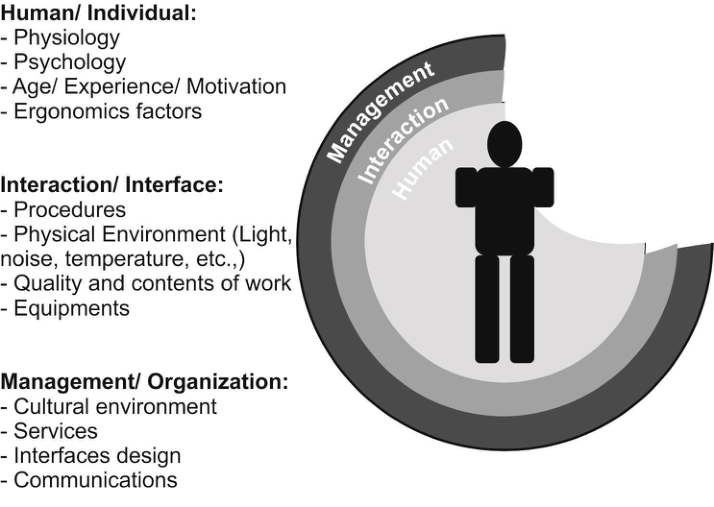
Human factors described by Bellamy (2007), Hughes (2008), Teperi (2012), OGP (2011) and FAA (2011) were selected, organized and proposed in figure 1.
Figure 1. Domains of human factors.
Any such factor, mentioned earlier, that acts at different stages of the garment life cycle still has to be filtered by the objective and subjective assessment of each subject/user, which exponentially maximizes the difficulty of individualization of elements to take into account and, optionally, tools to minimize these issues by the consumer. According to MacDonald (1998), apart from utilitarian reasons, the product “can give its user pleasure, not only in terms of its ergonomic fit but also through its aesthetic qualities (qualities of beauty)”. Tiger (1992) emphasizes the importance of pleasure seeking for human beings [as a part of human needs], supporting the reflections that pleasure plays a very important role in the conduction of human life […]. In this paper the human factors will be taken into account as the objective evidence that the designer can take into account and adapt to the consumer needs. It may be an active and concrete action in fashion design projects and functional clothing because creating usable products may not mean the same thing as creating pleasurable products (Jordan, 1996).
No one would argue, says Neville Stanton (2005), [that] with the aim of improved comfort, satisfaction and well- being, but the draws of the boundaries between the improvements for individuals and improvements for the whole system, may cause some heated debate. Sanders (1992) argues that the emphases is has to be put on human beings (as opposed to engineering, where the emphasis is more on strictly technical engineering considerations) and how Ergonomics In Design, Usability & Special Populations I (2022) the design of things influences people for better lifestyle.
Areas of influence of human performance are different and with diverse complexity levels, depending on the use of the final product. […]. The human performance in both sport and occupational activity is influenced by physical, physiological, psychological and technical factors (Laing and Sleivert, 2002; Martins, 2012). That influence, caused by multiple factors or by their different combination with other sub-factors or external features can create several situations that will be unique and particular for a specific project.
Human Factors Indicators The vast aim of human factors is collected and enclosed in macro factors that attempt to identify, collect and catalog the most important data factors that may improve the end user experience. The perception of the garment properties by the user is a concern for designers and brands, since clothing evolved to fashion and since subjective parameters overlapped objective ones, melting together and creating new needs and new realities. The set of garment properties can be defined as the quality factors, but, the meaning of quality itself, has also been developed and modified over the years by the perception change about the final object. If different groups of users, have different needs, than they may require different characteristics for a product to have quality, so the assessment of quality becomes dependent on the perception of the user (Bevan, 1995).
Therefore, the studies carried out by different authors, even if they have human factors catalogued in different ways, concluded that the main areas of intervention are explained as shown on figure 1.
Human: This first area is especially dedicated to the user, who, from an inclusive point of view, we consider the fundamental part of any analysis of the project as well as in relation to the object of study and the environment in which it operates. The analysis of the user focuses in the areas of human anatomy, anthropometry, biomechanics and physiology. Numerous factors related with race, age, background but also motivation, experience and psychological issues are a fundamental key in this area. For fashion field, we consider its values and its involvement in fashion, both depending on their personality variables and lifestyles preferences (Solomon, 2009).
Interaction: This second area of intervention is intended to take into account the interaction of the user/individual with the environment/ actuating space. In this area the human actuates as an interface with the work/ background, taking into account the work procedures, the physical environment, but also equipment, software, medical devices, information technology, quality of work, safety, etc. This area of intervention identifies mental processes such as perceptual processes, memory, reasoning, etc. In the area of human motor functions and their interactions with the system, we still have important processes such as decision making, human-machine interaction and human- environment, specialized professional performance, efficiency and professional training, etc. Interaction in fashion field can be considered the way how users and consumers react to garment as a medium and the environment. Consumer’s behavior depends on the human factors and the results from their interactions.
Management: The third area of intervention of human factors concerns the area of organization, more usually called management or systems. This area is concerned with the relationship of the individual / user with the social or professional organization. The main issues are related with the cultural environment, units cooperation, Communications, local procedures, work life quality, and also interfaces design, leadership, resources, responsibilities, morale, psychological pressure, work systems and design, teamwork, participatory design, cooperative work, virtual organizations teleworking, retail services, post purchase services, etc. This is an analysis of optimization in terms of organizational structures, policies and processes.
In addition to the areas of intervention of human factors and operational terms that are associated with each area, in order to identify the elements associated with the user, and collect related information, methods of data collection, implemented for this purpose are of great importance to reach the prefixed purpose. Thus, among the methods used for the evaluation of human factors, listed by Stanton (2005) in his Human Factors Methods: A Practical Guide for Engineering and Design, the methods chosen for the collection of information should be the most shifters for the type of information that is intended and should be used more than a method in association with each other. The results from the crossing of different methods may be considered justifiable and acceptable.
Ergonomics In Design, Usability & Special Populations I (2022)
Among the most common for information gathering methods, which seem more feasible to collect data from human factors for design fashion, we propose the following:
FASHION DESIGN PROJECT Inspired on the Inclusive Design Methodology, user is the central element of a design project and the main reference for the main choices made during the design project development so that the approach to user’s needs could be considered weighted and real. To satisfy the user, it is necessary to consider, besides his needs, abilities and limitations, the specifications of the materials used […] and of the clothing production (Martins, 2012).
As diferentes fases de desenvolvimento do projecto serão identificadas com as fases de concepção do produto de moda e seguem a metodologia mais utilizada para o desenvolvimento de projectos de moda e vestuário, podendo ser considerada como sendo uma metodologia linear e sequencial, mesmo que algumas tarefas possam ser desenvolvidas contemporaneamente.
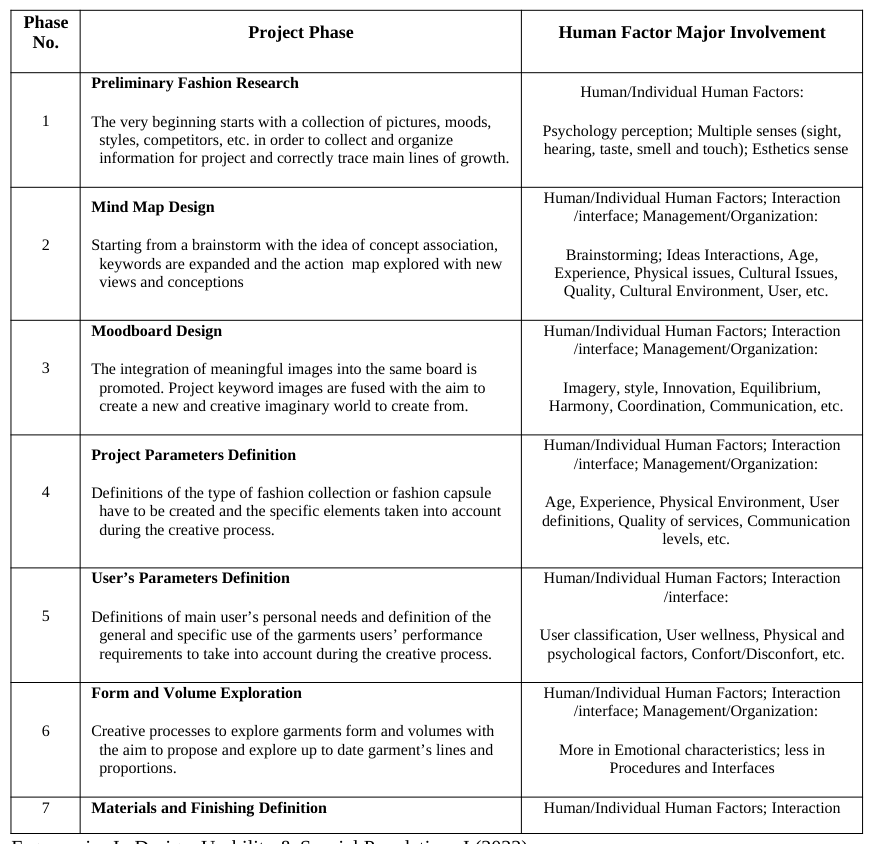
Assim, tendo em conta as diferentes fases do projecto, poderão ser identificadas as fases de maior importância para a introdução dos factores humanos de referência. As fases do projecto consideradas mais importantes são as que se seguem:
Table 1: Fashion design project phases and human factors involvement
Ergonomics In Design, Usability & Special Populations I (2022)
FINAL USERS’ PERCEPTION In order to better understand the perception of the consumer behaviour and needs in clothing purchase, an anonymous questionnaire intended to gather information about consumer needs and habits of consumers and clothing in general has been prepared. Collecting this type of information has two different and complementary objectives: On one hand, the need to obtain information about fashion clothing consumption habits of the users, and, on the other hand, to try to realize the importance that consumers ascribed to certain factors and if the perception is coincident with of the designers who work daily to introduce fashion products in the international market.
The pre-test questionnaire was prepared and distributed to 18 people to collect information from users was divided into four different areas: Characterization of the respondent; Factors influencing the user as a person / individual; Cognitive factors of the user with the object and the environmental influence of the user inside the (eco)system where operates and acts.
Thus, some of the collected results were as follows:
Chart 1: What is your gender?
Ergonomics In Design, Usability & Special Populations I (2022)
Chart 2: How often do you purchase clothing?
Chart 3: What is your occupation?
Ergonomics In Design, Usability & Special Populations I (2022)
Chart 4: What type of garments do you buy mostly?
Chart 5: How important are these factors when choosing your clothing?
Ergonomics In Design, Usability & Special Populations I (2022)
Chart 6: As a user...
Chart 7: Regarding the garment use...
The obtained results have been gathered from 180 different online users from different social conditions and references and the votes taken into account are the sum of value 6 (Agree) and 7 (Strongly Disagree).
Ergonomics In Design, Usability & Special Populations I (2022)
DISCUSSION
The establishment of performance guidelines on different garment domains, as a natural step forward, will be of great help to analyse and quantify the possibility to apply human factors to the design project. The definition of a specific area of human factors in the design sector is not easy since it is an area where we still need to settle knowledge and methods of intervention. For the fashion design sector such definitions have to be worked together with the end users since sometimes subjective factors may overlap with the objectives.
According to the survey’s results, female people have the habit to buy clothing once a month or every season, specially footwear (18%), accessories (15%) and jerseys (15%). Jackets are left aside by the respondents, probably because most of them are students and they do not use any kind of formal wear. Some respondents referred that garments usually have good fabrics but, it is very difficult to perceive this subjective perception by users and designers in the same way. The material used for garment production seems to be very important (16%), followed by the touch of the material (14%) and the possibility to have a printed textile substrate (14%). The option “The garment allows good movements” only deserve 13% preferences by the respondents. When asked to respond as a user’s, respondents declared to be satisfied with the garments they use to buy, feeling themselves comfortable on a daily use. When asked to answer about the garment use, 25% of the respondents declared to be very interested in co- design and cooperative design, during the fase of garment study and definition. 25% of the people answered that wish their clothes to be more adaptable to their needs and a 22% desire to have a more functional garments. Other auscultations to final users (Montagna, 2011) referred that in terms of smart and functional clothing, users identified the areas of radical sports, rehabilitation and health, as those which prefer the application of such devices. In terms of smart clothing components characteristics, respondents referred comfort, movements, thermal comfort and adaptation of the shape of the garment, as a will and next step.
At the same time, the effective perception of the designer values communicated in point 2 has to be corroborated and quantified by the final user. The establishing of objective and quantitative parameters must take into account objective and real physical data of the study object. The evaluation of subjective data could be very unsure and analyses of the performance features will depends of personal own perception.
CONCLUSIONS
The aspects presented in this research may show the evolution of the individual’s personality and its importance for Design projects. The fact that some respondents have chosen more accessories than clothing, for example, is for some researchers, a need to “be impress by others” (Cantista et all, 2008). Other interesting aspects have been proved relating to: according to Morais (2011). "Personal taste and necessity" were more important requirements than the “fashion factor" in the purchase act, being visible a growing personality concern. In future fashion design projects, the consumer can interact and participate more in the design process, helping to include more inclusive options on design objects and fashion design clothes.
The integration of human factors throughout the product creation process is something which appears to be becoming more and more common within manufacturing organizations (Jordans et al. 1996). The need for a constant relationship with the end consumer objects enables the development of human scale and with high levels of usability.
The link between particular emotions experienced during product use and the properties of products is also an important direction […] (Jordan, 1996). The definition of specific human factors for fashion design are an important step forward in fashion design, in the inclusion of the final user into the fashion design process and more important of all, is a milestone for the development of different levels in fashion design methodology and processes. Design methodology will focus more carefully on fashion users’ needs and could increase usability. In the clothing product project development scope, it is possible to solve the clothing problems in the early stages of conception, by introducing the ergonomics (human factors) principles (Martins, 2012).
Ergonomics In Design, Usability & Special Populations I (2022)
ACKNOWLEDGMENT
The authors wish to thank Research Centre for Architecture, Urbanism and Design (CIAUD) of ULisboa.
REFERENCES
Bevan, N. (1995). Measuring usability as quality of use. Software Quality Journal, 4(2), 115-130. Mellamy, L., & Geyer, T. (2007). RR543 - Development of a working model of how human factors, safety management systems and wider organisational issues fit together. Retrieved. from http://www.hse.gov.uk/research/rrpdf/rr543.pdf. Cantista, I., Vitorino, F., Rodrigues, P., & Ferreira, S. (2008). Values and Fashion Consumption of Working Women in Europe.
Paper presented at the 7Th International Congress Marketing Trends. FAA. (2011). Addendum: Chapter 14, Human Factors (PDF). Washington: Federal Aviation Administration. Gupta, D. (2011). Design and engineering of functional clothing. Indian Journal of Fibre and Textile Research, 36(4), 327-335. Hughes, R. G., Henriksen, K., Dayton, E., Keyes, M. A., Carayon, P., & Hughes, R. (2008). Understanding adverse events: a human factors framework. IEA (2003). IEA Triennial Report, 2000-2003, IEA Press, Santa Monica, CA. Laing, R. M., & Sleivert, G. G. (2002). Clothing, Textiles and Human Performance (Vol. 32). Manchester: The Textile Institute. Licht, D. M., Polzella, D. J., & Boff, K. R. (1989). Human factors, ergonomics and human factors engineering: An analysis of
definitions: Crew System Ergonomics Information Analysis Center. Karwowski, W. (2006) The Discipline of Ergonomics and Human Factors, in Handbook of Human Factors and Ergonomics, Third Edition (ed G. Salvendy), John Wiley & Sons, Inc., Hoboken, NJ. Jordan, P. W. (1998). Human factors for pleasure in product use. Applied ergonomics, 29(1), 25-33. Jordan, P. W., Thomas, B., McClelland, I. L., & Weerdmeester, B. (1996). Usability evaluation in industry: seminar discussion.
In Usability Evaluation in Industry, ed. P.W. Jordan et al, pp. 237-243. Taylor and Francis, London. Macdonald, A. S. (1998). Developing a qualitative sense. Human factors in consumer products, ed. N. Stanton, London: Taylor & Francis, 175-191. Martins, S. B. Ergonomics and Fashion: the OIKOS methodology for usability and comfort evaluation in clothing and fashion.
Work: A Journal of Prevention, Assessment and Rehabilitation, 41, 6059-6067. Montagna, G., Carvalho, H., & Carvalho, C. (2011, 24-25 November 2011). Vestuário Inteligente e Tecnológico em Portugal.
Paper presented at the Designa 2012 A Esperança Projectual, Covilhã, Portugal. Morais, C., Carvalho, C., & Broega, C. (2011). A design tool to identify and measure the profile of sustainable conscious fashion costumer Paper presented at the Autex2011 - 11th World Textile Conference at ENSISA OGP. (2011). Human factors engineering in projects. London: The International Association of Oil & gas Producers. Stanton, N. A., Hedge, A., Brookhuis, K., Salas, E., & Hendrick, H. W. (2005). Handbook of human factors and ergonomics
methods: CRC Press. Solomon, M. (2009). Os segredos da mente dos consumidores (C. M. e. P. Cotrim, Trans. 1ª ed.). V. N. Famalicão: Centro Atlântico, Lda. Teperi, A.-M. (2012). Improving the mastery of human factors in a safety critical ATM organisation. Unpublished Master
Dissertation, Faculty of Behavioural Sciences at the University of Helsinki, Helsinki. Tiger, L. (1992). The pursuit of pleasure, Boston, MA: Transaction Publishers. Tilley, A. R., & Associates, H. D. (2001). The measure of Man and Women: Human Factors in Design Wiley, John & Sons, Incorporated.
Ergonomics In Design, Usability & Special Populations I (2022)
LISTED IN THE AHFE DIGITAL BOOKSTORE CATALOGUE
Explore the complete digital volume
Advances in Ergonomics In Design, Usability & Special Populations: Part I
Read this individual research paper free through the original publisher, or explore the full digital proceedings book.
ISBN 978-1-4951-2106-7
Explore this ISBN in the AHFE Bookstore ↗Listed in the July 2026 bookstore catalogue; search by ISBN to confirm current availability · Digital book purchase optional