Sonia Seixas, Gianni Montagna, Maria João Felix (2022). The textile designer skills to face the emerging challenges of textile industry and the role of academia. In: Human Factors for Apparel and Textile Engineering. AHFE Open Access, vol. 32, pp. 23–30. https://doi.org/10.54941/ahfe1001534
This study aims to reflect on the role of different actors - industry, academia, designer, user - in the adoption of more sustainable production and consumption practices of textile products. Problems become more and more complex, due to the convergences of knowledge, and this affects the way textile designers work and consequently how textile design education should adapt. It is essential to prepare textile designers to face these new challenges that demand new ways of working. The methodology was carried out through literature review and data collection, to analyze the fundamental concepts and develop awareness strategies about sustainability and circular economy allowing to understand their importance between the different actors. The article concludes that there are fundamental skills for the textile designer to be able to respond to these challenges and that a transdisciplinary approach can be a way forward in a closer dialogue between industry and academia.
The textile industry has received strong criticism for the environmental impa- cts caused by the production processes and the amount of waste generated (Boström and Micheletti, 2016; UNECE, 2018; Ellen MacArthur Foun- dation, 2020). The fashion industry produced about 2.1 billion tons of Greenhouse Gases (GHGs) in 2018, equivalent to 4% of the global total (Berg et al., 2020). New challenges arise for the sector in the search for sustainable practices considering the principles of the circular economy, and digitaliza- tion (Ellen MacArthur Foundation, 2017, 2020; ATP, 2021). It is inevitable not to consider the entire production chain, from fiber production to usabi- lity and product disposal (Fletcher and Grose, 2012; Seixas, Montagna and Félix, 2021), where different actors are responsible for adopting more sustai- nable and circular practices. A new post-industrial context has emerged, less focused on the production and with a bigger focus on services giving rise to new objects and requirements from users, with which the design activity is faced (Manzini, 2011). With environmental, economic, social, and cul- tural concerns, essential to the survival of the human being and the planet,
design must intervene in the change of behaviors by focusing its practices not only on appearance but also on the interaction of objects with the user and with society. Problems become more complex and this affects the way textile designers work, and consequently, education in textile design, which should provide future designers with a set of skills, democratic values, and culture, but also resilience in multiple scenarios of the emerging crisis (Manzini, 2009; Meyer and Norman, 2020; Swanson, 2020). The textile industry includes dif- ferent actors with different purposes and needs, but all have co-responsibility in adopting more sustainable consumption practices. There is an urgent need for a change with a new mindset oriented towards the circular economy in the search for sustainable solutions (Sbordone et al., 2021). But how can these actors collaborate in a symbiotic search for a sustainable ecosystem, driving a paradigm shift by integrating circular economy practices for the sustainabi- lity of the future, the planet, and the well-being of human beings? What skills are needed for a textile designer? Through the literature review and data col- lection, it was possible to identify the key skills for the textile designer to be able to respond to emerging challenges and define some indispensable gui- delines for education in textile design. A transdisciplinary approach can be a way forward in a closer dialogue between designers, industry and academia.
THEORETICAL CONSIDERATION The Role of Textile Designer
The textile designer, confronted with the current and emerging challenges of the textile sector, where the concerns related to the circular economy and digi- talization, plays a key role in building a new strategic positioning. The use of renewable energy and recycled, or environmentally friendly raw materials, can mean an intelligent use of resources to ensure the socio-environmental well-being of humans and the planet (ATP, 2021). The textile designer is invo- lved in the entire design process, and in order to create textile objects that respond to the needs of the user and society, must combine aesthetic conside- rations with technology, cost and customer needs in addition to commercial viability, and in the current paradigm integrate issues intrinsic to sustaina- bility and circular economy (Studd, 2002). Therefore, all areas tangled in the creative process must work as a team, design is not an isolated activity, it is a complex process with several phases involved. Designers must work collaboratively with the different actors of the value chain in the search for solutions to problems that are becoming increasingly complex. It requires an understanding of the technical limits, methods and complexities of the mar- ket and must seek a balance between innovation, creativity and commercial viability (Gale and Kaur, 2002). The textile designer has an important role in the choice of raw materials and production processes in the attempt to minimize environmental and social problems (Papanek, 1995). It must be an agent of change proposing new solutions and even new visions of the world (Manzini, 2011). In this paradigm shift, in the search for a more sustainable textile industry and a less exacerbated consumption of products in favor of the sustainability of the planet and the human being, textile designers must
The Textile Designer Skills to Face the Emerging Challenges of Textile Industry 25
collaborate in multidisciplinary, interdisciplinary, and transdisciplinary teams with their different knowledge to respond to this common goal.
The Role of The Textile Industry Sustainability, circular economy and digitalization will become central in the activity of the textile industry because of the more informed and demanding behavior of the consumer. The manufacturing industry faces major challen- ges in the restructuring of production processes to minimize energy and water consumption and should seek to use these resources considering their re- entry into the production cycle (ATP, 2021). Thinking about the creative process, adopting more sustainable and pure fibers that are easy to sepa- rate after their life cycle, thinking about the product before and after its use, minimizing disposal and ending up in landfills, reducing the amount of tex- tile waste (Fletcher, 2009; Fletcher and Williams, 2013; Ellen MacArthur Foundation, 2020; Gwilt, 2020). A sustainable circular textile system will be one that is restorative and regenerative through design and that benefits business, society and the environment, prompting indispensable and syste- mic changes throughout the value chain, with textile design taking a central role for these changes occur, since, it is in the textile design process that the choices made of materials and processes significantly determine the environ- mental and climate impact of textile products in the product life cycle (Ellen MacArthur Foundation, 2017, 2020). Thus, the design phase becomes vital in all phases of the development of durable textiles designed for longer use, encouraging reuse, repair, recycling or dismantling. A new mindset between industry, designers, academia, and consumers is needed to achieve sustaina- ble improvements in the relationship between production and consumption (Sbordone et al., 2021). A collaborative approach between industry and aca- demia (Muratovski, 2020) to provide knowledge to future textile designers that respond to the challenges of the sector and the needs of the user, respe- cting the human being and the planet. Dual- teaching system could be a way of enabling the transfer of knowledge by bringing together industrial and academic practice in the same context.
The Role of Academia Textile designers are located at the beginning of the value chain and through- out the design process, they must update their critical and creative thinking process by adding a vision of sustainable thinking, adopting a more proa- ctive systems-based approach that can really close the loop (Goldsworthy, 2014). Design education must be updated from an education context that must come from the economic, historical, social, and ethical understanding of post-industrial society. It is important to encourage complex, critical, and deep thinking in students to ensure that a set of social and ethical commi- tments are fulfilled (Findeli, 2001; Friedman, 2012; Meyer and Norman, 2020). Design education should prepare future professionals for complex problems, about the interconnected complexity of human and social beha- vior, about the behavioral sciences, about social and political issues (Norman, 2010; Meyer and Norman, 2020). There is still a disconnect between the
designer, the industry and the user, and the academy must help to solve this problem. In this sense, it is necessary to transform the core system by col- laborating in a holistic and participatory paradigm with concerns based on social, environmental, economic, and ethical pillars, with the academy pla- ying a key role in the preparation of textile designers, future professionals, but also users and inhabitants of integrated ecosystems. Provide new learning experiences through the acquisition of a new view of knowledge, a new way of thinking, incorporating the theme of sustainability in a transversal way, responding more effectively to environmental and societal changes. Transmit tools that allow them, in an informed way, to adapt to change and make future-oriented decisions in a more socially just and developed world, acting as social innovators and becoming agents of change (European Commission, 2020). Develop critical thinking and skills needed for a sustainable future through formal and informal education (UNESCO, 2017). Designing a tex- tile product proves to be a complex process, it requires continuous thinking and textile designers must not only consider the material but also their soci- ocultural aspects, placing design at the center of the socio-ethical dimensions of sustainability (Vezzoli and Manzini, 2008). Think of collaborative netw- orks with the aim of increasing the efficiency and effectiveness of objects in a collective vision for a more open and democratic design process, allowing the creation of new values and new ways of interacting with objects, requiring a new set of skills (Fuad-Luke, 2009) that the academy should consider in the training of textile designers in a multidisciplinary, interdisciplinary and transdisciplinary approach.
METHODOLOGY
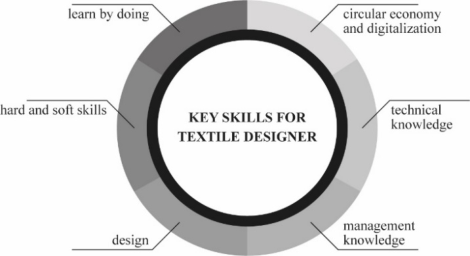
Interviews to Stakeholders Based on the literature review that made it possible to understand the new challenges facing the textile industry and how the academy can intervene in the preparation of textile design professionals. Semi-structured interviews were carried out in May 2021 with experts of the sector - textile designers, textiles craftsman’s, fashion and textile teachers, Portuguese technological center of the textile and clothing industries, Portuguese textile cluster, Portu- guese’s textile associations - to hear their opinion on the core skills that the textile designer must have to exercise their profession and help to boost the textile industry and the economy. The main questions were, Q1: As a tex- tile design professional, which technical skills do you consider crucial for the performance of the activity? What about soft skills? Q2: Considering higher education, what knowledge do you consider essential to be learned/taught for the textile design professional? Q3: What do you think is the best strategy for bringing industry closer to academia? That is, how can more professi- onal knowledge and skills be transmitted to students? The results allowed us to conclude that the textile designer must integrate a set of multidiscipli- nary knowledge from the most technical such as materials, “learn by doing”, industrial and textile process, to the complementary ones such as manage- ment, marketing, costs, planning, among others, including knowledge of the universe of design such as creativity, design methodology, interpreting
The Textile Designer Skills to Face the Emerging Challenges of Textile Industry 27
Figure 1: Key skills for textile designer. (Seixas, 2021).
society and consumer’s needs, understanding social, cultures and demogra- phics components. No less important, knowledge concerned to the themes of sustainability, circular economy, and digitalization since the sector itself faces these challenges. About soft skills, autonomy, entrepreneurial spirit, interre- lationship, proactivity, empathy, ethics, ability to be sensitive to changes in the world and global changes are essential, since the activity design is tea- mwork, it is a collaborative work. They mentioned the importance of the existence of a practical teaching applied in the training of these professionals with active teaching-learning strategies, a dual teaching, to put into practice the knowledge acquired in a real environment with concrete challenges, to better understand the application of concepts in an industrial environment (figure 1).
Skills of Textile Designer With the development of new technologies acquiring a consciousness about sustainability, circular economy and digitalization issues is imperative for tex- tile designers, who must now also consider the origin of materials throughout the creative process, making their roles more complex but also more challen- ging. The knowledge about the advantages and properties of materials and textile finishes combined with new technologies in the search for functio- nal, sustainable, and high-performance textile products, responding to the demands of the user and society, transposes a wide field of application to the universe of textile design. Develop a multidisciplinary and interdiscipli- nary mindset to help in the search for solutions to complex problems such as pressing issues of survival of the planet and human beings, considering the environmental, economic, social, ethical, and cultural impacts in a future vision. A collaborative approach allows us to expect and respect different perspectives, enabling constructive criticism and analysis of complex real- world problems. Build a new positioning by nurturing a new mindset and attitude throughout the value chain, with the textile designer collaborating throughout the textile production chain, designing solutions and fostering a sustainable, regenerating, and repairing natural systems, minimizing waste and pollution, benefiting the society, the environment and the economy (Ellen MacArthur Foundation, 2017, 2020; ATP, 2021).
CONCLUSION
The objective of this article was to investigate and reflect on the role of different actors – industry, academia, designer, user – in the adoption of more sustainable practices of production and consumption of textile pro- ducts. From the triangulation of the literature review and the interviews carried out, it was possible to perceive that the design problems are increa- singly complex, adding the dimensions inherent to the circular economy and digitalization. The textile designer must acquire new social, environmental, cultural, and ethical responsibilities in the design of textile products, looking for a global balance between humanity and the natural world. It should colla- borate in multidisciplinary, interdisciplinary and transdisciplinary teams with their different knowledge to promote sustainable, regenerating, and repairing natural systems, minimizing waste and pollution benefiting the society, the environment and the economy (Ellen MacArthur Foundation, 2017, 2020; ATP, 2021). The textile industry faces new challenges, there is an urgent need to restructure its production processes, minimize energy and water consum- ption, and look for solutions for its reuse considering its permanence in the production cycle, ensuring the least possible waste (ATP, 2021). The textile designer can act as an agent of change, adopting a more active role and building new social paradigms and new ethical models, thus contributing to the education of consumer behavior, being important to rethink the role of academia in the preparation of these future professionals, but also citi- zens. It is necessary to create synergies between industry and academia to provide new learning experiences. Through the duality of a new vision of knowledge and way of thinking, incorporating the theme of sustainability in a transversal way, responding effectively to environmental and societal chan- ges. It is believed that the main contribution to design with this study was the possibility of listing a set of key skills for the textile design professio- nal. Exercising in its profession the simultaneous response to the emerging challenges that the sector faces, and that education in textile design must reflect, it will also design new ways of responding to these situations and demands, with the integration of transdisciplinary approaches in combina- tion with multidisciplinary and interdisciplinary strategies. The importance of combining knowledge associated with the themes of circular economy and digitalization, technical knowledge, management, the universe of design in conciliation with soft skills will help in the search for answers to the men- tioned problems. The importance of a teaching-learning strategy based on “learning by doing” where academia and industry must collaborate in a closer relationship. A dual teaching in a transdisciplinary vision for textile designers to put into practice the knowledge acquired in a real environment with concrete challenges to better understand the application of concepts in an industrial environment, sharing ideas, opinions, and thoughts. For future studies, a continuation of this analysis is suggested to understand the best strategies to be used to reinforce synergies between academia and industry. How these skills can be taught to textile designers to help the textile indu- stry to face emerging challenges, generating a textile economy of the future ensuring the socio-environmental well-being of the human being and the
The Textile Designer Skills to Face the Emerging Challenges of Textile Industry 29
planet. Teaching focused on a multidisciplinary, interdisciplinary, and trans- disciplinary vision will provide designers with experience in collaboration, as well as communicating and analyzing contexts and information in different professional languages.
ACKNOWLEDGMENT
This work is financed by national funds through FCT - Fundação para a Ciência e a Tecnologia, I.P., under the Strategic Project with the refere- nce UIDB/04008/2020 and UIDP/04008/2020, and through the individual research grant 2020.04735.BD.
REFERENCES
ATP (2021) Visão Prospetiva e Estratégias ITV 2030. Contributo para um Plano Estratégico para o Sector Têxtil e Vestuário Português até 2030. Vila Nova de Famalicão, Portugal: ATP - Associação Têxtil e Vestuário de Portugal. Berg, A. et al. (2020) Fashion on Climate: How the Fashion Industry can Urgently Act
to Reduce its Greenhouse Gas Emissions. McKinsey & Company; Global Fashion Agenda. Boström, M. and Micheletti, M. (2016) ‘Introducing the Sustainability Challenge of Textiles and Clothing’, Journal of Consumer Policy, 39(4), pp. 367–375. doi: 10.1007/s10603-016-9336-6. Ellen MacArthur Foundation (2017) A New Textiles Economy: Redesigning Fash-
ion’s Future. London, UK. Ellen MacArthur Foundation (2020) Vision of a Circular Economy for Fashion.
London, UK. European Commission (2020) ‘Press statement by President von der Leyen on the New European Bauhaus’. Available at: https://ec.europa.eu/commission/presscor ner/detail/en/STATEMENT_20_1902. Findeli, A. (2001) ‘Rethinking design education for the 21st century: Theoreti-
cal, methodological, and ethical discussion’, Design Issues, 17(1), pp. 5–17. doi: 10.1162/07479360152103796. Fletcher, K. (2009) ‘Systems change for sustainability in textiles’, in Blackburn, R. S.
(ed.) Sustainable Textiles. Life Cycle and Environmental Impact. UK: Woodhead Publishing Limited, pp. 369–380. doi: 10.1533/9781845696948.1.3. Fletcher, K. and Grose, L. (2012) Fashion & Sustainability. Design for Change.
London, UK: Laurence King Publishing Ltd. Fletcher, K. and Williams, D. (2013) ‘Fashion Education in Sustainability in Practice’, Research Journal of Textile and Apparel, 17(2), pp. 81–88. doi: 10.1108/RJTA- 17-02-2013-B011. Friedman, K. (2012) ‘Models of Design: Envisioning a Future Design Education’,
Visibile Language, 46.1(2), pp. 132–153. Fuad-Luke, A. (2009) Design Activism: Beautiful Strangeness for a Sustainable World. London, UK: Earthscan. Gale, C. and Kaur, J. (2002) The textile book. Oxford, UK: Berg. Goldsworthy, K. (2014) ‘Design for Cyclability: pro-active approaches for maximi-
sing material recovery’, Making Futures, 3. Gwilt, A. (2020) A Practical Guide to Sustainable Fashion. Second Ed. London, UK: Bloomsbury Publishing Plc.
Manzini, E. (2009) ‘Viewpoint. New design knowledge’, Design Studies, 30(1), pp. 4–12. doi: 10.1016/j.destud.2008.10.001. Manzini, E. (2011) ‘Design Schools as Agents of (sustainable) Change’, International
Symposium CUMULUS//DRS for Design, 1, pp. 9–16. Meyer, M. W. and Norman, D. (2020) ‘Changing Design Education for the 21st Century’, She Ji, 6(1), pp. 13–49. doi: 10.1016/j.sheji.2019.12.002. Muratovski, G. (2020) ‘The Making of an American Design School: Lessons
Learned’, She Ji, 6(1), pp. 67–82. doi: 10.1016/j.sheji.2020.01.002. Norman, D. (2010) ‘Why Design Education Must Change’, core77. Papanek, V. (1995) Green Imperative: Ecology and Ethics in Design and Architecture.
New York, USA: Thames & Hudson Ltd. Sbordone, M. A. et al. (2021) ‘An Ideal Triangulation in Fashion and Textile: Industry, Academia and Users’, in Shin, C. S. et al. (eds) Advances in Industrial Design. New York, USA: Springer, Cham, pp. 698–706. doi: 10.1007/978-3-030-80829- 7_86. Seixas, S., Montagna, G. and Félix, M. J. (2021) ‘Materials Matters in Textile and
Fashion Design Education’, in Shin, C. S. et al. (eds) Advances in Industrial Design. New York, USA: Springer, Cham, pp. 681–688. doi: 10.1007/978-3-030-80829- 7_84. Studd, R. (2002) ‘The textile design process’, The Design Journal, 5(I), pp. 35–49.
doi: 10.2752/146069202790718567. Swanson, G. (2020) ‘Educating the Designer of 2025’, She Ji, 6(1), pp. 101–105.
doi: 10.1016/j.sheji.2020.01.001. UNECE (2018) Traceability of Sustainable Value Chains. Enhancing transparency in the garment and footwear sector for informed and responsible choices. Available at: https://unece.org/trade/traceability-sustainable-garment-and-footw ear (Accessed: 5 June 2021). UNESCO (2017) Education for Sustainable Development Goals Learning Objectives.
Paris, France: United Nations Educational, Scientific and Cultural Organization. Vezzoli, C. and Manzini, E. (2008) Design for Environmental Sustainability. London, UK: Springer-Verlag London Limited.
LISTED IN THE AHFE DIGITAL BOOKSTORE CATALOGUE
Explore the complete digital volume
Human Factors for Apparel and Textile Engineering
Read this individual research paper free through the original publisher, or explore the full digital proceedings book.
ISBN 978-1-958651-08-7
Explore this ISBN in the AHFE Bookstore ↗Listed in the July 2026 bookstore catalogue; search by ISBN to confirm current availability · Digital book purchase optional