Michela Balconi, Katia Rovelli (2025). Designing for the mind: the impact of university environments on well-being in students by (using) neurophysiological responses. In: Human Factors in Architecture, Sustainable Urban Planning and Infrastructure. AHFE Open Access, vol. 191, pp. 144–154. https://doi.org/10.54941/ahfe1006618
This study investigates the influence of different university environments on students’ well-being and cognitive restoration by using neurophysiological (central – electrophysiological [EEG]) and autonomic (peripherical) responses. 31 psychology students (aged 22-28 years) were exposed to four environments in a randomized order: a traditional classroom, an atrium, a laboratory, and an immersive exhibition. EEG data frequency bands: delta, theta, alpha, beta, gamma), autonomic data (heart rate, HR; skin conductance level, SCL) and psychometric data (the Building Wellbeing Scale [BWS] and the Perceived Restorativeness Scale [PRS]) were collected. Analysis revealed significant differences in the participants’ neurophysiological responses across environments. EEG results showed increased Delta and Theta activity in the temporo-parietal region during interactions with immersive environments, indicating greater cognitive engagement and relaxation. Beta activity was higher in classrooms, suggesting increased cognitive load. Autonomic measures revealed elevated skin conductance level in the atrium, indicating heightened arousal compared to other spaces. Psychometric assessments indicated that the atrium scored highest on relational well-being, while the exhibition was rated as most restorative, particularly in the coherence subscale. The atrium, with its open and naturally lit design, promoted social connection, while the exhibition fostered a restorative experience due to its engaging design. The findings suggest that environmental characteristics significantly affect both subjective and objective well-being, underscoring the importance of balancing cognitive stimulation and relaxation in academic spaces.
Neuroarchitecture is an interdisciplinary field that explores the interaction between human cognition, emotions, and the built environment (Karakas and Yildiz, 2020). By combining concepts from neuroscience, psychology, and architecture, it investigates how design influences mental states, emotions,
Designing for the mind: the impact of university environments 145
and well-being (Higuera-Trujillo et al., 2021). Extending the principles of environmental psychology, which historically examined the effects of physical spaces on behavior, neuroarchitecture employs neuroscientific tools like electroencephalography (EEG), autonomic measurements, and neuroimaging to deepen our understanding of these interactions (Wang et al., 2022). Research underscores the role of design in shaping neural dynamics, with aesthetic appeal identified as a determinant of well-being (Higuera-Trujillo et al., 2021). Furthermore, recent advancements in this field explore how architectural environments influence sensorimotor dynamics and real-world cognition. Moving beyond aesthetics, studies emphasize the necessity of designs that holistically address perception, behavior, and spatial affordances, offering innovative approaches to enhancing human experiences in built environments (Makanadar, 2024; Wang et al., 2022). The understanding of the cognitive and emotional effects of architecture is particularly relevant in the context of university environments. Universities increasingly recognize the role of physical spaces in supporting student learning, mental health, and social interaction. Consequently, principles derived from architectural and environmental psychology are applied to optimize educational infrastructures, including classrooms, study areas, and communal zones, thereby fostering engagement, focus, and well- being. Theoretical frameworks, such as Attention Restoration Theory (ART; Ohly et al., 2016), underscore the importance of natural elements – like green spaces – in reducing stress and enhancing attentional recovery. Furthermore, architectural features such as spatial coherence, intuitive wayfinding, and ergonomic design reduce cognitive load, facilitate navigation, and promote focus (Makanadar, 2024). Furthermore, sensory inputs, including light, sound, and color, are critical in shaping cognitive and emotional states. For instance, natural light enhances circadian rhythms, elevates mood, and boosts productivity (Blume et al., 2019), while acoustically optimized spaces minimize distractions and facilitate sustained cognitive engagement (Ajiboye, 2024). However, university campuses, as multifunctional environments, consist of diverse spaces – classrooms, laboratories, libraries, and social areas – that impose distinct cognitive and emotional demands. Classrooms benefit from structured layouts that promote concentration but must also incorporate elements such as natural light and ergonomic furniture to mitigate mental fatigue (Manca et al., 2020). Social areas, designed with open layouts, biophilic elements, and greenery, foster relaxation, social connectivity, and stress regulation (Zhong et al., 2022). Similarly, study spaces with flexible layouts and acoustic optimization enable sustained attention and adaptability to diverse learning styles (Barrett and Zhang, 2009). Neuroarchitecture principles provide a framework for optimizing these environments to enhance both academic outcomes and mental health. Advances in neuroscientific methodologies, such as EEG and autonomic measures, have significantly transformed the study of neuroarchitecture in educational settings (Llorens-Gámez et al., 2022). EEG, for example, captures brain oscillations reflecting specific cognitive and emotional states. Distinct brainwave patterns, including Delta, Theta, Alpha, Beta, and Gamma bands, are modulated by environmental factors and serve as metrics to assess the
146 Balconi and Rovelli
impact of design features (Cabrera et al., 2021). Delta waves, linked to relaxation and emotional regulation, are often prominent in environments that encourage sensory immersion (Norwood et al., 2019). Theta activity, associated with memory and creativity, is enhanced in settings that facilitate cognitive exploration (Assem et al., 2023; Tawil and Kühn, 2024). Alpha waves, indicative of calm alertness, are influenced by environments that balance sensory stimulation and tranquility (Deshmukh, 2023). Beta waves, reflecting focused attention, dominate in structured settings such as classrooms (Geake, 2009). Gamma activity, associated with cognitive integration, is heightened in complex and engaging environments (Tawil and Kühn, 2024). The integration of neuroarchitecture principles into university design emphasizes creating flexible, inclusive spaces that address diverse learning needs, incorporate biophilic elements to promote well-being, and prioritize accessibility to foster inclusivity. Moreover, designs that cultivate a sense of place identity through culturally resonant architecture strengthen community ties and enhance satisfaction with the university experience. This study investigates how various architectural environments within university campuses – including classrooms, atriums, laboratories, and immersive exhibition spaces – affect students’ cognitive, emotional, and physiological well-being, focusing on their influence on stress regulation, attention, and satisfaction. By examining neural and psychological responses to specific design features, the study aims to generate actionable insights for optimizing academic performance and holistic well-being. The central hypothesis posits that environments with distinct sensory and spatial characteristics elicit unique emotional and cognitive responses, thereby influencing well-being and stress regulation. Environments that promote attentional restoration and cognitive engagement are hypothesized to enhance academic performance and well-being (Higuera-Trujillo et al., 2021). For example, classrooms optimized for focused work are expected to increase alpha band activity, linked to concentration, with notable activation in the left temporal-parietal region due to the cognitive demands of maintaining focus (Balconi et al., 2023; Haynes, 2007). Laboratories, which require sustained cognitive effort, are hypothesized to elicit elevated beta wave activity, reflecting deep concentration (Balconi et al., 2023). Immersive exhibition spaces are anticipated to enhance theta wave activity, fostering relaxation and creativity, aligning with patterns observed in engaging environments (Balconi et al., 2023; Costa, 2009). Autonomic measures such as heart rate (HR), heart rate variability (HRV), skin conductance level (SCL), and skin conductance response (SCR) provide additional insights into emotional engagement and stress regulation. Restorative environments, such as exhibitions, are hypothesized to increase HRV, signifying reduced stress and enhanced recovery (Aeschbach et al., 2024). These spaces are also expected to elevate SCL and SCR, reflecting heightened emotional involvement and attentional demands (Acconito et al., 2023; Balconi and Fronda, 2022). To complement physiological measures, psychometric tools such as the Perceived Restorativeness Scale (PRS; Hartig et al., 1997) and the Building Wellbeing Scale (BWS; Watson, 2018) will assess subjective outcomes. The PRS evaluates the restorative potential of environments in reducing stress,
Designing for the mind: the impact of university environments 147
while the BWS assesses the impact of architectural design on well-being. By integrating neural, autonomic, and psychometric data, this study aims to provide a comprehensive perspective on designing university environments that enhance academic success and support students’ cognitive, emotional, and physiological health.
MATERIALS AND METHODS
Sample The sample consisted of 31 undergraduate psychology students from the Catholic University of the Sacred Heart, Milan (Mage = 23.29 years, SD = 1.32; age range = 21–28; education = 16.03 years). Inclusion criteria mandated enrollment at the Catholic University of the Sacred Heart and regular attendance, ensuring familiarity with the environment. Exclusion criteria were: (i) enrollment in another institution’s master’s program, (ii) cognitive, neurological, or psychiatric conditions, (iii) chronic or acute pain, and (iv) psychoactive medication use. Participation was voluntary and uncompensated. Written informed consent was obtained in accordance with the ethical guidelines of the Declaration of Helsinki (2013). The Ethics Committee of the Department of Psychology at the Catholic University of the Sacred Heart, Milan, approved the study, conducted in compliance with the General Data Protection Regulation (GDPR) - Reg. UE 2016/679 and associated ethical standards.
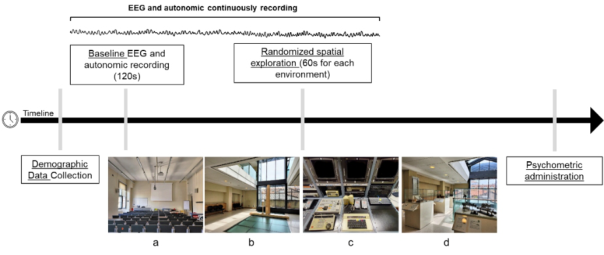
Experimental Procedure The experimental procedure consisted of four distinct step (Figure 1) that included demographic data collection, baseline recording, spatial exploration of the four university environments (a traditional classroom, an atrium, a laboratory, and an immersive exhibition), and psychometric administration.
Figure 1: Procedure’s steps and photographs of the explored spaces: (a) a traditional classroom, (b) an atrium, (c) a laboratory, and (d) an immersive exhibition.
The first step involved completing a demographic questionnaire via a Google Forms link (Google LLC, Mountain View, California, USA) before
148 Balconi and Rovelli
data collection began. The second step recorded baseline data under resting- state conditions using a wearable EEG (Muse Headband; InteraXon Inc., Toronto, Ontario, Canada) and a biofeedback (XPert2000; Schufried GmbH, Mödling, Austria) devices. Resting-state signals were captured over two minutes, alternating between one minute with eyes open and one minute with eyes closed. In the third step, participants proceeded to explore each environment for approximately one minute. The sequence of exploration was randomized for each participant. EEG and autonomic data were recorded during these sessions to capture physiological responses to the different settings. Finally, participants completed psychometric scales, the BWS and the PRS.
EEG and Autonomic Data Acquisition EEG data were recorded using the non-invasive Muse™Headband (version 2) by InteraXon Inc. This wearable system features four bipolar dry electrodes with gold-plated conductive cups and silicon rubber. Positioned according to the 10–20 international system (Jasper, 1958), electrodes are placed at frontal (AF7, AF8) and temporo-parietal (TP9, TP10) sites on the left and right forehead and ears, respectively. Data is transmitted via Bluetooth to the Mind Monitor app, with a sampling rate of 256 Hz and a 50 Hz notch filter. The app processes raw data through Fast Fourier Transform (FFT) to extract brain wave frequencies from five bands: delta (1–4 Hz), theta (4–8 Hz), alpha (7.5–13 Hz), beta (13–30 Hz), and gamma (30–44 Hz), calculating the Power Spectral Density (PSD) for each channel. PSD values typically fall within the range of –1 to +1.
Autonomic data were collected using the X-pert2000 portable Biofeedback system with a MULTI radio module (Schuhfried GmbH, Modling, Austria). A peripheral sensor was placed on the distal phalanx of the non-dominant hand’s second finger to measure electrodermal activity, including SCL and SCR, as well as cardiovascular indices such as HR and HRV. SCL and SCR were recorded in µS using a gold EDA electrode with current-current measurement at a 2 kHz sampling frequency, and alternating voltage was applied to prevent polarization. SCL resolution was 12 nanoseconds (ns) with a 20 Hz sampling rate. HR, measured in beats per minute (bpm), was captured via photoplethysmography at a 500 Hz sampling frequency. Hand movements were monitored with an accelerometer (calibrated in m/s2) on the sending unit to mitigate movement interference during recordings.
Data Analysis The EEG data were analyzed using repeated measures ANOVA with SPSS (version 27; IBM Corp., Armonk, NY, USA) to assess the effects of frequency bands, regions of interest (ROI), and hemispheric lateralization on brain activity. Five separate repeated measures ANOVAs were conducted for each frequency band (Delta, Theta, Alpha, Beta, Gamma). The independent variables included the following factors: ROI (frontal, temporo-parietal), hemispheric lateralization (right, left), and environments (four). Furthermore, four repeated measures ANOVAs were performed for each autonomic index
Designing for the mind: the impact of university environments 149
(HR, HRV, SCL and SCR) with environments (four) as the within-subject factor. Finally, univariate ANOVAs were performed for each subscale of the BWS and PRS with environments (four) as the between-subjects factor. Pairwise comparisons were applied to the data in case of significant effects. Polynomial contrasts were computed to evaluate potential linear or higher- order trends across locations. Post-hoc pairwise comparisons were performed with Bonferroni adjustment to control for Type I error. Effect sizes (η2) were calculated to assess the magnitude of the observed effects, and observed power was reported to evaluate the likelihood of detecting significant results given the sample size. Statistical significance was set at α = 0.05. All data were inspected for violations of sphericity using Mauchly’s test, and Greenhouse-Geisser corrections were applied when necessary.
RESULTS
EEG and Autonomic Results Delta. The analysis of variance revealed a statistically significant effect for ROI (F[1, 24] = 19.944, p = .000, η2 = .453), with an increase in Delta activity in the temporo-parietal area compared to the frontal area. A statistically significant interaction effect was found for ROI × environment (F[2, 72] = 3.681, p = .031; η2 = .132), indicating an increase in Delta activity in the temporo-parietal area across each of the four environments considered compared to the frontal area. Finally, a significant interaction effect was recorded for Lateralization × environment (F[3, 72] = 3.784, p = .014, η2 = .136). Pairwise comparisons revealed a statistically significant difference in Delta activity between the laboratory and the immersive exhibition in the left hemisphere, highlighting higher activation in the laboratory environment (µ = 1.628) compared to the immersive exhibition.
Theta. A significant main effect was found for Localization (F[1, 24] = 17.860, p = .000, η2 = .426), with higher activation of the Theta band in the temporo-parietal area compared to the frontal area.
Beta. A statistically significant effect was found concerning the Lateralization variable (F[1, 24] = 4.338, p = .048, η2 = .153), with an increase in Beta band activation in the left hemisphere compared to the right hemisphere.
Gamma. A statistically significant main effect was found for Localization (F[1, 24] = 4.492, p = .445, η2 = .157), with an increase in Gamma band activation in the temporo-parietal area compared to the frontal area.
SCL. A significant main effect was found for the Environment variable (F[3, 45] = 4.305, p = .009, η2 = .223), with higher skin conductance levels in the atrium environment compared to the classroom environment. No significant differences were found for HR, HRV, and SCR.
Psychometric Results BWS. For the Rationality subscale, a statistically significant effect was found for environment (F[3, 27] = 3.322, p = .034, η2 = .270), with higher levels of
150 Balconi and Rovelli
relationality observed in the atrium compared to the classroom (Figure 1a). No other significant effects were found.
PRS. For the Coherence subscale, a statistically significant effect was found for environment (F[3, 27] = 6.823, p = .001, η2 = .431). Specifically, higher levels of coherence were observed in the exhibition environment compared to the laboratory environment (p = .003). Additionally, coherence was higher in the classroom environment compared to the laboratory environment (p = .007).
DISCUSSION
The present study aimed to investigate the complex interplay between university environments and students’ neurophysiological, emotional, and cognitive well-being, contributing to the broader field of neuroarchitecture. The findings revealed significant variations across these environments. Delta and Theta demonstrated a marked increase in the temporo-parietal region during the exploration of immersive and socially engaging spaces. In contrast, Beta activity was predominantly observed in the classroom environment, reflecting the structured and cognitively intensive nature of this setting. Among the examined environments, the atrium was associated with the highest scores for relational well-being, whereas the exhibition space was identified as the most restorative, underscoring the critical role of spatial coherence and sensory engagement in fostering cognitive and emotional benefits. These findings highlight the relationship between environmental features and cognitive restoration. Environments characterized by coherence and sensory engagement appear to facilitate the replenishment of attentional resources, as evidenced by the increased Theta activity and the restorative ratings of the exhibition space. The immersive qualities of this environment appear to have significantly contributed to facilitating cognitive recovery and enhancing emotional regulation, underscoring the intricate interdependence between spatial design elements and neural processes. The theoretical framework of ART posits that exposure to environments with coherence and engagement significantly facilitates the replenishment of attentional resources, thereby enhancing both cognitive performance and emotional stability (Ohly et al., 2016). This is evident in the exhibition space, where the coherence subscale of the PRS and increased Theta activity reflected the environment’s potential to foster cognitive restoration. Furthermore, the immersive design elements likely enhanced participants’ engagement, corroborating ART’s emphasis on the role of sensory immersion in cognitive recovery. Delta oscillations, traditionally linked to states of rest and subconscious cognitive processing, showed significant activation in the temporo-parietal region, aligning with theories of episodic memory and social cognition. Delta waves are fundamental to processes governing emotional memory and feedback, particularly in contexts that elicit familiarity and facilitate episodic recollection (Balconi et al., 2018, 2024). This neural response was especially pronounced in the laboratory and exhibition settings, where novelty and coherence likely triggered episodic memory retrieval and attentional processes. The significant Theta activity observed in the
Designing for the mind: the impact of university environments 151
temporo-parietal region aligns with its role in memory encoding, emotional regulation, and stress relief. This finding underscores the restorative value of environments like the exhibition, which combines novelty and coherence to promote cognitive and emotional balance. The role of the temporo- parietal region in these processes is further supported by recent research that highlighted its involvement in theory of mind, empathy, and episodic memory (Allegretta et al., 2024; Balconi and Vanutelli, 2017) – processes that are particularly relevant in socially and emotionally engaging settings like the atrium and exhibition. Beta activity, predominantly observed in the classroom environment, reflects the structured and cognitively demanding characteristics of this setting. Beta oscillations, linked to sustained attention and problem-solving (Geake, 2009), indicate the classroom’s role in supporting focused cognitive tasks.
The autonomic findings, particularly the elevated SCL in the atrium, highlight the physiological arousal associated with open, well-lit environments. This observation aligns with existing research on the role of spatial openness and natural lighting in enhancing emotional engagement and facilitating social interaction. The significance of spatial symmetry and illumination in promoting positive emotional states has been emphasized (Shemesh et al., 2022), which is consistent with the atrium’s high relational well-being scores.
The psychometric results provide further insight into the interplay between relational and restorative qualities of academic spaces. The atrium’s high relational scores align with models of place attachment, which identify socio-emotional and functional values as key determinants of environmental satisfaction. Similarly, the coherence observed in the exhibition and classroom settings reflects the concept of coherence as a defining feature of restorative environments (Hauru et al., 2012). These findings validate the emphasis on the importance of spatial design in promoting both individual and collective well-being.
In conclusion, this study underscores the critical role of neuroarchitecture in designing academic spaces that cater to diverse cognitive and emotional needs. By leveraging theoretical frameworks like ART and integrating neuroscientific insights, the findings emphasize the importance of coherence, sensory engagement, and biophilic elements in fostering holistic well- being. Future research should explore the longitudinal impact of such designs on academic performance and extend investigations to diverse cultural and architectural contexts. Ultimately, this study highlights the transformative potential of evidence-based design principles in shaping educational environments that not only support learning but also nurture cognitive and emotional health.
ACKNOWLEDGMENT
Ethics Statement: The study involving human participants was conducted in accordance with the Declaration of Helsinki (2013), reviewed and approved by the Ethics Committee of the Catholic University of the Sacred Heart, Milan, Italy (approval code: 2021 PhDTD; approval date: 1 December 2021).
Consent to Participate: The participants provided their written informed consent to participate in this study.
Conflicting interest: The authors declared no potential conflicts of interest with respect to the research, authorship, and/or publication of this article.
Funding: No funds were received for this study. Data Availability Statement: The data presented in this study are available on request from the corresponding author due to ethical reasons for sensitive personal data protection (requests will be evaluated according to the GDPR - Reg. UE 2016/679 and its ethical guidelines).
REFERENCES
Acconito, C., Rovelli, K. and Angioletti, L. (2023), “Neuroscience for a new concept of decision-making style”, Neuropsychological Trends, LED EDIZIONI UNIV, No. 33, pp. 17–35, doi: 10.7358/neur-2023-033-acc1. Aeschbach, V. M., Schipperges, H., Braun, M. A., Ehret, S., Ruess, M., Sahintuerk, Z.
and Thomaschke, R. (2024), “Less is more: The effect of visiting duration on the perceived restorativeness of museums.”, Psychology of Aesthetics, Creativity, and the Arts, Educational Publishing Foundation, US, Vol. 18, No. 6, pp. 940–947, doi: 10.1037/aca0000475. Ajiboye, S. A. (2024), “Harmonizing Spaces: Investigating the Intersection of Sound and Architectural Design”, Studies in Art and Architecture, Vol. 3, No. 3, pp. 46–56, doi: 10.56397/SAA.2024.09.09. Allegretta, R. A., Rovelli, K. and Balconi, M. (2024), “The Role of Emotion
Regulation and Awareness in Psychosocial Stress: An EEG-Psychometric Correlational Study”, Healthcare, MDPI, Vol. 12, No. 15, p. 1491, doi: 10.3390/healthcare12151491. Assem, H. M., Khodeir, L. M. and Fathy, F. (2023), “Designing for human wellbeing: The integration of neuroarchitecture in design–A systematic review”, Ain Shams Engineering Journal, Elsevier, Vol. 14, No. 6, p. 102102, doi: 10.1016/j.asej.2022.102102. Balconi, M., Angioletti, L. and Cassioli, F. (2023), “Hyperscanning EEG paradigm applied to remote vs. face-to-face learning in managerial contexts: Which is better?”, Brain Sciences, MDPI, Vol. 13, No. 2, p. 356, doi: 10.3390/brainsci13020356. Balconi, M., Angioletti, L. and Rovelli, K. (2024), “Neurophysiological response to
social feedback in stressful situations”, European Journal of Neuroscience, Wiley Online Library, Vol. 60, No. 8, pp. 6030–6045, doi: 10.1111/ejn.16528. Balconi, M. and Fronda, G. (2022), “Autonomic system tuning during gesture observation and reproduction”, Acta Psychologica, Vol. 222, p. 103477, doi: https://doi.org/10.1016/j.actpsy.2021.103477. Balconi, M., Gatti, L. and Vanutelli, M. E. (2018), “Cooperate or not cooperate EEG,
autonomic, and behavioral correlates of ineffective joint strategies”, Brain and Behavior, Wiley Online Library, Vol. 8, No. 2, p. e00902, doi: 10.1002/brb3.902.
Designing for the mind: the impact of university environments 153
Balconi, M. and Vanutelli, M. E. (2017), “Empathy in Negative and Positive Interpersonal Interactions. What is the Relationship Between Central (EEG, fNIRS) and Peripheral (Autonomic) Neurophysiological Responses?”, Advances in Cognitive Psychology, Vol. 13, No. 1, p. 105, doi: 10.5709/acp-0211-0. Barrett, P. S. and Zhang, Y. (2009), “Optimal learning spaces: Design implications
for primary schools”. Blume, C., Garbazza, C. and Spitschan, M. (2019), “Effects of light on human circadian rhythms, sleep and mood”, Somnologie, Springer, Vol. 23, No. 3, p. 147, doi: 10.1007/s11818-019-00215-x. Cabrera, F. E., Sánchez-Núñez, P., Vaccaro, G., Peláez, J. I. and Escudero, J. (2021),
“Impact of visual design elements and principles in human electroencephalogram brain activity assessed with spectral methods and convolutional neural networks”, Sensors, MDPI, Vol. 21, No. 14, p. 4695, doi: 10.3390/s21144695. Costa, M. (2009), Psicologia Ambientale e Architettonica. Come l’ambiente e l’architettura Influenzano La Mente e Il Comportamento, FrancoAngeli. Deshmukh, V. D. (2023), “The electroencephalographic brainwave spectrum,
mindful meditation, and awareness: Hypothesis”, International Journal of Yoga, Medknow, Vol. 16, No. 1, pp. 42–48, doi: 10.4103/ijoy.ijoy_34_23. Geake, J. (2009), The Brain at School: Educational Neuroscience in the Classroom: Educational Neuroscience in the Classroom, McGraw-Hill Education (UK). Hartig, T., Korpela, K., Evans, G. W. and Gärling, T. (1997), “A measure of restorative quality in environments”, Scandinavian Housing and Planning Research, Taylor & Francis, Vol. 14, No. 4, pp. 175–194, doi: 10.1080/02815739708730435. Hauru, K., Lehvävirta, S., Korpela, K. and Kotze, D. J. (2012), “Closure of view
to the urban matrix has positive effects on perceived restorativeness in urban forests in Helsinki, Finland”, Landscape and Urban Planning, Vol. 107, No. 4, pp. 361–369, doi: https://doi.org/10.1016/j.landurbplan.2012.07.002. Haynes, B. P. (2007), “The impact of the behavioural environment on office productivity”, Journal of Facilities Management, Emerald Group Publishing Limited, Vol. 5, No. 3, pp. 158–171, doi: 10.1108/14725960710775045. Higuera-Trujillo, J. L., Llinares, C. and Macagno, E. (2021), “The cognitive-
emotional design and study of architectural space: A scoping review of neuroarchitecture and its precursor approaches”, Sensors, MDPI, Vol. 21, No. 6, p. 2193, doi: 10.3390/s21062193. Jasper, H. H. (1958), “The ten-twenty electrode system of international federation EEG”, Electroencephalogr. Clin. Neurophysiol., Vol. 10, No. 1, pp. 371–375. Karakas, T. and Yildiz, D. (2020), “Exploring the influence of the built environment
on human experience through a neuroscience approach: A systematic review”, Frontiers of Architectural Research, Elsevier, Vol. 9, No. 1, pp. 236–247, doi: 10.1016/j.foar.2019.10.005. Llorens-Gámez, M., Higuera-Trujillo, J. L., Omarrementeria, C. S. and Llinares, C. (2022), “The impact of the design of learning spaces on attention and memory from a neuroarchitectural approach: A systematic review”, Frontiers of Architectural Research, Elsevier, Vol. 11, No. 3, pp. 542–560, doi: 10.1016/j.foar.2021.12.002. Makanadar, A. (2024), “Neuro-adaptive architecture: Buildings and city design that
respond to human emotions, cognitive states”, Research in Globalization, Elsevier, p. 100222, doi: 10.1016/j.resglo.2024.100222.
154 Balconi and Rovelli
Manca, S., Cerina, V., Tobia, V., Sacchi, S. and Fornara, F. (2020), “The effect of school design on users’ responses: a systematic review (2008–2017)”, Sustainability, MDPI, Vol. 12, No. 8, p. 3453, doi: 10.3390/su12083453. Norwood, M. F., Lakhani, A., Maujean, A., Zeeman, H., Creux, O. and Kendall, E.
(2019), “Brain activity, underlying mood and the environment: A systematic review”, Journal of Environmental Psychology, Elsevier, Vol. 65, p. 101321, doi: 10.1016/j.jenvp.2019.101321. Ohly, H., White, M. P., Wheeler, B. W., Bethel, A., Ukoumunne, O. C., Nikolaou, V.
and Garside, R. (2016), “Attention Restoration Theory: A systematic review of the attention restoration potential of exposure to natural environments”, Journal of Toxicology and Environmental Health, Part B, Taylor & Francis, Vol. 19, No. 7, pp. 305–343, doi: 10.1080/10937404.2016.1196155. Shemesh, A., Leisman, G., Bar, M. and Grobman, J. (2022), “The emotional influence of different geometries in virtual spaces: A neurocognitive examination”, Journal of Environmental Psychology, Vol. 81, doi: 10.1016/j.jenvp.2022.101802. Tawil, N. and Kühn, S. (2024), “The Built Environment and the Brain: Review of
Emerging Methods to Investigate the Impact of Viewing Architectural Design”, Environmental Neuroscience, Springer, pp. 169–226, doi: 10.1007/978-3-031- 64699-7_9. Wang, S., Sanches de Oliveira, G., Djebbara, Z. and Gramann, K. (2022), “The embodiment of architectural experience: A methodological perspective on neuro- architecture”, Frontiers in Human Neuroscience, Frontiers, Vol. 16, p. 833528, doi: 10.3389/fnhum.2022.833528. Watson, K. J. (2018), “Establishing psychological wellbeing metrics for the built
environment”, Building Services Engineering Research and Technology, SAGE Publications Sage UK: London, England, Vol. 39, No. 2, pp. 232–243, doi: 10.1177/0143624418754497. Zhong, W., Schröder, T. and Bekkering, J. (2022), “Biophilic design in architecture and its contributions to health, well-being, and sustainability: A critical review”, Frontiers of Architectural Research, Elsevier, Vol. 11, No. 1, pp. 114–141, doi: 10.1016/j.foar.2021.07.006.
LISTED IN THE AHFE DIGITAL BOOKSTORE CATALOGUE
Explore the complete digital volume
Human Factors in Architecture, Sustainable Urban Planning and Infrastructure
Read this individual research paper free through the original publisher, or explore the full digital proceedings book.
ISBN 978-1-964867-67-0
Explore this ISBN in the AHFE Bookstore ↗Listed in the July 2026 bookstore catalogue; search by ISBN to confirm current availability · Digital book purchase optional