Jing Zhang, Guangtian Zou, Xintong Wei (2025). The Current characteristics and spatial development model of Mongolian medical facilities. In: Human Factors in Architecture, Sustainable Urban Planning and Infrastructure. AHFE Open Access, vol. 191, pp. 106–116. https://doi.org/10.54941/ahfe1006614
This study analyses the current situation of Mongolian medical facilities in China by categorizing and statistically analysing the existing Mongolian medical facilities in China, and selects representative outpatient clinics, community health service stations and clinics to carry out on-site visits and research. The physical status of the built environment, interviews with people's satisfaction, observation of people's activity trajectories were summarised and compared with the functional space involved in the complete medical process of Mongolian medical activities, and existing problems such as irrational configuration of the various types of areas of the Mongolian medical facilities, fuzzy and single positioning of operational functions, and poor correlation of the functional space of the Mongolian medical facilities were put forward, and the concept of future functional space development model of the medical facilities was proposed for the problems of the research. Then, it puts forward the conception of the future functional space development mode of Mongolian medical facilities, which will provide a reference basis for architectural programming, design and construction of Mongolian medical facilities in the future.
Mongolian medicine originated, and spread mainly in China and Mongolia, and is one of the four major ethnic minority medicine systems in China. As a representative national medicine in the northern region of China, Mongolian medicine has a special advantage that meets the local humanistic and geographic conditions, especially in Inner Mongolia, where people harbor deep feelings for Mongolian medicine, as well as a strong sense of identity and dependence (Duntu Ya et al., 2013; Jigmund,1997; Qigeqitu, 2020). As the architectural carrier of the inheritance of Mongolian medicine, the number of Mongolian medical facilities is increasing day by day, and the prototype of the Mongolian medical network in Inner Mongolia region of China is basically formed (Tusken, 2022), but there are still practical
The Current Characteristics and Spatial Development Model of Mongolian Medical Facilities 107
problems such as unclear function types, unsuitable space-area ratios, and repeated unsmooth flow lines, etc., and some of the facilities are unable to provide relatively satisfactory medical services to the people who visit the hospitals.
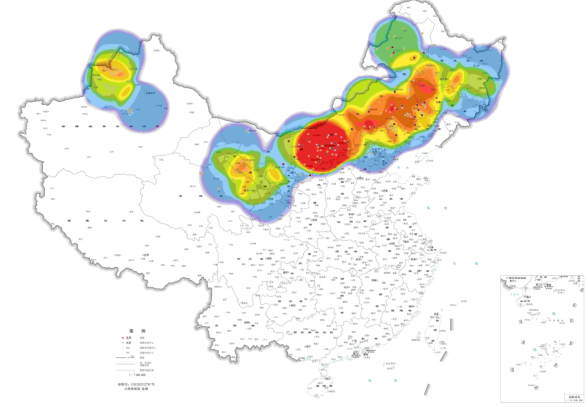
CHARACTERISTICS OF MONGOLIAN MEDICAL FACILITIES This study collects and collates data from multiple sources, such as data information from the Chinese Medicine Administration of China’s national and provincial and municipal autonomous regions, governmental data information, and data information from network registration medical platforms, and based on visual analysis, it is known that China’s Mongolian medicine medical facilities are distributed in Inner Mongolia, Heilongjiang, Liaoning, Jilin, Gansu, Qinghai, Xinjiang, and Beijing (State Administration of Traditional Chinese Medicine, 2024), which is an important part of the medical system of the northern region of China (Figure 1).
Figure 1: Distribution of Mongolian medical facilities in China (based on the Chinese standard map, self drawn by the author).
INVESTIGATION AND ANALYSIS OF MONGOLIAN MEDICAL FACILITIES Overview of Field Research
This study selected representative outpatient departments, community health service stations, and clinics in Mongolian medical facilities for field research. The research time was selected from 8:00–12:00 and 15:00–20:00 on non working days to extract physical data of the built environment and behavioral activity data of the users of Mongolian medical facilities. The scale, functional composition, and organizational flow of these three representative Mongolian medical facilities were analyzed.
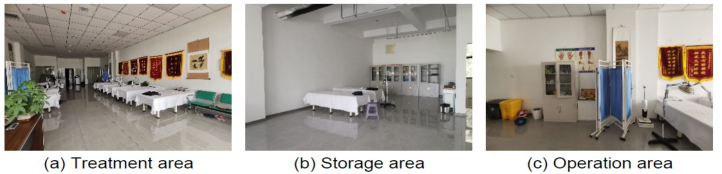
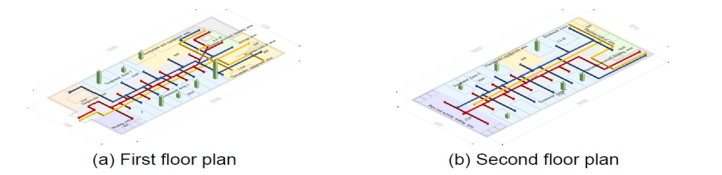
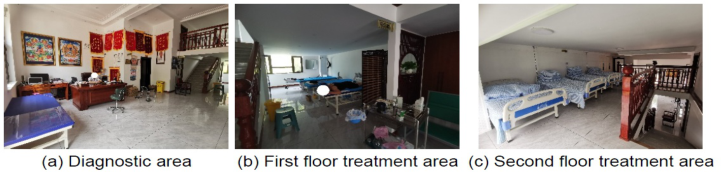
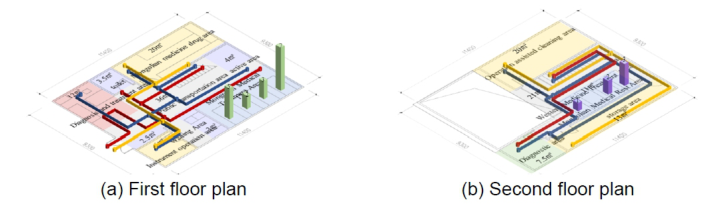
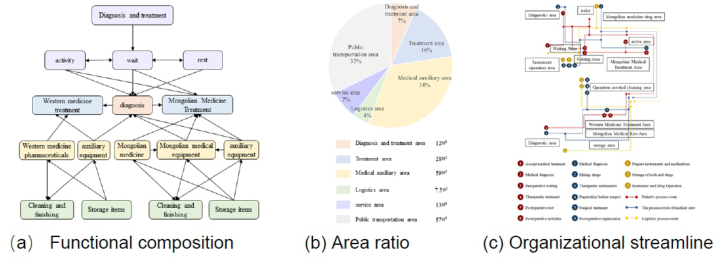
Mongolian Medicine Outpatient Department Among the types of outpatient departments in Mongolian medicine, public outpatient departments have a larger scale, and there are more integrated medical models of Mongolian medicine and traditional Chinese medicine, mostly belonging to branches of hospitals; Private outpatient departments are relatively small in scale and often adopt a medical model of Mongolian medicine. This study selected the WSGL outpatient department as the research object, with an area of 240 square meters, two floors, 19 treatment beds, and Mongolian medical treatment as the main medical method (Figure 2). The functional space of the outpatient department consists of a diagnosis and treatment area, a treatment area, an equipment operation and disposal area, a Mongolian medicine pharmacy area, and a rest and waiting area. Among them, the medical related space area accounts for 62%, and the non-medical space area accounts for 38%. Based on the observation of the medical operation process and the diagnosis and treatment behavior routes of doctors and patients, it was found that the layout of the instrument and tool operation space and the medication space is the main problem with the facility (Figure 3). The equipment, tools, and medication space on the first floor are located in a distant corner, and doctors need to turn back multiple times during operation, which reduces efficiency. The equipment, tools, and medication space on the second floor is located in the middle, making the doctor’s operation flow relatively more convenient. It was found that the number of patients receiving treatment on the first floor exceeded that on the second floor. After inquiry, it was found that patients with privacy, quietness, and longer treatment time usually choose to receive treatment on the second floor, while most other patients choose to receive treatment on the first floor for convenience (Figure 4).
Figure 2: Realistic scene environment of WSGL outpatient department (photo by the author).Figure 3: Plan of WSGL outpatient department (self drawn by the author).
The Current Characteristics and Spatial Development Model of Mongolian Medical Facilities 109
Figure 4: Function scale streamline of outpatient department (self drawn by the author).
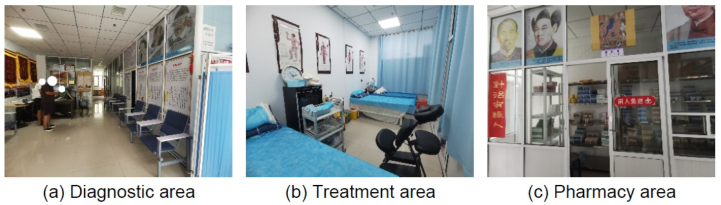
Mongolian Medicine Community Health Service Station Mongolian medicine community health service station belongs to the primary health care institutions, a small number of service stations use Mongolian medicine as the main means of medical treatment, and most of the other service stations are combined with other medicine to jointly undertake the basic health care services within the community. In this study, the JMD community health service station was selected as the object of study, with an area of 176.5 square metres, a total of two floors, and 9 consultation beds, with Mongolian medicine and western medicine as the main medical treatment (Figure 5). The functional space of the service station consists of independent diagnosis and treatment area, treatment area, operation and disposal area, pharmacy area and waiting and resting activity area for Mongolian medicine and Western medicine, of which 61% of the area is medical-related space and 39% is non-medical space. Observing the diagnosis and treatment routes of doctors and patients based on the medical operation process, it was found that the lack of function and insufficient area of the instrument tool space and pharmacy space were the main problems of the facility (Figure 6). On the ground floor, the instrumentation and pharmacy spaces were small and located at the ends of the corners, resulting in many operations taking up space in the treatment area and on public transport. Records of bed usage showed that the number of people treated on the ground floor was significantly higher than on the first floor, and enquiries made it clear that the main purpose of most of the patients was to use Mongolian medical treatments, and therefore the Western medical treatment area on the first floor was under-utilised (Figure 7).
Figure 5: Realistic scene environment of JMD community health service station (photo by the author).Figure 6: Plan of JMD community health service station (self drawn by the author).Figure 7: Function scale streamline of community health service station (self drawn by the author).
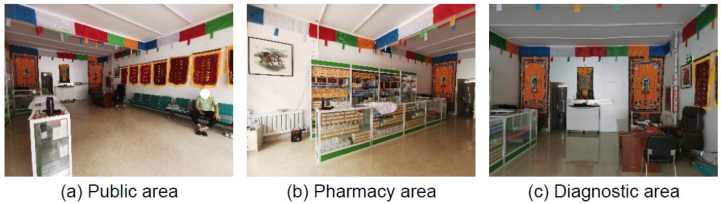
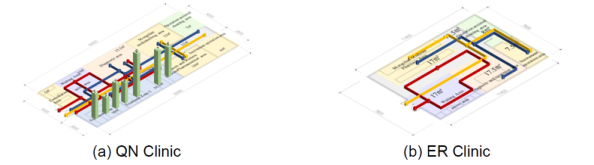
Mongolian Medical Clinics Mongolian medicine clinics are categorised into external treatment method- based clinics and internal treatment method-based clinics, with external treatment method-based clinics generally being larger in size and internal treatment method-based clinics generally being smaller in size. In this study, QN Mongolian Medicine Clinic and ER Mongolian Medicine Clinic are selected as research objects, both of which are located in the ground floor space of commercial services on the ground floor of the residence. Among them, the QN Mongolian Medicine Clinic has an area of 117 square metres and uses external Mongolian medicine as its main modality, with a diagnosis and treatment area, treatment area, operation and disposal area, pharmacy area, and waiting and resting activity area (Figure 8); the ER Mongolian Medicine Clinic has an area of 86.5 square metres, and uses internal Mongolian medicine as its main modality, with a diagnosis and treatment area, a Mongolian medicine pharmacy area, a Mongolian medicine pharmacy mixing area, and a waiting and resting activity area (Figure 9).
In QN clinic, the waiting area was located in the front, the diagnosis and treatment area in the middle, the pharmacy and operation area in the back, and 7 treatment beds; in ER clinic, the pharmacy and waiting space was located in the front, the diagnosis and operation space was located in the back, and there were no treatment beds and no supporting space for external treatments; QN clinic accounted for 70% of the area of the medical- related space, and 30% of the area of the non-medical space; ER clinic had
The Current Characteristics and Spatial Development Model of Mongolian Medical Facilities 111
57% of the area of the medical-related space, and 43% of the area of the non-medical space. 57% of the area of medical-related space and 43% of the area of non-medical space in the Mongolian medicine clinic (Figure 10). Based on the medical operation process and the observation of doctors’ and patients’ treatment behaviours, the distance between the treatment area and the space for instruments and tools and the space for medicines is relatively far in the QN clinic, which leads to the doctor stacking some instruments and tools and medicines in the treatment space, resulting in crowded and cluttered treatment space and restricted behaviours, while the ER clinic, with an average length of 15–30 minutes, does not have any beds in the clinic, with relatively simple space organisation. There is no bed space, and the organisation of the spatial flow is relatively simple and smooth (Figure 11).
Figure 8: QN clinic realistic scene environment (photo by the author).Figure 9: ER clinic realistic scene environment (photo by the author).Figure 10: Plan of QN clinic and ER clinic (self drawn by the author).Figure 11: Functional scale streamline of clinic (self drawn by the author).
EXISTING PROBLEMS IN MONGOLIAN MEDICAL FACILITIES Poorly Configured Regional Typology of Districts
Mongolian medical facilities in Inner Mongolia, China, are facing an imbalance in the Mongolian medical highlands, large differences between different regions of the urban, rural and pastoral areas, and an insufficient supply of basic medical facilities. In particular, there is a lag in the development of the Mongolian medical highlands in the western part of the region, with the distribution of Mongolian medical facilities in pastoral areas and remote rural counties and soums and gachas being more scattered, with missing and obsolete equipment, and with an insufficient supply of and poorer quality of basic medical facilities, resulting in a constant loss of people seeking medical care.
Unclear Positioning of Functional Space Types Existing Mongolian medical facilities did not specify the functions, scale and flow lines of the space required for Mongolian medical activities during the initial planning, resulting in a mismatch between the spatial environment of the completed ring and the Mongolian medical activities. In the completed buildings, due to factors such as lack of space or distance, the space for the operation of instruments and tools and the space for medicines take up part of the space for public transport, so that the crowd can barely complete the Mongolian medical activities in a crowded and noisy environment.
Poor Spatial Correlation of Healthcare-Related Functions The medical process of Mongolian medicine is an overall continuous and complete process, the reality is that the operating tools pharmacy space and the auxiliary space before and after treatment are scattered in the treatment space, public transport space and corners, resulting in repeated overlap of the diagnostic and treatment flow, resulting in the fragmentation of the overall medical process, leading to the lack of adequate operating space for the healthcare crowd, and lack of comfort for the patient’s healthcare environment.
The Current Characteristics and Spatial Development Model of Mongolian Medical Facilities 113
CONCEPTUALISATION OF A FUNCTIONAL SPATIAL DEVELOPMENT MODEL FOR MONGOLIAN MEDICAL FACILITIES Establishment of the Functional Architecture of the Mongolian Medical Network in Different Regions
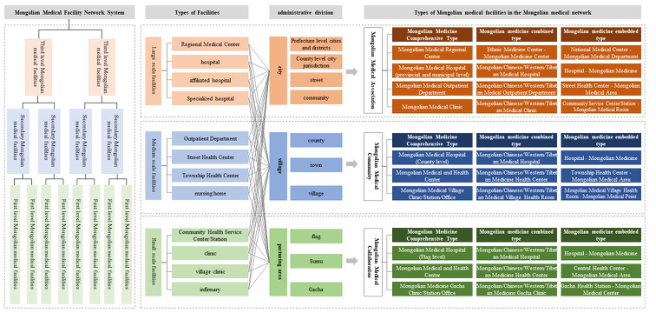
After the research, it is known that there is a big difference between Mongolian medical facilities in different regions, and the number of primary medical facilities in the spatial distribution of sub-centre cities and remote urban areas is insufficient, which should be strengthened to achieve the sinking of medical resources and the increase of equipment and facilities in contact with higher-level medical care. Based on the special characteristics of different regions in Inner Mongolia Autonomous Region, the trend concept of different functional types of structures in urban, rural and pastoral areas under the Mongolian medical service network is put forward, the supply forms of integrated Mongolian medicine, integrated Mongolian-Chinese medicine, integrated Mongolian-Western medicine, integrated Mongolian- Tibetan medicine and multiple medical models are analysed, and the development trends of integrated, integrated and embedded Mongolian medicine are clarified, so as to expand the number of Mongolian medicine- related facilities. In turn, it expands the types of construction of facilities related to Mongolian medicine (Figure 12).
Figure 12: Types of Mongolian medical facilities in the Mongolian medical service network (self drawn by the author).
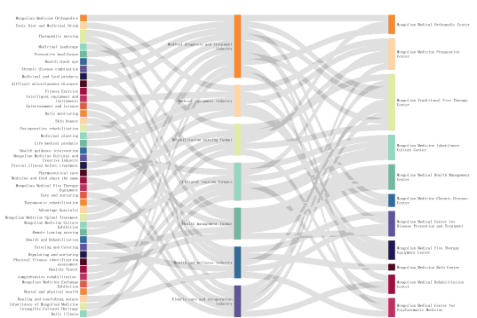
Expanding the Types of Functions of the Different Nature of the Mongolian Medical Care Business The future development mode of Mongolian medicine is not only limited to the medical industry, but also to the development of new business modes in multiple directions, such as Mongolian medicine preparation, Mongolian medicine device, Mongolian medicine rehabilitation, Mongolian medicine nursing, Mongolian medicine culture, Mongolian medicine culture and tourism, Mongolian medicine health management, Mongolian medicine and health care, and Mongolian medicine pension, etc. Therefore, it is necessary
to take into account the future development trend in the planning and design of the facilities to specify the operation and construction mode of the facilities and to realise the integration of the multi-industry business modes. By extracting the development trend of the industry related to Mongolian medicine, this study summarises seven types of development modes related to Mongolian medicine, and conceives 11 types of construction modes for the future development trend of Mongolian medical facilities, which in turn expands the types of building facilities related to Mongolian medicine (Figure 13).
Figure 13: Functional types of new business models for the future development of Mongolian medical facilities (self drawn by the author).
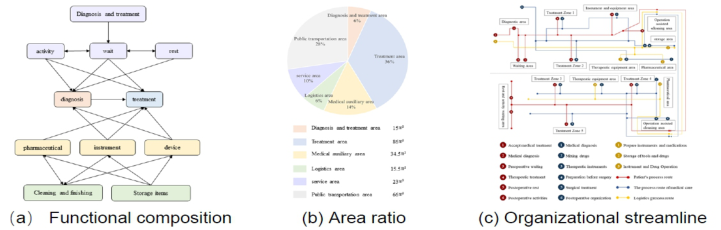
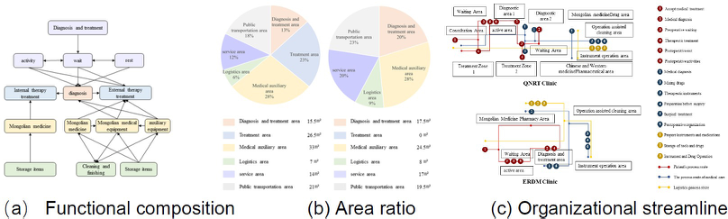
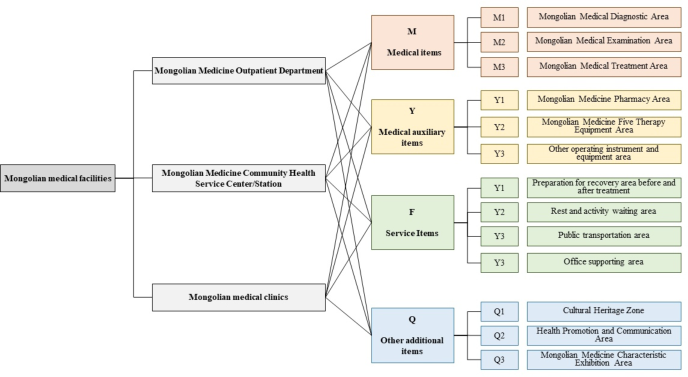
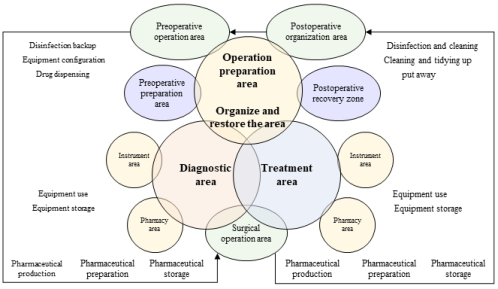
Clarify the Functional Space in Line With the Medical Process of Mongolian Medicine By sorting out the functional spatial composition of outpatient clinics, community health service stations, and Mongolian medicine clinics in Mongolian medicine medical facilities, this study divides the spatial environment into medical items, medical auxiliary items, service items, and additions on demand (Figure 14). Based on the spatial relationship of each type, it is clear that the treatment area needs to be adjacent to the instrument operation area and the pharmaceutical preparation area of the medical process, so as to avoid the accumulation of fragmented instruments and pharmaceuticals in the treatment area. In addition, the absence of preparation and recovery areas in many facilities leads to the suspension of people in the public space, which increases the discomfort and tension of patients. As shown in Figure 15, in the Mongolian medical facilities should include the flow of medical patients, health care crowd flow, the flow of Mongolian medical instruments and tools, the flow of Mongolian medicine and pharmaceuticals, cleanliness and dirt flow, it is recommended that the facilities to the patient-centred flow path model, the patient does not need to move repeatedly, but the doctor as the main activity of the mobile object to go back in the medical space, and therefore the treatment space
The Current Characteristics and Spatial Development Model of Mongolian Medical Facilities 115
should be set up adjacent to the appliances, medicinal agents and operation space, in the space to reach a certain area can be on-demand. When the space reaches a certain area, it can be set up in points according to the scope of medical treatment.
Figure 14: Functional composition of Mongolian medical facilities (self drawn by the author).Figure 15: Functional connection of Mongolian medical facilities (self drawn by the author).
CONCLUSION
Under the strategic goal of traditional medicine inheritance and innovation, Mongolian medical facilities, as the architectural carriers of Mongolian medicine practice, are now facing real problems such as imperfect construction of facility spatial system network, unclear development mode, and mismatch of spatial function layout. Through in-depth analyses of outpatient clinics, community service stations and clinics, the study clarifies the existing problems and future development trends of Mongolian medical facilities. On this basis, the study also proposes the functional structure
of the Mongolian medical network, the functional types of the Mongolian medical business and the functional spatial composition of the Mongolian medical process for the future Mongolian medical practice and even the Chinese medical practice to cope with the increase in the proportion of chronic diseases and the aging society in China, in order to provide suitable architectural carriers for the medical practice of Mongolian medicine and even Chinese medicine to cope with the increase in the proportion of chronic diseases and the aging society in China in the future.
REFERENCES
Ao Duntu Ya, Si Qintu, Bao Hashen, Cai Hua. (2013). Traditional Mongolian Medicine Techniques and Theoretical Basis for Sub Health. Chinese Ethnic and Folk Medicine Volume 22, No. 4. Ba Jigmund. (1997). A Brief History of Mongolian Medicine. Inner Mongolia: Inner
Mongolia Education Press. Qigeqitu. (2020). Modern Mongolian Medicine. Inner Mongolia: Inner Mongolia Science and Technology Press. Tusken. (2022). Research on the Development Process of Mongolian Medicine. Chinese Journal of Ethnic Medicine Volume 28, No. 7. State Administration of Traditional Chinese Medicine (2024). Statistics Yearbook. Official website of the State Administration of Traditional Chinese Medicine: http://www.natcm.gov.cn.
LISTED IN THE AHFE DIGITAL BOOKSTORE CATALOGUE
Explore the complete digital volume
Human Factors in Architecture, Sustainable Urban Planning and Infrastructure
Read this individual research paper free through the original publisher, or explore the full digital proceedings book.
ISBN 978-1-964867-67-0
Explore this ISBN in the AHFE Bookstore ↗Listed in the July 2026 bookstore catalogue; search by ISBN to confirm current availability · Digital book purchase optional