Álvaro M. Sampaio, André Lima, Catia Silva, Ana Catarina Martins Miranda, António J. Pontes (2022). Design and Production of Hybrid Products. In: Additive Manufacturing, Modeling Systems and 3D Prototyping. AHFE Open Access, vol. 34, pp. 1–8. https://doi.org/10.54941/ahfe1001583
Injection moulding (IM) is a well-known and widely employed fabrication process, which allows the production of versatile and lightweight parts, with precise dimensional tolerance. Multi-material and multi-component products are achieved by means of process variations of the conventional IM. Although the resulting products present combined properties and functionalities, the available techniques require specific machinery and complex tooling design. This paper presents a new processing approach, based in a hybrid method, for the fabrication of multi-material products, with enhanced functionality, based in the combination of IM with additive manufacturing (AM) technologies by means of overmoulding process.
Industrial processes and products are in constant development due to the increasing requirements for the fabrication of time and cost competitive parts with optimized performance, customizable in terms of design and materi- als, lightweight, and integrating additional functionality. When employing conventional technologies to solve these issues, typically moulding tools are required, and when concerning complex shapes there are technologic limitati- ons in regarding to the fabrication. In addition, the development of solutions and tools is time consuming, costly, and products customization is limited.
Considering this, alternative solutions are required to guarantee the achie- vement of such demands. For this reason, one possibility to solve this matter consists of combining AM technologies with conventional technologies. Due to constant advancements in regarding to AM processes optimization for shorter lead times, cost reduction, improved design freedom, new materi- als, tighter tolerances, larger building areas, among other enhancements, layered processes are often employed as replacement technologies for conven- tional processes (Pontes, 2021). This is related to the innovative aspects of AM processes which, if wisely explored can improve and even revolutionize conventional manufacturing efficiency. The combination of processing tech- nologies or hybrid manufacturing is one possible answer to bypass obstacles
by combining processes strengths and overcoming manufacturing limitations (Lima et al., 2017; Sampaio et al., 2019). In this scope, a recent approach being explored consists in the combination of alternative processes and pro- ducts with conventional injection moulding, by means of overmoulding steps, in order to facilitate the next-generation of customized products. Summarily, the hybrid method encompasses the fabrication of an insert part by means of AM processes, followed by the positioning and fixation of the insert within the mould cavity, and a subsequent overmoulding step allows the genera- tion of a multi-material product. When resorting to AM processes for the fabrication of insert parts, it is possible to mass customize a part at relati- vely low-cost (no tools, moulds or punches are needed) and short lead times (Guo and Leu, 2013). Combining this possibility with injection moulding it is assured design freedom to change products when necessary, and without the need for the development of new tools and awaiting times.
ADDITIVE MANUFACTURING AND THE HYBRID METHOD AM processes allow the generation of lightweight parts while maintaining, and in some cases, improving the performance (e.g. structurally). This is rela- ted to the ability to produce lattice structures (e.g. honeycomb, chiral truss) (Guo and Leu, 2013) and also to perform topology optimization (Attaran, 2017). The possibility to integrate a lightweight insert part, with improved structural performance, into a mould for an overmoulding step, facilitates the fabrication of a lightweight and multi-material product. The integration of lattice structures as reinforcing features in products obtained by IM opens new possibilities for reinforcing products and for integrating shapes which are difficult to obtain by conventional techniques. The reduction of wei- ght ultimately leads to a reduction of material waste and overall cost, and a minimized environmental impact.
Regarding material possibilities, AM processes present a portfolio of available materials that can only be processed in each specific technology. This is related to the unique properties and additives of these materials’ composition, meaning that materials with such properties are not availa- ble for other types of processing techniques. In addition, possibilities range from employing a single building material, to generating variations of a same polymer formulation during the building process of the insert part (e.g. colour gradients, hardness shore gradients), and also combine different materials during the manufacture (in the same technology or by combining technologies).
The portfolio of materials adequate for injection moulding is very exten- sive as research for new materials has been going on for many decades. This includes e.g. thermoplastics, foams, elastomers, and reinforced pla- stics with various types of additives and fillers. Also, it is possible to create multi-material products based in variants techniques of the injection moul- ding, which expands possibilities. Considering the numerous possibilities for material combination within each processing technology, and also by combing technologies, the process to generate products which vary material composition along its structure is simplified and improved. With the hybrid
Design and Production of Hybrid Products 3
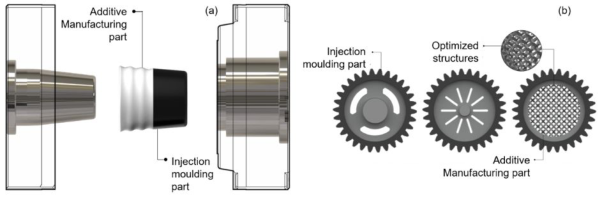
Figure 1: CAD representation of a hybrid: (a) cup with detail of the mould and (b) toothed gear wheels.
method, it is possible to assure specific properties at pre-defined locations of a multi-material product and therefore, improve its overall performance. Ano- ther benefit consists in the fact that there are specific plastic materials which are difficult and expensive to process conventionally (e.g. PEKK), and that may be easily processed by already optimized AM processes, and afterwards overmoulded.
ON-GOING RESEARCH Based in the presented possibilities and advantages when resourcing to the hybrid method, several analysis and case-studies are under analysis to eva- luate processing possibilities and difficulties such as, e.g. material chemical compatibility, possible integration of structural snap-fits for enhanced adh- esion, control dimensional tolerances, and avoid conventional processes complications and defects (e.g. flash, warpage). For example, Figure 1 (a) depicts a customized cup, based on the same mould tool, by simply using an insert part built by AM with a different material and design to be overmoul- ded. This way, one can change a product configuration and aesthetics without changing the mould. A toothed wheel (Figure 1 (b)) is presented as exam- ple of a product combining a lightweight and optimized structure produced by AM with a teeth profile with dimensional accuracy defined by injection overmoulding.
These examples present some of the possibilities that combining AM with IM enables, which can greatly evolve the actual workflow of plastic industry for the production of versatile and customizable products (Miranda, 2019; Pontes, 2021). In order to be possible to apply this method, the joint between materials may occur through welding based in the materials’ chemical com- patibility, or by resorting to structural interlocks for dissimilar materials. If intended, one may combine both approaches, since AM processes allow the fabrication of structural interlocks.
This possibility simplifies the bonding between compatible and dissimilar materials in a single product. As this step of the method is of paramount importance, this paper presents the research undertaken regarding bounding strategies in terms of material compatibility and joint design. For that it was used a hybrid specimen composed by a half produced by AM and another half by overmoulding.
HYBRID SPECIMEN PRODUCTION A hybrid tensile test specimen type B (ISO 527-2) was defined based in an existent mould tool with a half insert part produced by Fused Deposition Modelling (FDM) and an overmoulded half. A UV-stable acrylonitrile styrene acrylate (ASATM), and an electrostatic dissipative acrylonitrile butadiene sty- rene (ABS-ESD7TM) from Stratasys Ltd. were used to manufacture the insert parts with a Fortus 900mc. Main process conditions, for both building mate- rials, include: flat (XY) build orientation; 100 % infill; raster angle of ±45° and layer height of 0.254 mm.
For the overmoulding, a standard polypropylene (PP) ISPLEN® PP070 G2M (Repsol) and an ABS with 15% of carbon fibre (LNP™STAT-KON™ COMPOUND AE003), supplied by SABIC were used. Main processing con- ditions, for a switchover volume of 10 cm3 include: injection temperature of 180-238 °C and 220-270°C, mould temperature of 40 °C and 80 °C and a holding pressure of 140 bar and 80 bar for 8s for PP and ABS, respectively.
CRITICAL ASPECTS DEFINITION To assure a quality hybrid part, certain critical aspects, such as, insert part gap to fit the mould, temperature and material compatibility need to be determi- ned. For the gap to fit the mould, several gaps bellow the nominal dimension were defined for the insert part, varying from 0.00 to 0.50 mm in steps of 0.05. Overmoulding with both IM materials has shown that flash occurre- nce is reduced with tighter gaps (up to a gap of 0.15 mm when overmoulding with PP) and, that it is smaller when overmoulded with ABS due to its higher viscosity associated with the filler content (up to 0.35 mm flash occurrence is negligible). Surface defects (e.g. crushing marks) were more visible for tigh- ter gaps, between 0.00 mm and 0.10 mm, corresponding also to the hardest manual fitting in the mould. Based on the results, 0.15 mm was the most sui- table gap that combined the ease of fitting the mould with the least defects. During this study material compatibility was evaluated showing that both AM materials are compatible with ABS and non-compatible with PP.
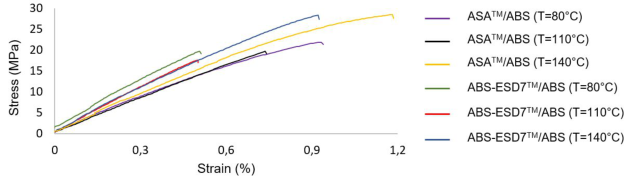
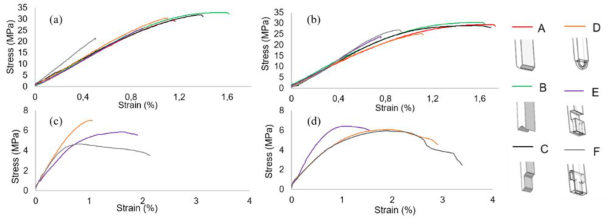
Temperature influences molecular diffusion which improves adhesion between compatible materials. For amorphous polymers, such as ABS, diffusion occurs close to the glass transition temperature (Emblem and Hardwidge, 2012). Considering this, insert parts were pre-heated at three temperatures that were comparatively tested, for compatible materials only: (i) 80 °C, equal to the mould temperature for ABS; (ii) 110 °C, closest to the glass transition of both AM materials (108 °C) (Stratasys Ltd., 2022); 140 °C, in order to consider a much higher temperature. Joint adhesion strength was evaluated by tensile testing (ISO 527-1), with an Instron 5969 Dual Column Tabletop Testing System with video extensometer considering a tensile test speed of 5 mm/min and a cell load of 50kN. Based in Figure 2, for both over- moulded ASATM and ABS-ESD7TM, the load at maximum tensile strength (~1100 N to 1220 N), tensile stress (~27 MPa to ~28 MPa) and strain (~1 % to 1,1 %) at break are higher when the insert part temperature is 140 °C.
Besides joint strength, the evaluation of the most suitable insert part tem- perature considered the structural stability of the insert part during handling
Design and Production of Hybrid Products 5
Figure 2: Typical stress-strain curves obtained for the hybrid specimens of ASATM/ABS and ABS-ESD7TM/ABS for different insert part temperatures.Figure 3: Joint designs for compatible (A, B, C) and non-compatible (D, E, F) materials.
and ease of fit in the mould. A temperature of 110°C was the most suitable by direct comparison because, although the highest temperature improves adhesion strength it was rather complex to manually handle the insert part and place it in the mould cavity.
JOINT ANALYSIS The mechanical behaviour of a bonded structure is influenced by material compatibility and joint design (Emblem and Hardwidge, 2012). Therefore, several joint designs were defined (Figure 3) to improve adhesion between compatible materials, by increasing the contact area and promoting a uni- form stress distribution, and also, to create bond between non-compatible materials by defining interlocks to create mechanical connection. All the desi- gns account mass balance between the halves of the hybrid specimen while contemplating the manufacturing reproducibility.
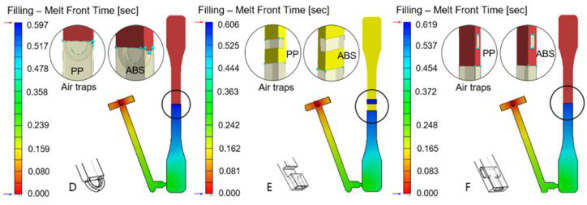
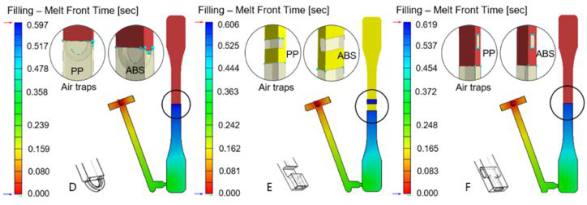
Joint design was validated based in simulation analysis of the overmoul- ding process with the software Moldex3D R16. Joints A, B and C were not simulated as no major issues were expected due to design simplicity. Main conditions include an injection temperature of 235 °C and 270 °C and a mould temperature of 40 °C and 80 °C for PP and ABS, respectively. Simu- lation results (Figure 4) indicate that the filling was complete and the filling time is dependent on the geometry of the joint because, for the same geometry, it presents approximately the same filling time, for both injection materi- als. Small air traps occur for all the interlocks which may be diminished by controlling processing speed and pressure.
The production of the hybrid specimens with the new joint configurati- ons considered the processing conditions previously presented and occurred without difficulties.
Hybrid specimens were analysed by computed tomography (CT) with a Metrotom 800 from ZEISS. Transversal and longitudinal analysis enabled
Figure 4: Moldex3D simulation results for joint D (left image), E (middle image), and F (right image).Figure 5: Tomography images of representative hybrid specimens for the majority of joints in analysis.Figure 6: Hybrid tensile test specimens: (a) ABS-ESD7TM overmoulded with ABS; (b) ASATM overmoulded with ABS; (c) ABS-ESD7TM overmoulded with PP; (d) ASATM overmoulded with PP.
to verify the quality of the joints (Figure 5). It is noticeable the presence of voids (blue and green dots) in all insert parts which is related to the FDM process. Joint A (similar to B), C and F present an interface between materials with no anomalies or voids. Joint D presents no voids or anomalies when overmoulded with ABS while a significant volume of voids (blue, green and red dots) are present when overmoulded with PP. This may be related to material compatibility. Finally, joint E presents a deflection of a thinner zone that allowed the injected material to cross over.
Hybrid specimens were then subjected to tensile testing, with the same con- ditions as previously presented, in order to make a comparative evaluation of joint strength. The typical stress-strain curve obtained are presented in Figure 6. All hybrid specimens fractured at the joint, typically at the zone of more fragility (e.g. thinner sections) of the insert part. For compatible mate- rials, joints B and C provided the highest values of load at maximum tensile strength (~1250 to ~1300 N), tensile stress (~30 to ~33 MPa) and strain (~1.3 to ~1.7 %) at break. Regarding the joints defined for non-compatible
Design and Production of Hybrid Products 7
materials, joints D and F presented the best behaviour. Values ranging betw- een ~950 to ~1200 N and ~245 to ~270 N for load at maximum tensile strength, ~23 to ~30 MPa and ~3.8 to ~6.5 MPa for tensile stress at break and, ~0.7 to ~1.1 % and ~0.9 to ~3.3 % for tensile strain at break were obtained when overmoulding with ABS and PP, respectively. For all joint designs, hybrid specimens produced with ABS-ESD7TM provided slightly stronger bond than ASATM, when overmoulded with ABS. However, when overmoulded with PP, mechanical performance is rather similar for both AM materials varying mostly based in the joint design. Also, when overmoul- ding with PP, each joint presents a different behaviour varying from tough to brittle behaviour.
CONCLUSION
A hybrid method for the fabrication of customizable products based on the combination of AM processes with conventional IM through overmoulding steps was presented. This paper briefly presents the possibilities and advanta- ges of such combination (i.e. production of customizable products presenting complex geometries combined with advanced material properties and enha- nced functionality). This paper also presented the hybrid manufacturing of a test specimen based in the combination of AM and IM. Critical aspects were assessed indicating that the most suitable insert part gap was 0.15 mm due to less surface defects and negligible flash. Also, the insert part tempe- rature, for the materials in study, was 110 °C, a value closest to the glass transition temperature of both AM materials used and only necessary for compatible materials. Several joint designs were defined and analysed for compatible and non-compatible materials. Based in joint strength and defe- cts, joints B and C were most suitable for compatible materials while D and F were more suitable for non-compatible materials. Future work encompasses the fabrication of case-studies based in the studied materials and selected joint designs.
ACKNOWLEDGMENT
This work is supported by: European Structural and Investment Funds in the FEDER component, through the Operational Competitiveness and Inter- nationalization Programme (COMPETE 2020) [Project n° 039334; Funding Reference: POCI-01-0247-FEDER-039334]
REFERENCES
Attaran, M. (2017). “the rise of 3-D printing: The advantages of additive manufacturing over traditional manufacturing, Business Horizons, Volume 60, pp. 677–688 Emblem, A., Hardwidge, M. (2012). “Adhesives for packaging”, in: Packaging
Technology, Anne Emblem and Henry Emblem (Ed.) Woodhead Publishing, pp. 381–394 Guo, N., Leu, M.C. (2013). Additive manufacturing: technology, applications and research need, Frontiers of Mechanical Engineering, Volume 8, No. 3.
Lima, A., Silva, C., Sampaio, A.M., Pontes, A.J. (2017). “Development of a methodology for hybrid products during the additive manufacturing process”. in: 4D – Designing, Development, Developing, Design, International Conference. Kaunas, Lithuania. Miranda, C. (2019). Overmoulding of Additive Manufacturing parts (Master’s
thesis), Master in Polymers engineering, University of Minho, Guimarães. Pontes, A.J. (2021). “Designing for additive manufacturing”, in: Design and Manufacturing of Plastics Products, Pouzada, S. (Ed.), Elsevier, pp. 249–292 Sampaio, A.M., Gonçalves, R., Lima, A., Cruz, J.S.C., Figueiredo, B., Carvalho,
S. and Pontes, A.J. (2019) “Design for Additive Manufacturing of Mechanical Connections Toward Hybrid Products”, in: Advances in Additive Manufacturing, Modeling Systems and 3D Prototyping, Di Nicolantonio, M., et al. (Ed.). Springer International Publishing, pp. 418–427 Stratasys (February 8, 2022). 3D Printer Materials; Materials Catalog. Stratasys Website: https://www.stratasys.com/materials/search
LISTED IN THE AHFE DIGITAL BOOKSTORE CATALOGUE
Explore the complete digital volume
Additive Manufacturing, Modeling Systems and 3D Prototyping
Read this individual research paper free through the original publisher, or explore the full digital proceedings book.
ISBN 978-1-958651-10-0
Explore this ISBN in the AHFE Bookstore ↗Listed in the July 2026 bookstore catalogue; search by ISBN to confirm current availability · Digital book purchase optional