Oluwayemisi Adebola Abisuga, Deon De Beer (2022). A Systematic Literature Review and Prospects for the Additive Manufacturing in the Creative Industries. In: Additive Manufacturing, Modeling Systems and 3D Prototyping. AHFE Open Access, vol. 34, pp. 9–22. https://doi.org/10.54941/ahfe1001584
In the Creative Industries (CI), Additive Manufacturing is one of the new areas of investigation and without doubt has the potential for disruptive innovation capable to transform the traditional manufacturing paradigm and increase the largely accepted and required shift towards the design, conceptualisation, and adoption of sustainable Additive Manufacturing (AM) process. The objective of this study is to conduct a Systematic Literature Review (SLR) to identify and describe different publications that can contribute to additive manufacturing in the creative industry’s knowledge base. The purpose is to identify the publication trends that largely explain the adoption the additive manufacturing in the manufacturing process of handicraft industry product literature through the description of the main discourse rising newly in the field. This research contributes to filling the gap in terms of SLR on the importance of CI and AM for industrial development conducted by bibliometric analysis. The results of this systematic review revealed that: notwithstanding the increasing concern about the growth of the CI, issues related to product innovation and technological development of the industries are understudied; there is promising literature for the development of contextual creative industry practice which researchers are dedicating their works. However, a further focus of research on the fashion, textile, architecture, sculpture, and archeological sites has emerged in the more specialised literature.
Recently, the Arts and Crafts are considered to be part of the additive manufacturing established technologies, which is gradually becoming an acknowledged production resolution within creative industries, using ran- ges of polymeric, ceramic, and metallic base materials. The publication – by Rautray and Eisenbart (2021) – demonstrated the importance of the AM as one of many processes which have the potential to interrupt handicraft and its existing craft production paradigm manufacturing processes. Rautray and Eisenbart exert that arts products are unique and personalized as an art more
than a product. Other researchers (Castro E Costa et al, 2017; Hu, 2013), also believes the growth of new technology and tools will create a change from mass manufacturing to mass personalization. The creation and inte- gration of 3D printing in the design and manufacturing of art products can visibly be followed by the great number of online renowned artists, produ- cers, and designers in CI, however, the usage of 3D printers in CIs is much restricted to high-standard AM (Havenga, de Beer, Van Tonder, and Camp- bell, 2017). This paper provides prompt access to key works of literature that aim to contribute to the knowledge base about AM in CIs. Mainly, the arti- cle reviews and characterises main research in the literature addressing the application of AM in the different areas of CIs. In addition, these reviews have been grouped according to availability to the specific industry, thereby revealing several opportunities and future research gaps. The carefully chosen methodology of a systematic literature review was used because it provides easy guidance for the precise question at hand; “what are the prospects of production of creative industry products via additive manufacturing techno- logies?”, which allows fast identification of relevant literature in the different areas of the CI related to AM.
CREATIVE INDUSTRIES AND ADDITIVE MANUFACTURING Additive Manufacturing refers to a collection of technologies through which 3D objects are tangibly produced directly from a computer-aided design (CAD) model from digital data. The CAD is simply a model sliced up into sequences of cross-sectional layers, of each layer serially fabricated on the AM device, layer-by-layer on each other, until the original CAD data object is completely formed. Generally, AM has been employed mostly for tooling applications and in the production of prototypes, but technology advance- ment has caused an improvement and made it more economically feasible and broadly accessible. This application is also referred to as Rapid Manufa- cturing (RM) as a result of the increased usage to manufacture end-products. Within other industries such as the aerospace, automotive, and medical indu- stries, RM has established several encouraging applications, however, such applications often demand wide-ranging testing and investigation to cer- tify appropriate stages of reliability, certification, and safety, which causes a slow adoption of the prototype (Reeves, 2008). In the case of the crea- tive industry products most applications sometimes do not need this severe valuation providing them more prospects as the most viable industry for exploiting RM. Presently RM has not been privileged to be adopted within the handicrafts industry, because it is recognised as an industry with an origin from individual talent, skill, and creativity with a prospect for job creation through the creation and use of an intellectual property (Abisuga, Mpofu & Nenzhelele, 2021; Oyekunle, 2017). Unlike other technology inclined sectors, the handicraft industry Small and Medium Enterprises (SMEs) lacks the technical knowledge, training, finance, and government supports. The lack of knowledge, abilities and opportunities that AM offers have caused many creative industry practitioners and designers to be unemployed and job seekers.
A Systematic Literature Review and Prospects for the Additive Manufacturing 11
OPPORTUNITIES FOR CREATIVE INDUSTRIES With manufacturing and technology gradually captivating abroad with low labour wages and job creations, African business enterprises need to discover means to tap into these opportunities to make manufacturing more econo- mically sustainable. A good approach to exploiting this is by manufacturing more focused products which relate more closely to end-user needs, which consecutively puts more value on the products. Several handicraft-based cre- ative products such as sculpture, textiles, fashion, jewellery, paintings, now adopted business models which are similar and connected to possible RM models. The product that is manufactured is mostly individual arts, produ- ced locally with tools in the old traditional way. As a result, several designers and crafters are beginning to use AM machines to produce high technology innovative craft products. De Beer, et.al. (2012) in their collaborative research project created a design of direct AM jewellery in AlumideTM, an Aluminum and Nylon matrix by going beyond complex shapes to also produce inno- vative techniques by inserting gemstones in the designs which result in the production of "bespoke jewellery series". Also, the Birmingham School of Jewellery, UK, inspire learners to design, develop, and produce CAD models of jewellery products to experiment, test and personalised the materials and processes needed for the application of precious metal through direct metal laser melting (DMLM) technology into the production abilities of SMEs in the UK jewelry manufacturing industry (Cooper, 2016). It is generally beli- eved that DMLM was established in Germany in the 1990s (Wiesner, 2005; Meiners, Wissenbach, Gasser, 1998). De Beer and Campbell (2017) point out in their study that at the Venda University of Technology (VUT), the AM concept gave rise to the creation and backing of the I2P® Lab sup- ported for instance to encompass AM in strengthening the SA Footwear industry. This has established a high-standard advanced manufacturing cen- ter funded by the South African government, with specific importance to design and AM. Also, this makes the I2P® labs approved as ‘regional inno- vation centers for the shoe industry’ where AM is applied to produce sample lasts, wedges, shoe sole molds, or complete designs, an exceptional place worldwide.
Bingham (2007) referred to textile structures made by AM techniques, as AM textiles, which is gaining rising attention in the past decade. The AM textiles give an opportunity to innovative design and develop new results for high-performance and conventional textile applications. As a result of their potential to greatly improve the complexity and functio- nality caused by conventional fiber-based textiles, AM textiles likewise allow the capability to produce shapely textile artefacts that can pro- vide the development of high-performance, personalised textile applicati- ons from different materials presently being processed by AM technologies (Bingham & Hague, 2013). The examples above show the application of AM in creative industries, hence, this is proof needed for creative enter- prises and designers to recognize the prospect of these technologies more effectually.
12 Abisuga and De Beer
OPPORTUNITIES ADDITIVE MANUFACTURING OFFERED TO THE CREATIVE INDUSTRIES Previously, designers who finds it challenging or impossible to create com- plex geometries by other means are now capable to do so with the advantage of 3D CAD modeling combined with AM. AM eliminates several traditional manufacturing limitations designers and crafters go through, of which alter- natively they probably have to use a support material which is sometimes difficult to remove the unused material (Rautray & Eisenbart, 2021). Several AM technologies allow the production of fully functional artefacts and pro- totypes. Also, AM processes produce an underlying poor surface roughness which needs to be measured alongside post-processing requirements. Altoge- ther, these elements can cause part orientation design and complexity when the AM machine forms layers. The cost of AM technologies can also cause a constraint as it involves different processes which have obviously in recent years become more competitive (Jiménez, et al., 2019). Furthermore, RM is sometimes better with appropriate high-value and customised applications but have different cost constraint than traditional techniques (Ngo, et al., 2018). This implies these technologies can develop to be economically sustai- nable for a wider range of applications thereby providing more opportunities for designers to use these approaches.
A unique opportunity 3D printing offer is mass customisation i.e., manufa- cture of diverse personalized products of which every product can be different though retaining a low cost because of mass production (Dillenburger and Hansmeyer 2013). In the case of customised products, 3D printing is free of the extra cost attributable to mould making and tooling crafting. As a result, mass production of quantifiable duplicate parts can be economical like the same type of different personalised products. Changing to different designs is simple with insignificant additional cost and without special preparation. Also, for complex geometries such as lattice structures, AM has the prospect for mass production, when the application of traditional methods of manufa- cturing like casting is not easy and involves extra timewasting equipment and post-processing (Ford & Despeisse, 2016). As a result of its underlying flexi- bility AM provides many opportunities for user customisation and eventually user-friendly end products. The opportunities allow for a formerly impos- sible level of customised products to be achievable. Through custom-made products to be manufactured at the same time, creative businesses and arti- sts need to take this advantage to maximise the importance of using AM. Manufacturing with the AM is different from other manufacturing processes considering the production can take place in different locations instead of one large industrial plant. Because of AM technologies and the rapid growth of CAD software, there will be a major change in the manufacturing of traditio- nal handicrafts in near future. This development will uncover a new opening of opportunity for future designers to contribute to the design practice with considerably little or no hand skills. Integration of the creative industries and tradition with contemporary technologies will result in the development of new handicrafts that address contemporary issues (Gulati and Mathur 2017). This type of incorporation of technology and tradition will create the way for
A Systematic Literature Review and Prospects for the Additive Manufacturing 13
Digital Artists in the future. Consequently, there is a substantial opportunity for upgrading in the development and adaptation to encourage the upcoming Digital Artisans that will be equipped with the required AM technologies, designing software, culture, and the awareness of traditional belief.
METHODOLOGY
Research on additive manufacturing has increased significantly, demonstra- ting that this has become an essential model in technology advancement. The present study is based on creative industries and additive manufacturing and identifying the accessibility, trends, growths, and measuring the impact of publications in this area of study. The study adopted the Systematic Lite- rature Review (SLR) approach by Kitchenham and Charters’s (2007). When handling many articles distributed over a long period the SLR method is speci- fically suitable because it provides satisfactory replicability and transparency as a research method (Armitage & Keeble-Allen, 2008). The SLR centered on a bibliometric analysis of the existing literature was conducted to identify the more productive authors and institutions, research topics, and publicati- ons most thoroughly focused on additive manufacturing technology and its adoption in the invention of creative industry products. To carry out an effe- ctive SLR, the Scopus database was chosen as the leading and frequently used online archive in many bibliometric studies (Torchia et al., 2015; Unger et al., 2011; Rashman et al., 2009). Although, some of the identified articles were also obtainable in the Web of Science. The search is narrowed to publicati- ons from 2000 to 2021 that contain the keyword “Additive Manufacturing” – as a topic – of selected tangible Creative Products (I.e. in titles, abstra- cts, and keywords), and exclude no intangible creative products. To attain the required documents, only scientifically validated articles that provide a description and critical evaluation of studies concerning the research que- stion were included, hence excluding conferences, reviews, books, and book chapters. When processing some of the data obtained, the analysis options provided by Scopus, VOSviewer, and the Nvivo platform were used. These facilitated analyses of the results are presented in the next section. To process the data obtained from Scopus, the analysis platform NVivo and VOSviewer were used to develop bibliometric interactive maps with an explicit visual element (Perianes-Rodriguez et al., 2016; Waltman et al., 2010).
RESULTS
Publications Growth
Table 1 summarised the exact terminologies used to search and identify potential articles. To avoid numerous irrelevant search results and ensure searches identified related documents, the precise phrase ‘additive manufa- cturing’ was used contrary to those with any of the words in any sequence. This initial search yielded 2,325 publications (Table 1). Using RefWorks (a bibliography and referencing database management tool) 915 irrelevant studies were removed, resulting in a total of 1,410 publications. For the remaining publications, the subject area and keywords were consistently
14 Abisuga and De Beer
Table 1. Publications selection stages.
Table available in the original PDF paper.
Stage Description Results
2325 publications
Stage 1: Data base Scopus Stage 2: Search of data base with the fourteen keywords
Stage 3: Analysis of publications only scientific publications, excluding other document types
700
Stage 3: document type
Selections that only includes English, and relevant keywords
700
Stage 4 Inclusion of publications that addressed elements of Additive Manufacturing and creative industries from 2001 – 2021
reviewed to eliminate irrelevant studies. The English Language and year of publication criteria were further used and 710 publications were eliminated including those with unrelated keywords.
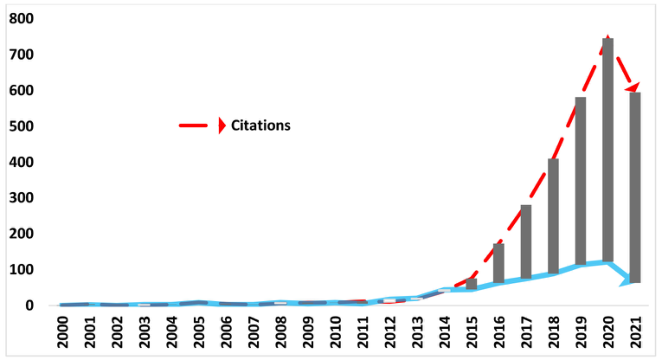
Research on the adoption of AM in the creative industries is new, and the number of publications has grown considerably in the past 2 decades, which has drawn substantial attention in academia. Figure 1 illustrates the yearly trends of publications and citations on creative industries, showing a steep rise in the number of publications with more consistent from 2015 onwards with a total of 45 publications, and a peak at 2020 with 122 works published for the year. However, the stage 3 of analysis from the year 2000 onward, the creative industries started to show a consistent level of publications with a total of 65 articles in 11 years (i.e. 2001 to 2011), with only textile having 17 publications in this earlier publication. Regarding the number of citati- ons per publication for the past decade, the number of citations has grown progressively (see Figure 1).
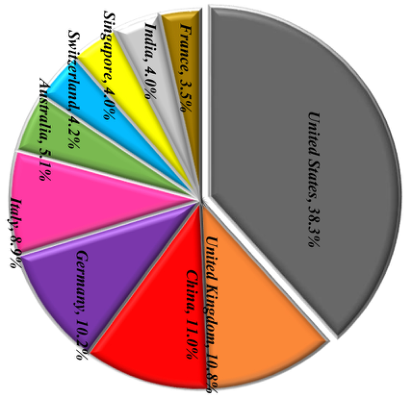
Figure 2 shows the top ten countries contributing the high percentage of 71% have out of the 46 countries identified.in the Scopus database. The systematic literature review proved that the United States of America has contributed the most to studies on additive manufacturing in the creative industries with 38% of the total share. The USA is followed China and Uni- ted Kingdom with 11% and 10.8% of the publications, respectively. France has the least publications with only 3.5%. Remarkably, the continent with
A Systematic Literature Review and Prospects for the Additive Manufacturing 15
Figure 1: Number of annual publications and citations.Figure 2: Top ten countries with the most publications.
the least publication on this topic is Africa with only two countries (Egypt fol- lowed South Africa), respectively. NVivo and Vosviewer software was used to identify and analyse the keywords and most used words revealed in the final sample of 700 documents.
Most Productive Authors Concerning this study sample, the results confirm that 124 authors the auth- ors of the 700 publications, contributed towards research development in this study area. Table 2 provides the top ten authors that have most contri- buted to the creative industries. The table comprises the authors with most publications and their total of citations. Although Wang Y. has the most publications (i.e. twenty-one), Murr L.E. was the author with the highest recorded number of citations with a total of 1981 citations publications.
16 Abisuga and De Beer
Table 2. Top ten authors with most publications in the area of additive manufacturing in creative industries.
Table available in the original PDF paper.
Authors Number of publications Total Average citations Authors citations per article
1. wang y. 21 343 4.9 2. zhang y. 17 296 4.2 3. zadpoor a.a. 15 1694 24.0 4. wang w. 15 485 6.9 5. murr l.e. 14 1981 28.0 6. li y. 14 567 8.0 7. liu y. 14 95 1.3 8. wang x. 13 1004 14.2 9. zhang x. 13 599 8.5 10. hutmacher d.w. 13 459 25
The ten authors’ have published the highest number of articles on this addi- tive manufacturing in the past four years, which shows that studies in the field of creative industries and AM studies are presently rising. Out of the 700 publications in the sample these ten authors alone have 22% shares with Wang Y having the highest followed by Zhang Y and Zadpoor A.A. Concerning the author with the highest citation Murr L.E has 28% followed by Zadpoor A. A with 24%. Regarding table 2 and the top ten publications (i.e. 8 journals and 2 conference proceedings) from the Scopus database, just 700 publications contributed the most on this topic. Only four of the ten journals presented in table 2 are from the Netherlands making it the high- est publishing country, this is followed by the United Kingdom having three which shows that the importance of research in this subject area is on increase in Europe.
Most Used Words
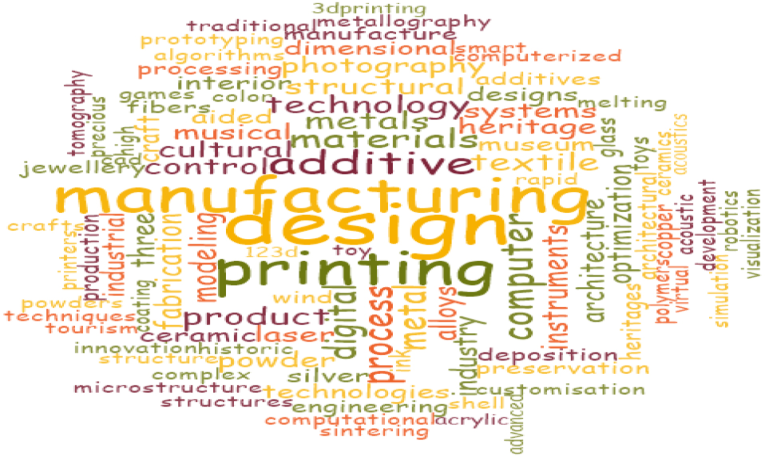
Figure 3 shows the data analysis by Nvivo computer software to analyse keywords in the 700 selected publications, concentrating on their titles, abstracts, and keywords. This analysis confirmed that the most words in keywords illustrated in figure 3 are some of the most frequently used words which revealed creative industry terminologies, such as “craftsman- ship”, “heritages”, “conservation”, “cultural”, “crafts”, “preservation”, “virtual”, “convectional” and “production”. This demonstrates that the studies analysed relate the creative industries and their relationships with additive manufacturing. As can also be seen in figure 3, the most common and frequently used words include; “manufacturing”, “prototyping”, “additive”, “industry”, “manufacturing”, “optimization”, “robotics”, “additives”, “sin- tering”, “technology”, “printing” and “modelling” are very significant and carry substantial weight in these publications.
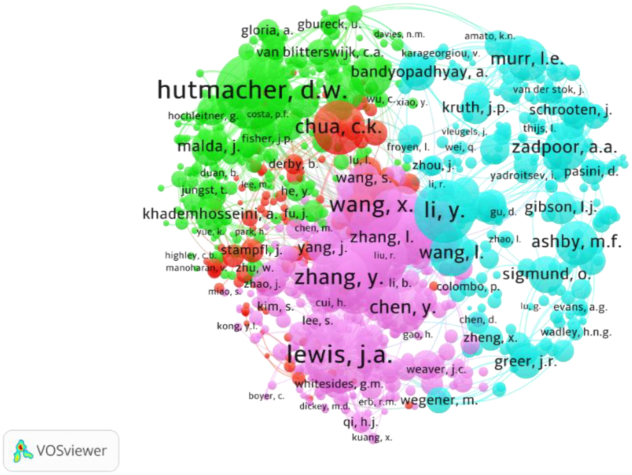
The total strength of the citation links with other authors was calculated and the authors with the greatest total link strength were selected. Figure 4 shows the co-cited author network based on a minimum number criterion of 50 co-citations per author, which discloses the presence of four clusters
A Systematic Literature Review and Prospects for the Additive Manufacturing 17
Figure 3: Most used words.Figure 4: Networks of co-cited authors.
of the most outstanding co-authors. The number of authors selected is 134 with some of the 134 authors in the network not connected. The largest set of connected items consists of 116 items with 616 authors meeting the threshold. For each of the 616 authors, the total strength of the co-citation links with other authors was calculated. Even though these authors focus on diverse areas, but turn out quoting each other more often, they present a strong connection among them, in addition to how the four clusters complement
18 Abisuga and De Beer
Table 3. Top ten journals with the highest number of publications.
Table available in the original PDF paper.
Number of H-Index Country Journals Number of Publications Citations
15 163 124 United Kingdom
Additive Manufacturing 63 1035 65 Netherlands Rapid Prototyping Journal 38 447 91 United Kingdom Materials and Design 37 1728 164 Netherlands Materials 25 508 111 Switzerland Procedia Cirp 25 305 65 Netherlands Procedia Manufacturing 19 127 43 Netherlands Advanced Materials 18 1396 527 United States International Journal of Advanced Manufacturing Technology
each other. The citations show interlinks between different scientific concepts and between authors the concurrence in this subject area (Kraus et al., 2014). The citation frequencies are an indicator of neither an article communicates main scientific knowledge which can be used as the foundation for other research (Acedo and Casillas, 2005).
This is as a result of the higher number of authors and publications that began to increase through this decade. Table 3 shows analyses of the cumu- lative impact of a journal output and performance and measures of quality with quantity by comparing the number of publications to citations (Costa & Bordons, 2007). In terms of publications, the analysis verified that ‘Additive Manufacturing’ comes out the most frequently in the ten top journals. This in addition also reveals this journals’ high interest in these subject areas, addi- tive manufacturing can be seen as a strategic instrument in the development and growth of the creative industries. The table indicates the sample publica- tions under analysis with “Materials and Design” having the highest number of citations, and the Netherlands as the only country with the highest number of 5 out of the top ten journals identified in this study. The h-index provides the author-level metric measuring both the citation impact and productivity of the publications. From the sample under analysis, Advanced Materials has the highest h-index of 527, which means that every 527 articles have at least 527 citations, which helps the recognition of the leading publicati- ons (Gundolf & Filser, 2013). The ‘Advanced Materials’ have h-index 527 of journal-level metric revealing highest productivity measures and impact of publications. Appendix 1 below present’s top articles on AM in Creative Industry goods.
CONCLUSION
This research aims to contribute to the body of the scientific field inherent in the connection of AM and CI by identifying the position of its pre- sent state-of-the-art, aiming at the original classification of existing research
A Systematic Literature Review and Prospects for the Additive Manufacturing 19
works, identifying industrial opportunities, and highlighting the potential for future applications and sustainability. In consequence, AM has brought many innovations and opportunities in CIs. In the CIs the AM supports effectually with saving time, rapid prototyping, cost, material reduction complexity, and extremely reorganized production process. The purpose of this research is to perform a systematic literature review to identify the key research trends by means of the linkage between AM and CIs. Established on the bibliome- tric analysis, this study was able to identify fourteen creative industry goods that are traditionally produced by handcrafting and are presently adopting manufacturing using the AM techniques. Appendix below presents a brief summary of top articles on AM in the Creative Industries.
Through these literature findings, this study concludes that the application of 3-D printing technology in present-day CI is huge and not only restricted to the manufacturing of automobiles, aerospace, medical construction, etc. Although the technology has progressively witnessed the power of growth, it will be critical in further research to look at some challenges presently facing using this technique for CI’s goods.
ACKNOWLEDGMENT
We gratefully acknowledge the funding supported by the National Resea- rch Foundation and Department of Science and Innovation of South Africa {Grant specific unique reference number (UID) 136266}.
REFERENCES
Abisuga, O.A., Mpofu, K and Nenzhelele, T.G. 2021. Issues in innovation and development in the handicrafts industries of KwaZulu-Natal, South Africa. Innovation and Development, pp. 1–20. https://doi.org/10.1080/2157930X.2021.1951636 Acedo, F.J. and Casillas, J.C. 2005. Current paradigms in the international manage-
ment field: an author co-citation analysis. International Business Review, 14(5), pp. 616–639. Anggoro, P.W., Yuniarto, A.T., Tauviqirrahman, M., Jamari, J., Bayuseno, A.P., Purwanto, K.B. and Widyanarka, O.K.W. 2020. Puzzle Islamic Floral Patterns Product Tiles for Wall and Ceiling to Decorate of Al Huda Mosque Indonesia— Design, Manufacturing, and Fabrication. Springer. Armitage, A. and Keeble-Allen, D. 2008. Undertaking a structured literature review
or structuring a literature review: tales from the field. The Electronic Journal of Business Research Methods, Vol. 6 No. 2, pp. 103–114. Bingham, G. A. & Hague, R. 2013. Efficient three dimensional modelling of additive manufactured textiles. Rapid Prototyping Journal, 19(4), pp. 269-281. Bingham, G.A., Hague, R.J.M., Tuck, C.J., Long, A.C., Crookston, J.J. and Sherburn,
M.N. 2007. Rapid manufactured textiles. International Journal of Computer Integrated Manufacturing, 20(1), pp. 96–105. Campos, T., Cruz, P.J. And Figueiredo, B., 2019. Paper in architecture: The role of additive manufacturing, Da Silva Bartolo, P. J., F.M. Da Silva, S. Jaradat and H. Bartolo, eds. In: Industry 4.0 - Shaping The Future of The Digital World - Proce- edings of the 2nd International Conference on Sustainable Smart Manufacturing, S2M 2019; Castro E Costa, E., Duarte, J.P. and Bártolo, P. 2017 ‘A review of additive manu-
Castellá, F., Pérez-Estebanez, M., Mazurek, J., Monkes, P., Learner, T., Niello, J.F., Tascon, M. And Marte, F., 2020. A multi-analytical approach for the characteri- zation of modern white paints used for Argentine concrete art paintings during 1940–1960. Talanta, 208. Cooper, F., 2016. Sintering and additive manufacturing: “additive manufacturing
and the new paradigm for the jewellery manufacturer”. Progress in Additive Manufacturing, 1(1-2), pp. 29–43. Costa, R. and Bordons, M., 2007. The h-index: Advantages, limitations and its relation with other bibliometric indicators at the micro level. Journal of Informetrics, 1(3), pp. 193–203. De Beer, D.J.; Becker, L.; van der Walt, P.; Mauchline, D.; Campbell, Ian; Dean, L.T.
2012. Additive manufacturing of alumide jewellery. Loughborough University. Conference contribution. https://hdl.handle.net/2134/11196 De Beer, D.J.; Campbell, I. 2017. Using Idea-2-Product Labs® as a strategy for accelerating technology transfer. Loughborough University. Journal contribution. https://hdl.handle.net/2134/21381 Dillenburger, B. and Hansmeyer, M. 2013. The Resolution of Architecture in the
Digital Age’ in Springer Berlin Heidelberg, 347–357. Dresler, N., Inberg, A., Ashkenazi, D., Shacham-Diamand, Y. and Stern, A.
(2019). Silver Electroless Finishing of Selective Laser Melting 3D-Printed AlSi10Mg Artifacts. Metallography, Microstructure, and Analysis, 8(5), pp. 678–692. Elmelegy, N.A., 2018. 3D printing; the future of innovative shapes and materials in women fashion design. Eurasian Journal of Analytical Chemistry, 13(3), pp. 151–173. Ford, S. and Despeisse, M., 2016. Additive manufacturing and sustainability: an
exploratory study of the advantages and challenges. Journal of Cleaner Produ- ction, 137, pp. 1573–1587. Gulati, V. and Mathur, S. 2017. Digital manufacturing of Indian traditional handicrafts. International Journal of Computer Applications, 164(11), pp. 1–4. Gundolf, K. and Filser, M. 2013. Management research and religion: a citation
analysis. Journal of Business Ethics, 112(1), pp. 177–185. Guo, S., Xu, H., Thalmann, N.M. and Yao, J., 2017. Customization and fabrication of the appearance for humanoid robot. Visual Computer, 33(1), pp. 63–74. Havenga, S.P.; de Beer, D.J.; Van Tonder, P.J.M.; Campbell, I. 2017. Using ace-
tone (propanone) as a post-production finishing technique: Crossing the divide between art and technology. Loughborough University. Conference contribution. https://hdl.handle.net/2134/24193 Hu, S.J. 2013. Evolving Paradigms of Manufacturing: From Mass Production to Mass Customization and Personalization. Procedia CIRP, 7, pp. 3–8, available: http://dx.doi.org/10.1016/j.procir.2013.05.002. Jiménez, M., Romero, L., Domínguez, I.A., Espinosa, M.D.M. and Domínguez, M.
2019. Additive Manufacturing Technologies: An Overview about 3D Printing Methods and Future Prospects. Complexity, 2019. Kantaros, A. and Diegel, O., 2018. 3D printing technology in musical instrument research: reviewing the potential. Rapid Prototyping Journal, 24(9), pp. 1511–1523. Kaufman, J., Clement, M. and Rennie, A.E. 2015. Reverse engineering using close
range photogrammetry for additive manufactured reproduction of egyptian arti- facts and other objets d’art. Journal of Computing and Information Science in Engineering, 15(1).
A Systematic Literature Review and Prospects for the Additive Manufacturing 21
Kitchenham, B. A. and Charters, S. 2007. Guidelines for performing Systematic Literature Reviews in Software Engineering (EBSE 2007-001). Keele University and Durham University Joint Report. Kumar, V., Singh, R. and Ahuja, I.S. 2021. On 3D printing of electro-active
PVDF-Graphene and Mn-doped ZnO nanoparticle-based composite as a self- healing repair solution for heritage structures. Proceedings of the Institution of Mechanical Engineers, Part B: Journal of Engineering Manufacture. Kraus, S., Filser, M., O’Dwyer, M. and Shaw, E. 2014. Social entrepreneurship: an exploratory citation analysis. Review of Managerial Science, 8(2), pp. 275–292. Martínez-García, A., Sandoval-Pérez, I., Ibáñez-García, A., Pernías-Peco, K., Varela-
Gandía, F.J. and Galvañ-Gisbert, J., 2019. Influence of process parameters of different additive manufacturing techniques on mechanical properties and safety of customised toys. Procedia Manufacturing; Vol. 41. pp. 106–113. Meiners, W., Wissenbach, K and Gasser, A. 1998. Fraunhofer Ges Forschung, Germany, ‘shaped body especially prototype or replacement part production. German Patent 19:649–865. Ngo, T.D., Kashani, A., Imbalzano, G., Nguyen, K.T.Q. and Hui, D. 2018. Additive
manufacturing (3D printing): A review of materials, methods, applications and challenges. Composites Part B: Engineering, 143, pp. 172–196. Oyekunle, O.A 2017. The contribution of creative industries to sustainable urban development in South Africa. African Journal of Science, Technology, Innovation and Development, Vol. 9, No. 5, pp. 607–616. Perianes-Rodriguez, A., Waltman, L. and van Eck, N.J. 2016. Constructing biblio-
metric networks: a comparison between full and fractional counting. Journal of Informetrics, 10(4), pp. 1178–1195. Rashman, L., Withers, E. and Hartley, J. 2009. Organizational learning and knowledge in public service organizations: a systematic review. International Journal of Management Reviews, 11(4), pp. 463–494. Rautray, P. and Eisenbart, B., 2021. Additive manufacturing – Enabling digi-
tal artisans, Proceedings of the Design Society; 23rd International Con- ference on Engineering Design, ICED 2021, Cambridge University Press, pp. 323–332. Reeves P. 2008. Rapid manufacturing for the realisation of ’user described’ entertainment and recreational content. In International Conference on Additive Technologies, ICAT 2008, Slovenia. Ryabinin, K.V. and Kolesnik, M.A. 2019. Adaptive Scientific Visualization Tools for
a Smart Paleontological Museum. Programming and Computer Software, 45(4), pp. 180–186. Torchia, M., Calabr‘O, A. and Morner, M. 2015. Public– private partnerships in the health care sector: a systematic review of the literature. Public Management Review, 17(2), pp. 236–261. Unger, J.M., Rauch, A., Frese, M. and Rosenbusch, N. 2011. Human capital and
entrepreneurial success: a meta-analytical review. Journal of Business Venturing, 26(3), pp. 341–358. Waltman, L., Van Eck, N.J. and Noyons, E.C. 2010. A unified approach to mapping and clustering of bibliometric networks. Journal of Informetrics, 4(4), pp. 629–635. Wiesner, K. 2005. Sintering technology for jewellery and multicolour rings. In: Bell E
(ed) The Santa Fe Symposium on Jewelry Manufacturing Technology 2005. Met- Chem Research, Albuquerque, New Mexico, USA, pp 501–520. YU, J., 2021. The Application of 3D Printing Technology in Sculpture. Springer Science and Business Media Deutschland GmbH
22 Abisuga and De Beer
Appendix 1
Top Articles on AM in Creative Industries
LISTED IN THE AHFE DIGITAL BOOKSTORE CATALOGUE
Explore the complete digital volume
Additive Manufacturing, Modeling Systems and 3D Prototyping
Read this individual research paper free through the original publisher, or explore the full digital proceedings book.
ISBN 978-1-958651-10-0
Explore this ISBN in the AHFE Bookstore ↗Listed in the July 2026 bookstore catalogue; search by ISBN to confirm current availability · Digital book purchase optional