Andrei Alexandru Popa, Olgierd Krzysztof Nowakowski, Andreas Holmetoft Lyder, Lars Duggen (2022). Design and Manufacturing Considerations of a Constant-Force Mechanism for Low Force Regimes. In: Additive Manufacturing, Modeling Systems and 3D Prototyping. AHFE Open Access, vol. 34, pp. 69–75. https://doi.org/10.54941/ahfe1001591
The evolution of rapid prototyping and additive manufacturing technologies has triggered the return of constant-force mechanisms (CFMs) among trending research topics over the past decade. Moreover, CFMs represent functional, cost-efficient alternatives to more complicated force sensing setups widely used in precision manipulation systems. Delivering essentially constant force response over a prescribed displacement range solely due to their mechanical structure, CFMs lend themselves towards a damage-free interaction between actuators and their environment. Mechanical overload protection may be granted to robot end-effectors, with CFMs compensating for absent or costly force feedback. Targeting low forces such as those typically required in the biomedical sector has proven problematic due to the increased relative impact of friction during operation. This effort proposes a low force device which also acts as a safety release mechanism. Intended for oropharyngeal swabbing, the design employs standard mechanical components and 3D printed fixtures, thusly distinguishing itself from compliant mechanism counterparts, more sensitive to manufacturing tolerances.This paper encompasses the mathematical modeling of a curved surface which engages rollers, in turn connected to compression springs. The tailored use of bearings and contact surface materials reduces the impact of friction on the response. The formulation of the curve is also valid for forces far above the goal and may be used as a design guide for parabolic rolling. After numerically validating the mathematical model, a prototype was manufactured and tested. The repeated testing of the physical setup exhibited a maximum deviation of within +/- 13% from the 1 N target force. The findings are subsequently leveraged towards a case study of a hand-held throat swabbing device, manufactured and successfully tested within patient-acceptable swabbing force ranges.The presented procedure is helpful as a design guide for creating constant force mechanisms targeting low forces, manufactured from 3D printed parts and off-the-shelf mechanical components.
solution for but not limited to overload protection and robotic end-effectors (Wang and Xu 2018). While low-cost alternatives do exist, they generally add complexity (Kim, et al. 2021) or require special operation regimes (Hoffmann, et al. 2022).
Indeed, a wide variety of designs has emerged, ranging from compliant cantilevers (Rahman and Zhou 2014) to pin joints and springs (Lambert and Herder 2017). The impact of friction – more drastic as the target forces decrease – is often mitigated by rollers or sliders in these prototypes, yet fabrication considerations are not always fully investigated. Furthermore, in applications requiring fast disengaging as a safety feature, most designs fall short of providing this functionality (Keung and Chen 2019).
A favourite among prototyping methods, 3D printing enables the low-cost manufacturing of custom parts for sectors spanning from wearables (Popa, et al. 2021) to medical applications (Hasibuzzaman, et al. 2017).
Indeed, advances in additive manufacturing materials enable both the accuracy and surface quality needed. The development of engineering resins such as those from Formlabs (Formlabs 2022) enables low-friction appli- cations to be considered. A tailored selection of materials impacting the behaviour of the CFM can be found in this paper.
Adding to previous research efforts by both addressing a low force appli- cation as well as designing, manufacturing and testing a physical prototype, the current attempt first documents the underlying mathematics of a curve profile tailored towards specific force ranges. The generic model is then used to target a force of 1 N, imposing requirements on the active components of the prototype, i.e. the springs and rollers. With geometric resolution and surface roughness of paramount importance, photopolymer resin is used on all contact areas. Coupled with the use of miniature rollers, the sliding fri- ction is restricted to two isolated members. The setup is tested and proven successful. Expanding the physical model towards a practical application, an oropharyngeal swabbing design is prototyped and tested. It too shows satisfa- ctory results. Concluding remarks and considerations on further development are offered in the end of the paper.
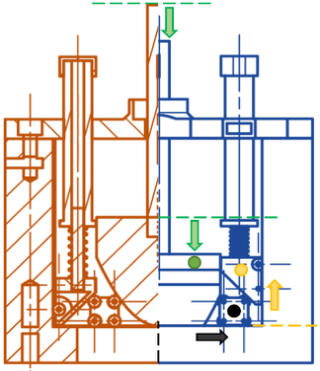
CONCEPT AND MODELING The concept is founded a previous design based on parallel springs and rollers as active elements (Liu, et al. 2017). The functioning principle is illustrated in Figure 1 and can be described as follows.
The center piece of parabolic profile (green dot) is vertically displaced by the shaft, causing the rectangular roller (black dot) to move horizontally. The latter pushes the trapezoidal slider (yellow dot) upwards, compressing the spring which exerts the required force. The profile of the center piece is designed to produce a constant force response.
The force balance of the system requires the roller or bearing trajectory to be described by a parabola of form
αy2
Equation reproduced from the original PDF.
Design and Manufacturing Considerations of a Constant-Force Mechanism 71
Figure 1: Design concept in unloaded (section-cut, orange) and displaced positions (full view, blue); the arrows indicate the travel directions and functionality of various subcomponents.
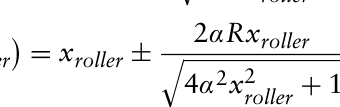
The shape of the guide (green dot in Figure 1) must be the envelope curve for the set of circles of radius R and whose center lies on curve (1) (Yates 1947), of coordinates
= αx2
(2)
xenvelope
xroller
roller ± α q 4α2x2 roller + 1
(3)
yenvelope
xroller
Equation reproduced from the original PDF.
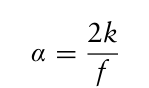
with xroller being the abscise of Equation 1. The term α includes physical characteristics of the spring (stiffness k) and target force f, and is defined by
Equation reproduced from the original PDF.
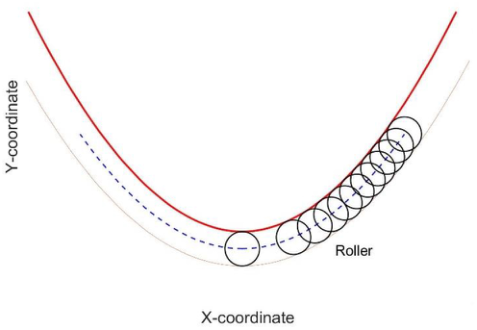
f (4) Plotting for a distinct set of roller radius R, spring constant k and target force f, yields trajectories such as that shown in Figure 2. The envelope may then be the profile of a 3D printed guide.
PROTOYPING The impact of friction has been previously modeled for large target forces. Its influence is amplified in the case of low force regimes, leading to a design heavily based on rolling contact. Replicating the value of the “α” term from Liu, et al. 2017, weak compression springs of stiffness k equal to 0.1 N/mm are chosen to complement the 1 N target force. The shaft is carried by a linear roller bearing, and the two telescopic sleeves (light grey in Figure 3) are machined to tolerance with respect to their afferent shafts.
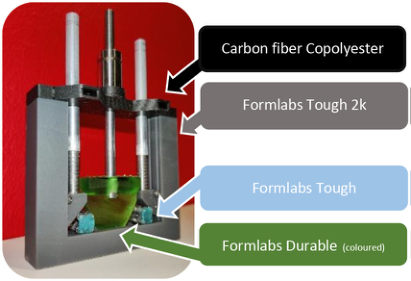
Figure 2: Trajectory for a family of rollers of radius R along the designed envelope curve.Figure 3: Prototype with afferent materials; all unspecified components are made of Stainless Steel.
The straightness requirement on their alignment, as well as due to ducti- lity concerns, important when press-fitting the sleeves and slider bearing into position, suggests carbon fiber reinforced copolyester as the material of choice for the top piece (black in Figure 3). The latter was 3D printed on an Fused Filament Fabrication (FFF) machine, also ensuring geometric strai- ghtness as opposed to the deformation-prone resin solutions. These, however, prove to be well-suited considering the miniscule inner diameter of the rol- lers, acting as shafts and simplifying the construction by avoiding more metal inserts. Engineering resins from Formlabs yield low-friction surfaces (Form- labs 2022). Among these, Durable Resin is the selected material due to its friction coefficient and strength characteristics.
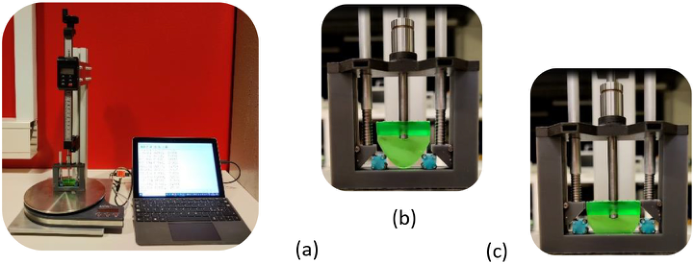
TESTING The assembled prototype was tested by undergoing controlled displacement in a stiffness tester (Figure 4a) and obtaining the force response through a
Design and Manufacturing Considerations of a Constant-Force Mechanism 73
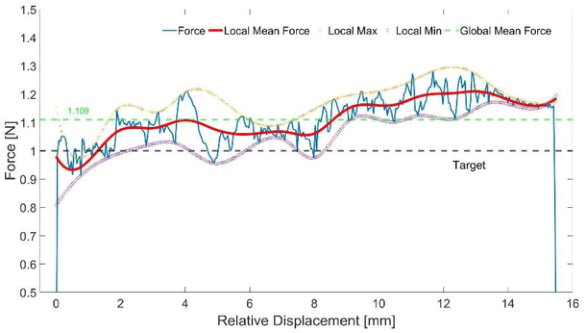
Figure 4: Test setup including Displacement gauge, mass sensor and data recording (a); prototype in the unloaded position (b) and at maximum displacement prior to snap (c).Figure 5: Measured prototype force response.
digital scale. Due to unavoidable friction, the travel is restricted to 15 mm. Once the predetermined travel distance has been reached, the mechanism shall disengage, no longer exerting force (Figure 4b and 4c). This allows the system to be protected from forces above a threshold.
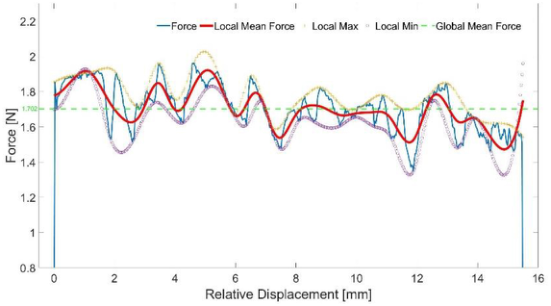
Figure 5 reveals an offset of 10% from the target force, with oscillations stemming from the unavoidable friction due to mounting of the miniature components, as well as the low regime of the sensor readings. The mean force remains within ±13% of the global mean force within a displacement range of 1 to 15 mm. Given the low target force, manufacturing techniques and the presence of sliding friction in the telescopic members, the results show good potential for low constant-force mechanisms.
CASE STUDY Having validated the physics, a case study of an oropharyngeal swabbing device is investigated. In this situation, the force would be that exerted by a person’s throat onto a swabbing pin attached to the actuating shaft of the
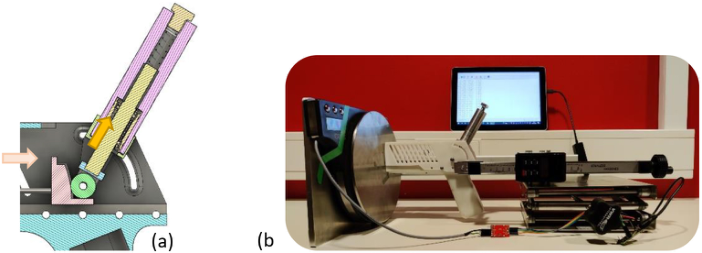
Figure 6: Tilting spring design for swabbing device (a) and test setup (b).Figure 7: Measured swabbing prototype force response.
previous design. The same curve generation is now employed towards actu- ating a single spring within a tilting enclosure. The latter is designed to exert constant force at different angles.
The results of this new test (Figure 6b) are shown below (Figure 7). The significant offset from the target force can be explained by the angle of the spring. Indeed, a person swabbing with the proposed device would not per- form a purely horizontal motion. The tilting capability of the spring enclosure can allow for adjustment in this regard, so that the force is maintained in the desired regime in various swabbing scenarios.
A deviation of ±23% from the mean value of 1.702 N over the travel length satisfactory considering the arbitrarily tilted enclosure and the low target force.
CONCLUSION AND FUTURE DEVELOPMENT The double spring prototype has demonstrated the possibility of employing rapid prototyping towards successfully creating a fully mechanical solution for a constant-force device. To further lower the impact of friction, the tele- scopic members should also exhibit rolling friction, similarly to that of the center shaft with its linear bearing. The quick-release feature renders it parti- cularly useful in scenarios where excessive actuation occurs, creating a safety
Design and Manufacturing Considerations of a Constant-Force Mechanism 75
buffer over the displacement plateau of constant force. Inspired by this functi- onality, the case study can itself be enhanced by including a mapping of angles versus force. A sensor could be used to indicate the ideal tilting angle to the operator, depending on the swabbing incline. Furthermore, the process could be automated by including a motor that can react to the measured angular deviation and compensate by tilting the enclosure to its ideal position in the given scenario. The low-force regimes addressed by this effort can be explo- red by physical prototypes which shed light on needed design changes and optimization solutions.
REFERENCES
Formlabs. 2022. Accessed February 10, 2022. https://formlabs.com. Hasibuzzaman, Md, Asnida Abdul Wahab, Gan Hong Seng, and Muhammad Hanif Ramlee. 2017. “Three-dimensional printed orthosis in biomedical application: A short review.” Journal of Physics: Conference Series. Hoffmann, Niclas, Samet Ersoyal, Gilbert Prokop, and Matthias Hoefer. 2022.
“Low-Cost Force Sensors Embedded in Physical Human-Machine Interfaces: Concept, Exemplary Realization on Upper-Body Exoskeleton, and Validation.” Sensors. Keung, Godfrey, and Chao Chen. 2019. “Novel Design of An Adjustable Constant Force Mechanism based on Cam and Spring.” Advances in Mechanism and Machine Science. Springer, Cham. Kim, Uikyum, Gwanghyun Jo, Heeyeon Jeong, and Cheol Hoon Park. 2021.
“A Novel Intrinsic Force Sensing Method for Robot Manipulators.” IEEE Tran- sactions on Robotics 2218–2225. Lambert, Patrice, and Just L. Herder. 2017. “An Adjustable Constant Force Mechanism Using Pin Joints and Springs.” New Trends in Mechanism and Machine Science. Springer. Liu, Yang, De-Jun Li, De-ping Yu, Jian-guo Miao, and Jin Yao. 2017. “Design
of a curved surface constant force.” Mechanics Based Design of Structures and Machines 160–172. Popa, Andrei-Alexandru, Alin Drimus, Eric W. MacDonald, and Lars Duggen. 2021.
“A Conformal, Optimized 3D Printed Kneepad With Deformation Sensing.” IEEE Access 126873–126881. Rahman, Minhaz Ur, and Hong Zhou. 2014. “Design of Constant Force Compliant Mechanisms.” International Journal of Engineering Research & Technology. Wang, Piyu, and Qingsong Xu. 2018. “Design and modeling of constant-force
mechanisms: A survey.” Mechanism and Machine Theory 1–21. Yates, Robert C. 1947. A Handbook on Curves and their Properties. Edwards Brothers, Inc.
LISTED IN THE AHFE DIGITAL BOOKSTORE CATALOGUE
Explore the complete digital volume
Additive Manufacturing, Modeling Systems and 3D Prototyping
Read this individual research paper free through the original publisher, or explore the full digital proceedings book.
ISBN 978-1-958651-10-0
Explore this ISBN in the AHFE Bookstore ↗Listed in the July 2026 bookstore catalogue; search by ISBN to confirm current availability · Digital book purchase optional