Andrei Alexandru Popa, Olgierd Nowakowski, Lars Duggen (2024). On the manufacturing of potted electrical connectors with 3D printing resin: an unobtrusive workflow. In: Human Aspects of Advanced Manufacturing, Production Management and Process Control. AHFE Open Access, vol. 146, pp. 79–86. https://doi.org/10.54941/ahfe1005153
The application space of additive manufacturing knows ongoing expansion due to advances in materials and improvements in equipment, but also the novel, creative use of well-established techniques. Vat photopolymerization (VPP) can be employed in the manufacturing of industrial grade electrical connectors with embedded conductive terminals. The proposed workflow includes the insertion of these terminals towards obtaining environmentally sealed connectors during the curing phase inherent to VPP 3D printing, thereby not disrupting nor adding to the original manufacturing steps. The novelty of the approach is further enhanced by potting the electrical terminals into the 3D printed substrate with the same material (thermoset resin) in which the connector body was produced. The naturally subsequent UV-curing of the full ensemble yields robust electrical connectors, mechanically tested and validated for their rigidity and ultimately characterized for their electrical performance. The complete manufacturing workflow can be extended to other commercially available connector types, relevant to a broad range of power and data transfer applications.
Injection molding (IM) remains the preferred technique for the large-scale manufacturing of plastic components almost two centuries after its inception (Czepiel et al., 2023). Exploiting the newly discovered gutta-percha natural rubber with its thermoplastic latex derivative, injection molding saw formal daylight before the middle of the 19th century (White, 1990), with patented machines available shortly after (Hyatt & Hyatt, 1872). Traditionally reliant on precision-machined metal molds, IM enables part creation with high con- sistency, facilitating the production of plastic components with fine tolerance requirements at a rapid pace. These assets of injection molding, while crucial to many industries, do not come without drawbacks. Start-up costs when designing, manufacturing and fine-tuning the mold alone can land upwards of $60,000, usually involving the precise machining of a suitable metal alloy. Alternatives under the form of 3D printed inserts have been attempted drasti- cally lowering the cost of entry into production. The thermal and mechanical stresses inherent to the process, however, render these fixtures usable for a
mere fraction of the cycles their metal counterparts can withstand (Gohn et al., 2022). Moreover, the higher surface roughness associated to Fused Fil- ament Fabrication (FFF) and Multi Jet Fusion (MJF) 3D printing leads to suboptimal mechanical and optical properties of the injection molded parts (Habrman et al., 2023).
Additive manufacturing (AM) has seen increased adoption into many areas of modern industry (Kanishka & Acherjee, 2023). Otherwise known as 3D printing, AM is often used to iterate quickly through prototype versions and to create conceptual models. Neither of these applications typically require the 3D printed parts to deliver market-worthy mechanical performance, rel- egating some polymer-based AM techniques to mere approximations of the end-product. While this is optimal in the early stages of development in most product design processes, it typically proves insufficient as they progress towards a commercially viable product (Iftekar et al., 2023). Advances in Vat Photopolymerization, however, have led to commercially sound prod- ucts manufactured directly by 3D printing (Carbon, 2024). It is worth noting that the surface roughness of parts created by Stereolitography, a variation of VPP, can be superior to that of injection molded parts (Özdilli, 2021). In this context, manufacturers such as Formlabs have begun including materials tailored for injection molded fixtures into their portfolio (Formlabs, 2024). Additionally, the case-specific direct manufacturing of components via AM can financially compete with IM for medium-series production. Studies sug- gest that around 80.000 parts can be produced by 3D printing at a lower cost than that of injection molding, entry expenses included (Kazmer et al., 2023). Coupling this to the aforementioned quality of VPP parts translates to an interesting alternative to IM for mid-scale production, particularly given the inexpensive design reiterating which AM boasts. Naturally, obtaining proto- types with market-worthy tolerances and mechanical characteristics rapidly and cheaply is another noteworthy asset of VPP versus IM, distancing the former from its “early-prototyping-tool” reputation. In VPP, the resin is pho- tocured into a near net shape, a so-called “green-state”, in which they have yet to obtain their full mechanical properties until their final curing phase in a temperature-controlled UV-chamber. It is this natural process window that allows for the insertion of various components, among which electrical terminals, that can then be overmolded between the substrates during full hardening (Popa et al., 2019).
The use of 3D printing in the context of electronics has been present for the better part of three decades, with various techniques employed towards creating structures with embedded sensing (Popa et al., 2021) and conduc- tive terminals (Popa et al., 2018). Customarily, the integration of electronics with 3D printed structures imply either process interruptions or component insertion after the additive manufacturing is complete (Carradero Santiago et al., 2020).
Originally developed as a means of protecting intellectual property in cir- cuit design, the potting of electronics with epoxy-based resins has drawn attention to itself in the late 1970s (Shapley, 1978). Together with injection molding, these resins are nowadays used for the cementing of metal pins into
On the Manufacturing of Potted Electrical Connectors With 3D Printing Resin 81
position within IM polymer substrates, with environmentally sealed electrical connectors as a product example.
Leveraging the state-of-the-art automated resin 3D printing setup from Formlabs (Form Auto, 2024) and its continuous throughput with no human interaction between consecutive print jobs, this effort proposes the unobtru- sive potting of metallic pins into additively manufactured substrates in their process-inherent “green-state”, towards creating Metri-Pack sealed connec- tors. By using the same 3D printing photocurable resin as the potting agent, the need for an additional epoxy resin is removed, simplifying the manufac- turing logistics. The robustness of the obtained connectors is then tested and validated mechanically and electrically, with concluding remarks presented at the end of this study.
METHOD
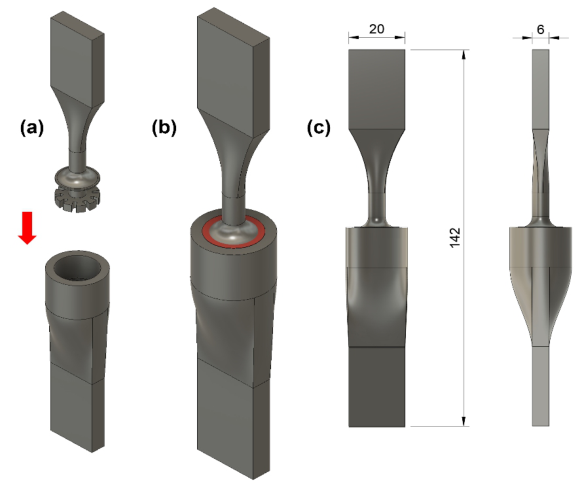
The hypothesis of electrical connectors potted with photocurable resin dis- playing comparative strength to exclusively 3D printed components was validated by mechanical testing on Lloyd Instruments LD30 testbench. Specifically, the ultimate tensile strengths of “dog bone” specimens that were a. fully 3D printed and b. 3D printed in two halves and potted with photocur- able resin (Rigid 10K from Formlabs) were compared. Figure 1 highlights the manufacturing steps of the process.
Figure 1: Potting process concept illustration (a and b) and dogbone dimensions (c).
The male part of the specimen designed for potting has a round piston- like shape with grooves cut radially into its bottom. This has been done to
increase the contact area and aid air in escaping from the bottom boundary during the potting process.
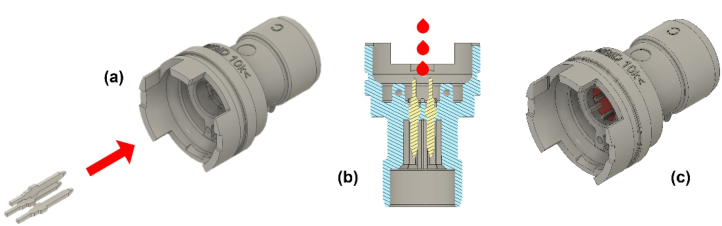
Once these results were deemed acceptable, the potting of metal termi- nals into “green-state” 3D printed Metri-Pack connectors was performed. As shown in Figure 2, after a double 10 minute wash in isopropanol of the printed part, the pins were inserted into pre-made cavities, and flooded in photocurable, Rigid 10K resin from Formlabs. The same resin was used to manufacture the part itself, due to its manufacturer claim of injection mold- ing worthy stiffness (Source Formlabs rigid 10k). Due to the same air bubble prevention considerations, flow channels for the potting resin were created. The full assembly of 3D printed connector housing, inserted metal pins and uncured potting resin, was then post-processed as per manufacturer specifi- cation in a UV chamber for 60 minutes at 70oC. This final step completes the polymerization cycle, granting parts their datasheet material properties.
To validate the mechanical integrity of the newly obtained connector, com- pression tests were performed on individual pins up to a ramped force of 40 N. The value is chosen in accordance with standardized testing carried out by at least one large-scale manufacturer in Denmark, whose identity is protected by a Non-Disclosure Agreement.
The electrical performance of the 3D printed, potted connectors, is quali- fied by using standard, off-the-shelf female terminals interfacing to the male, potted connectors, after 100 cycles of attachment/detachment. This value is roughly one order of magnitude higher than the expected use for this family of connectors. The qualification is done based on the measured conductivity of each pin on of the connector.
RESULTS AND DISCUSSION
Tensile testing the “potted” specimens and their fully 3D printed equiva- lents served as a validation of the concept before attempting to construct the full Metri-Pack connector. It is worth mentioning that the potted resin will solely undergo the post-process UV and heat curing cycle, thus not experiencing the initial polymerization during 3D printing. The mechanical response is therefore expected to be lower than that of material undergoing
On the Manufacturing of Potted Electrical Connectors With 3D Printing Resin 83
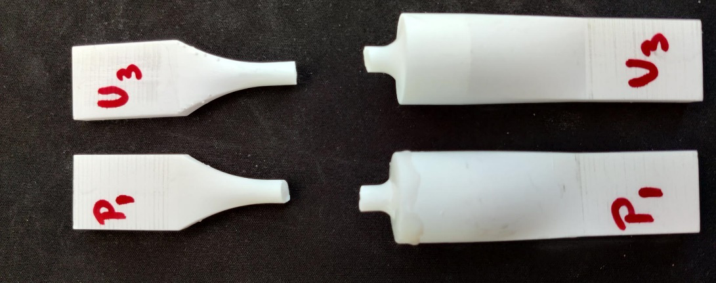
both the 3D printing polymerization and the subsequent UV-curing stage. Three specimens of each type were tested, as shown in Figure 3.
Figure 3: Dogbones post-test.
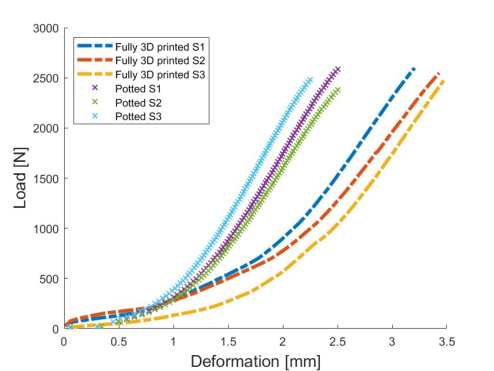
The results of Figure 4 reveal comparative UTS for both potted (between 80 and 91 MPa) and fully 3D printed (between 87 and 90 MPa) specimens, yet superior elasticity for the latter category (deformation at break of 3.2– 3.5 mm, versus 2.2–2.5 mm). This can be explained by the aforementioned partial curing of the potting resin. With this in mind, the concept was val- idated on the premise of potted samples exhibiting a promising strength regime.
Figure 4: Load-deformation curves for potted vs. printed dogbones, respectively.
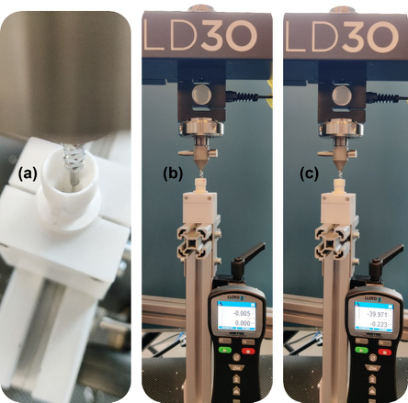
Having validated the physics of the concept, the case of the Metri-Pack connector was subsequently investigated. Using the same LD30 testbench in compression mode, pins were loaded individually to obtain their deflection
at 40 N. The tests were performed cyclically on the separate pins, with 5 load- ings of each, without any significant change in the negligible deflection. On these grounds, the structural integrity of the 3D printed Metri-Pack connec- tor with photocurable resin potting of terminals can be validated. Figure 5 displays the measurement procedure along with results.
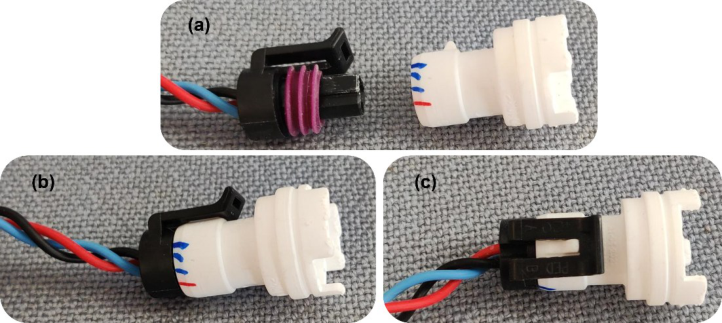
Figure 5: (a) Test setup close-up, (b) sample ready for testing and (c) with load applied.Figure 6: Printed receptable connecting to the off-the-shelf mating connector: (a) before mating, (b), (c) side and top view of the mate locked to the receptable.
The dimensionality and the functionality of the connector was tested by interfacing to a standard, injection molded female connector. Three samples were attached and detached 50 times, with their electrical conductivity unaf- fected by the uncharacteristically high number of detachments. The fit itself is unproblematic, with the seal of the female connector pressing neatly against the face of the 3D printed male part.
On the Manufacturing of Potted Electrical Connectors With 3D Printing Resin 85
The implications on human aspects and, in turn, the work design, are linked to a reduction of risk. By potting with a thermoset resin as opposed to, for example, epoxy-based composites typically used for such connectors, the human operator is now exposed to the same level of danger. While care and protective equipment are still necessary, the mere fact that the same raw material can be used for both 3D printing and potting is a valuable asset.
CONCLUSION
This study has successfully demonstrated a novel method to integrate electri- cal components within a 3D printed structure. The experiments performed as a part of this study lead to the conclusions that potting using photopoly- mers yields a reliable mechanical and electrical connection, both in the case of bonding two 3D printed pieces, as well as in conjunction with metal elements inserted as a part of the assembly. Indeed, the cured green state-liquid bond has shown to be of comparable strength to a fully printed element in the ten- sile specimen study. Furthermore, a practical application for resin potting has been demonstrated and tested successfully against an industrial standard in the connector study. While the tests have shown that reliable material bond- ing could be achieved, the industrial use of this method would need further work on the repeatability of the potting, and prevention of potential defects such as air bubble formations. Nonetheless, this study proves the potential of 3D printing as a useful asset in creating functional prototypes and customiza- tion of small-to-medium series of electronic devices, especially if said devices normally would employ components overmolded into their structure. While 3D printing is comparatively slow and costly in high-volume production, its starting cost remains only a fraction of that required by injection molding, while it retains the ability of immediate and costless modifications to the man- ufactured components. While obtaining the facilities to produce parts using 3D printers can be expensive, the cost of such has significantly decreased in the recent years. As an example, with an investment of below 10.000 USD, one could obtain three Formlabs Form 3 machines, able to produce 750 pieces of the Metripack connector shown in this study per week, at a rate of 10h 39m per build plate of 20 connectors. It is also important to mention that places which currently employ such machines can seamlessly integrate pot- ting into their workflow, as it does not require resources beyond those of the original 3D printing process. It is for the reasons above that potting using 3D printing photopolymer offers an attractive alternative to the current iterative process of creating functional R&D prototypes and low-volume customized production of mechatronic products.
ACKNOWLEDGMENT
The authors would like to acknowledge Veenith Shetty from Danfoss A/S for his kind help in providing standard Metri-Pack connectors, and the Fabrikant Mads Clausen Foundation for funding the acquisition of the 3D printing equipment used in this study.
REFERENCES
Carbon, 2024. Carbon 3D. [Online] Available at: https://www.carbon3d.com/ [Accessed 2024]. Carradero Santiago, C. et al., 2020. 3D Printed Elastomeric Lattices With Embedded
Deformation Sensing. IEEE Access, Volume 8, pp. 41394–41402. Czepiel, M., Ba´nkosz, M. & Sobczak-Kupiec, A., 2023. Advanced Injection Molding Methods: Review. Materials (Basel), Volume 17. Form Auto, 2024. Formlabs Form Auto. [Online] Available at: https://formlabs.com/eu/3d-printers/form-auto/ [Accessed 2024]. Formlabs, 2024. Formlabs. [Online] Available at: https://formlabs.com/eu/store/materials/rigid-10k-resin/ [Accessed 2024]. Gohn, A. M. et al., 2022. Mold inserts for injection molding prototype applications
fabricated via material extrusion additive manufacturing. Additive Manufactur- ing, Volume 51. Habrman, M. et al., 2023. Injection Moulding into 3D-Printed Plastic Inserts Produced Using the Multi Jet Fusion Method. Materials, Volume 16. Hyatt, J. & Hyatt, J., 1872. Improvement in Process and Apparatus for Manufactur-
ing Pyroxyline. United States of America, Patent No. US133229. Iftekar, S. F., Aabid, A., Amir, A. & Baig, M., 2023. Advancements and Limitations in 3D Printing Materials and Technologies: A Critical Review. Polymers, 15(11). Kanishka, K. & Acherjee, B., 2023. Revolutionizing manufacturing: A comprehen-
sive overview of additive manufacturing processes, materials, developments and challenges. Journal of Manufacturing Processes, Volume 107. Kazmer, D. et al., 2023. Strategic cost and sustainability analyses of injection molding and material extrusion additive manufacturing. Polymer Engineering and Science, Volume 63, pp. 943–958. Özdilli, Ö., 2021. Comparison of the Surface Quality of the Products Manufactured
by the Plastic Injection Molding and SLA and FDM Method. International Journal of Engineering Research and Development, Volume 13, pp. 428–437. Popa, A.-A., Drimus, A., MacDonald, E. & Duggen, L., 2021. A Conformal, Optimized 3D Printed Kneepad With Deformation Sensing. IEEE Access, Volume 9, pp. 126873–126881. Popa, A.-A., Mai, C., Duggen, L. & Jouffroy, J., 2018. Towards Printing Mecha-
tronics: Considerations for 3D-printed conductive coupling. Auckland, NZ, IEEE. Popa, A.-A.et al., 2019. 3D Printed Hybrid Flexible Electronics with Direct Light Synthesis. s.l., Springer. Shapley, D., 1978. Industry Takes to “Potting” Its Products for Market. Science, 24
November, Volume 202, pp. 848–849. White, J., 1990. Principles of Polymer Engineering Rheology. New York: Wiley.
LISTED IN THE AHFE DIGITAL BOOKSTORE CATALOGUE
Explore the complete digital volume
Human Aspects of Advanced Manufacturing, Production Management and Process Control
Read this individual research paper free through the original publisher, or explore the full digital proceedings book.
ISBN 978-1-964867-22-9
Explore this ISBN in the AHFE Bookstore ↗Listed in the July 2026 bookstore catalogue; search by ISBN to confirm current availability · Digital book purchase optional