Narges Goshayeshisafa (2023). Traces of Memory, Footprints of Material. In: The Human Side of Service Engineering. AHFE Open Access, vol. 108, pp. 375–382. https://doi.org/10.54941/ahfe1003140
Our environment is the key component of our survival on earth and has the most optimal solutions that worked for three and a half billion years. Dr. Janine Benyus, pioneer in the field of Biomimicry has shown that when we emulate nature's designs and processes, we can create a healthier, more sustainable planet. Natural phenomena all around us can be the inspiration for solutions to our current problems. Human body is full of inspirations. One of the most efficient parts of a human's body is their brain. As humans go through time, their brain creates new connections and destructs the unnecessary ones to not misuse the limited resources of the brain. The result of this behavior is making new memories and forgetting the old ones. Research shows that this behavior of the brain which results in forgetfulness is a healthy process and is crucial to brain functionality. This dynamic part of the body changes as it goes through time. Just as humans go through time, so do the materials we create. Designing materials that do not exhaust the limited resources of earth can be inspired by those natural evolutionary processes that have engineered our magnificent brains. Such process creates materials that are responsive, dynamic, and easily return to enrich the cycle of life. This project is inspired by how our mind and body work. As technology advances while being inspired by brain processes in material creation we’re invited to open new doors synthesizing natural processes with current technologies. While we explore the opportunities for more sustainable materials development through additive manufacturing and computational designs, we collaborate with nature to bring these ideas to life. The result of this project showcases a taxonomy of bio-degradable materials that has been designed and created utilizing Rhino-Grasshopper and Robotic Fabrication using UR10 robotic arm. In these material prototypes, the behaviors of sample materials such as shape change, and strength have been studied to explore the opportunities they provide by engineering material properties as well as geometrical features. This study emphasizes on the need to take meaningful actions in creating sustainable materials that do not exhaust the limited resources of earth.
As we go through time, our body and mind changes. Our environment and our interactions leave traces on us that define who we are. As our body and mind go through time, so do materials. Time can leave traces on materials as it leaves traces on us. This natural process of adaptability and change is not being practiced in material creation methods in today’s world. Current strategy is to create objects that do not show the trace of time on them and remain frozen in time as long as possible. But this approach is not serving us and our environment as we see the sustainability issues growing by second. Adapting nature’s solutions that has been tested for a very long time can
bring up great opportunities to solve our sustainability problems. Biomimi- cry enables us to change perspective and to discover purposes of materials. This project is inspired by how our mind and body work. It creates materials using parametric modeling tools and additive manufacturing synthesizing the processes between human minds and materials.
METHODOLOGY
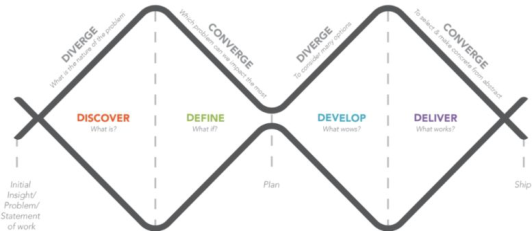
In this research, the double diamond design process has been applied. This model encourages understanding and picking the right problem and explo- ring potential ideas to solve it. The double diamond model consists of four different stages. The first stage is the Discovery phase where a range of chal- lenges will be recognized to determine which one has the most value to focus on. The second stage, Define is when the problem to solve is established cle- arly. Develop is the third stage where the potential solutions emerge. The fourth and last stage is Deliver, which requires refining the final solution.
DISCOVER – MATERIAL SUSTAINABILITY The concept of sustainability has become increasingly important over the years as humans have started to see the results of their actions. The mate- rials that we use in our lives are made up of substances that can hurt our environment. The world produces 2.01 billion tons of waste annually (Kaza et al., 2018). This is about five million tons per day which is the same as the weight of 500 Eiffel tower in one day. More than 50% of the waste are the materials that are designed and built to not easily be destroyed over time (Kaza et al., 2018) and so they do not easily go back to the cycle of life. They take an exceptionally long time to be disposed and some even require waste treatments that have hurtful effects on the environment. Our environment is the key component of our survival on earth. If we do not treat it well, we would not have its resources to benefit from.
DISCOVER - BIOMIMICRY The practice of biomimicry emphasizes on imitation of the systems, behavi- ors, and elements of nature to design for human problems. Dr. Janine Benyus
Traces of Memory, Footprints of Material 377
a pioneer in the field of biomimicry urges designers to take design advice from nature. She expresses on the fact that all the other organisms on earth are older than us and has solutions for the challenges that a young species like us might have. They have solved their problems in ways that sustains the planet, and they are ready to gift us with their experiences (Benyus, 2009).
Dr. Neri Oxman who is a designer and a professor at the MIT Media Lab is another important figure in the area of biomimicry. She is the inventor of a design philosophy called “Material Ecology.” Material ecology is combi- ning materials science, digital fabrication technologies, and organic design to produce techniques and objects learned by the natural systems. She follows the same principle as Benyus and encourages designers and scientists to study nature and get inspired to solve the current problems.
The idea of biomimicry is a relatively new area which attracts more and more researchers from diverse disciplines every day.
DISCOVER - BRAIN The separation of mind and body and who we are without our body or who we are without our consciousness has been under discussion by philosophers and neuroscientists for a very long time. Rene Descartes, the 17th century Fre- nch philosopher, who discovered this problem believed that mind and body are distinct since the nature of mind is completely different than the nature of body. His theory is now called mind-body dualism (Hatfield, 2017). Over time different philosophers brought up different theories to support or object Descartes’s theory. A British neuroscientist Anil Seth explores the topic of consciousness in a unique way. He believes that brain’s perception of rea- lity is a controlled hallucination which is shaped by the inputs that the brain gets. He explains that the experiences of the self and the world are brain’s best guesses which is determined by their usefulness to help the organism to stay alive. Seth describes that the experience of the self is also a special kind of controlled hallucination which is fundamentally about controlling the body (Seth, 2017). The understanding of the self is experiencing a con- tinues person over time with a name and a set of memories which is shaped by various aspects of the environments. As American neuroscientist David Eagleman explains in his book called The Brain, every seven years, every atom in human’s body gets replaced with a different one. But the link that holds our continuous sense of self stable is our memories (Eagleman, 2015). Memories are crucial parts of creating the self. When we experience an event personally, memories begin to take lasting forms in the hippocampus in the hours and days that follows the event. These lasting forms create neurons connections in the brain. The more often a memory is recalled the stron- ger its neural network becomes and the better we remember that experience or that memory (The University of Queensland). But as new memories get created the old ones get faded away. As Eagleman explains, we only have a finite number of neurons, and they need to multitask (Eagleman, 2015). Brain needs to be efficient in using these neurons. As the consequence the less remembered memories will eventually fade away and replaced by the new ones. Researchers at Biology Department at MIT demonstrated that brain
378 Goshayeshisafa
is built to forget. Scott Small director of the Alzheimer’s Disease Research Center at Columbia University explains that forgetfulness to some extent is critical to help people replace the bad memories with the good ones, make better decisions, and be more creative (Small, 2021).
This sustainable cycle of memory creation and destruction is very well planned and executed by the brain. Reusing the limited resources of the brain is both smart and sustainable. Brain revolutionary processes in creating memory is producing human’s consciousness while being intelligent about not misusing the limited resources that the brain has available.
DEFINE This project is inspired by how our mind and body work. It creates materials using parametric modeling tools and additive manufacturing synthesizing the processes between human minds and materials.
Additive manufacturing is the process of creating an object from a three- dimensional model which first was brought up in 1980’s as a method of rapid prototyping in different fields such as engineering and health. As this techno- logy advanced over the years, it is now being used as a tool that can create complete products that are durable and can be utilized (Wong, 2012).
Computational design is the creation of a model where parts of the design is calculated by the computer. The design process will be in the computer language to create algorithms that would generate a specific design. This method would enable the design to be dynamic and repeatable. Computatio- nal design tools make the design process more efficient. They help in creating more dynamic results that automate the repetitive tasks (Ramage, 2022).
Additive manufacturing and computational design are the two technolo- gies that pair up in the workflow of this research. These two new technologies can be great tools in material creation. They allow flexibility in the design, behaviour, and raw material of the objects.
DEVELOP In the develop stage, the technologies to be used were chosen. Universal Robot – UR10 equipped with the dispenser was selected as the additive manufacturing tool and Rhino/Grasshopper was selected as the computa- tional design tool. Rhino/Grasshopper and UR10 are a good pair for two reasons: first, the connection between the software and the UR10 was fea- sible and second, Grasshopper would allow possible complex designs to be computed using visual programming. In addition to that, the materials that would serve the purpose and the philosophy of the research were narrowed down in this phase. A few materials that were chosen to be tested are Chi- tosan, Corn Starch, Gelatine, and Silicon. Chitosan is from outer skeleton of shellfish which makes it cheap and environmentally friendly. It comes in powder and in contact with acid it will change viscosity. Corn Starch, which is the starch, derived from corn grain is in powder form and can be mixed with water to create different viscosities. Gelatine comes from animal body and can come back to nature without force. Silicon is a chemical element was
Traces of Memory, Footprints of Material 379
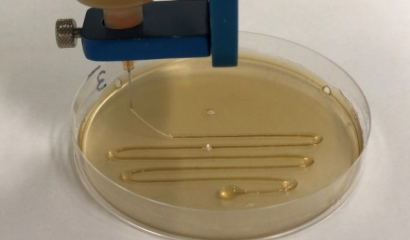
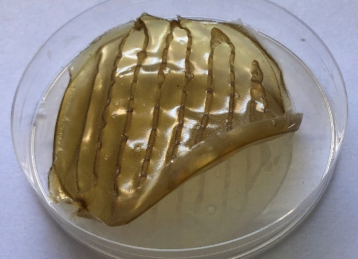
Figure 2: Chitosan-based material dispensing utilizing industrial robotic arm.Figure 3: Three-dimensional shape of chitosan layer – the bend is aligned with the lines being dispensed on the layer.
chosen as a prototyping material for its ability to easily be casted and show change towards the environment.
After choosing all the required technologies and materials, the process of dispensing the materials started. There are many different factors involved when dispensing with the UR10. The viscosity of the material was the main factor on how successful the result would become. UR10 dispensing equi- pment which works with air pressure, needs materials with specific viscosity. They cannot be too hard or too soft. The particular viscosity to get the best effect was hard to achieve in Corn Starch, Gelatine, and Silicon. But it was possible with Chitosan. Variations in the amount of acidity of the solution and the amount of Chitosan would control the viscosity. Due to this factor, Chitosan was chosen to be the best material to work with the dispensing machine. In addition to that, aspects such as air pressure, speed of the robotic arm, and the type of the extrusion tip would be important factors to consi- der. Small changes in each of these factors, would make big differences in the results.
Creating different shapes and patterns was another focus in this research. For example, a thin layer of Chitosan created interesting three-dimensional shapes after dispensing horizontal line on it and letting it dry out.
380 Goshayeshisafa
Another aspect of this research was to realize the material degradability. How easily they were able to dissolve and be forgotten depended on the mate- rial and the solvent. For instance, Chitosan was dissolvable in weak acid and would easily go back to nature while Gelatine would dissolve in hot water rapidly.
DELIVER The outcome of this project was showcased at two exhibitions at the Califor- nia State University, Long Beach in the form of a combination of digital and physical achievements of this project.
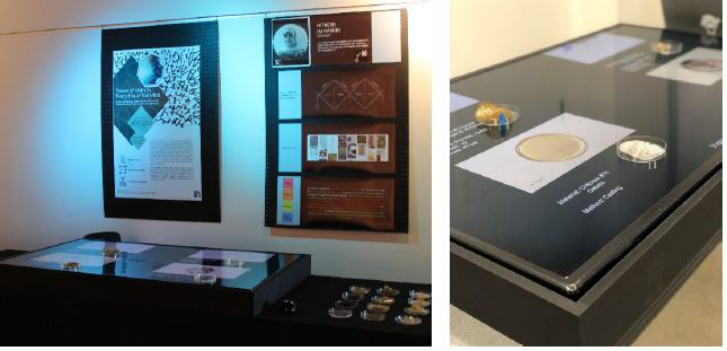
The screen showcased a taxonomy of biodegradable materials. In each part of the screen the viewer was able to see the process of creating the material in digital format (the videos showing the process of creating the material) and interact with the material itself in physical format (pieces of materials in petri dishes placed on the screen underneath the relevant process video). Information on the materials used, cut speed of the robotic arm, types of the extrusion tip, and the air pressure were all presented on the screen as well. This type of presentation was helpful because it allowed the viewer to be able to be involved in all the different steps in producing the material as well as allowing them to touch and feel the finished product.
Many kind and productive feedback were given for improvements in this project. The most frequent suggestion was to build a functional or archite- ctural design from one of these materials and let them fade away over time to go back to nature. As they explained and I agree with this idea as well, having this part of the process would create the full cycle of creating, living, and fading away of the materials. Creating this full cycle would allow for a complete comparison with the cycle of memory creation and destruction and a better understanding of this analogy.
For the future work, one of my priorities is to create a functional or archite- ctural piece using UR10. In addition to that, trying different materials would
Figure 4: Presentation of a taxonomy of biodegradable materials combining digital and physical formats.
Traces of Memory, Footprints of Material 381
be an interesting addition to this research. Also, being able to create more consistent three-dimensional shape can be another fascinating aspect to be explored.
CONCLUSION
As humans we live in an era that our environment is deeply damaged, and our next generations are in danger. The processes and the methods that humans currently use to survive on earth are not the best practices. These processes can cause damage and disruption on the existence of nature which has been around for billions of years. Natural processes have been able to maintain themselves for a very long time and has invaluable experiences that can be studied and implemented. Human body is also full of inspirations. Particu- larly, the revolutionary and sustainable methods that brain incorporates to maintain itself is fascinating. The natural cycle of creating and destructing memory in our brain is both functional and sustainable in not misusing the resources of the brain. As humans go through time, this groundbreaking pro- cess makes us evolve based on our interactions with our environment and at the same time it is aware of the limited brain resources. Just like humans, materials we create go through time. The materials that we create do not need to be frozen in time. They can be interactive and dynamic and easily go back to the cycle of life. Materials must be part of a process that helps main- tain the environment and not misuse the limited resources that earth provides for us. By following natural processes and taking advantage of current tech- nologies such as additive manufacturing and computational design, we can collaborate with nature to create environmentally friendly materials that do not exhaust the limited resources of earth.
ACKNOWLEDGMENT
This project is to satisfy the thesis project for the master program in Human Experience Design Interactions at California State University, Long Beach. This project would not be possible without the help of my advisors and my family. Words cannot express my gratitude to my professor and chair of my committee, Dr. Behnaz Farahi for her invaluable support and feedback. I also could not have undertaken this journey without my defense commit- tee: Professor Heather Barker, Dr. Elza Chu, and Professor Jonathan Lo. They generously provided knowledge and expertise to guide me in this path. I am also grateful to my classmates and cohort members for their editing help, feedback sessions, and moral support. Lastly, I am extremely grateful to my family, especially my spouse, my parents, and my sister. Their belief in me has kept my spirits and motivation high during this process.
REFERENCES
Benyus, J. (2009). Biomimicry in action[Video]. TED Confere- nces.https://www.ted.com/talks/janine_benyus_biomimicry_in_action. Eagleman, D. (2015). The Brain. Pantheon Books.
382 Goshayeshisafa
Hatfield, G. (2017). René descartes. The Blackwell Guide to the Modern Philosophers: From Descartes to Nietzsche, 1–27. Kaza, S., Yao, L. C., Bhada-Tata, P., & Van Woerden, F. (2018). What a Waste 2.0
: A Global Snapshot of Solid Waste Management to 2050. World Bank Group. https://openknowledge.worldbank.org/handle/10986/30317. Oxman, N., Ortiz, C., Gramazio, F., & Kohler, M. (2015). Material ecology. Q. B. I. (n.d.). How are memories formed? The University of Queensland. https://qbi.uq.edu.au/brain-basics/memory/how-are-memories-formed#:~: text=The%20brain%20simmers%20with%20activity,strength%20of%20conne ctions%20between%20neurons. Ramage, M. (n.d.). What Is Computational Design? Trimble Construction. Retrieved January 31, 2023, from https://constructible.trimble.com/construction-industry/ what-is-computational-design. Seth, A. (2017). Your brain hallucinates your conscious reality[Video]. TED Con-
ferences. https://www.ted.com/talks/anil_seth_your_brain_hallucinates_your_ conscious_reality. Small, S. A. (2021). Forgetting - THE BENEFITS OF NOT REMEMBERING.
Crown. (n.d.). The Double Diamond. Design Council. Retrieved January 31, 2023, from https://www.designcouncil.org.uk/. Wong, K. V., & Hernandez, A. (2012). A review of additive manufacturing. International scholarly research notices, 2012.
LISTED IN THE AHFE DIGITAL BOOKSTORE CATALOGUE
Explore the complete digital volume
The Human Side of Service Engineering
Read this individual research paper free through the original publisher, or explore the full digital proceedings book.
ISBN 978-1-958651-84-1
Explore this ISBN in the AHFE Bookstore ↗Listed in the July 2026 bookstore catalogue; search by ISBN to confirm current availability · Digital book purchase optional