Bernd Dworschak, Alexander Karapidis (2023). Technology - competence - learning within HR analytics solutions - a holistic approach to enable digital transformation and value creation. In: The Human Side of Service Engineering. AHFE Open Access, vol. 108, pp. 341–348. https://doi.org/10.54941/ahfe1003136
In times of organizational transformation, e.g. with regard to increased digitization or the development of new business models to improve value creation, it is necessary to identify competence requirements at an early stage. Therefore, trends and technologies require organizations to deal with the existing competences within the organization and to carry out early identification of competences in order to be able to react early to changing competence requirements.The Fraunhofer competence compass, which covers all process steps of a strategy-oriented competence management, is used as the basis for determining competence requirements. Competence management and the determination of competence requirements contained therein aim to make individual and organizational competences in the company tangible in order to be able to use them profitably (e.g. with regard to competitiveness and value creation) and to be able to develop them systematically and in a targeted manner. In combination with the results of the trend and technology analysis, job profiles of the future with new competence requirements then can be developed or new job profiles can be identified. What is the challenge then for HR? The challenge is to establish a data driven competence management, hence to make use of HR/People Analytics. This requires a consistently data-based architecture that anticipates new business requirements and identifies the resulting necessities for developing new competences. Subsequently, learning offers adapted to the needs of the employees and their requirements are proposed, implemented and evaluated. For this purpose, existing data models have to be evaluated and possibly redefined, data sources have to be newly developed and in a "control center" e.g. in the form of an AI-based dashboard. In the context of data-based competence management activities, practical data analytics procedures must also be identified, implemented as prototypes and tested. Thus, HR is faced with new requirements in the field of HR/people analytics. HR should be able to carry out or support well-founded data analyses, how these and corresponding hypotheses relate to business-relevant questions (such as the development of value creation) and what actions can be taken based on the analyses. This requires more than just IT competence, it also requires specialist technical knowledge. However, what is needed is the ability to translate strategic questions of corporate development into relevant hypotheses, to obtain the relevant data and to analyze them. Finally, the contribution tries to relate the approach of a strategy-oriented competence management and the characteristics of workforce ecosystems, a new strategic approach to the future of work, and to draw corresponding conclusions for HR/people analytics.
Much could be written about the differences and history of the discussion around the terms “competence” and “skill”, but in our opinion the terms can in principle be used synonymously. The same applies to the terms “compete- nce management” and “skill management”. At the Fraunhofer Institute for Industrial Engineering IAO, we have adopted a pragmatic working definition for working with companies about competence management: competence is the ability of individuals, teams or organisations to successfully carry out an activity or task (Dworschak et al., 2020).
Anyone who has ever dealt with the recording and analysis of competences is aware that competences manifest themselves in actions in certain situations and contexts and are therefore observable. This in turn means that the respe- ctive context is a key factor that makes competences distinguishable from one another.
THE CONCEPT OF COMPETENCE FROM THE PERSPECTIVE OF WORK SCIENCE The concept of competence is the subject of numerous specialist disciplines, including psychology, vocational education, economics and business admi- nistration. While psychology looks at competence from the perspective of cognitive abilities and motivational aspects, vocational education deals with the entirety of all performance dispositions that enable a person to fulfil the professional requirements placed on her or him.
Overall, it can be stated that almost all specialist areas that deal with the topic of competences formulate the concept of competence on an individual level in terms of a person’s ability to act. Accordingly, they understand the individual as an actual or potential bearer of competences and thus place employees at the centre of competence development.
Business administration, on the other hand, also deals with so-called orga- nisational competences at the level of strategic management and understands the performance of the company as the central direction of action of com- petence management. This perspective not only focuses on maintaining the skills currently required, but also on updating them with a view to coping with future requirements.
As part of our concept, the concept of competence is considered from the perspective of ergonomics in order to ensure its applicability for corporate practice. The competence management based on this understanding of the term enables companies to control the stock of competences in the company in a strategy- and goal-oriented manner. Competence management aims to make individual and organisational competences in the company tangible so that they can be used beneficially and developed both systematically and in a targeted manner (North et al., 2018; Sauter & Staudt, 2016).
The megatrend “digitalisation” is increasingly penetrating our living envi- ronment and is reflected in the change in work. For companies, this means not only a constant change in work tasks, activities and processes, but also that the competitive environment can change surprisingly and massively at any time and new, previously unknown requirements have to be met ad hoc.
Technology - Competence - Learning Within HR Analytics Solutions 343
Competence management can support companies in dealing with these chan- ges and requirements. However, this is not an original field of HR activity, but also addresses organisational development or corporate strategy.
If HR wants to advance to become an experienced business partner in strategic questions, HR has to become competence managers. This means mastering all process steps of competence management and having detai- led knowledge of future competence requirements through digitisation and Industry 4.0 as well as possible competence development measures (Dwor- schak et al., 2020). The Fraunhofer Competence Compass was developed for this purpose, which describes a five-step procedure for strategy-oriented competence management (cf. Schnalzer et al., 2022 in detail).
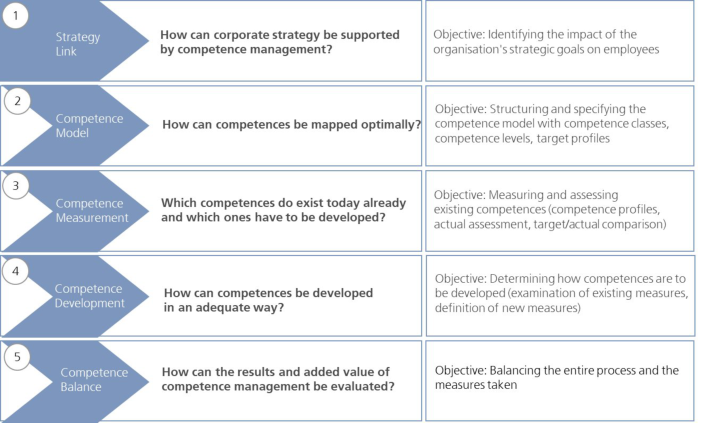
THE FRAUNHOFER COMPETENCE COMPASS: COMPETENCE MANAGEMENT IN FIVE STEPS The Fraunhofer Competence Compass offers a systematic approach for strategy-oriented competence management with the analysis, design and balancing of further training needs and strategic competence development and further training planning for organisations. The compass contains a modular system to set up and carry out the determination of compete- nce requirements and to operate competence management. The Compass comprises the following five steps (Fig. 1).
The first step involves linking competence management to the corporate strategy and referring companies’ development goals and tasks to available and required competences (North et al., 2018). Workshops with technical experts and managers, for example, are a good way to derive concrete fields of action from the corporate strategy and to identify areas of responsibility that the company will have to deal with in the future. This is followed by the
Figure 1: The Fraunhofer competence compass.
344 Dworschak and Karapidis
specification of tasks in the fields of action that companies, their departments and employees will have to master in the future.
The step of linking strategy and the determination of competence require- ments has also to be carried out taking into account the time horizon, validity, resources, responsibilities as well as processes and tasks. For companies with different locations, it is important to synchronise the strategic specifications of the head office with their own location-specific personnel and organizatio- nal framework. The results have to be presented to decision-makers, modified if necessary and approved.
The second step concerns the systematic structuring and specification of the competence model, taking into account the company context and the adaptation to current and future requirements. A competence model includes competence classes (which competences do we want to consider?), the scope of the model (a model for the entire organisation or just for certain functi- ons?), assessment levels or competence levels (grades? Beginners? experts?) and the definition of competence profiles (existing and future important competences?). In a competence model, central terms for strategy-oriented competence management in the respective organisation are defined and a common understanding of this is created among all those involved.
The third step includes the measurement and assessment of existing com- petences. With the competence measurement and assessment, it is necessary to answer the question of which competences are available at which level and which have to be further developed in the future or acquired from scra- tch. In order to determine the competence requirements, it is necessary to define measuring instruments, measuring methods and those involved in the measurement.
The competence assessment (actual assessment) can be carried out by managers, by self-assessment and, if necessary, further assessments. The basis of the competence assessment is the observable behaviour in a specific con- text. Context-related action anchors or descriptions must be defined for the competence measurement. It is important to ensure that not too many situati- ons and contexts are included, otherwise the complexity of the measurement becomes too high.
The target values are determined for all competences of the actual asses- sment. The aggregated target values of all competences together form the requirement profile. The comparison between existing (actual) and required (target) competences identifies gaps, evaluates the relevance and extent of the gaps and documents the measurement with its results.
The fourth step focuses on the way in which competences can be developed or further developed. The identified competence gaps have to be prioritised and those selected for which development measures should be initiated. Exi- sting personnel development measures have to be evaluated with regard to the necessary development of skills and possibly adapted to the specifically measured gaps in skills (Erpenbeck et al., 2021).
Depending on the competences to be developed, decisions regarding the learning sources (material or human), the learning methodology (e.g. instru- ctive or self-directed), the target groups (e.g. at individual, team or depar- tment level) including the analog and digital learning tools required for this,
Technology - Competence - Learning Within HR Analytics Solutions 345
the learning paths (e.g. modular or block-by-block), the learning time (lear- ning time, learning duration, learning pace, learning breaks) and the learning locations (in-house or external, at the workplace or in designated rooms) (Dyrna et al., 2018).
Overall, it has to be ensured that the implementation of personnel deve- lopment measures to effectively close gaps in competences is carried out consistently and promptly. The more clearly the objectives are, for exam- ple with regard to the question of which competences are to be developed by when and to what extent, the easier it is to check them later.
The fifth step is about balancing and optimising the competence develo- pment activities and the entire competence management process. Accounting is defined as a systematic empirical analysis of the results of a goal-oriented activity in order to measure, compare and, if necessary, modify them. This means that the competence assessment has to take into account the objecti- ves, the model, the competence-developing activities and the performance criteria.
In addition to balancing the learning of employees, a second focus is on balancing the competence management activities themselves. Sustaina- ble measures should be implemented to improve the impact of competence management activities on the specific context (such as the introduction of technology). This is also a direct link of competence management, HR analytics and the support of value creation.
NEW CHALLENGES FOR HUMAN RESOURCE MANAGEMENT: HR ANALYTICS AND DATA-BASED COMPETENCE MANAGEMENT The presented Fraunhofer Competence Compass offers a structured pro- cedure and application-oriented aids for a strategy-oriented competence management. However, there are further challenges for HR in the future: HR itself is affected by digitisation in several ways: HR has to, on the one hand, ensure that there is a sufficient number of employees with the appro- priate competences and skills throughout the company to carry out tasks to cope with new digital work processes (Hamilton & Sodeman, 2020). On the other hand, digitisation poses the challenge on HR of further developing and optimising its own processes and instruments (Petry & Jäger, 2021).
The term “Competence Management 4.0” (Dworschak et al. 2020) can be understood as the data-based enrichment of an existing competence mana- gement, which allows already known key figures to be clearly displayed on dashboards and connections, for example between personnel development measures and company success, with the help of AI-supported processes (HR Analytics) (Jatobá et al., 2019). So, HR Analytics can be seen and can help organisations to describe, to structure, to diagnose, and to predict on the basis of data workforce-related and performance outcome-related aspects (Rasmussen & Ulrich, 2015).
Descriptive and diagnostic (e.g. the description of the competences of employees in specific job profiles and possible further training options for new skills requirements), predictive (e.g. age structure analyses or loss of skills due to departures in the future) and prescriptive analyses (e.g. AI-based
346 Dworschak and Karapidis
recommendations for skills development) are used here for new work proces- ses of the employee groups concerned). So, the main purpose of HR analytics should be to collect data and applying it to analyses that can shape business outcomes (Dasari & Rama Devi, 2022).
This requires a consistently data-based architecture that anticipates new business requirements and identifies the resulting necessities for identifying and developing new competences (Pape, 2016). To do this, existing data models have to be evaluated, redefined if necessary and expanded with new data-based indicators. Additionally, data sources have to be newly develo- ped and brought together in a data lake. Data lakes are used to store raw data in its native format. So, they are repositories containing structured data, semi-structured data as well as unstructured data.
In order to create a meaningful data lake, it is a central task of HR to derive and operationalise concrete goals of competence management, for example from the corporate strategy and business aims. This means converting the objectives of competence management in terms of content, extent, time frame, etc. into measurable key figures and processing them in terms of data. For all data-based competence management activities, it is important to iden- tify practicable data analytics procedures, implement them as prototypes and transfer them to regular operation.
Nevertheless, there are still barriers to implement HR analytics aligned with competence management activities, such as preparation issues (e.g. lack of data integration or insufficient data metrics), missing advanced analy- tics software with regard to profiles of HR professionals, missing skills in advanced data analytics and issues such as keeping HR analytics in the HR department and focus on HR issues only instead of solving business pro- blems for the benefit of added value for the entire organisation (Fernandez & Gallardo-Gallardo, 2021).
CONCLUSION
The HR transformation process with regard to competence management is more evolutionary than revolutionary and should always focus on the added value of organisations (Klepi´c, 2022). How competence management in com- panies develops depends strongly on how companies and their services and products are affected by topics such as digitisation or electrification. Addi- tionally, the organisational structure, the corporate culture, the competitive situation or geopolitical events - such as wars or pandemics - are factors that accelerate the development process towards Competence Management 4.0. So, the role of HR will change dramatically in the next years. HR needs to invest in understanding the way to understand and digitalise HR pro- cesses, harvest data and prepare for analyses with data in a systematic and performance-oriented way (Saxena et al., 2021). Furthermore, people are central actors in and for value creation. In consequence, the competences of employees, teams and entire organisations are relevant factors and input variables for value creation. By means of different competence management activities, employees are enabled to master new (digital) work processes more quickly – especially, by closing professional and interdisciplinary competence
Technology - Competence - Learning Within HR Analytics Solutions 347
gaps, since they are identified data-driven more quickly and can be closed in a more target-oriented way making use of specific workplace learning and training offers. A more rapid and gap-oriented development of competences directly contributes to value creation.
So, this is why HR, competence management and HR analytics also play an important role in digital transformation and value creation. In particular, HR analytics carried out in terms of predictive analytics can lead to major com- petitive advantages (Kahrwehl & Kauffeld, 2021). And the discussion of the new strategic approach of workforce ecosystems, defining them “as a stru- cture focused on value creation for an organization” even extends the scope of consideration by taking into account internal and external actors of the organisations (Altman et al., 2021). It is a promising idea which should be lin- ked to approaches of competence management and HR analytics in order to effectively manage competences and to “orchestrate” workforce ecosystems (Altman et al., 2022).
REFERENCES
Altman, E. J., Schwartz, J., Kiron, D., Jones, R., & Kearns-Manolatos, D. (2021).
Workforce Ecosystems: A New Strategic Approach to the Future of Work, MIT Sloan Management Review and Deloitte. https://www2.deloitte.com/content/dam /Deloitte/ de/Documents/human-capital/Workforce-Ecosystems-Study2021.pdf. Altman, E. J., Kiron, D., Jones, R., & Schwartz, J. (2022). Orchestrating Workforce Ecosystems: Strategically Managing Work Across and Beyond Organizational Boundaries, MIT Sloan Management Review and Deloitte. Bauer W., Link, M., Ganz, W. (2021). Successfully developing workplace-related
skills using digital assistance systems; in: Sihn W. & Schlund, S. (eds.): Competence development and learning assistance systems for the data-driven future, Berlin, pp. 1–22. Dasari, S. R., & and Rama Devi, V. (2021). Resource-Based View of HR Analytics using Content Analysis. Proceedings of the Global Conference on Innovations in Management and Business (GCIMB 2021), https://dx.doi.org/10.2139/ssrn .4132075. Dworschak, B., Karapidis, A., Zaiser, H., & Weisbecker, A. (2020). Kompetenz-
management4.0 - Kompetenz und Kompetenzentwicklung in einer digitalisierten Arbeitswelt. In R. Knackstedt, K. Kutzner, M. Sitter, & I. Truschkat (Eds.), Kompetenzmanagement in Organisationen. Grenzüberschreitungen im Kompe- tenzmanagement: Trends und Entwicklungsperspektiven (pp. 145–157). Berlin: Springer. Dyrna, J., Riedel, J., & Schulze-Achatz, S. (2018). Wann ist Lernen mit digitalen Medien (wirklich) selbstgesteuert? Ansätze zur Ermöglichung und Förderung von Selbststeuerung in technologieunterstützten Lernprozessen. In T. Köhler, E. Schoop, & N. Kahnwald (Eds.), Gemeinschaften in neuen Medien. Forschung zu Wissensgemeinschaften in Wissenschaft, Bildung und öffentlicher Verwaltung, Dresden, pp. 155–166. Erpenbeck, J. et al. (2021). Die Kompetenzbiographie: Wege der Kompetenzentwi-
cklung, 3. edition., Münster / New York. Fernandez, V., & Gallardo-Gallardo, E. (2021). Tackling the HR digitalization challenge: key factors and barriers to HR analytics adoption, Competitiveness Review, Vol. 31 No. 1, pp. 162–187. https://doi.org/10.1108/CR-12-2019-0163
348 Dworschak and Karapidis
Hamilton, R. H., & Sodeman, W. A. (2020). The questions we ask: opportunities and challenges for using big data analytics to strategically manage human capital resources. Business Horizons, 63(1), 85–95. https://doi.org/10.1016/ j.bushor.2019.10.001 Karwehl, L., & Kauffeld, S. (2021). Traditional and new ways in competence
management: Application of HR analytics in competence management, Gruppe. Interaktion. Organisation. Zeitschrift für Angewandte Organisationspsychologie, Gr Interakt Org 52:7–24, https://doi.org/10.1007/s11612-021-00548-y Jatobá, M., Santos, J., Gutierriz, I., Moscon, D., Fernandes, P. O., & Teixeira, J. P.
(2019). Evolution of artificial intelligence research in human resources. Procedia Computer Science, 164, 137–142. https://doi.org/10.1016/j.procs.2019.12.165 Klepi´c, I. (2022). The Influence of Human Resources Competency Management on the Business Success of Small and Medium Enterprises. Naše gospodarstvo/Our economy. 68. 12–27.10.2478/ngoe-2022-0020. Koren, A. (2010). Conceptual Considerations on the Practical Use of Competence
Audits in Production Systems, Proceedings Professional Training Facts, Stuttgart. North, K., Reinhardt, K., & Sieber-Suter, B. (2018). Kompetenzmanagement in der Praxis: Mitarbeiterkompetenzen systematisch identifizieren, nutzen und entwi- ckeln, 3. edition, Wiesbaden. Pape, T. (2016). Prioritising data items for business analytics: framework and appli-
cation to human resources. Eur J Oper Res 252(2):687–698. https://doi.org/10. 1016/j.ejor.2016.01.052 Petry, T., & Jäger, W. (2021). Digital HR – Smarte und agile Systeme, Prozesse und Strukturen im Personalmanagement (2. edition). Rasmussen, T., & Ulrich, D. (2015). Learning from practice: how HR analy-
tics avoids being a management fad, Organizational Dynamics, vol. 44, no. 3, pp. 236–242 Sauter, W., & Staudt, F.-P. (2016). Strategisches Kompetenzmanagement 2.0: Potenziale nutzen - Performance steigern, Wiesbaden. Saxena, M., Bagga, T., & Gupta, S. (2021). Fearless path for human resource person-
nel’s through analytics: a study of recent tools and techniques of human resource analytics and its implication, International Journal of Information Technology, vol. 13, no. 4, pp. 1649–1657. Schnalzer, K. et al. (2022). Vorgehensweise zur Kompetenzbedarfsermittlung in Organisationen, https://publica.fraunhofer.de/handle/publica/419707.
LISTED IN THE AHFE DIGITAL BOOKSTORE CATALOGUE
Explore the complete digital volume
The Human Side of Service Engineering
Read this individual research paper free through the original publisher, or explore the full digital proceedings book.
ISBN 978-1-958651-84-1
Explore this ISBN in the AHFE Bookstore ↗Listed in the July 2026 bookstore catalogue; search by ISBN to confirm current availability · Digital book purchase optional