Chun-Wei Hsu, Chien-Hsu Chen (2022). Application of Robots for Enhancing Social Presence in Remote Communication Scenarios. In: Human Factors in Robots, Drones and Unmanned Systems. AHFE Open Access, vol. 57, pp. 19–24. https://doi.org/10.54941/ahfe1002305
The application of robots will be in various situations soon, including the growing need for remote communication accelerated by the COVID-19 epidemic. The usage rate of instant messaging is higher than regular calling, including text, internet calls, and video calls. Since remote communication is now more convenient and more used than before, it is important to make the user experience in remote communication better and clearer. This research aims to design a robot for remote communication to enhance the social presence of remote objects through the interaction between humans and robots and propose a human-robot interaction model based on this purpose. They focus on people’s emotional expressions since one of the most important parts of communication between humans. In order to make it easier for users to accept the robot and have a nice interactive experience with it, the shape of the robot is designed as a beast-like. A bionic quadruped robot that can move flexibly is used as the design prototype, making it possible to adjust the video lens and screen simultaneously and make rich and diverse interactive actions. In this case, the robot would help its user communicate with others, making the user’s emotion expressed appropriately by the robot’s movement, sound, and facial expression. In order to accomplish these functions, the robot should also be able to recognize human facial expressions and body movements by using camera and image recognition; therefore, the robot can react to those inputs.
Robots are one of the following milestones in the development of human technology. Robots were first used in industry as a tool to replace humans and to automate repetitive tasks. These robots have human-like abilities and can complete tasks more efficiently. For example, the most widely used robo- tic arms imitate human arms, which can flexibly grasp objects and move objects quickly. These robots are called industrial robots, used to com- plete high-efficiency tasks that humans cannot achieve and replace humans to perform more dangerous tasks. Most of these industrial robots have only task-oriented sensors and algorithms, and their priority is to complete assignments rather than interact with humans.
With the evolution of technology, the application fields of robots are more extensive, such as military, medical care, education and service. Human-robot interactions are increasing in these fields, and since not everyone can operate complex interfaces or even programming, the ideal situation is that human- robot interaction is as natural as human-human interaction. Therefore, given the importance of sociability, robots need to receive human speech, expressi- ons, and body movements and then recognize their meaning and respond appropriately. We need robots to automatically understand what humans want to express, make judgments, and perform tasks.
As mentioned above, automation is an important feature for the robot, divided into information acquisition, information analysis, decision, and action implementation (Parasuraman, Sheridan, & Wickens, 2000). Among the four automation parts, the decision is the most important and the most complicated since the context could be complex.
Humans are born with emotions, and in socialization, they learn how to recognize and express feelings completely. Emotions help people understand the context and are indispensable in communication. For example, when someone looks angry, we may act more carefully not to offend him. However, robots can only simulate human thinking patterns through algorithms, and decisions related to emotions are often too complicated to obtain the best results with simple logic.
The frequency of people’s use of mobile phones for instant communication has been higher than that of telecommunications calls in the past. Various instant messaging software on smartphones, such as LINE or Facebook’s Messenger, have become the main means of communication for the public. With the maturity and popularization of wireless network technology and smart devices, as long as the public has the above two, they can enjoy various online instant messaging services, including message or video transmissions, voice and video calls, which are almost completely free. Therefore, online instant messaging applications have been widely used, whether it is between family members, friends, or work contacts. The COVID-19 epidemic in the past two years has distanced people from each other and has accelerated the development of online instant messaging. They have all switched to online methods, using online meeting software such as Google Meet or Webex to conduct events. In response to the rapidly rising demand, these instant messa- ging software have begun to accelerate the optimization and increase of their services, and new communication applications have begun to appear, such as Gather Town, which uses the style of pixel games to gather users together in a 2D virtual space, combined video call and game interaction.
However, as the frequency and time of use increase, many problems arise. When using message communication, due to the lack of face-to-face rhy- thm, facial expressions, and body movements, it is impossible to understand the meaning of the other party correctly. When using video calling, even if the technical problems of the network, software, and equipment are remo- ved, the limited video window during interaction still has a gap between the actual face-to-face direct interaction experience. In some situations where it is inconvenient or unwilling to use video calling, users will choose to turn off the camera and only use voice or even text messages to communicate.
Application of Robots for Enhancing Social Presence in Remote Communication Scenarios 21
For instance, in public spaces such as public transportation, libraries, or offi- ces that are not suitable for calls, or in situations such as conferences and courses where people do not want to be seen by the correspondent.
RELATED WORKS Social Presence Theory
The theory of social presence was first proposed by Short et al. It mainly discusses how people feel when they get along with others in human- computer interaction (Short, Williams, & Christie, 1976). Direct interaction face to face will have the highest social presence, and indirect interaction through communication technology will be lower, so social presence is also used to evaluate the effectiveness of remote communication technology. The social presence theory originates from Morton Wiener and Albert Mehra- bian’s research on immediacy and Michael Argyle and Janet Dean’s concept of intimacy (Cui, Lockee, & Meng, 2013). Wiener and Mehrabian define the immediacy of human-human interaction as nonverbal communication beh- aviors, such as eye contact and physical interaction, that increase the level of intimacy between people (Mehrabian, 2017). Argyle and Dean believed that the intimate interaction between people combines eye contact, physical proximity, and smiling (Argyle & Dean, 1965).
Biocca et al. proposed a scale to test the degree of social presence in an interactive experience and subdivided social presence into co-presence, psychological involvement, and behavioral engagement. Face-to-face direct interaction has also been validated for all three indicators tested, scoring higher in all three indicators than other indirect interactions (Biocca, Harms, & Gregg, 2001).
Co-presence: The feeling of being in the same social context with the interacting object, which covers 1) perceptions such as sight or hearing, uni- lateral recognition of the object’s presence, and 2) from the other’s reaction to oneself, making both parties aware of each other’s existence (Heeter, 1992).
Psychological involvement: If it is not enough to merely recognize the other’s physical presence (whether in a physical or virtual presence), the human body should serve as a medium through which to present its state of consciousness (Biocca, 1997). Psychological intervention refers to how the observer is psychologically focused on the other, including intimacy, empathy, trust, and mutual understanding.
Behavioral engagement: Behavioral interaction is the essence of social exi- stence, including verbal dialogue, facial expressions, eye contact, and body movements. Communication between humans mostly relies on text and lan- guage dialogue, so the earliest letters and voice calls can mostly meet human beings’ most basic communication needs. With the development of science and technology, technologies such as video and virtual reality allow expres- sions, eyes, or body movements to be presented to meet more complete communication needs.
Sociable Robot Engelhardt et al. define service robots as “having intelligent, programmable systems of tools that can sense, think, and act to enhance human well-being
22 Hsu and Chen
or expand human productivity”, but this definition discusses more human productivity and Non-social interaction (Engelhardt, Edwards, Rahimi, & Karwowski, 1992). Thus Bartneck and Forlizzi redefine a social interaction- oriented robot: “A social robot is an autonomous or semi-autonomous robot that interacts and communicates with humans following the behavioral norms expected by the people it intends to interact with” (Bartneck & For- lizzi, 2004). Humans are accustomed to social interaction, and therefore, if the performance of technology meets human social expectations, people will derive pleasure from human-computer interaction and further enhance their sense of identity with their abilities (Reeves & Nass, 1996). In the future, robots will be used in more fields, which means that the direct interaction between robots and humans will also increase, regardless of whether the main task of robots is social interaction with humans.
Robot morphology is a very important part of social interaction robot, which will directly affect human’s cognition, feeling, and human-machine role of a robot, and then have a different interactive experience. Onnasch and Roesler sorted out a complete robot classification system (Onnasch & Roes- ler, 2021), and in the part of robot types, they believed that in the past, simply classifying all aspects of robots together was too rough and mostly only eva- luated the appearance of robots (Fong, Nourbakhsh, & Dautenhahn, 2003). Therefore, Onnasch and Roesler divided the evaluation of morphological characteristics of robots into appearance, communication, movement, and context, and each has anthropomorphic, zoomorphic, and technical types.
DESIGN PROCESS Prototype
The robot in this study will be equipped with a screen and a camera lens, and it needs to be able to flexibly adjust the above two functions. In order to reduce the mechanical properties to conform to the biological image, the robot’s own movements should be used instead of using more mechanical structures. The bionic quadruped robot was selected because of its flexible limbs, which can quickly and smoothly perform movements such as panning, tilting, or twisting in the manner of quadrupeds, which meets the needs menti- oned above adjusting the screen and camera lens. The quadruped animal type also meets the design requirements of animal-like robots. In particular, qua- drupeds such as dogs and cats have always been common pets to accompany humans and will be more familiar to people in terms of interactive experience.
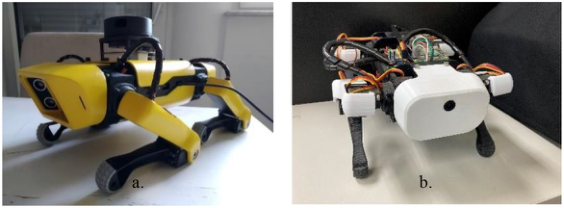
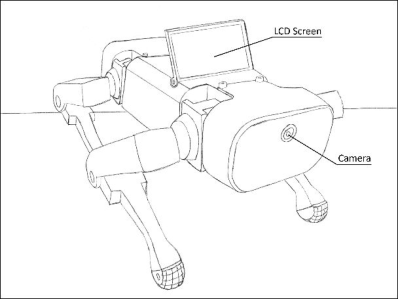
The basic prototype of this research is referenced to the open-source resou- rces of the internet and redesigned after modification, from the mechanism components circuit components to software systems. Pérez collected the SpotMicro open-source creations related to bionic quadruped robots in the online community and organized the files and resources into a project called SpotMicroAI (see Figure 1a) (Pérez, 2019). This study refers to the content of this project and makes some minor changes according to research needs, such as changing the ultrasonic sensor in front of the robot into a camera (see Figure 1b). The complete design diagram is shown in Figure 2, and a screen that can adjust the obliquity will be added to the back of the robot because,
Application of Robots for Enhancing Social Presence in Remote Communication Scenarios 23
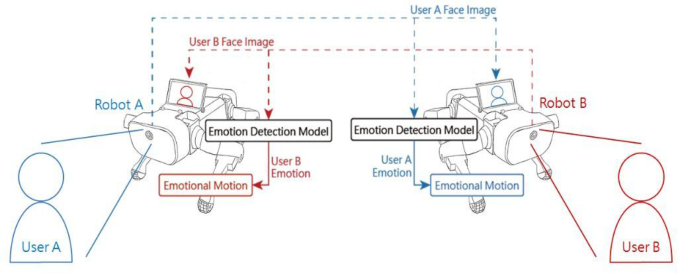
Figure 1: Spotmicroai and the basic prototype design.Figure 2: Complete design of remote communication robot.Figure 3: Interaction system model with social presence.
according to the robot’s movements, it may cause the problem that the screen cannot be seen.
Interaction System Model As seen in Figure 3, user A’s face image can be captured by the camera in front of robot A, then sent to robot B and displayed on the screen. At the same time, the image will be analyzed by the machine learning model to recognize user A’s emotion. According to the emotion, robot B will take relevant actions
24 Hsu and Chen
to enhance user A’s emotion for user B. Same process will also be imple- mented from robot B to robot A so that both users will have lively remote communication interaction through better emotional communication.
CONCLUSIONS AND FUTURE WORK This robot system is designed to increase social presence in remote commu- nication by enhancing emotional interaction. Further research is needed to identify how the robot’s action can represent the user’s emotion. For exam- ple, when the user is happy, the robot might dance, and the other user should consider the dance acts as a happy action. Hence, a user study should be held to figure out the user’s emotional cognition to different robot actions. Furth- ermore, the robot mechanism and appearance will be modified according to the interaction between the prototype and the users.
REFERENCES
Argyle, M., & Dean, J. (1965). Eye-contact, distance and affiliation. Sociometry, 289–304. Bartneck, C., & Forlizzi, J. (2004). A design-centred framework for social human-
robot interaction. Paper presented at the RO-MAN 2004. 13th IEEE international workshop on robot and human interactive communication (IEEE Catalog No. 04TH8759). Biocca, F. (1997). The cyborg’s dilemma: Progressive embodiment in virtual environments. Journal of computer-mediated communication, 3(2), JCMC324. Biocca, F., Harms, C., & Gregg, J. (2001). The networked minds measure of social
presence: Pilot test of the factor structure and concurrent validity. Paper presented at the 4th annual international workshop on presence, Philadelphia, PA. Cui, G., Lockee, B., & Meng, C. (2013). Building modern online social presence: A review of social presence theory and its instructional design implications for future trends. Education and information technologies, 18(4), 661–685. Engelhardt, K., Edwards, R., Rahimi, M., & Karwowski, W. (1992). Human-robot
integration for service robotics. Paper presented at the Human-robot interaction. Fong, T., Nourbakhsh, I., & Dautenhahn, K. (2003). A survey of socially interactive robots. Robotics and autonomous systems, 42(3-4), 143–166. Heeter, C. (1992). Being there: The subjective experience of presence. Presence:
Teleoperators & Virtual Environments, 1(2), 262–271. Mehrabian, A. (2017). Nonverbal communication: Routledge. Onnasch, L., & Roesler, E. (2021). A taxonomy to structure and analyze human– robot interaction. International Journal of Social Robotics, 13(4), 833–849. Pérez, F. F. (2019). Home - SpotMicroAI. Retrieved from https://spotmicroai.readth
edocs.io/en/latest/ Parasuraman, R., Sheridan, T. B., & Wickens, C. D. (2000). A model for types and levels of human interaction with automation. IEEE Transactions on systems, man, and cybernetics-Part A: Systems and Humans, 30(3), 286–297. Reeves, B., & Nass, C. (1996). The media equation: How people treat computers,
television, and new media like real people: Cambridge university press Cambridge, United Kingdom. Short, J., Williams, E., & Christie, B. (1976). The social psychology of telecommunications: Toronto; London; New York: Wiley.
LISTED IN THE AHFE DIGITAL BOOKSTORE CATALOGUE
Explore the complete digital volume
Human Factors in Robots, Drones and Unmanned Systems
Read this individual research paper free through the original publisher, or explore the full digital proceedings book.
ISBN 978-1-958651-33-9
Explore this ISBN in the AHFE Bookstore ↗Listed in the July 2026 bookstore catalogue; search by ISBN to confirm current availability · Digital book purchase optional