Vânia Carneiro De Carvalho (2022). Decoration and Nostalgia - Historical Study on Visual Matrices and Forms of Diffusion of Fêtes Galantes in the 20th Century. In: Human Dynamics and Design for the Development of Contemporary Societies. AHFE Open Access, vol. 25, pp. 1–9. https://doi.org/10.54941/ahfe1001365
In São Paulo/Brazil, between the years 1950 and 1980, porcelain sculptures representing courtesy scenes were fashionable in wealthy and middle-class homes. Several Brazilian factories started to produce such images and many others were imported, the most of them from Germany. These representations were inspired by the fêtes gallants, a rococo style genre from the 18th century. Factories like Meissen, Limoges and Capodimonte produced thousands of copies which circulated in Western Europe and the Russian Empire. During the 19th century, from French institutional policies, the fêtes galantes were revalued along with the recovery of the rococo. This political and cultural movement resulted not only in domestic interiors decorated with authentic pieces from the 18th century gathered together by collectors, but also in the production of new objects. Following decorative practices, studies anachronistically reclassified 18th artisans as artists, constructing their biographies, circumscribing their peculiarities, and identifying their works. Many pieces from the privates collections ended in museums. The porcelain aristocratic figures won the world and are produced until today. It was at the end of the 19th century, in the region of Thuringia, that the technique of lace porcelain emerged. Produced by women in a male-dominated environment, the technique involved the use of cotton fabric soaked with porcelain mass which was then sewed and molded over the porcelain bodies of male and female figures. After that, the piece was placed in the oven at high temperature, burning the fabric and leaving the lace porcelain. It is significant and relevant for the purposes of this research that the lace porcelain technique was never recognized as a object of interest by the academic literature on porcelain. It is likely that the presence of the female labor, the practice of sewing and the use of fabric have been interpreted by the male academic and amateur elite as discredit elements. Added to this, the lace porcelain became very popular in the 20th century. The reinterpretation of rococo in the 20th century was also understood as a lack of artistic inventiveness associated with marketing interests, which resulted in the marginalization of these sculptures. What is proposed here is to study these objects as pieces of domestic decoration practices, recognizing in them capacities to act on the production of social, age and gender distinctions. I intend, therefore, to demonstrate how these small and seemingly insignificant objects were associated with decorative practices of fixing women in the domestic space in Brazil during the 20th century. They acted not alone but in connection with other contemporary phenomena such as post-war fashion, the glamorization of personalities from the American movie and European aristocracy and the rise of Disney movies, which promoted the gallant pair as a romantic idea for children in the western world.
REBIS PORCELAIN – MEANING AND AGENCY In 1956, in the city of Porto Alegre, at the state of Rio Grande do Sul, loca- ted in the southernmost part of Brazil, where many European immigrants from Germany and Eastern Europe settled, the German Anton Steiner star- ted his own production of porcelain bibelots, the Rebis. He brought the models from Renner, another small manufacturer of German origin also established in Porto Alegre, where he had worked as a craftsman. Many of his figures were molded from German pieces known as Dresden figures (Harran, 2002).
Figure 1: Rebis Porcelain Industry and Commerce Brand, Porto Alegre, RS, Brazil. Photograph by José Rosael. Collection of the Museu Paulista-USP.
Rebis never advertised its production, except what was advertised in each porcelain object itself. Each sculpture was stamped with the manufacturer’s brand, the green design of two palm trees, the only tropical touch of the enterprise. Below the brand was the telephone number and the name Rebis, an acronym for the initials of the surnames of the company’s first partners: Res, Bilan and Steiner (figure 1). The manufacturer experienced significant success within the scale of its business, selling to stores in major Brazilian cities such as São Paulo and Rio de Janeiro, as well as to the northeastern region of the country.
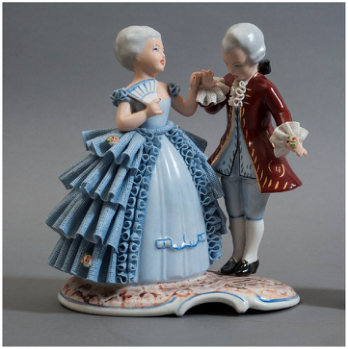
The flagship of the enterprise were figures inspired by the European ari- stocracy of the 18th century, originating from a rococo genre known as fête galante and which used porcelain textile lace as its greatest attraction. In addition to copying figures from other manufacturers, Rebis also created its own models, one of them entitled Debutantes. The observation of the chara- cteristics of this sculpture informs us about the possible meanings that such images sought to convey (figure 2).
The couple has juvenile features. The debutant ball refers to the ritual of introducing a young woman to society, a recurring practice among wealthier families. Although the couple seems to share the scene equitably, it is the man who sets the woman in motion, inviting her to dance. However, it is the female figure that is shown most vigorously to the eyes of others through the skirt armed by the crinoline and enriched by porcelain lace. It is to women that this image is addressed.
E-auction or display sites such as Pinterest and Instagram often name such images as romantic, which helps us understand their meaning in home décor: an indication of adherence to the belief in loving union as the foundation of the family constitution. But not only that. The “antique” and supposedly luxurious clothes are part of the feeling of nostalgia these images trigger. The pleasant practice of dance, performed in a decorous way, is situated in a tem- poral dimension as remote as it is utopian, almost ahistorical, making us believe that the couple’s harmony is a natural and eternal fact. Used as deco- rative objects in the domestic space, the sculpture indicates the ideal place for cultivating the loving relationships that would sustain the family. The debu- tante couple acts as a metaphor for the woman’s entry into adulthood, as a wife and responsible for the house, a place where her performance must be circumscribed.
Decoration and Nostalgia – Historical Study on Visual Matrices and Forms of Diffusion 3
Figure 2: Debutantes. The model was launched in 1956 and produced in four different sizes. Rebis Porcelain Industry and Commerce, Porto Alegre, RS, Brazil. Photograph by José Rosael. Collection of the Museu Paulista-USP.
In addition to its symbolic aspects, the materiality of this sculpture also helps us to understand its functions. Debutantes was produced in different sizes, reaching 9.5 cm in height, small enough not only to have its price redu- ced and fit in the budget of middle class, but to decorate girls’ rooms. The smallness and variety of colors and decorations on the dresses invite colle- cting. Maintaining the physical integrity of fragile porcelain, above all lace, requires special care. The interaction of the body with the object takes place in a motor and unconscious dimension (Warnier, 1999; Miller, 2004; Boivin, 2008), inducing behaviors considered appropriate for women. By demanding different care than those given to plastic or rubber objects, porcelain slows down movements, requests delicacy, attention and organization, so that its ornamental character and miniaturized details can be enjoyed. The accumu- lation of objects of this nature, if they are collected, implements a routine of searching, acquiring, cleaning and organizing that ends up making them a structuring element of decoration and behavior (Carvalho, 2017a).
REPRESENTATION AND DISSEMINATION Fêtes galantes are images representing the European aristocracy in situations of productive leisure, that is, scenes of a lifestyle in which work is completely absent – scenes of hunting, dancing, musical, theatrical, gastronomic encoun- ters, games, readings (Unruh, 2008; Helman, 2004). In the last decades of the 18th century, many of the characters represented in the fêtes galantes acqui- red bourgeois contours, such as the mother surrounded by her children, the father and the couple in love. The latter will cross the 19th and 20th centuries, reaching the 21st.
But how did such sculptures gain the world? Meissen, located in Saxony, was the first European manufacture to replace expensive porcelain imported from China. Founded in 1708, it paved the way for others such as Höchst, Vienne, Nymphenburg, Ludwigsburg, Chelsea, Capodimonti, Sèvres and,
4 Carvalho
close to Meissen, the manufactures of the Dresden region (Wilhelm and Reber, 1980). The founders of the fête galante genre, like good artisans they were, moved between painting, engraving and porcelain. In addition to the engravings, which circulated throughout Europe and fed the archives of the porcelain manufactures, they created the models that would become the matrices of a colossal serial production of sculptures.
The serial production technique allowed, still in the 18th century, that fêtes galantes were consumed by people outside the restricted circle of the aristocracy. As the prices of sculptures were still very high, they reached the luxury homes of the upper bourgeoisie first. But the porcelain creati- ons of the gallant scenes were copied, adapted and periodically re-released on the market and reached homes of the middle class as early as the 19th century.
LEGITIMATION Throughout the 19th century, Europe, especially France, experienced a pro- cess of retaking the arts linked to the Ancien Régime. Rococo came to be worshiped by artists, writers and amateur collectors. The Empress Josephine herself legitimized these initiatives by putting to use the Louis XV furniture. She even wore dresses that belonged to Marie Antoinette at parties inspired by the gallant events of the past. In addition to the political meanings associ- ated with Rococo, the style was held responsible for the excellence of French artisans. The revival resulted not only in domestic environments decorated with authentic 18th century pieces gathered by collectors, but in the pro- duction of new objects that reproduced the 18th century style, which also included new porcelain sculptures (Silverman, 1992).
The interest in Rococo was also responsible for studies that anachronisti- cally reclassified the artisans of the 18th century as artists, who had their biographies constructed and their production peculiarities analyzed, which resulted in its understanding as work of art. Private collecting fed the com- merce of these works in antique shops and auctions and ensured the survival of Rococo techniques and plastic language in workshops linked to public institutions.
The cycle was completed with the institutionalization of private collecti- ons, which became part of the museums permanent collections, along with entire residences transformed into house-museums, as was the case with the Nissim de Camondo Museum in Paris, and the Wallace collection in London. Objects from the 18th century, including porcelain sculptures, treasured and on display in public institutions, offered a kind of symbolic ballast for objects that circulated in the market, guaranteeing prestige even to a new strand of courtesy images that would become extremely popular in the 20th century – sculptures with porcelain textile lace.
The Lace Porcelain Harran mentions the pioneering use of porcelain textile lace in 1770 by Meis- sen manufacturer in discreet details of collars and sleeves of the clothes of
Decoration and Nostalgia – Historical Study on Visual Matrices and Forms of Diffusion 5
Figures 3, 4: Marie Antoinette, Meissen, 1873 and 1877, model by Sigmund Karl August Ringler.
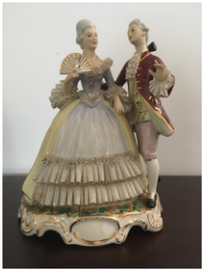
Figure 5: Rebis, 1970, model by Anton Steiner.
the sculptural figures (Harran, 2002). However, there is no published scul- pture of any manufacturer that shows the use of this technique at such an early date. As far as I could verify the oldest lace porcelain sculpture presen- ted in a publication is from 1873 (figure 3). It is a representation of Queen Marie Antoinette (1755-1793), identified as K118 in the Meissen historical collection (Mitchell, 2004).
Similar sculpture appears in another publication with the same code K118 but dated from 1877. The name of Sigmund Karl August Ringler (1837- c.1918) appears as the creator of the model (figure 4). The sculpture of Marie Antoinette would have been commissioned by King Ludwig II of Bavaria (1845-1886) to decorate one of his castles (Zöller-Stock, 2010). Although in the two publications the figures of Marie Antoinette are not identical, they are from the same mold. Under an ermine mantle with the Bourbon royal family lily, the dress is all lace detailing and flower appliqués. Porcelain lace contours the neckline, draws the sleeves, and forms a triangle on the chest, over the corselet. The wide skirt has garlands of lace and two pleated lace strips at the bottom. The 1970 Rebis model by Anton Steiner, although infinitely simpler, resembles the Meissen model (figure 5). Porcelain textile lace is not modeled on porcelain. The textile lace is soaked in liquid porcelain, then shaped and
6 Carvalho
sewn onto the figures’ bodies. Once this is done, the sculpture is placed in the oven at high temperature, burning the fabric and leaving the lace porcelain, which is very delicate and difficult to maintain. By 1776, Meissen had women working on blue painting, polishing and gilding, but not lace work (Kovale- vski, 2010). Thirteen years before the first date I found referring to the Marie Antoinette mold, in 1860, five women worked at the Meissen manufacturer using lace (Zöller-Stock, 2010). The technique of manufacturing porcelain textile lace was never recognized in the erudite literature, where I found a very few mentions of it. It is likely that the involvement of female labor, the practice of sewing and the use of fabric have been interpreted by amateur scholars and the academy dedicated to the study of porcelain as factors of discrediting these objects.
The reinterpretation of rococo with textile resources leaves in the back- ground the plastic challenges that porcelain as material presents. The porce- lain body that was entirely covered by Dresden lace – so called when the technique left Meissen to spread in the manufactures of the neighboring region – had become a hard block, without any refinement in its modeling, that is, the porcelain had become only a support for the fabric. Added to these changes in production are others arising from the sphere of consum- ption. It is in the 19th century that the taste for dense decoration becomes very popular in the homes of the middle class, and so a female responsibility (Saisselin, 1985; Grier, 1988).
REBIS IN THE ICONOSPHERE In order to understand the strength of sculptures produced by manufactures like Rebis, it is necessary to place them in the macrostructure of the current visual culture, that is, in the iconosphere, understood as the repertoires of images of a time in its visual environments, its circuits and communication systems (Meneses, 2003). In the iconosphere, images create connections and reach their users as large packages of converging meanings. There are several connections that strengthen the apparently insignificant Rebis bibelots and their likes of it. These connections can only be pointed out here.
The first concerns the so-called classical ballet. The 18th century aristo- cratic dance and mise en scène were one of the matrices of this dance system. Initially aimed at male characters, female figures became, in the 19th cen- tury, protagonists of the choreographies. Photographs of famous ballerinas circulated around the world as a symbol of female beauty. Lightness, flutte- ring lace skirt, the use of the pointe inaugurated by Geneviève Gosselin and disseminated by Marie Taglioni (Bourcier, 2001), heels, pirouettes and the arabesque become symbols of femininity. Classical ballet provided girls with a type of training desired in Brazil by parents, who invested in ballet classes taught in many schools throughout the 20th century. It is not by chance that the best-selling Rebis bibelots were the ballerinas.
The second connection comes from fashion. In the context of fashion launched in the 1950s, Dior’s new look was inspired by the luxurious and structured dresses of the 18th century. They dressed the movie actresses and nourished the post-war conservative thinking, which advocated the return of
Decoration and Nostalgia – Historical Study on Visual Matrices and Forms of Diffusion 7 women to the home, suburban life and the belief in romantic love as a reason for female dedication exclusively to husband and children, away from work out of home. Associated with the promotion of this domestic way of life is the glamorization of the aristocracy and their relations with cinema and tele- vision media, the most notable example being that of Grace Kelly, an actress who married in 1956 the Prince of Monaco, Rainier III.
The third connection I would like to point out is Disney cartoons. The global consumption of cartoons created by Walt Disney and his stories of princesses transformed the static and tiny fêtes galantes into dynamic repre- sentations projected on the big movie screens, produced with the latest technology available or created at the time (Bohas, 2016; Carvalho, 2017b). The prince and the future princess danced in the cartoons with clothes inspi- red by the 18th century aristocracy, promoting the gallant pair as a romantic ideal for children in the western world. Cinderella is the most emblematic and interesting film because it has been staged as ballet since 1749 and because of the numerous remakes released in cinema and television to this day.
Finally, one cannot forget about the circulation of porcelain sculptures in virtual collections such as Instagram and Pinterest, in addition to digital auctions and shopping sites where these objects can be easily found.
CONCLUSION
I tried to demonstrate how the sculptures of courtesy scenes managed to adapt to different contexts they inhabited, at the same time as they managed to con- quer new, more popular social strata, thanks to local production and changes in the way they were made (fabric lace), in the type of labor they use (female and unskilled) and in the formats they adopted (reduced). This malleability allowed meanings of luxury and prestige to be maintained over three centu- ries, although modulated and adapted to the cultural and social changes to which they were associated.
I also tried to demonstrate how the representations of the leisure life of the aristocracy are transmuted into representations of the enamored couple, basis of romantic love, the nuclear family and the fixation of the woman as complement of the husband. As so she can be responsible for the mission of taking care of the house, as well as building the atmosphere for the subjecti- vities development. These images have been updated, but have not lost their strength, on the contrary, in the 20th century iconosphere they seem to have acquired versatility and social verticality.
One of the most relevant results of the research was the formation of a collection of these objects in the Museu Paulista, a history museum. Sérgio Skopinski’s business was successful for 58 years, he closed its doors in 2013, according to him, because of Chinese competition with its resin bibelots. In 2015, the Museu Paulista of the University of São Paulo acquired 221 deco- rative objects with representations of courtesy scenes, 87 pieces by Rebis and 10 forms of the Debutantes figure. These objects marginalized by museums that worship works of art, now have a place in a history museum, where they became documents that allow us to understand the constitution of values and
8 Carvalho
taste in middle social segments of Brazilian society, previously invisible as were its objects.
Finally, the research opens paths for the valorization of decoration studies in the field of history and brings elements so that we can understand why, despite all cultural, social and political changes, we still experience a strong tendency to maintain woman circumscribed or responsible for the home envi- ronment. Research shows the strength of small objects, which are there to induce our behaviors, without us realizing it.
ACKNOWLEDGMENT
I would like to thank Monica Romãozinho. This research was made possible due to the Grant 2017/07366-1, São Paulo Research Foundation (FAPESP) and the financial aid of the Research Fund of the Museu Paulista-USP.
REFERENCES
Bohas, Alexandre. (2016), The Political Economy of Disney. The Cultural Capitalism of Hollywood. London: Macmillan Publishers, pp. 15–32. Boivin, Nicole. (2008), “The Agency of Matter”. In: Material Cultures, Material
Minds. The impact of things on human thought, society, and evolution, Nicole Boivin. Cambridge University Press, pp. 129–180. Bourcier, Paul. (2004), História da dança no ocidente. São Paulo: Martins Fontes,
2001. Carvalho, Vânia Carneiro de. (2017a), “As esculturas inspiradas na vida galante: um exercício de análise.” In: Domesticidade, Gênero e Cultura Material. Brito, F.; Mello, J.; Lira, J.; Rubino, S. (Eds.). São Paulo: CPC-USP: EDUSP, pp. 253–273. Carvalho, Vânia Carneiro de. (2017b), “Quando sonhar está na moda – a nostalgia
do feminino na cultura de consumo”, História. Questões & Debates. Curitiba, v. 65, n.2, pp. 149–195, jul./dez. Grier, Katherine. (1988), Culture & Comfort: Parlor Making and Middle-Class Identity, 1850–1930. London,Washington: Smithsonian Institution Press. Harran, Jim & Susan. (2002), Dresden Porcelain Studios. Identification and Value
Guide. Paducah, Kentucky: Collector Books. Helman, Mimi. (2006), “Interior Motives: Seduction by Decoration in Eighteenth- Century France”. In: Dangerous Liaisons: fashions and Furniture in the Eighte- enth Century. Koda, H.; Bolton, A. (Eds.), MetPublications, pp. 15–23. Kopytoff, Igor. (2010), “A biografia cultural das coisas: a mercantilização como pro-
cesso”. In: A vida social das coisas: as mercadorias sob uma perspectiva cultural. Appadurai, Arjun (Ed.). Niterói: Editora da Universidade Federal Fluminense. pp. 89–123. Kovalevski, Bärbel. (2010), “Frauen in Meissen. Die vergessenen Malerinnen der Porzellanmanufaktur”. In: Kunst oder Kommertz? Meissener Porzellan im 19. Jahrhundert, Staatleche Schlösser, Burgen und Gärten Sachsen (Eds.). Sandstein Verlag, pp. 55–60. Meneses, Ulpiano Bezerra de. (2003), “Fontes visuais, cultura visual, história visual.
Balanço provisório, propostas cautelares”. Revista Brasileira de História. São Paulo, v. 23, n. 45, pp. 11–36. Miller, Daniel. (2004), “Extracts from Material Culture and Mass Consumption”.
In: Material Culture: Critical Concepts in the Social Sciences. Buchli, Victor (Ed.). London, Nova York: Routledge, v. II, pp. 292–336.
Decoration and Nostalgia – Historical Study on Visual Matrices and Forms of Diffusion 9
Mitchell, Laurence. (2004), Meissen. Collector’s Catalog. Woodbridge, Sulffolk, Antique Collectors’ Club Ltd. Saisselin, Rémy G. (1984), Bricabracomania. The Bourgeois and the Bibelot. London,
Thames and Hudson. Silverman, Debora L. (1992), Art Nouveau in Fin-de-Siècle France. Politics, Psychology, and Style. Berkeley, Los Angeles, Oxford, University of California Press. Warnier, Jean-Pierre. (1999), Construire la culture matérielle. L’homme qui pensait
avec ses doigts. Paris: Presses universitaires de France. Wilhelm, Peter & Reber, Horst. (1980), La porcelaine européenne du XVIIIe Siècle.
Fribourg/Suisse: Office du Livre. Unruh, Allison. (2008), Aspiring to la Vie Galante: Reincarnations of Rococo in Second Empire France. Doctoral Thesis of the Institute of Fine Arts, New York University. Zöller-Stock, Bettina. (2010) “All Nations are welcome. Meissener Porzellan auf
den Weltausstellungen”. In: Kunst oder Kommertz? Meissener Porzellan im 19. Jahrhundert. Staatleche Schlösser, Burgen und Gärten Sachsen (Eds.). Sandstein Verlag, pp. 85–114.
LISTED IN THE AHFE DIGITAL BOOKSTORE CATALOGUE
Explore the complete digital volume
Human Dynamics and Design for the Development of Contemporary Societies
Read this individual research paper free through the original publisher, or explore the full digital proceedings book.
ISBN 978-1-958651-01-8
Explore this ISBN in the AHFE Bookstore ↗Listed in the July 2026 bookstore catalogue; search by ISBN to confirm current availability · Digital book purchase optional