Mónica Romãozinho (2022). Somewhere Between Architecture and Jewelry. In: Human Dynamics and Design for the Development of Contemporary Societies. AHFE Open Access, vol. 25, pp. 10–18. https://doi.org/10.54941/ahfe1001366
Labcom-UBI, Universidade da Beira Interior, Rua Marquês de Ávila e Bolama 6201-001 Covilhã, Portugal; CIAUD, Research Centre for Architecture, Urbanism and Design, Lisbon School of Architecture, Universidade de Lisboa, Rua Sá Nogueira, Polo Universitário do Alto da Ajuda, 1349-063 Lisboa, Portugal ↗
Our projects talk about knowledge and experience accumulated through time, so they work like powerful memory boxes. All that information reappears when we start sketching our first exploratory drawings. Architecture always influenced the way we see and understand the world and things in general, the “real” architecture which surrounds us every day, but maybe in a particular way the imaginary one that we can discover through set design projects, ephemeral exhibition design, even visionary drawings related to unbuilt ideas. We aim to demonstrate that jewels and architecture can share fundamental principles. When we look at a jewellery piece, we can observe its volumetric, how does light and shadow model the piece, the scale, the contrast between full and empty spaces, the composition, the sense of horizontality or verticality, its symmetry or asymmetry, its ergonomics, among other aspects but how can we relate to this intriguing object, what kind of emotions can it arouse in us? Perhaps we can play with similar feelings in other scales. In this perspective, our article focuses on the relation between architecture and jewellery applied research considering the philosophy “learning-by-doing” pursued by Charles and Ray Eames, inspiring and timeless references from the past. We follow a design methodology that implies continuous research about other authors and movements, the continuous selection of waste objects and materials, the development of sketches along with all the processes, and experimental prototyping. On the other hand, we incorporate specific goals related to product sustainability since the beginning of the present projects, namely upcycling. The main goals transversal to these experimental series consists of exploring space as a concept, interaction, and, at last, wearability. The jewel itself can have a strong presence in a certain way very close to the artwork but it is created and materialized for real people so we prefer to think about it as design because it is supposed to be owned and appropriated by someone and to contribute simultaneously to communicate their personality, to break with typified and mass fashion design, to conquer an immaterial dimension, to provoke emotion the moment we “dress” it.
JEWELLERY: MEANINGS AND FUNCTIONS Architecture always influenced the way we see and understand the world and things in general, the “real” architecture which surrounds us every day, but
maybe in a particular way the imaginary one that we can discover through set design projects, ephemeral exhibition design, even visionary drawings rela- ted to unbuilt ideas. So, when we look at a jewellery piece, we can observe its volumetric, how does light and shadow model the piece, the scale, the contrast between full and empty spaces, the composition, the sense of hori- zontality or verticality, its symmetry or asymmetry, its ergonomics, among other principles. And how can we relate to this intriguing object, what kind of emotions can it arouse in us? Perhaps we can play with similar strategies and feelings in other scales. In this perspective, our article focuses on the relation between architecture and jewellery applied research considering the philoso- phy “learning-by-doing” pursued by Charles and Ray Eames, inspiring and timeless references from the past.
The jewel itself can have a strong presence in a certain way very close to architecture although, on a mimetic scale, it is created and materialized for real people, and it can be a result of a design methodology. It is supposed to be owned and appropriated by someone and to contribute simultaneously to communicate their personality, to break with typified and mass fashion design, to conquer an immaterial dimension, to provoke emotion the moment we “dress” it. In ancient times, the jewel fulfilled a function: protection, an exaltation of power, and clarification of a specific social status. Ancient Egypt is a rich civilizational testimony of the multiple meanings a jewel could carry on. The necklaces of the Middle Empire, authentic collars, were used in festivals or religious rituals, namely funerals, and were composed of natural materials such as plants or engraved and golden wood or then produced in faience, metal, or semi-precious stones (Cosgrave, 2012, p. 24). These functi- ons of a symbolic and ancestral character intersect with a utilitarian proposal, observable in the archaic period of Greek civilization, in which himation or chiton was trapped by brooches, for instance.
Unlike a painting or a sculpture, a jewel was always placed on our body, accompanying us, and establishing with it a sensory, semantic, utili- tarian relationship depending on this interaction, then fulfilling a function or functions. The jewel plays the important function of communicating our personality, our memories, and may even assume the role of a manifesto. The ancestral meaning of jewellery was awakened in a certain way with this pandemic and the 1st Lisbon Contemporary Jewellery Biennial, held betw- een 16 September and 20 November 2021, demonstrated the meaning of protection and personal identity that a jewel can contain itself, in particu- lar the exhibition “The biennial Cold Sweat”, curated by Cristina Filipe and João Norton de Matos with Exhibition design from Fernando Brizio. Each piece was created considering the protection and healing predicates associ- ated with the permanent collection of the Health and Pharmacy Museum at Lisbon. According to the texts presented at this exhibition, Shield (2020) from Inês Nunes, for instance, derives from the interpretation of the Medical Diagnosis Figure displayed there, which Japanese and Chinese ladies used during the 19th century during a medical consultation so they could hide their face or even Gordillo’s necklace that through the assemblage of com- ponents establishes a relationship with the tablet dispenser machine of the museum.
12 Romãozinho
Some of the actual jewellery approaches keep their value as unique cre- ations, other products reveal a closer connection with Industrial Design, resulting from concepts that integrate values such as modularity, rationality, industrial waste materials, and even technology. The jewel indeed accompa- nies fashion by assuming more and more a clear role of fashion accessory, because as Silvano refers, in a market situation where competition is extre- mely tough and the economy of scale makes growth imperative, brands have begun to increase the number of collections produced per year and invest in the production of accessories (2021, p. 156). But on the other hand, and parallel to these trends, the jewel assumes a personality proper to an author’s product closer to the fine arts and also to the product design, less volatile to fashion phenomena such as trickle-down or bubble. A new paradigm shift is urgently, to think more than ever of products less volatile, accessi- ble to all, which are not definitely limited here to the utilitarian aspect that runs out of consumption, but especially now in this pandemic context, to think of objects that can be containers of meanings and emotions, also more sustainable not only derived from strategies that we can integrate into the creative process since the beginning but because we won’t desire to throw them away.
DIALOGUE(S) BETWEEN ARCHITECTURE AND JEWEL SCALE: LINES AND SURFACES The next project is not born merely of a critical attitude, it is born above all from a certain disenchantment with the world. Society moves fast even during the pandemic context, expels information at an equally unmeasured rate, produces garbage that spreads across continents and oceans. What is our role as designers in such an unstable context marked by social asymmetries and blatant environmental scourges? In unstable moments, we need to bala- nce continuities and our projects derived from the evolution of other solutions documented by the History of Design mostly from a socio-anthropological perspective, in a search for lost time: “Any final product of an industry, is a technical individual with a long ancestry of archetypes (of previous models) increased of the manufact that are reproduced throughout its creative pro- cess” (Costa, 1988, p. 44). Memory plays a decisive role in the creative process, in an implicit way not explicit, as Daciano da Costa would observe: “On the other hand, it is good to discipline it with a project methodology that is the ordering of the creative process, integrating all objective and subjective factors, for the optimization of the final form of the individual. To aesthetic values – balance, harmony, and proportion of form – it is now necessary to add the innovation value that no longer results from aesthetics but seems to be a preponderant factor of sociological order. These are the subjective values that the designer must know how to sustain during the creative process so that this keeps a dimension of communication that distinguishes it, differen- tiates it, from a growing population of objects that populate our daily life. Design and Memory are the two human components, possibly with different weights, in the process of putting an idea in motion, to get to the identifiable product” (Ibidem).
Somewhere between Architecture and Jewellery 13
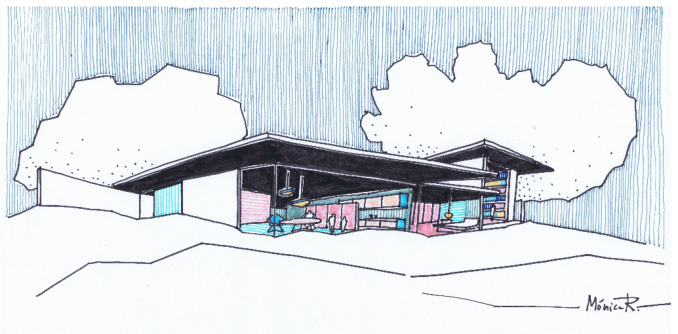
Figure 1: Example of experimental drawings. Mónica Romãozinho.
Our projects talk about knowledge and experiences accumulated through time, they work like powerful memory boxes. All that information reappears when we start sketching our first exploratory drawings. Our architectural imaginary drawings (Fig. 1) are a strong reference for all these experiments, namely the project “Lines and surfaces”, among others. Inside the same ima- gined habitats, the line draws paths above modular walls and floor surfaces, defines carpets that emphasize distinct interior areas and functions or han- ging wall modules, sometimes also present in furniture solutions. Through visionary drawings we develop the exercise of redefining mostly the relation between architecture and nature, between body and space, searching for solu- tions that could exalt lightness and give back poetry to our daily life. We are no longer driven by the desire to idealize cosmic cities that may result from the occupation of other planets or to explore the fourth dimension, we must think about the challenge of a world immersed in the pandemic. Our dra- wings from a detached and speculative perspective reflect a concern for the territory and the possible new model of occupation of the same that restores the relationship between man and nature.
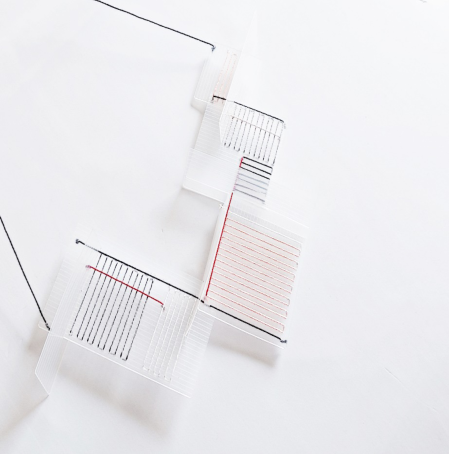
In the jewel object, the line, a textile element, is our pencil, it defines rectangles, squares, sometimes lines of distinct shades intersect, forming networks and crossing surfaces previously drilled made by polypropylene wastes (Fig. 2). The coloured alignments play a visual role but also a stru- ctural one, assembling horizontal and vertical plans. The line defines a route that sometimes submits to orthogonality, other times frees itself by taking dia- gonal directions. The line leads our look, when arranged horizontally invites us to a route through our eyes, when vertical circumscribes our visual field, limiting us to a frame through which we contemplate a fragment of landscape. The path formed by the sequence of lines is always developed in a transversal direction to the polypropylene texture. The horizontal planes are traversed by tears where the verticals fit and its support is reinforced by perpendicular lines that function as tie rods. The earrings (Fig. 3) are formed by detach- able components, so we can combine the PLA small square with another
containing the transparent plans, dramatizing the sense of asymmetry. Both the ring (Fig. 4) and the collar implied previous cardboard models and the first is born from a prior planning process in which a tear was provided where the initial cut-out plane will fit after folding.
The linearity of the works of authors from the visual arts and design influ- enced in a particular way these projects. Anni Albers’ early work in weaving is a constant reference, namely the 1925 Smyrna Rug. She was a student at Bauhaus and its products marked a rationalist language, defined by synthesi- zed contours and geometric shapes and no longer expressionist that provided a serial production, then more economical and democratic. This sense of economy would also be present in her own jewellery projects, such as the necklaces dating from 1940, composed of circles in plastic or aluminium, poor materials, joined by velvet or grotto ribbon. It reflects the influence exerted by De Stijl’s movement. It is worth remembering that Van Doesburg was at the Bauhaus in January 1921 for a short time having returned in the same year to direct the course “Stijl Cursus”in an atelier not far from the sch- ool that had been arranged by Adolf Meyer, a close collaborator of Gropius and director of the school (Rodrigues, 1989, p. 77). Russian constructivism would also influence these solutions and their respective languages. El Lis- sitzky had explored through his works such as Prouns that were exhibited the Great Art Exhibition in Berlin (1923), we are moved by the intention of creating a simple vocabulary, searching for an economy in forms and constru- ction: “With their multiple references to real and abstract space, the Prouns became a system through which Lissitzky not only ruminated upon formal properties of transparency, opacity, color, shape, and line but began to dwell upon the deployment of these forms into socialized space, placing him into
Somewhere between Architecture and Jewellery 15
Figures 3 and 4: “Lines and surfaces” series. Earrings (needlework thread, polypropy- lene wastes, PLA-3D print). 2021 | Ring (needlework thread, polypropylene wastes). 2021. Design | Photos: Mónica Romãozinho.
the path of the emergence of Constructivism, which using a similarly redu- ctive visual vocabulary, sought to merge art and life through mass production and industry.” (Tupitsyn, 1999, p. 9).
Other references were not explicit for us at a first moment such as the deli- cate work of Agnes Martin (1912–2004), with its grids and stripes, lines that, second that resulted from the intersection from the essence of two artistic movements, Expressionism and Minimalism, achieving the notion of bala- nce and lightness: “When she hit, at last, on the format of the grid—a motif that was tacit in modern painting after Cubism but never before stripped, and kept, so bare—she found ways to make those qualities the exclusive basis of a wholly original, full-bodied art.” (Schjeldahl, 2016). On the other hand, Agnes Martin’s work intersects with the interpretation of places and landscape: ≪“She insisted that the results did not exclude nature but ana- logized it. She said, “It’s really about the feeling of beauty and freedom that you experience in landscape”≫(Ibidem). But identification with her artw- orks is attached mostly to its spatiality. We like to think the same way about our compositions as a landscape, evoking subtly the textiles that emerged inside our imaginary architectures, defining rugs that covered floor and walls surfaces. The notion of spatiality, extrapolation around abstract volumetry, experimentation around a geometric vocabulary, was visible in the pioneering contribution of jeweler artists associated with the School of Padua, namely Giampaolo Babetto or Graziano Visintin, disciples of Mario Pinton.
BETWEEN OUTSIDE AND INSIDE: UN JARDIN GÉOMÉTRIQUE We follow a design methodology that implies continuous research about other authors and movements, the selection of waste objects and materi- als, sketches along with all the processes, and experimental prototyping.
16 Romãozinho
On the other hand, we incorporate specific goals related to product sustai- nability since the beginning of the present projects, namely upcycling and easy separation of different materials as well, particularly present in the next project.
We work inside the Design field which explains our detachment from gems and precious materials. The materials of the jewellery sphere are questioned, poor and residual materials are intersected such as polypropylene wastes, present in the previous project. As José Aurélio’s jewels proclaim: “Pairing gold with an organic element found on the shoreline, adding silver to a fra- gment of bone, using plastic for major commemorative symbols all attest to the artist’s belief that materials lack any intrinsic value and his refusal of the hierarchies handed down by tradition, academia or history” (Oitavas da Oficina. José Aurélio: Joalharia, 2021, p. 39). We are interested in the obje- cts trouvés that integrate an assemblage and communicate something, mostly the idea of spatiality, objects ignored and to which we are indifferent despite having fulfilled an important function. The same question would be posed in an interview with Marcel Duchamp about his ready-mades and the answer was this: “That depended on the object; in general, it was necessary to be careful with the look. It is very difficult to choose an object because after fifteen days one begins to like it or to hate it. One must come to anything of such indifference, that one has no aesthetic emotion” (Cabanne, 2002, p. 70). Duchamp, an author of works such as Fontaine or Grand Verre and chess player up to 45 years, focused less on the aesthetic value of objects or images, and more on the idea of movement: “A game of chess is a visual and plastic thing, and if it is not geometric in the static meaning of the word, it is a mechanics since it moves; it’s a drawing, it’s a mechanical reality. The pieces are not beautiful by themselves nor the shape of the game, but what is beautiful - if the word “beautiful” can be used, is the movement” (Ibidem, p. 25).
Discarded phones that that stop working, computers in permanent out- dated, soon quickly unused, USB cables that play an important role in the process of transferring and transporting information representative of the spending of hours and hours of our life delivered to these digital media, ther- mal sinks, an old interrupt that allows you to illuminate or dive into darkness, electronic components, network connectors. In this immersion into the uni- verse of accumulated and polluting goods, we discover objects different from each other that reveal more simple or more complex compositions in the arrangement of its components, belonging to different “species”or typologies that form the metaphor of the world and its biodiversity.
In the project “Un jardin géométrique”, we discover a geometric garden that unfolds into volumes interconnected by alignments forming a cohesive and harmonious whole. Small “trianons”, houses of fresco, symbolic obje- cts that time has not erased, emerge through the green, silver-colored water mirrors, garden benches, flower beds, labyrinths, and other routes through which we wander in search of ourselves. These “electronic” gardens reflect an intimate scale close to a more Mediterranean tradition that considers the topography of the place, made for walking and contemplation, evoking the memory of Portuguese gardens that emerged mostly since the Baroch period
Somewhere between Architecture and Jewellery 17
Figures 5 and 6: “Un jardin géométrique” series. Lac d’argent et trianon de verre sur fond vert. Earrings (electronic board, network connector, silver). 2020. | Jardin vert sous la neige. Reversible earrings (electronic board, silver). 2020. Design | Photos: Mónica Romãozinho.
under the influence of French models such as Vaux-Le-Vicomte and Versail- les. Sometimes the garden is covered in white, but the snow cannot hide the small species and the linear trees equally determined. The garden assumes this way two antagonistic faces. The classic orthogonality is occasionally sha- ken by diagonal and autonomous elements, the silver earrings components (Fig. 4 and 5). The main goals transversal to these experimental series consist of exploring space as a concept, interaction through the sensory function of textures, and also changeability which is a possibility explored in the rever- sible earrings. The landscape was already there, we didn’t have to construct anything, not even to create holes to fit the new silver components, we just imagined and completed these geometric gardens and delicate architectures (Fig. 6).
CONCLUSION
What unites these human hand objects with architecture? Volume modeling? The relation between shadow and light? The relation between structure and nonstructural elements? The tension between full and empty? The presen- ted projects are just exercises around possible dialogues between space and jewel scales that we do not want to be limited to formal aspects. Just as in architecture, the game of forms leads us to sensory experiences and emo- tions, we also want to “carry” these objects of this pretension. More than jewels, these pieces are objects that in their abstraction can awake multiple meanings, thoughts, even interrogations. These are objects to wear, designed to be appropriated. The designation of the object instead of the jewel was immortalized by the Dutch Gijs Bakker and Emmy Van Leersum in their exhibition “Objects to wear” that opened at the Electrum Gallery in the 70s (Filipe, 2019, p. 859). They are not produced to be kept inside a safe, evoking
an attitude proclaimed even by Portuguese artists such as José Aurélio pre- viously referred: ≪“These pieces have not been scrupulously kept pristine, nor shut away in safes, but rather remained accessible and to hand. And those who wear them openly comment on them, call them uncomfortable or comfortable, describe the texture as soft or otherwise. These sensations can be summarised in a single sentence: “It feels good to put on”≫(Oitavas da Oficina. José Aurélio: Joalharia, 2021, p. 40).
REFERENCES
Cabanne, P. (2002). Marcel Duchamp. Engenheiro do Tempo Perdido. Rodrigues, A.
(Trad.). Lisboa: Assírio & Alvim. Cosgrave, B. (2012). História da indumentária e da moda: da antiguidade aos dias atuais. Resende, A., trad. Barcelona: Gustavo Gili Costa, D. (1988). Design e mal-estar. Lisboa: Centro Português do Design. Filipe, C. (2019). Joalharia contemporânea em Portugal: Das vanguardas de 1960
ao início do século XXI. Lisboa: MUDE. Oitavas da Oficina. José Aurélio: Joalharia [Exhibition catalogue]. (2021). Part of MUDE FORA DE PORTAS program and 1st Lisbon Contemporary Jewellery Biennial. Lisboa: MUDE-Museu do Design e da Moda, Coleção Francisco Capelo. Rodrigues, A. (1989). A Bauhaus e o Ensino Artístico. Lisboa: Editorial Presença. Schjeldahl, P. (17 October 2016). Agnes Martin, a matter-of-fact mystic. The climb
through Guggenheim’s retrospective of the late abstract painter’s work feels like a secular pilgrimage. The New Yorker Website: https://www.newyorker.com/maga zine/2016/10/17 Silvano, F. (2021). Antropologia da Moda. Lisboa: Documenta. Tupitsyn, M. (1999). El Lissitzky: Beyond the abstract cabinet [Exhibition catalogue]. Museu d’Art Contemporani de Barcelon / Museu de Arte Contemporânea de Serralves, Porto. New Haven: Yale University.
LISTED IN THE AHFE DIGITAL BOOKSTORE CATALOGUE
Explore the complete digital volume
Human Dynamics and Design for the Development of Contemporary Societies
Read this individual research paper free through the original publisher, or explore the full digital proceedings book.
ISBN 978-1-958651-01-8
Explore this ISBN in the AHFE Bookstore ↗Listed in the July 2026 bookstore catalogue; search by ISBN to confirm current availability · Digital book purchase optional