Shiyue Hu, Han Shu, Yifan Lin, Zhenhong Huang, Xiaozheng Zhang, Jianliu Zhuang, Miaohui Wang (2026). When Light Embraces Porcelain: How Correlated Color Temperature and Emotion Influence the Visual Perception of Porcelain. In: Human Factors in Communication of Design. AHFE Open Access, vol. 216, pp. 278–287. https://doi.org/10.54941/ahfe1007644
This study investigates the interaction of different correlated color temperatures (CCT, 3000 K – 5500 K) and emotions (positive, neutral, negative) on the visual perception of porcelain materials. A 3×6 mixed experimental design was adopted, recruiting 36 participants to conduct subjective evaluations of porcelains from both aesthetic dimensions (sense of order, beauty, exquisiteness, neatness) and physical dimensions (transparency, hardness, fragility, naturalness). The results showed that CCT had a significant main effect on the visual perception of porcelains, with the optimal aesthetic scores observed at mid-to-high color temperatures of 4500 K – 5000 K. Emotion had a slight moderating effect on beauty and exquisiteness. The interaction effect between CCT and emotion significantly influenced the aesthetic dimensions of sense of order and neatness, as well as the physical dimensions of hardness and fragility. The research indicates that CCT is the dominant factor in the aesthetic perception of porcelains, with emotion playing an auxiliary moderating role. It is suggested that museums prioritize mid-to-high color temperature lighting and foster a neutral or positive emotional atmosphere to optimize the visitor experience.
With the increasing refinement of lighting design in museums, art galleries, and other cultural exhibition venues, the impact of artificial lighting environments on the visual presentation of exhibits and the aesthetic experience of audiences has garnered growing attention. Correlated color temperature (CCT), as a core lighting parameter, not only directly determines the color rendering and detail presentation of artworks such as porcelains (Feltrin et al., 2020), but can also indirectly influence the perception of material characteristics and aesthetic judgment through its interaction with the audience’s emotion.
Existing research confirms that lighting can influence an individual’s emotional and cognitive state through the visual channel (Lin & Liu, 2017), and that emotions further regulate an individual’s visual perception patterns and outcomes (Zadra & Clore, 2011), forming a chain of effects: “lighting → emotion → perception.” Simultaneously, human judgment of material properties
When Light Embraces Porcelain: How Correlated Color Temperature 279 relies on the integration of visual cues and contextual factors such as lighting conditions (Motoyoshi et al., 2007; Yamazoe et al., 2019). Most existing studies have focused on the influence of single factors on visual perception. However, the coupling effect between artificial lighting and emotion, as well as its application in the perception of porcelain materials, remains to be further explored, which constitutes the starting point of this study.
This study aims to investigate the influence of the interaction effect between artificial lighting with different CCT and individual emotion on the visual perception of porcelain materials. The core research questions include: (1) Do different CCT in the 3000 K – 5500 K range significantly affect the perception of porcelains across dimensions such as warmth, brightness, and beauty? (2) Do different emotion (positive, neutral, negative) moderate the effect of CCT on porcelain perception? Based on this, the study proposes two core hypotheses: CCT has a significant main effect on the visual perception of porcelain; emotion have a significant moderating effect on the relationship between CCT and porcelain perception.
By empirically examining the differential effects of CCT on porcelains, the moderating role of emotion, and the interaction mechanism between the two, this study can expand the interdisciplinary research field of environmental psychology and material perception. On a practical level, it can provide a reference for the human factors design of lighting for porcelain exhibits in museums, promoting a shift in lighting design from a “technology-oriented” to an “experience-oriented” approach.
EXPERIMENT Experimental Design
This study employed a 3 (emotion: positive, neutral, negative) × 6 (CCT: 3000 K, 3500 K, 4000 K, 4500 K, 5000 K, 5500 K) mixed experimental design, with emotion as a between-subjects variable and CCT as a within-subjects variable. The dependent variables were the ratings of eight visual perception dimensions of the porcelain material, specifically encompassing two core dimensions: aesthetic dimensions (sense of order, beauty, exquisiteness, neatness) and physical property dimensions (transparency, hardness, fragility, naturalness).
Participants Thirty-six participants were recruited (18 males, 18 females; mean age 20.24 ± 1.13 years). They were randomly assigned to three groups: positive, neutral, and negative, with 12 participants in each group (6 males, 6 females). Each group received only the corresponding type of emotional induction to avoid cross-emotional interference. All participants had normal or corrected-to- normal vision, no color blindness or color deficiency, and no history of psychiatric illness. All participants voluntarily signed an informed consent form prior to the experiment, and the study complied with the ethical principles for human subject research.
Experimental Materials Open Affective Standardized Image Set (OASIS): This image set contains standardized valence and arousal ratings, ensuring the scientific validity of the induction. From this set, 12 positive, 12 neutral, and 12 negative emotional images were selected (36 images in total). The image themes encompassed figures, scenes, objects, etc., and were balanced for extraneous attributes such as visual complexity and color saturation.
Positive and Negative Affect Schedule (PANAS) (Watson et al., 1988): This schedule contains 20 items and employs a 5-point Likert scale (1 = very slightly or not at all, 5 = extremely). It was used to assess participants’ emotional states before and after the experiment to verify the effectiveness of the emotional induction.
Porcelain Semantic Perception Scale: Based on existing material perception research (Chen et al., 2024; Fleming et al., 2013), this scale was developed. It comprises eight visual perception dimensions and utilizes a 5-point semantic differential scale to systematically quantify participants’ visual perceptual experience of the porcelain material.
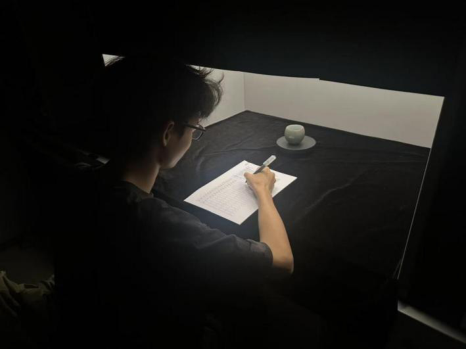
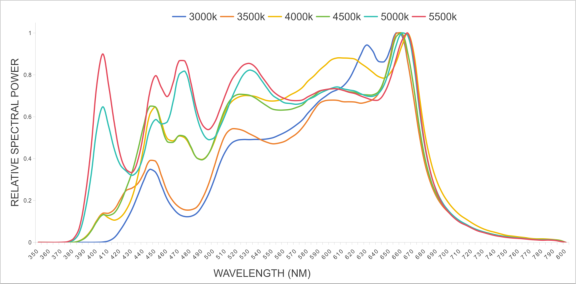
Experimental Environment The experiment was conducted in an independent, quiet space within the Optical Laboratory at Huaqiao University. A replica of a Song Dynasty Ding ware master cup was used as the single visual stimulus, placed at the center of the display table, with uniform glaze and no decorative textures, measuring 6 cm in height and 6.6 cm in top diameter. The core lighting equipment used was an 11-channel spectrally tunable light box (THOUSLITE LED Cube), with a fixed illuminance setting of 150 lux, capable of accurately outputting six target correlated color temperature levels (3000 K – 5500 K). The ambient illuminance, temperature, and humidity were kept constant, with no external light or acoustic interference, meeting the environmental control requirements for psychological experiments.
Figure 1: Formal experimental scene.Figure 2: Spectral power distributions of the six experimental CCT conditions.
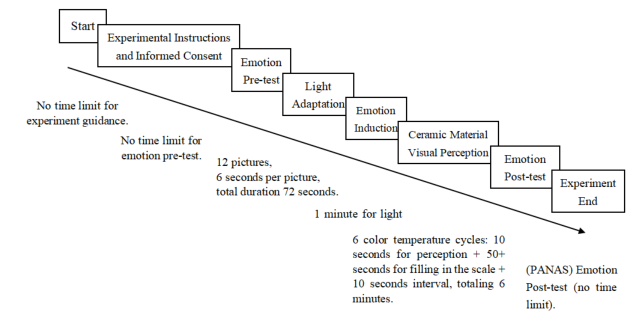
Procedure The entire experiment lasted approximately 25 minutes. First, the experimenters explained procedures and relevant precautions to the participants upon arrival. After signing the informed consent form, participants completed the pre-test PANAS. Subsequently, participants entered the experimental space and underwent a 1-minute light adaptation period to acclimate to the lighting conditions of the experimental environment.At the start of the formal experiment, participants first received the corresponding type of emotional induction by viewing emotional images (each presented for 6 s, 12 images totaling 72 s) to activate the target emotion. Following the emotional induction, participants fixated on the porcelain stimulus material on the display stand for 10 s to fully perceive its material visual characteristics. They then had 50 s to independently complete the porcelain Visual Perception Scale. After completing the scale, participants rested with their eyes closed for 10 s, which concluded one experimental trial. Each participant completed one trial under each of the six CCT conditions, resulting in a total of six trials. After all trials were completed, participants filled out the post-test PANAS, marking the formal end of the experiment.
Figure 3: Experimental flowchart.Figure 4: Visual presentation of ding ware under different color temperature illuminations (From left to right: 3000 K, 3500 K, 4000 K, 4500 K, 5000 K, 5500 K).
RESULTS
Validation of Emotional Manipulation Efficacy The descriptive statistics of the PANAS positive and negative affect scores for the three groups of participants before and after the experimental task were analyzed.The results showed that the initial emotional states of the three groups were balanced, with no systematic differences. After the experiment, the positive affect group had significantly higher positive affect scores compared to baseline (p < 0.001) and significantly lower negative affect scores compared to baseline (p < 0.001); the negative affect group had significantly higher negative affect scores compared to baseline (p < 0.001) and significantly lower positive affect scores compared to baseline (p < 0.001); the neutral affect group showed no significant changes in either positive or negative affect scores before and after the experiment (all p > 0.05).
These findings indicate that the emotional induction method employed in this experiment effectively activated the participants’ target emotion, and these emotions remained stable throughout the experiment, satisfying the requirements of the experimental design for the effectiveness of emotional manipulation.
Effect of CCT CCT has a significant main effect on the visual perception of Ding ware porcelains, with its core influence concentrated in the aesthetic dimensions, while certain indicators in the physical dimensions also show significant differences. The specific results are as follows:
Aesthetic Dimensions: CCT had a significant main effect on the aesthetic dimensions of sense of order (p = 0.014), beauty (p = 0.031), and exquisiteness (p < 0.001). Overall mean analysis showed that the highest average score for the aesthetic dimensions was at 5000 K CCT (M = 3.99, SD = 0.117), followed by 4500 K CCT (M = 3.95, SD = 0.213), with no significant difference between the two. Furthermore, the scores for both were significantly higher than those in the low CCT groups (3000 K: M = 3.60, SD = 0.258; 3500 K: M = 3.43, SD = 0.215; 4000 K: M = 3.51, SD = 0.13). The average score at 5500 K CCT (M = 3.75, SD = 0.049) was significantly lower than at 4500 K, but remained higher than the low CCT groups, indicating that mid-to-high color temperatures are more suitable for presenting the aesthetic perception of porcelains.
Examining the scoring characteristics of individual indicators, mid-to-high color temperatures significantly enhanced the core aesthetic indicators. Both 5000 K and 4500 K maintained high scores for sense of order, beauty, and
When Light Embraces Porcelain: How Correlated Color Temperature 283 exquisiteness, which are the primary reasons for the excellent overall scores in the aesthetic dimensions.
Physical Dimensions: CCT had a significant main effect on the physical dimensions of transparency (p = 0.01) and hardness (p < 0.001). Overall mean analysis showed that the highest average score for the physical dimensions was at 4500 K CCT (M = 3.58, SD = 0.371), followed by 5000 K (M = 3.41, SD = 0.241), and 5500 K ranked third (M = 3.38, SD = 0.13). All three were significantly higher than the low CCT groups (3000 K: M = 3.20, SD = 0.403; 3500 K: M = 3.02, SD = 0.458; 4000 K: M = 3.32, SD = 0.13), with the overall physical dimension score being lowest at 3500 K CCT. This demonstrates the positive enhancing effect of mid-to-high color temperatures on the visual perception of porcelain physical dimensions.
The suitability of mid-to-high color temperatures (4500 K–5000 K) for presenting the aesthetic perception of porcelain may be related to their non-visual effects on visual clarity, information processing efficiency, and subjective comfort. Luo et al. (2023) indicated that high color temperature light sources can significantly enhance individuals’ alertness and visual comfort, thereby increasing perceptual sensitivity to details and textures of artifacts. Zhu et al. (2019) found that high color temperatures can facilitate visual information processing, benefiting aesthetic judgments of artifact form and surface texture. Shamsul et al. (2013) also confirmed that, compared to low color temperatures, mid-to-high color temperatures significantly enhance subjective preference and reduce visual fatigue. Therefore, mid-to-high color temperatures enhance the aesthetic perception of details and overall order of porcelain by improving visual clarity and comfort.
Table 2: The change of different dimensions in each colour temperature.
Table available in the original PDF paper.
Effect of Emotions Emotion has a slight moderating effect on the visual perception of porcelains, primarily influencing certain indicators within the aesthetic dimensions and a single indicator within the physical dimensions, with the overall moderating effect being weaker than that of CCT. The specific results are as follows:
Aesthetic Dimensions: Emotion had a significant main effect on the aesthetic dimensions of beauty (p = 0.037) and exquisiteness (p = 0.001).
Overall mean analysis showed that the neutral emotion group had the highest average score for the aesthetic dimensions (M = 3.86, SD = 0.173), followed by the positive emotion group (M = 3.71, SD = 0.193), and the negative emotion group had the lowest score (M = 3.535, SD = 0.142). This indicates that negative emotions lower the aesthetic perception evaluation of porcelains, while neutral emotions are more conducive to the overall perception of the aesthetic dimensions. Notably, the neutral emotion group’s score for exquisiteness (M = 4.05) was significantly higher than that of the positive (M = 3.47) and negative (M = 3.48) emotion groups, which is the primary reason for its highest overall score in the aesthetic dimensions.
Physical Dimensions: Emotion had a significant main effect only on the physical dimension of hardness (p = 0.009). Overall mean analysis showed that the neutral emotion group had the highest average score for the physical dimensions (M = 3.40, SD = 0.142), followed by the positive emotion group (M = 3.29, SD = 0.297), and the negative emotion group had the lowest score (M = 3.26, SD = 0.156). The gradient difference in overall scores among the three groups was relatively small, with only slight fluctuations. This directly reflects the weaker overall moderating effect of emotion on the physical dimensions.
According to Fredrickson’s (2001) broaden-and-build theory, negative emotions narrow attention, causing individuals to focus on local, threat-related features and thereby interfering with the processing of overall beauty and exquisiteness (Shalev & Hadad, 2025). In contrast, while positive emotions broaden attention, they can weaken the detailed encoding of spatial locations in the early visual cortex (Vanlessen et al., 2013), which is not conducive to the evaluation of order and exquisiteness. Neutral emotions, however, do not produce such attentional biases, providing a more stable perceptual foundation for aesthetic processing.
Table 3: The change of different dimensions in each mood.
Table available in the original PDF paper.
Interaction Effects of CCT × Emotion The interaction effect between CCT and emotion has a moderating effect on the visual perception of porcelains, with significant main effects on specific indicators within both the aesthetic and physical dimensions. The specific results are as follows:
When Light Embraces Porcelain: How Correlated Color Temperature 285 Aesthetic Dimensions: The interaction effect between CCT and emotion had a significant main effect on the aesthetic dimensions of neatness (p = 0.004) and sense of order (p = 0.011). Overall mean analysis showed that the highest average score for the aesthetic dimensions occurred with the interaction of 5000 K CCT and the positive emotion group (M = 4.27, SD = 0.126), followed by the interaction of 4500 K CCT and the neutral emotion group (M = 3.96, SD = 0.349), and the interaction of 5500 K CCT and the negative emotion group ranked third (M = 3.85, SD = 0.144). The scores for all other interaction combinations were below 3.90. Furthermore, the overall aesthetic dimension scores for interaction combinations involving mid-to- high color temperatures with any emotion were significantly higher than those involving low color temperatures with any emotion. This demonstrates the positive reinforcing effect of interaction mid-to-high color temperatures with emotions on the overall perception of the aesthetic dimensions.
Physical Dimensions: The interaction effect between CCT and emotion had a significant main effect on the physical dimensions of hardness (p = 0.033) and fragility (p = 0.033). Overall mean analysis showed that the highest average score for the physical dimensions occurred with the interaction of 4500 K CCT and the neutral emotion group (M = 3.62, SD = 0.485). The overall physical dimension scores for interaction combinations involving mid-to-high color temperature groups (4500 K, 5000 K, 5500 K) with any emotion group were significantly higher than those involving the low color temperature of 3500 K coupled with positive or negative emotions. This indicates that mid-to-high color temperatures serve as the core foundation for enhancing the coupled perception of physical dimensions, and that neutral emotions can strengthen the physical perception effect specifically at medium color temperatures.
The essence of the coupling effect between CCT and emotion lies in the synergistic action of environmental perception and psychological state. By optimizing perceptual processing efficiency and reinforcing the matching of perceptual cues, it achieves a targeted enhancement of the visual perception of porcelain. Furthermore, this effect exhibits dimensional selectivity and contextual adaptability.
Table 4: Means and SDs of each dimension under different emotions and CCTCorrelated statistics for the interaction effect between CCT and emotion across various dimensions.
Table available in the original PDF paper.
Dimension Approximate Chi-Square df P F Greenhouse- Geisser
Huynh- Feldt Sense of Order 88.617 54 0.011 0.692 0.407 0.675
This study employed a mixed experimental design to systematically investigate the mechanisms by which CCT and emotion influence the visual perception of porcelains. The core conclusions are as follows: CCT is the dominant core factor in the aesthetic perception of porcelains; emotion exerts a slight moderating effect on the aesthetic perception of porcelains; The interaction between CCT and emotion significantly affects the aesthetic dimensions of sense of order and neatness, as well as the physical dimensions of hardness and naturalness. This study explored and refined our understanding of the differential effects of CCT on porcelains, the moderating role of emotion, and the interaction mechanism between these two factors. It clarified the priority hierarchy where CCT acts as the primary driver and emotion serves as an auxiliary moderator, thereby contributing to the multivariate interaction research system within the field of human factors in porcelain perception. Furthermore, the study suggests that for porcelain exhibition scenarios, museums can provide lighting solutions in the mid-to-high CCT range of 4500 K - 5000 K, while simultaneously fostering a neutral or positive visiting atmosphere to enhance visitors’ visual perceptual experience of porcelain exhibits. However, this experiment also has limitations, such as a relatively limited sample size consisting solely of university students; differences in the persistence and naturalness of emotions induced in the experiment compared to actual visiting scenarios; and a focus only on visual perception dimensions without integrating multisensory experiences like touch or thermal perception. Future research could be further refined by expanding sample diversity, optimizing scene immersion, and integrating multisensory and physiological indicators.
ACKNOWLEDGMENT
We thank Professor Daqing Zhu for providing the lighting equipment and laboratory for this experiment.
FUNDING This research was funded by Xiamen Natural Science Foundation Project (No. 3502Z202573039).
REFERENCES
Chen, J., Cheng, Y., & Guo, Q. (2024). Evaluation method and the influence of visual comfort of porcelain tiles in indoor environment—A study based on the Delphi and AHP. Buildings, 14(9), 2829. https://doi.org/10.3390/buildings14092829 Feltrin, F., Leccese, F., Hanselaer, P., & Smet, K. A. G. (2020). Impact of Illumination
Correlated Color Temperature, Background Lightness, and Painting Color Content on Color Appearance and Appreciation of Paintings. LEUKOS, 16(1), 25–44. https://doi.org/10.1080/15502724.2018.1522261 Fleming, R. W., Wiebel, C., & Gegenfurtner, K. R. (2013). Perceptual qualities and material classes. Journal of Vision, 13(8), 9. https://doi.org/10.1167/13.8.9 Fredrickson, B. L. (2001). The role of positive emotions in positive psychology: The
broaden-and-build theory of positive emotions. American Psychologist, 56(3), 218–226. https://doi.org/10.1037/0003-066X.56.3.218
When Light Embraces Porcelain: How Correlated Color Temperature 287 Lin, Y., & Liu, C. (2017). Bangong zhaoming de guangshengwu xiaoying yanjiu zongshu
[A Review of Research on the Photobiological Effects of the Photobiological Effects of Office Lighting]. Zhaoming Gongcheng Xuebao, 28(3), 1–8+19. Luo, W., Kramer, R., Kompier, M., Smolders, K., de Kort, Y., & van Marken Lichtenbelt, W. (2023). Effects of correlated color temperature of light on thermal comfort, thermophysiology and cognitive performance. Building and Environment, 231, 109944. https://doi.org/10.1016/j.buildenv.2022.109944 Motoyoshi, I., Nishida, S., Sharan, L., & Adelson, E. H. (2007). Image statistics and
the perception of surface qualities. Nature, 447, 206-209. https://doi.org/10.1038/ nature05724 Shalev, T., & Hadad, B.-S. (2025). Modulation of perception by emotion: Altered sensitivity and perceived magnitude of negatively valenced stimuli. Attention, Perception, & Psychophysics, 87(6), 1964–1973. https://doi.org/10.3758/s13414- 025-03110-w Shamsul, B. M., Sia, C. C., Ng, Y. G., & Karmegan, K. (2013). Effects of light’s colour
temperatures on visual comfort level, task performances, and alertness among students. American Journal of Public Health Research, 1, 159–165. https://doi. org/10.12691/ajphr-1-7-3 Vanlessen, N., Rossi, V., De Raedt, R., & Pourtois, G. (2013). Positive emotion broadens attention focus through decreased position-specific spatial encoding in early visual cortex: Evidence from ERPs. Cognitive, Affective, & Behavioral Neuroscience, 13(1), 60–79. https://doi.org/10.3758/s13415-012-0130-x Watson, D., Clark, L. A., & Tellegen, A. (1988). Development and validation of brief
measures of positive and negative affect: The PANAS scales. Journal of Personality and Social Psychology, 54(6), 1063–1070. https://doi.org/10.1037/0022-3514.54.6.1063 Yamazoe, T., Funaki, T., Kiyasu, Y., & Mizokami, Y. (2019). Evaluation of Material Appearance Under Different Spotlight Distributions Compared to Natural Illumination. Journal of Imaging, 5(2), 31. https://doi.org/10.3390/jimaging5020031 Zadra, J. R., & Clore, G. L. (2011). Emotion and perception: The role of affective
information. Wiley Interdisciplinary Reviews: Cognitive Science, 2(6), 676–685. https://doi.org/10.1002/wcs.147 Zhu, Y. Y., Yang, M. Q., Yao, Y., Xiong, X., Li, X., Zhou, G. F., & Ma, N. (2019). Effects of illuminance and correlated color temperature on daytime cognitive performance, subjective mood, and alertness in healthy adults. Environment and Behavior, 51(2), 199–230. https://doi.org/10.1177/0013916517738077
LISTED IN THE AHFE DIGITAL BOOKSTORE CATALOGUE
Explore the complete digital volume
Human Factors in Communication of Design
Read this individual research paper free through the original publisher, or explore the full digital proceedings book.
ISBN 978-1-964867-92-2
Explore this ISBN in the AHFE Bookstore ↗Listed in the July 2026 bookstore catalogue; search by ISBN to confirm current availability · Digital book purchase optional