Hamid Estejab, Sara Bayramzadeh (2025). AI vs. Authentic: Decoding Architectural Imagery. In: Artificial Intelligence and Social Computing. AHFE Open Access, vol. 163, pp. 305–311. https://doi.org/10.54941/ahfe1006217
As AI becomes increasingly integrated into design processes, accurately distinguishing AI-generated architectural images from real photographs is crucial for effective communication and decision-making in the field. Aim: This study explored how experienced designers perceive and identify AI-generated images, focusing on the challenges they encounter and the visual cues they rely on to assess authenticity. Method: Employing a mixed methods approach, five designers (1–20 years of experience) from a single firm participated in an hour-long focus group session on the Miro platform. They examined 16 images—8 AI-generated and 8 real—and were asked to identify AI-generated visuals. Annotations and discussions were thematically analyzed to capture participants’ decision-making processes and patterns of observation. Result: Overall, participants correctly classified 65% of exterior images and 70% of interior images. Analysis revealed five recurrent themes: subtle distortions in spatial elements, distorted or “demon-like” human features, warped backgrounds and inconsistent perspectives, over-perfection that lacked real-world imperfections, and reliance on professional domain knowledge. Night shots and images containing people presented consistent difficulties, while architectural expertise bolstered participants’ confidence in detecting anomalies. Limitation: Time constraints, limited zoom functionality on the Miro platform, and occasional confusion with voting mechanics potentially reduced thoroughness and accuracy. Environmental factors, including early-finishers discussing progress, introduced additional distractions that may have biased responses. Conclusion: These findings highlight how architectural expertise, image content, and technological constraints shape the process of identifying AI-generated images. As part of a broader ongoing study also including participants without an architectural background, this research underscores the importance of examining how diverse user groups approach AI-generated visual content.
The rapid advancement of AI-generated imagery has reshaped the design landscape, raising critical questions about authenticity, authorship, and trust. As AI tools such as Midjourney, DALL-E, and Stable Diffusion produce
increasingly photorealistic visuals, distinguishing between real and synthetic images has become a growing challenge for architects, designers, and decision-makers. This distinction is crucial in ensuring credibility, preventing misinformation, and maintaining the integrity of design representation (Bushey, 2023). However, as generative models continue to evolve, the traditional notion of “seeing is believing” is being disrupted, posing ethical, cognitive, and industry-wide implications (Bushey, 2023).
Ethically, AI-generated images introduce concerns regarding misinformation and intellectual property. The ability to create hyper- realistic architectural visuals opens the door to deceptive practices, where manipulated images can mislead clients and stakeholders. Furthermore, questions of authorship arise as AI systems train on vast datasets, often incorporating copyrighted works without clear attribution (Carrasco, 2024). These issues emphasize the need for transparency and guidelines to ensure responsible AI use in design.
Cognitively, human perception is susceptible to biases when differentiating AI-generated and real images. Studies show that individuals tend to overestimate their ability to detect AI-generated visuals, leading to an overconfidence bias that makes them more vulnerable to deception (Köbis et al., 2021). Conversely, the prevalence of AI-generated content has given rise to an Impostor Bias, where even authentic images are doubted due to heightened skepticism (Casu et al., 2024). Design professionals also experience prompt bias, where the phrasing of an AI-generated image request influences creative direction, subtly shaping their decisions (Popescu and Schut, 2023).
From an industry perspective, AI-generated images are transforming workflows in architecture, interior design, and visual communication. Architects are increasingly incorporating AI tools for concept visualization, with studies showing high adoption rates in firms like Perkins&Will (Tisi and Longhi, 2024). Similarly, in interior design, AI accelerates visualization processes but also influences client expectations, requiring professionals to balance efficiency with authenticity (Gaona, 2024).
This study examines how design professionals perceive and assess AI-generated versus real architectural images, identifying the patterns that inform their judgments. Through a focus group study, this research explores the intersection of human perception, AI technology, and design authenticity, contributing to the broader discourse on the evolving role of AI in creative industries.
RESEARCH DESIGN This study employed a mixed-method approach utilizing focus group to explore how architectural professionals differentiate between AI-generated and real architectural images. The session was conducted on the Miro online platform, which facilitated interactive participation while minimizing bias through structured anonymity settings. The study aimed to capture both quantitative accuracy rates and qualitative insights by analyzing participants’ selection processes and thought patterns.
AI vs. Authentic: Decoding Architectural Imagery 307
PARTICIPANTS AND RECRUITMENT Participants were recruited from a single design firm to ensure a shared professional background while incorporating a range of experience levels. Eligibility criteria required participants to have a minimum of one year of experience in the design field and prior exposure to AI image-generation tools such as Midjourney, DALL-E, or Stable Diffusion. Through a convenience sampling method, five participants were selected, representing experience levels ranging from one to twenty years, which allowed for a diverse spectrum of expertise and familiarity with architectural visualization techniques.
IMAGE SELECTION AND PREPARATION A total of sixteen images were selected for the focus group, comprising eight AI-generated images and eight real architectural images. AI-generated images were created using Midjourney, with textual descriptions derived from real photographs to enhance visual consistency and prevent stylistic bias. The real images were sourced from architectural photography archives, ensuring they were unfamiliar to the participants to mitigate recognition bias. To maintain comparability, images containing visible text, such as signage or watermarks, were excluded, and those with evident distortions or unrealistic features were revised. The dataset included an equal distribution of interior and exterior images, with variations in lighting conditions and the presence of human figures to assess their impact on perception.
FOCUS GROUP PROCEDURE The one-hour session began with an introduction outlining the study’s objectives, ethical considerations, and instructions for participation. Participants were provided with a shared Miro board link and instructed to disable their cursors to prevent observational bias. The study was structured into multiple phases to ensure comprehensive data collection.
In the first phase, participants were presented with two sets of eight images, each containing four real and four AI-generated images. They were asked to identify the AI-generated images while thinking about the visual patterns that informed their decisions. Each section, containing total of eight AI and real images, was displayed for four minutes, with additional time provided if necessary, to accommodate variations in response speed. During this time, participants engaged in a double-blinded voting process to record their choices. To minimize bias, neither participants nor researchers were able to see individual selections. After voting, participants annotated the images with sticky notes, marking specific elements they considered indicative of AI generation. These annotations helped identify common visual cues and patterns influencing their judgments.
A structured discussion followed the voting process, during which participants elaborated on their experiences, thought processes, and confidence levels in identifying AI-generated images. The session concluded with a debriefing, where participants reflected on their overall impressions
308 Estejab and Bayramzadeh
and the challenges associated with distinguishing between AI-generated and real images.
DATA COLLECTION AND ANALYSIS Data were collected through both quantitative and qualitative means. The quantitative component consisted of accuracy rates derived from participant voting, which were analyzed based on variables such as image category (interior vs. exterior), lighting conditions (day versus night), and the presence of human figures. The qualitative component involved thematic analysis of participant discussions and annotations, focusing on recurring visual patterns during image evaluation.
QUANTITATIVE FINDINGS Participants evaluated 16 images, evenly split between AI-generated and real architectural photographs. The overall accuracy rate was 65% for exterior images and 70% for interior images, indicating slightly higher confidence in identifying AI-generated interior scenes.
Among exterior images, those featuring people were identified with 70% accuracy, while those without people had a 60% accuracy rate. Similarly, daytime images were correctly classified 70% of the time, while nighttime images had a lower accuracy rate of 60%. These findings suggest that human presence and lighting conditions influenced participants’ ability to discern real from AI-generated visuals.
In the interior category, images without people had an 80% accuracy rate, whereas images containing human figures were only identified correctly 60% of the time. AI-generated human figures seemed to introduce ambiguity, leading to increased misclassification.
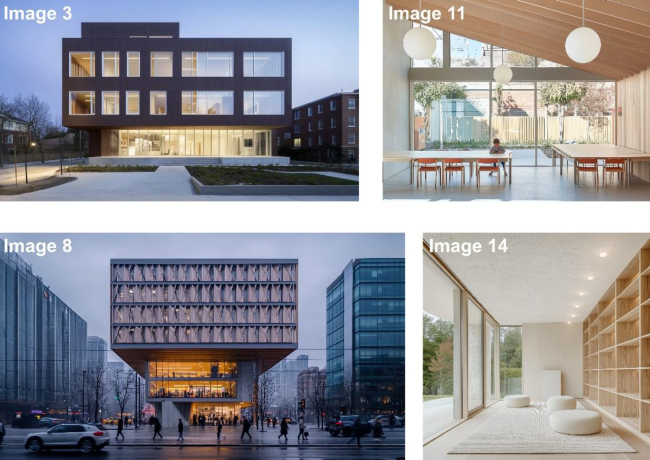
Certain images proved particularly challenging. Among AI-generated images, image 3 and Image 11 (interior, with people) had the lowest accuracy rates, both at 40%. Conversely, Image 8 (exterior, 80% accuracy) and Image 14 (interior, 100% accuracy) were the easiest to identify as AI-generated (Figure 1).
For real images, some were misclassified as AI 60% of the time, suggesting that certain authentic images contained visual qualities participants associated with AI generation. These results highlight that while professionals are skilled at identifying AI-generated images, specific contextual factors— such as human figures, lighting, and background composition—can influence their accuracy.
QUALITATIVE FINDINGS: THEMATIC ANALYSIS Five key themes emerged from participant discussions, reflecting the cognitive strategies used to identify AI-generated images. Distortions & Imperfections, People & Facial Features, Background Indicators, Realism vs. Over-Perfection and Domain Knowledge.
AI vs. Authentic: Decoding Architectural Imagery 309
Figure 1: The most challenging and the easiest AI-generated images.
Distortions & Imperfections were frequently cited as indicators of AI generation. Participants noted misaligned architectural elements, blurred edges, and spatial inconsistencies, such as illogical furniture placement and warped structural details. These distortions were subtle but often triggered suspicion.
People & Facial Features were another major factor. AI-generated humans frequently exhibited blurred faces, unnatural proportions, and missing facial elements, making them a strong cue for synthetic imagery. However, when AI successfully rendered human figures convincingly, participants struggled to differentiate them from real images.
Background Indicators played a significant role in decision-making. Participants highlighted issues such as merged building edges, inconsistent depth perception, and distorted skylines, particularly in nighttime AI-generated images. These abnormalities often disrupted realism and raised doubts.
Realism vs. Over-Perfection was a recurring theme. AI-generated images often appeared too clean, too polished, and perfectly balanced, lacking the natural imperfections present in real-world environments. Conversely, some real images were mistakenly classified as AI due to their staged or hyper- refined appearance.
Domain Knowledge & Confidence influenced identification accuracy. Participants with more architectural experience relied on their understanding of proportions, structural logic, and material application to determine an image’s authenticity. Unrealistic elements, such as exaggerated overhangs or uniform lighting, were flagged as potential AI-generated features. However, even experienced professionals encountered uncertainty when AI-generated images exhibited a high degree of realism.
310 Estejab and Bayramzadeh
CONCLUSION
This study explored how architectural professionals distinguish between AI-generated and real architectural images, revealing both strengths and challenges in their identification process. While participants demonstrated a strong ability to detect AI-generated visuals, accuracy was influenced by key factors such as lighting conditions, human figures, background composition, and the level of visual refinement. Interior images were identified more accurately than exterior ones, and AI-generated human figures often introduced ambiguity. The thematic analysis highlighted that professionals rely on distortions, unnatural facial features, background inconsistencies, and an overly polished appearance as primary indicators of AI generation. However, as AI-generated images continue to improve in realism, even experienced professionals may struggle to differentiate them from real photographs.
Several limitations impacted the study’s findings. The Miro platform’s zoom restriction (400%) limited participants’ ability to examine fine details, potentially affecting their judgment. Voting mechanics confusion required procedural adjustments, introducing slight inconsistencies. Time constraints may have influenced participant confidence, particularly in cases where they felt rushed to make decisions. Additionally, the small sample size (five participants from a single firm) limits the generalizability of findings, as broader industry perspectives may yield different results. Future research should expand the participant pool, incorporate diverse professional backgrounds, and explore the impact of emerging AI advancements on architectural visualization. Despite these limitations, the study provides valuable insights into the evolving relationship between AI and architectural design, emphasizing the need for professionals to develop a critical eye when interpreting AI-generated imagery.
ACKNOWLEDGMENT
The authors would like to express gratitude to the architectural professionals who participated in this study for their valuable insights and time. Special thanks to NAC Architecture and Kent State University for supporting this research and providing the necessary resources.
REFERENCES
Bushey, J. (2023) ‘AI-Generated Images as an Emergent Record Format’, in 2023 IEEE International Conference on Big Data (BigData). 2023 IEEE International Conference on Big Data (BigData), Sorrento, Italy: IEEE, pp. 2020–2031. Available at: https://doi.org/10.1109/BigData59044.2023.10386946. Carrasco, M. (2024) ‘AI and the Built Environment: Bridging Technology, Design,
and Cultural Identity’, 24 December. Available at: https://www.archdaily.com/ 1024493/ai-and-the-built-environment-bridging-technology-design-and-cultural- identity#: ∼: text=intelligence%20on%20the%20design%20profession, unique%20aspects%20of%20human%20creativity (Accessed: 28 February 2025).
AI vs. Authentic: Decoding Architectural Imagery 311
Casu, M. et al. (2024) ‘GenAI Mirage: The Impostor Bias and the Deepfake Detection Challenge in the Era of Artificial Illusions’, Forensic Science International: Digital Investigation, 50, p. 301795. Available at: https://doi.org/10.1016/ j.fsidi.2024.301795. Gaona, J. (2024) ‘How AI Is Revolutionizing Interior Design’, How AI Is Revolutionizing Interior Design, 30 April. Available at: https:// marymount.edu/blog/how-ai-is-revolutionizing-interior-design-and-how-to- successfully-use-ai-as-an-interior-designer/#: ∼: text=University%20marymount, in%20a%20matter%20of%20minutes (Accessed: 28 February 2025). Köbis, N. C., Doležalová, B. and Soraperra, I. (2021) ‘Fooled twice: People cannot
detect deepfakes but think they can’, iScience, 24(11), p. 103364. Available at: https://doi.org/10.1016/j.isci.2021.103364. Popescu, A.-R. and Schut, A. (2023) ‘Generative AI in creative design processes: a dive into possible cognitive biases’, in IASDR 2023: Life-Changing Design. IASDR 2023: Life-Changing Design, Design Research Society. Available at: https:// doi.org/10.21606/iasdr.2023.784. Tisi, B. and Longhi, F. (2024) ‘Advantages, Challenges and Perceptions in using
AI Generative Images: A Case Study at Perkins&Will Sao Paulo Studio’, Perkins&Will Research Journal.
LISTED IN THE AHFE DIGITAL BOOKSTORE CATALOGUE
Explore the complete digital volume
Artificial Intelligence and Social Computing
Read this individual research paper free through the original publisher, or explore the full digital proceedings book.
ISBN 978-1-964867-39-7
Explore this ISBN in the AHFE Bookstore ↗Listed in the July 2026 bookstore catalogue; search by ISBN to confirm current availability · Digital book purchase optional