Lora Metanova, Neli Velinova (2025). Artificial Intelligence and Media Literacy - Navigating Information in a Digital World. In: Artificial Intelligence and Social Computing. AHFE Open Access, vol. 163, pp. 261–267. https://doi.org/10.54941/ahfe1006212
Artificial intelligence (AI) is playing an increasingly important role in the media ecosystem, transforming both the creation and distribution of content. At the same time, the growing influence of AI raises questions about media literacy as a key aspect of critical thinking in the digital age. This article explores the relationship between AI and media literacy by analyzing how automated technologies shape information perception, fake news detection, and critical content evaluation skills. The article combines theoretical review and empirical research to identify the main challenges and opportunities in the field. The focus is on the interaction between AI tools, such as content recommendation algorithms and generative models, and the ability of users to analyze, interpret, and create information. It analyzes the possibilities of using AI as a means of improving media literacy through interactive learning platforms, capabilities for identifying prejudice and hate speech, and as a support tool in journalistic work for effective and rapid data analysis and fact-checking.
Artificial intelligence (AI) is playing an increasingly important role, including in the media, and is having an increasing impact on the way information is created and disseminated. Content recommendation algorithms, generative models, and fact-checking systems are now part of the media ecosystem. In some ways, they make it easier to find information and distribute it more quickly, and can make the work of journalists easier, but they also increase the risks of creating fake news, disinformation, and manipulative content. In this context, media literacy is becoming a critical skill needed to navigate the digital world. With the development of AI technology, media literacy is also taking on new dimensions, posing new challenges related to the acquisition of additional skills and the development of critical thinking necessary for the effective use of AI technologies.
AIM AND MAIN RESEARCH QUESTIONS OF THE STUDY The present study aims to analyze the impact of artificial intelligence on the media ecosystem in the context of the opportunities and challenges for
information users. The aim is to clarify to what extent users use artificial intelligence and for what purposes, what are the main skills they possess and which they need to acquire in order to have the necessary critical thinking in order to be able to navigate digital content and limit the impact of fake news and manipulative information.
Five main research questions are posed: Do users have knowledge of this technology, what is their attitude towards it and what do they use it for? Is there a need for additional skills to be included in the concept of digital media literacy in connection with the development of AI technology?
METHODOLOGY
A complex set of research methods was used – theoretical review, statistical data analysis. A survey was conducted among 30 people aged 17 to 25 years old – to examine the knowledge and attitudes of the youngest people, who, according to research, are generally the most familiar with new technologies and have the most positive attitude towards them.
IMPACT OF ARTIFICIAL INTELLIGENCE ON THE DISSEMINATION OF INFORMATION Various studies show three main methods by which artificial intelligence influences the media environment.
One is by recommending content, thus creating a personalized information flow. The concept of so-called filter bubbles was presented by Eli Pariser (Pariser, 2011).
The second is its enormous possibilities for creating content – video, audio and text, which increases the risk of spreading fake news. NewsGuard’s monthly report for November 2024 found that the top 10 chatbots collectively repeated false statements 26.67 percent of the time, and offered no response 17.67 percent of the time. The “fail” rate (the percentage of responses containing false statements or offering no response) is consistent with the results of NewsGuard’s October audit, which showed no improvement (NewsGuard, 2024). NewsGuard has so far identified 1,254 AI-generated news and information sites operating with little or no human oversight (NewsGuard, 2025).
At the same time, AI also provides great opportunities for fact-checking and exposing false information and the ability to quickly check facts.
Concerns about the potential of AI to generate fake news and disinformation have focused attention on developing its potential and on various automated fact-checkers to counter false information, which have been extensively explored by Lucas Graves (Graves, 2018). However, he stresses that deciding the truth of public claims and separating legitimate views from disinformation is a difficult and often contradictory task, challenges that carry over to AFC. Based on a review of current efforts and interviews with both fact-checkers and computer scientists, he finds that it requires sensitivity to context that remains far beyond the reach of
Artificial Intelligence and Media Literacy - Navigating Information in a Digital World 263
fully automated fact-checking. Overall, the conclusion is that automated fact-checking systems will require human oversight for the foreseeable future.
All these studies show that in the modern information environment, orientation and sifting out the true from the false information is extremely important and increasingly difficult. Some researchers (Livingston, 2004) outline four components as key to media literacy – access, analysis, evaluation, and content creation, which together constitute a skills-based approach to media literacy. Each component supports the others. The European Commission includes in media literacy all technical, cognitive, social, civic and creative abilities that allow citizens to have access to the media, to critically understand the media, and to be able to use them effectively.
Artificial intelligence adds new challenges to information sifting. With its capabilities to generate video and audio, this technology makes it more difficult to distinguish fake news and disinformation and makes it very difficult, even impossible, to navigate without people having knowledge and skills to work with artificial intelligence tools.
ATTITUDES ABOUT ARTIFICIAL INTELLIGENCE A survey of 28 markets conducted by the Reuters Institute reports a remarkably low awareness of respondents about artificial intelligence in general (45% of them say they have heard or read a lot or a moderate amount about it. Meanwhile, 40% of respondents say they have heard or read a little, and 9% do not give an answer (Reuters Institute for the Study of Journalism, 2024). The profile of those who say they are very informed about artificial intelligence is mainly young people with higher education. 56% of them are under 35, and 54% are highly educated.
The researchers specify that this data gives an idea of how much information about AI respondents have received, but not where they have seen it, nor what kind of information it is or what experience they have had with AI themselves. Recent studies have shown that people do not always recognize what AI is and most do not use it regularly. The study registers a direct relationship between the degree of knowledge of the technology and comfort with using content by artificial intelligence. The data shows that people with greater awareness of artificial intelligence tend to feel relatively more comfortable using it in journalism. Although still very low, comfort with using news produced primarily by AI is twice as high among those who have seen or heard more about AI (26%) compared to those who know less (13%). The difference is similar when asked about comfort with using news produced primarily by a human with some help from AI (45% of the more informed versus 30% who know less about artificial intelligence).
A study in Bulgaria shows similar trends – the majority of Bulgarian citizens (63%) claim to know what artificial intelligence is. Every 4 in 10 people express a negative attitude towards its use. Young people are the most positive, and with increasing age the share of negative answers increases (Trend, 2017).
264 Metanova and Velinova
YOUNG PEOPLE AND ARTIFICIAL INTELLIGENCE – DATA FROM A SURVEY RESEARCH STUDY The survey was conducted among 30 respondents aged between 17 and 25, using online questionnaires. 25% of the respondents are schoolchildren, 61% are university students and 14% are graduates.
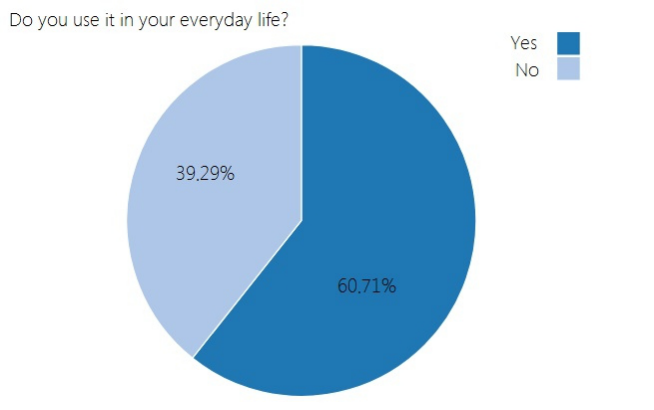
The results of the study show that 96.30% of the respondents are informed about artificial intelligence and only 3.70% claim that they are not familiar with AI. In total, 60.71% of people claim to use AI technologies (see Figure 1).
Figure 1: Use of AI.
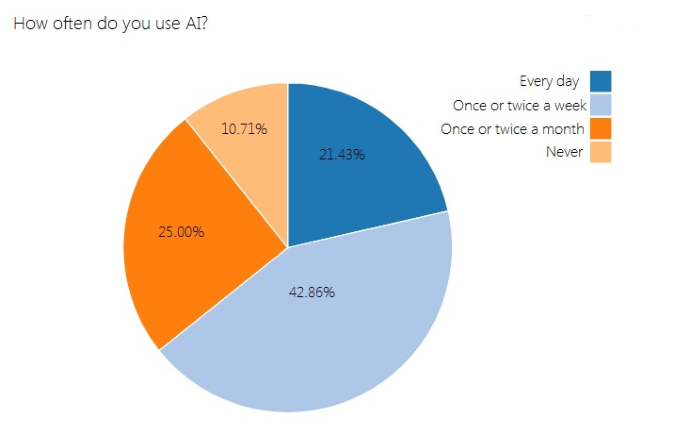
The highest percentage of people who use such technologies once or twice a week is 42.86%. Those who use it once or twice a month are 25%, 21.43% use it every day and only 10.71% answer that they never use artificial intelligence (see Figure 2).
Those who use artificial intelligence say they use it mostly for fact-checking (25.86%), learning new things (22.41%), and helping with everyday tasks (18.97%). 17.24% use it for fun, and 15.52% use it mainly for work.
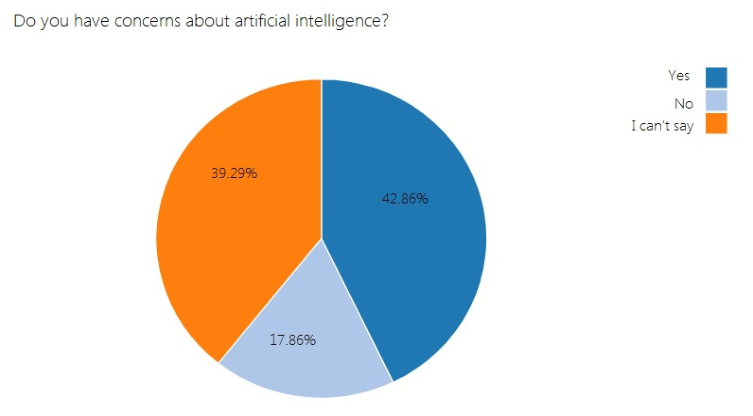
42.86% of respondents admit that although they use artificial intelligence, they have concerns about its imposition on people’s lives, 39.29% say they cannot judge, and 17.86% say they are not worried about the introduction of artificial intelligence into our daily lives (see Figure 3).
The question about their concerns in the questionnaire is free text to allow them to express their concerns without being limited by specific answers. The results show that the concerns of young people are related to the fact that in the future artificial intelligence will be overdeveloped and humanity will not be able to control it and rather it will control people.
Artificial intelligence takes away from people’s creative thinking (especially students) and they start to use less of their potential because it is easier for
Artificial Intelligence and Media Literacy - Navigating Information in a Digital World 265
them to use programs like Chat GPT instead of thinking for themselves, is another problem according to the respondents.
Figure 2: The frequency of AI use.Figure 3: Concerns about AI.
Another concern shared by young people is that not all the facts that artificial intelligence provides are true. The respondents are also afraid of the possibility that artificial intelligence will displace a large part of people in their work, thus depriving them of a livelihood. Others fear that it could
266 Metanova and Velinova
harm society if it is given the opportunity to make decisions, as they may be to the detriment of people. Some of the interviewees are worried about the mass disinformation, which is largely facilitated by the use of artificial intelligence. According to others, the entry of AI into art kills the individual human part of it, thus taking away its most valuable characteristic. According to them, this will contribute to the depersonalization of art.
When asked whether they approve of AI and why, some of the interviewees stated that it is a very useful tool for work, but the risks of its use are still not clear, since it is developing too quickly. The majority of the young people surveyed believe that AI is a useful tool for work, if you use it properly and if there is human control over it.
DISCUSSION
Artificial intelligence is entering people’s everyday lives very quickly and transforming many areas of life. It is gaining key importance in terms of access to information, providing many opportunities, but also hiding many risks for the creation and distribution of false and manipulative content.
The great possibilities for generating all kinds of content - photos, video, text, audio, and so on quickly and with a high degree of credibility, put on the agenda the need for rapid adaptation and acquiring new skills. The issue of rapid response of the education system is also important, because although young people are the most informed and prepared compared to older generations, research shows distrust and uncertainty regarding this technology. A deeper knowledge of the technology and the skills to work with it would contribute to using its advantages to facilitate work in many areas, would increase opportunities in the field of education, acquisition and verification of facts, which in turn would help to limit fake news and disinformation.
Three main directions are outlined in which to focus on expanding the scope of digital media literacy both within the educational system and outside it – by non-governmental organizations, additional training courses and others:
1. Training in recognizing content produced by artificial intelligence. 2. Training and knowledge of platforms for automated content verification. 3. Basic knowledge in prompt engineering in order to be able to use the technology effectively. For example, when using popular chatbots without the necessary culture of inquiry, inaccurate or even completely incorrect answers are more often obtained, and the chatbot’s “hallucinations” can mislead and confuse the user who does not have the appropriate skills to work with it.
KEY FINDINGS Artificial intelligence creates a new reality in terms of information consumption and requires the development of new standards in terms of digital media literacy.
Artificial Intelligence and Media Literacy - Navigating Information in a Digital World 267
Although young people are informed about the technology and use it relatively often, they have concerns and distrust, which shows that they do not know or have little knowledge of the possibilities to limit the risks when using it.
Training related to the recognition of content by artificial intelligence, the skills to use the capabilities of technology to obtain fast and reliable information, to facilitate work and study activities and to check facts, will help to limit the risks and make full use of the opportunities.
CONCLUSION
Artificial intelligence creates a new reality that requires new skills. The focus should be on the earliest possible training in the area of acquiring new digital media skills, expanding and redefining the concept of media literacy. This will allow for the full use of the enormous possibilities of this technology, while limiting the risks as much as possible.
REFERENCES
Graves, L. (2018). Understanding the Promise and Limits of Automated Fact-Checking. doi: 10.60625/risj-nqnx-bg89. Avaible from: https://reutersinstitute.politics.ox.ac.uk/sites/default/files/2018-02/ graves_factsheet_180226%20FINAL.pdf [accessed 10 February 2025]. Livingstone, S. (2004). Media Literacy and the Challenge of New Information and Communication Technologies, The Communication Review, 7:3–14, 2004. Taylor & Francis Inc. ISSN: 1071–4421 print doi: 10.1080/10714420490280152. NewsGuard. (2024). November 2024 - AI Misinformation Monitor of Leading
AI Chatbots [online]. Avaible from: https://www.newsguardtech.com/ai-monitor/ november-2024-ai-misinformation-monitor/ [accessed 10 February 2025]. NewsGuard. (2025). Tracking AI-enabled Misinformation [online]. Avaible from: https://www.newsguardtech.com/special-reports/ai-tracking-center/ [accessed 10 February 2025]. Pariser, E. (2011). The filter bubble. What the internet is hiding from you.
The Penguin Press, New York. https://hci.stanford.edu/courses/cs047n/readings/ The_Filter_Bubble.pdf. Reuters Institute for the Study of Journalism. (2024). Digital-news-report for 2024. Public attitudes towards use of AI and journalism [online]. Avaible from: https://reutersinstitute.politics.ox.ac.uk/digital-news-report/2024/ public-attitudes-towards-use-ai-and-journalism [accessed 10 February 2025]. Trend. (2017). Attitudes of the Bulgarians - January 2017 [online]. Avaible from: https://rctrend.bg/project/%D0%BD%D0%B0%D0%B3%D0%BB%D0%B0% D1%81%D0%B8-%D0%BD%D0%B0-%D0%B1%D1%8A%D0%BB%D0% B3%D0%B0%D1%80%D0%B8%D1%82%D0%B5-%D1%81%D0%BF %D1%80%D1%8F%D0%BC%D0%BE-%D0%B8%D0%B7%D0%BA% D1%83%D1%81%D1%82%D0%B2%D0%B5/ [accessed 14 February 2025].
LISTED IN THE AHFE DIGITAL BOOKSTORE CATALOGUE
Explore the complete digital volume
Artificial Intelligence and Social Computing
Read this individual research paper free through the original publisher, or explore the full digital proceedings book.
ISBN 978-1-964867-39-7
Explore this ISBN in the AHFE Bookstore ↗Listed in the July 2026 bookstore catalogue; search by ISBN to confirm current availability · Digital book purchase optional