Anastasiia Fomina, Yan Luo (2025). Art and Emotion in the Age of AI: Understanding Human Engagement with AI-Generated and Traditional Art. In: Artificial Intelligence and Social Computing. AHFE Open Access, vol. 163, pp. 230–238. https://doi.org/10.54941/ahfe1006209
AI-generated art has become a part of our daily lives, from website illustrations to art exhibitions; generative AI is increasingly influencing traditional art and human-made design. However, there is limited research exploring the impact of AI-generated art on human emotions and aesthetics. This study aims to analyze how people of different age groups perceive and engage with AI-generated art compared to traditional art, exploring the emotional connections they establish with each type of artwork and how these connections vary based on their backgrounds and experiences. In this study, the primary emotions defined by the Geneva Emotional Wheel are employed to analyze the emotional responses of respondents toward both AI-generated art and traditional art. The results indicate that most respondents favor traditional art and feel wider emotional resonance towards it compared to AI-generated art. However, when respondents are presented with a choice between traditional art and AI-generated art without being informed of their origins, AI-generated artworks emerge as the top choice. These results suggests that further exploration into the emotional and aesthetic dimensions of AI-generated art is essential for understanding its potential future acceptance.
Artificial intelligence (AI) has shifted from a popular theme in science fiction to a transformative force in our daily lives, becoming integral to various fields, including art. AI-generated art refers to artworks produced through artificial intelligence technologies, enabling machines to create unique artistic expressions via diverse algorithms and techniques. This includes a wide range of visual creations, like digital paintings, illustrations, animations, musical compositions, poetry, and prose.
The advent of AI in the artistic realm not only enhances the creative process but also holds the potential to broaden human creativity. Unlike humans, AI is not constrained by cultural biases, educational backgrounds, or personal experiences, allowing it to explore and generate novel artistic ideas that may transcend traditional human limits. However, it is important to acknowledge that AI technologies have their limitations, including biases in data, challenges related to creativity, ethical considerations such as copyright
Art and Emotion in the Age of AI: Understanding Human Engagement 231
issues, imperfect outputs, and risks associated with dependency (Rani, Dong, Shah, & Xaba, 2023).
As AI-generated art becomes increasingly prevalent—found in advertisements, social media, and art exhibitions—it raises critical questions about how audiences engage with and perceive this new form of art. Despite its growing presence, there is a limited amount of research focusing on the emotional and aesthetic responses elicited by AI-generated art compared to traditional art forms. Understanding the emotional connections that individuals establish with these different types of artworks is essential, especially as these connections may vary based on background and experience.
This study investigates which emotions, and aesthetic factors resonate with audiences, as these elements can significantly influence viewer engagement. By employing the primary emotions defined by the Geneva Emotional Wheel, the research assesses whether AI-generated art can evoke emotions comparable to those caused by traditional artwork. Insights gained from this exploration not only contribute to the discourse on AI art but also enhance understanding of its practical applications in everyday life, ultimately informing how to create optimal interactions between audiences and technology.
HISTORICAL PERSPECTIVES ON AI ART AND ITS IMPACT ON HUMAN CREATIVITY Creativity has always been an inseparable part of human life. In different eras, it served various purposes: during the time of cave dwellers, drawings helped tell stories; in ancient civilizations, it was used for religious expression and the documentation of historical events; during the Renaissance, it explored humanism and the natural world; and in the 19th century, it began to convey the complexities of personal and societal struggles. Throughout these centuries, art has always gone hand in hand with technology. Nowadays, the art world is facing a new technological revolution with the rise of AI. Chen et al. (2020) divide the history of AI art into three stages: the germination stage (1960s to the late 20th century), the rising stage (late 20th century to early 21st century), and the popularization stage (21st century to the present). During the germination stage, pioneers utilized early computer programs to generate visual patterns and create artwork. For instance, Desmond Hen developed the Henry drawing machine for automatic drawings; Harold Cohen created “AARON,” a computer program that generates visual art; and Ray Kurzweil composed music using computers to recognize patterns and generate melodies. In the rising stage, IBM’s “Deep Blue” robot defeated chess champion Garry Kasparov in 1997. Artistic projects, such as Char Davies’ “Osmose,” used virtual reality for interactive exploration. This marked a transition of AI art into interactive art, incorporating human-computer interaction technologies as artists began experimenting with more complex interactive systems that responded to human input. Finally, in the popularization stage, AI art entered the era of cognitive intelligence, leveraging deep learning and
232 Fomina and Luo
advanced algorithms. Notable developments included Google’s DeepDream, which started generating artistic images, and the development of Generative Adversarial Networks (GANs) for art creation. Harshit Agrawal’s work, such as “The Anatomy Lesson of Dr. Algorithm,” combined aesthetic rules with machine learning (Chen, Shidujaman, & Tang, 2020).
With the intervention of machine intelligence in artists’ lives, concerns have emerged with each technological advancement. However, as history has shown, like the advent of photography in the 19th century, machine intelligence has the potential to democratize artistic production by making tools accessible to a wider audience. The rise of AI casts doubt on the fact that creativity is an exclusively human quality. Initially, AI art seemed limited to mathematics and algorithms, but the creative capabilities of AI tools have evolved. Today, AI acts as a collaborative creator—an extension of human creativity. It enables novel forms of art, such as neural art and style transfer, expanding the creative repertoire beyond human-only capabilities. Tools like Google’s DeepDream and style-transfer algorithms allow artists to explore new aesthetics and create works that are both innovative and shaped by technology (Agüera y Arcas, 2017).
The integration of AI fosters a broader understanding of creativity, framing art as a collaborative, dynamic process that combines human intention with algorithmic innovation (Mazzone & Elgammal, 2019). Nonetheless, many artists and researchers express concerns about the role of AI in artmaking. Critics argue that AI’s contributions may still amount to mere mimicry rather than true creativity, as AI systems heavily rely on human-curated datasets and algorithms. This reliance can lead to public biases favoring human-made art over AI-generated works, particularly in aspects of emotional expression and composition (She & Cetinic, 2022).
THE INFLUENCE OF AESTHETICS, ART, AND AI ON HUMAN ARTISTIC EXPERIENCE In a world driven by technology and efficiency, it is easy to overlook the deep influence that aesthetics and art have on human life. Beyond mere visual pleasure, aesthetics infuse every aspect of existence, shaping perception of the world and enriching human experience. The concept of beauty in art has been a topic of philosophical discussion over the years. Philosophers such as Plato and Aristotle explored the nature of beauty and its connection to truth and goodness. In the Middle Ages, aesthetics was closely tied to religious themes, and during the Renaissance, there was a revival of interest in human nature and the nature of beauty. In the age of Enlightenment, Immanuel Kant offered a philosophical framework for understanding aesthetics in his Critique of Judgment, originally published in 1790. According to Kant, aesthetic judgment is the capacity to appreciate beauty in nature and art without regard to their utility or moral status. Public opinions about art are thus shaped by individual subjectivity and cultural background. Consequently, both the artist and the context in which the artwork is created play vital roles in influencing how it is experienced and interpreted (Kant, 1994). In her research, Winter Dorothea (2023) explores the question of whether AI
Art and Emotion in the Age of AI: Understanding Human Engagement 233
can truly create works of art through the lens of Immanuel Kant’s framework of art (KAA). It emphasizes freedom as a key characteristic of art, noting that human artists exercise “practical freedom” in choosing subject matter, color palettes, and techniques based on their creative instincts rather than external requirements. AI challenges this notion since there is no inherent intention or emotional depth behind AI-generated art—only data and algorithms drive its creation which means its outputs are bound by these limitations and, therefore, lack true freedom. Therefore, from a Kantian perspective, AI cannot be considered an artist in the same way humans are because it lacks fundamental freedom. AI-generated art is considered art only because it is initiated by a human creator and relies on human artistry (Winter, 2023). Nevertheless, it elicits strong public reactions, whether positive or negative. Regardless of the response, be it admiration or disdain, the reality is that people must confront a world increasingly shaped by AI technologies. On this note, Barale Alice (2021) argues that AI art presents a valuable opportunity to rethink the understanding of aesthetics, creativity, and perception. Instead of merely debating whether AI can be creative, it invites humanity to examine what AI art reveals about the essence of creativity itself and how humans perceive and express the world around (Barale, 2021).
As the dialogue surrounding AI-generated art continues to evolve, it becomes increasingly important to understand how individuals perceive and emotionally respond to these creations in comparison to traditional art forms. The contrasting characteristics of AI art—driven by algorithms and lacking inherent emotional intent—challenge publics preconceived notions of creativity and beauty.
APPLYING THE GENEVA EMOTIONAL WHEEL TO MEASURE EMOTIONAL RESPONSES TO ART The appreciation of AI art has sparked intense discussions among experts and the public alike, as it presents innovative methods of creativity while simultaneously challenging our understanding of emotional resonance in art. Daniel Berlyne’s concept of “new experimental aesthetics” laid the groundwork for exploring how aesthetic experiences can be measured through emotional responses (Berlyne, 1974). However, building on Silvia’s critique (Silvia, 2005), it becomes evident that the traditional frameworks established by Berlyne face limitations when applied to AI-generated art, as they primarily address human-created artworks and the familiar emotional responses they invoke.
In this context, we propose the Geneva Emotional Wheel (GEW) as a more fitting framework for analysis. The GEW is a tool for measuring emotional reactions to objects, events, and situations, developed and empirically tested by psychologist Klaus Scherer (Scherer, 2005); (Sacharin, Schlegel, & Scherer, 2012). This study focuses on eight specific emotions—joy, trust, fear, surprise, sadness, disgust, anger, and anticipation—out of the twenty emotion types available in the GEW for several reasons. Firstly, these eight emotions are fundamental to understanding human experiences and interactions with art. By selecting this subset, we aim to ensure that the emotional landscape
234 Fomina and Luo
we analyse is diverse enough to reflect the complexity of how individuals perceive and evaluate different artistic expressions. Secondly, the choice of these emotions is grounded in their relevance to the context of art appreciation. Finally, focusing on a manageable number of emotions allows for clearer data analysis and more concise interpretations of the findings. By categorizing the emotions elicited by both traditional and AI-generated art, the Geneva Emotional Wheel facilitates a nuanced understanding of how these differing artistic expressions are perceived and valued.
Survey Setup The purpose of this study is to analyse how people of different age groups perceive and engage with AI-generated art compared to traditional art. It aims to explore the emotional connections participants establish with each type of artwork and how these connections may vary based on their backgrounds and experiences. The survey consists of 15 questions, organized into three sections: Demographic Information and Art Experience Section gathers background information about respondents, helping to categorize them by age and level of art expertise. Participants are asked to provide details about their educational background (art-related or non-art-related), their frequency of museum visits, and their familiarity with AI-generated art. This information provides context for respondents’ perceptions and experiences.
The Emotional Evaluation Section focuses on understanding the emotional responses of participants toward both AI-generated and traditional art. Participants are asked to express their overall impressions of AI-generated art, identify the emotions they experience when viewing different types of artwork, and compare their emotional reactions to both forms. This helps gauge the emotional depth of the participants’ engagement with art.
The Aesthetic Preferences Section analyses participants’ aesthetic preferences and evaluations of various artworks, aiming to understand how viewers perceive and respond to both AI-generated and traditional art. Respondents are asked to rate specific AI-generated artworks based on their aesthetic appeal, select qualities that attract them to AI art, and assess aspects such as originality and emotional expression. A total of 5 AI artworks (“AICAN” by Ahmed Elgammal; “Gyre 35700” by Mark Stock; “CUSP” by Jake Elwes; “Théâtre D’opéra Spatial” by Jason Allen; “Neural Glitch” by Mario Klingemann) and 5 contemporary human artworks (“Water Memories (Dew)” by Agnes Waruguru; “The Collection” by Marin Majic; “A Fly and a Whale” by Meredith Sellers; “Dedham II” by Mirela Cabral; “Secret Garden” by Paula Turmina) were selected for participant evaluation. To minimize bias, all 10 artworks are selected to be indistinguishable as either AI-generated or traditional at first glance. This approach allows participants to choose artworks they genuinely prefer, without preconceived notions influencing their decisions. Ultimately, the primary aim of this section is to reveal the aspects of art that resonate most with viewers and to explore their general preferences between AI-generated and traditional art.
Art and Emotion in the Age of AI: Understanding Human Engagement 235
RESULTS
A total of 80 valid responses were collected for this study. While the sample size is relatively small, it has yielded several significant conclusions.
Demographics of Respondents: All participants were Russian-speaking individuals aged between 15 and over 65 years. Responses were categorized by age, revealing that young adults (15–24 years old) represented the majority, accounting for 70% of all responses. Participants aged 25–44 made up 20%, while those over 45 contributed the remaining 10%. Notably, 45% of respondents reported having an art-related education, and 91.2% visited museums or art exhibitions at least once a year, indicating a substantial interest in the arts. Furthermore, 73.8% of participants were familiar with AI art, and 62.5% had either created or interacted with AI-generated art. Additionally, 42.5% of participants expressed a positive or very positive impression of AI art. Across all age groups, the primary emotions elicited by AI art were surprise, anticipation, and joy.
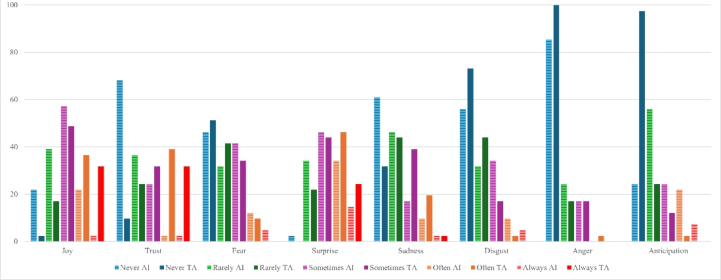
Differences in Emotional Responses to AI-Generated and Traditional Art Across Age Groups: The largest group of respondents consisted of young adults, totalling 56 participants. The data indicate that traditional art elicits more favorable emotional responses compared to AI-generated art, with higher levels of joy and trust, alongside fewer negative emotions such as disgust and anger. The substantial difference in trust levels suggests that traditional art is perceived as more credible and relatable. In Figure 1, the maximum response for any emotion was recorded at 41, which has been established as 100%. Consequently, the Y-axis indicates percentages ranging from 0 to 100, while the X-axis denotes the various emotions, each categorized within a scale of never, rarely, sometimes, often, and always. Traditional Art (TA) is represented by solid color columns, whereas AI-Generated Art (AI) is depicted with lighter colors and stripes, allowing for a clear visual distinction between the two categories (see Fig. 1).
Figure 1: Emotional responses of 15–24 years-olds to AI-generated art and traditional art.
In contrast, the emotional responses of adults aged 25 and older also reveal a preference for traditional art over AI-generated art. Similar to young adults,
236 Fomina and Luo
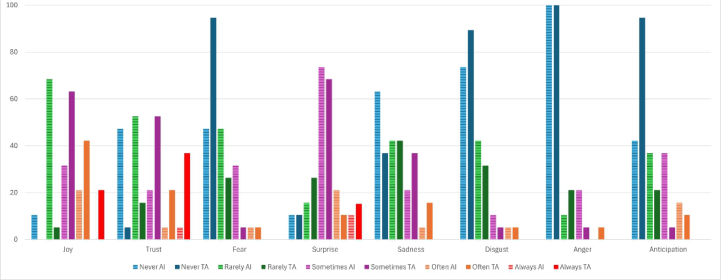
feelings of fear are virtually absent with traditional art; however, AI art does not evoke fear either, although it elicits a broader range of responses. Traditional art consistently provokes more frequent surprise among older adults, indicating stronger engagement with this medium. Additionally, traditional art is significantly less likely to inspire disgust compared to AI art, demonstrating a more positive reception overall. In Figure 2, the maximum response for any emotion was recorded at 19, which has been established as 100%. The Y-axis indicates percentages ranging from 0 to 100, the X-axis denotes the various emotions, each categorized within a scale of never, rarely, sometimes, often, and always. Traditional Art (TA) is represented by solid color columns, whereas AI-Generated Art (AI) is depicted with lighter colors and stripes.
While both young adults and older adults show a preference for traditional art, adults aged 25 and older exhibit a narrower emotional range than their younger counterparts. Although traditional art generally elicits higher levels of joy, trust, and engagement across both age groups, the emotional experiences of older adults tend to be less varied than those of younger adults (see Fig. 2).
Figure 2: Emotional responses of 25+ years-olds to AI-generated art and traditional art.
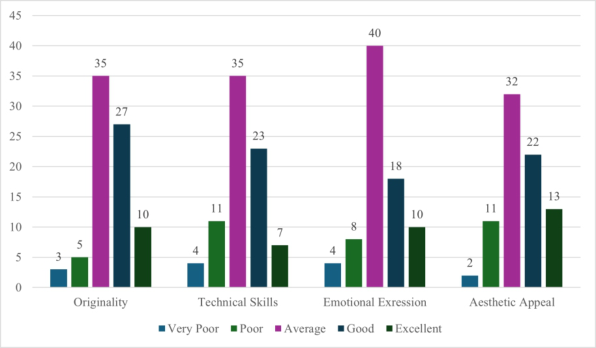
Perceptions of Aesthetic Quality in AI and Human-Created Artworks: When presented with a selection of 10 artworks—where respondents could not definitively identify whether the pieces were created by humans or AI— participants overall favored traditional art. The top five choices included three AI-generated artworks: “Théâtre D’opéra Spatial” by Jason Allen, “AICAN” by Ahmed Elgammal, and “Gyre 35700” by Mark Stock, along with two human-created pieces: “The Collection” by Marin Majic and “Dedham II” by Mirela Cabral. After respondents learned the origins of the artworks, they highlighted the color scheme, composition, and originality of the AI pieces as their best qualities. However, when asked to rate the overall aesthetic qualities of AI-generated artworks, most respondents rated them as being good to average (see Fig. 3).
Art and Emotion in the Age of AI: Understanding Human Engagement 237
Despite a general willingness to engage with AI, a clear preference emerged when respondents were asked to choose between AI art and traditional art. In this scenario, 73.8% preferred traditional forms of art, while only 8.8% opted for AI art, and the remaining participants could not decide between the two.
Figure 3: Perceptions of aesthetic quality in AI artworks.
CONCLUSION
In conclusion, exploring the intersection of AI-generated art and human creativity reveals a complex and evolving relationship that mirrors broader changes in artistic expression. The study highlights that while AI art is gaining traction and showcasing unique qualities, traditional art continues to resonate more deeply with audiences across various age groups. Respondents expressed a preference for traditional art due to its emotional richness, trustworthiness, and overall engagement, often citing feelings of joy and connection that AI art has yet to replicate.
Scepticism towards AI art remains prevalent, particularly among older generations, who tend to favor the emotional depth and authenticity inherent in human-created works. Insights gathered through the Geneva Emotional Wheel illuminated the varied emotional responses elicited by both AI and traditional art, demonstrating how different generations perceive and evaluate these artistic expressions.
Interestingly, many young adults who participated in the survey displayed a keen interest in both AI-generated and traditional art, reflecting how their upbringing in a technology-driven environment influences their engagement with diverse forms of artistic expression. This generation is the first to grow up in a reality shaped by AI, engaging with it as seamlessly as earlier generations have with the internet or mobile phones.
As creativity continues to evolve in our rapidly changing landscape, it is essential to recognize AI not merely as a tool but as a collaborator that
238 Fomina and Luo
offers fresh perspectives on aesthetics. This shift invites a thought-provoking dialogue about the essence of creativity and the meaning of producing art. In grappling with these questions, audiences are encouraged not only to consider the art itself but also to reflect on the implications of technology for our understanding of creativity and intention.
REFERENCES
Agüera y Arcas, B. (2017). Art in the Age of Machine Intelligence. Arts, 6(4), 18. Barale, A. (2021). “Who inspires who?” Aesthetics in front of AI art. Philosophical Inquiries, 9(2), 199–224. Berlyne, D. E. (1974). Studies in the new experimental aesthetics: Steps toward an
objective psychology of aesthetic appreciation. Washington, DC: Hemisphere. Chen, W., Shidujaman, M., & Tang, X. (2020). AiArt: Towards Artificial Intelligence Art. The Twelfth International Conference on Advances in Multimedia (MMEDIA 2020) (pp.47–52). Lisbon, Portugal: IARIA Press. Kant, I. (1994). Critique of Judgment (Kritika sposobnosti suzhdenia). Moscow:
Iskusstvo. Mazzone, M., & Elgammal, A. (2019). Art, Creativity, and the Potential of Artificial Intelligence. Arts, 8(1), 26. Rani, S., Dong, J., Shah, D., & Xaba, S. (2023). Revolutionizing the Creative Process:
Exploring the Benefits and Challenges of AI-Driven Art. Intelligent Computing and Optimization Conference. 8, pp. 234–243. Chamonix, France: Springer. Sacharin, V., Schlegel, K., & Scherer, K. R. (2012). Geneva Emotion Wheel rating study. Geneva, Switzerland: University of Geneva, Swiss Center for Affective Sciences. Scherer, K. R. (2005). What are emotions? And how can they be measured? Social
Science Information, 44(4), 693–727. She, J., & Cetinic, E. (2022). Understanding and Creating Art with AI: Review and Outlook. ACM Transactions on Multimedia Computing, Communications and Applications, 18, 1–22. Silvia, P. (2005). Emotional Responses to Art: From Collation and Arousal to
Cognition and Emotion. Review of General Psychology, 9, 342–357. Winter, D. (2023). Aesthetic Aspects of Digital Humanism: An Aesthetic- Philosophical Analysis of Whether AI Can Create Art. Werthner, H., et al. Introduction to Digital Humanism, 211–224.
LISTED IN THE AHFE DIGITAL BOOKSTORE CATALOGUE
Explore the complete digital volume
Artificial Intelligence and Social Computing
Read this individual research paper free through the original publisher, or explore the full digital proceedings book.
ISBN 978-1-964867-39-7
Explore this ISBN in the AHFE Bookstore ↗Listed in the July 2026 bookstore catalogue; search by ISBN to confirm current availability · Digital book purchase optional