Yuxi Yuan, Yan Luo (2024). Contemporary Innovative Application of Ancient Glaze Craft under the Perspective of Non-Heritage Revitalization. In: Human Factors in Design, Engineering, and Computing. AHFE Open Access, vol. 159, pp. 218–226. https://doi.org/10.54941/ahfe1005585
Ancient glaze is a material aesthetics with Chinese cultural characteristics, and the ancient glaze firing process combines art and culture as a national intangible cultural heritage. However, in the context of modernization and the impact of contemporary emerging art and high technology, the inheritance and development of the application of ancient glaze craft is limited. This paper takes the ancient glazing craft as a carrier, analyzes and summarizes the deficiencies in the existing specific design practice cases, and proposes a more systematic and structured design thinking framework, from material to spiritual to organizational levels of creation.Taking the large-scale glaze art installation of Fuyao University of Science and Technology "Heart Like Bodhi" designed by Prof. Luo Yan's team from the School of Design of Shanghai Jiaotong University as an example, this paper discusses how to utilize ancient glaze craft to carry out contemporary design innovation, and combine science and technology to realize the living inheritance of intangible cultural heritage.
According to evidence, the word “glaze” first appeared in the Western Zhou Dynasty, and then developed into an independent Chinese handicraft. In the Qing Dynasty Sun Tingquan wrote the “Yanshan Miscellany” in the glaze (Sun et al., 2010), detailed records of the material of the glazed products, from the material category, “glaze” that is “glass”. Therefore, glaze was the main material for all kinds of glassware in early China. Although it has similarity with western glass in visual presentation, and both of them are mainly composed of silica, but unlike the calcium-sodium glass imported from the west later, this ancient Chinese glass made of many special materials is the unique lead-barium glass in China.
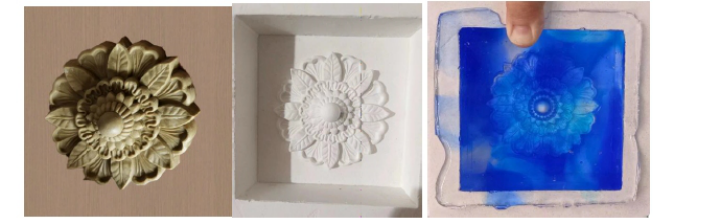
Ancient glazing process mainly uses dewax casting method to design and produce works in hot process, take the production process of glazing with lotus pattern in the work of “Heart like Bodhi” as an example, the production of ancient glazing firstly needs to determine the design concept,
Contemporary Innovative Application of Ancient Glaze Craft Under the Perspective 219
draw out sketches and then form three-dimensional line drafts, according to the design drawings, carve clay prototypes or print them precisely through three-dimensional modelling by means of science and technology. According to the design drawings, the prototype of clay mould is carved or the design prototype is printed out precisely by three-dimensional model through science and technology. Afterwards, in order to ensure the integrity of the prototype, it is necessary to coat the surface of the prototype with silica gel and fix the shape with plaster to make a silica gel mould, and make a hollow silica gel mould according to the prototype, because the silica gel mould will shrink due to the influence of high temperature, the mould should be larger than the original clay model by 2–3 cm. after the completion of the production of the silica gel mould, it is necessary to fill the inner part of the mould with wax, and when the wax has cooled down, the wax mould will be filled with wax. After the wax mould cools down, the surface of the wax mould should be carefully repaired by repairing the burrs and air holes, and then the wax should be repaired to make it further close to the original design of the prototype. Next, it is necessary to make the refractory plaster mould, fill the refractory plaster on the outside of the repaired wax model, and then dewax it after the plaster has solidified, using the method of steam dewaxing, putting the whole body in a high temperature environment for dewaxing, so as to make the wax model gradually melt and flow out, leaving the cavity to form the wax model cavity, leaving the sub-shape of the design prototype in the refractory plaster mould, that is, to become the refractory plaster negative mould. Next, the glazing material is cleaned and put into the refractory plaster. The refractory plaster and glazing material are put into the furnace for firing and casting, and the melted material will fill up the cavity of the wax mould and completely fill up the shape of the mould. Once the glazing material is fully melted and fills the wax mould, it is necessary to wait enough time for it to cool and solidify. The cooling time depends on the material used and the complexity of the casting, and it usually takes a few hours to a few days. After curing, the refractory plaster moulds are removed and rinsed, and then the excess injection portions are cut, the rough embryo of the piece is trimmed, and the details are fine-tuned to bring it closer to the prototype. Finally, the surface can be sandblasted, pickled, finely ground and polished to achieve the desired artistic effect (see Fig. 1).
Figure 1: Ancient glaze craftsmanship.
220 Yuxi and Yan
Due to the cumbersome, time-consuming and labour-intensive production process and low output rate, the production cost of ancient glazing craft is usually high, which leads to expensive products, restricting its market competitiveness and limiting the development and inheritance of the craft. Ancient glaze craft focuses on the manual production of manpower and is mainly inherited by traditional masters and disciples. However, with the change of the current mainstream consumption mode and environment, the batch factory makes the creation form changed, the application scene of the traditional inheritance mode is less and less, and the inheritance of the skill itself is subject to the impact of the market.
The development of western glass has been involved in all fields of life, from daily life consumables to artistic creation to high-tech interpretation. China’s history since the emergence of glazed products, most of them are the luxury goods of the king and wealthy households, Kangxi in the Qing Dynasty was deliberately set up a glass factory in Boshan, the output of a large number of exquisite crafts for the royal family to play and enjoy, and continues to this day, the main function of the application of the definition of the “decorative” rarely jumped out of the “decorative”, most of them to decorations and works of art to present. The exquisite sense of handicraft makes the products in the actual use of the function is limited to a certain extent, still can only be limited to small high luxury objects such as vases, wine cups, etc., compared with the modern industrial production of glass products in the modern scene of the high use of adaptability there is a big gap, so the ancient glazed glass products in the market demand has been greatly reduced.
Besides, in terms of man-made demand, due to the modernization of life style and consumption concept, the constant change of people’s aesthetic level itself makes the complexity of the market increase, the practicality and beauty of the products are inseparable under the increasingly internationalized aesthetic market, and the joining of more diversified artistic languages and forms makes people’s aesthetic acceptance of the ancient glazed glass itself decrease, for example, in the ancient glazed products emphasizing on colour, some traditional glazed products have a lower acceptance degree than those produced by modern industry. For example, in the ancient glaze products which emphasize on colour, the colour of some traditional colours itself is already slightly outdated, and should be adjusted to meet the modern aesthetic demand.
The traditional ancient glaze production is based on handmade techniques, emphasizing the fineness of the original moulds, and the later stage requires many times of artificial polishing to enhance the details. The production process relies on the skilled techniques and traditional experience of the craftsmen, and contains many complicated and time-consuming links, which gives the ancient glaze works unique touch and visual effect. The current market focuses on the application of technology to improve production efficiency, optimise the use of resources, and achieve product standardisation and large-scale production. Through automation, mechanisation and the use of information technology, the problem of low production efficiency and high production cost of handcraft can be solved. However, this rapid, standardised
Contemporary Innovative Application of Ancient Glaze Craft Under the Perspective 221
form of production is often dominated by mechanical production but limits the delicacy of the work, which can easily lead to the loss of the uniqueness and artistry of traditional handicrafts, and puts traditional handicrafts at risk of being marginalised.
With the progress of computers, the Internet, virtual reality, augmented reality and other technologies, the development of science and technology has expanded the boundaries of contemporary art expression, and the prevalence of digital art is a notable feature of the development of modern art. The convenience of digital tools makes this type of artwork interactive, easy to disseminate and reproduce, and at the same time highly malleable, easy to combine with other fields such as music, film, games, etc. to form new forms of artistic expression.
Traditional handicrafts emphasize the uniqueness of craftsmanship and the temperature of handmade, and the works often carry deep cultural and historical backgrounds, with high cultural values and emotional connotations. The elements of ancient glaze works originate from diverse traditional Chinese cultures, and the visual presentation is mostly dominated by classical shapes and bright colours, while the contemporary art works combined with science and technology mostly emphasize the characteristics of the artist’s personal thoughts, and the effect is minimalist and has a mechanical sense, pay more attention to innovation and the application of technology, and their works can be quickly copied and disseminated, which contrasts with the uniqueness and scarcity of traditional handicrafts, and the two forms of expression form a strong sense of conflict.
New aesthetics, new concepts and new technologies have formed a strong impact on the artistic elements of traditional handicrafts. In terms of creative themes, techniques and concepts, in addition to the inheritance of traditional culture, it is more important to connect with contemporary art and technology, convert the useless and put forward a more systematic and structured design thinking framework.
CONTEMPORARY ARTWORK PRACTICE OF REVITALISING ANCIENT GLAZE CRAFTSMANSHIP In order to explore how to make use of ancient glaze technology for contemporary design innovation, the author participated in the creation of a large-scale glaze installation artwork designed by Professor Luo Yan’s team from the School of Design of Shanghai Jiaotong University for Fuyao University of Science and Technology. Mr Cao Dewang, the founder of the university, is influenced by Buddhist culture, and the artwork combines Fuyao Glass founded by Mr Cao with the ancient glaze culture, while the colourful and changing glaze, due to its process characteristic of “coming from the fire and going to the water”, reveals introspection and clarity, therefore, in the Buddhist classics, it is said that “the body is like glaze, the inside and outside are clear. Therefore, in the Buddhist classics, “the body is like glass, clear inside and outside”is regarded as the highest state of personal cultivation.
222 Yuxi and Yan
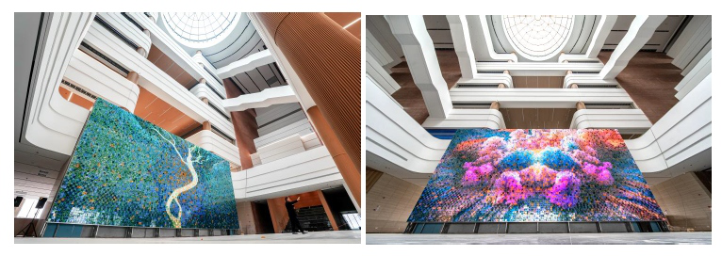
The work combines different colours, thicknesses and patterns of ancient glazed lotus flowers, which are interlaced to form a large-scale art installation. The LED screen at the back is intelligently interacted by cutting-edge digital technology, automatically generating a variety of gorgeous images, which are even more profound and mysterious through the ancient glaze. The artwork draws ideas from Chinese cultural legends and religious texts, showing change and constancy, illusion and reality, external appearance and internal concealment. With the ancient handmade colourful glaze on the outside and the cutting-edge digital display technology on the inside, it is a combination of the ancient and the modern, crystal clear and brilliant (see Fig. 2).
Figure 2: Artwork: Heart like bodhi.
Design Translation Based on Glazed Culture Glaze is a Chinese speciality glass, used to show status and identity in the past, which fits the brand culture of Fuyao Glass as a glass from China to the world, and provides a new idea for the starting point of the theme of glaze creation.
Glazed glass is usually used in palaces or high-ranking temples and halls. The glazed pagoda of the Da Zhen En Temple, built by Zhu Di, the first Emperor of Ming Dynasty, to repay his parents, has stood on the land of Nanjing for nearly 400 years, and at one time was the tallest building in southern China, as well as a marvel in the world’s architectural history. In recent years, entrepreneur Wang Jianlin donated $1 billion to rebuild the glazed pagoda at its original location. Some of the original glazed components are still intact after 600 years and are being reused in this restoration, which shows the durability and plasticity of the material.
Buddha depicted the wonderful scene of the Oriental glazed world 2,600 years ago. The Oriental glazed world is the pure land of Medicine Buddha, i.e., Medicine Glazed Light Buddha, Medicine Buddha heals all beings, and the Oriental glazed world where Medicine Buddha is located is just as clear and transparent as a glaze, which represents the people of the Oriental world in the future, who are clear and quiet in their six roots, clear and transparent, and quiet and peaceful. The Medicine Buddha has three medicines: medicine
Contemporary Innovative Application of Ancient Glaze Craft Under the Perspective 223
for the body, medicine for the mind, and medicine for the heart, which is exactly in line with what the university aims to cultivate: practicing the body, learning the skills, and correcting the mind, and it is also in line with the life experience of the founder of the university, Mr. Cao Dewang, who started from founding the enterprise to provide people with jobs to solve the problem of the public’s survival, and then led Fuyao to become the No. 1 in the world by teaching the skills of the people in combination with the innovative science and technology, and then to the establishment of the university to teach and educate the mind and open up the wisdom of the young people. The highest wisdom of Medicine Buddha is to heal. The highest wisdom of Medicine Buddha is the spirit of healing, and therefore, Mr Tsao’s endeavours are on the same path as the aspirations of Medicine Buddha.
The most common theme for the creation of glazed works is Buddhist themes. In the Diamond Sutra, it is said, “If a Bodhisattva has the appearance of me, human beings, living beings, or the appearance of a living being, he is not a Bodhisattva”, which is to ask people to detach themselves from “appearances” and figurative modelling, and in the Heart Sutra it is also said, “Colour is emptiness, and colour is emptiness. In the Heart Sutra, it is also said that “Colour is emptiness and emptiness is colour”, meaning that everything in the world is empty and delusional, while the air gives birth to and contains all things. Therefore, we take “the elephant is invisible, but contains all things” as the starting point of creation, from the artistic point of view, abstract images are more reminiscent and thinkable than figurative images, more durable and more in-depth, therefore, we do not do obvious figurative modelling at the end, we do not stay on a fixed picture, and we constantly show different gorgeous pictures, so as to express the changeability of the world, the birth of the world, the changeability of the world, the changeability of the world, the changeability of the world, the changeability of the world, the change of the world, the change of the world, the change of the world. The world is ever-changing and everlasting, all of which is based on the Buddhist concept of the invisibility of the elephant.
Presentation of Artistic Techniques The subject matter of this work is inspired by Dunhuang’s Eight Treasures Lotus Motif, Buddhist sutra changes, and many other forms of Buddhist art, which are expressed in modern, abstract aesthetics.
Yakushi Sutra Variations is a very rare giant Buddhist sutra variation from Guangsheng Temple in Hongdong County, Shanxi Province, and is currently preserved at the Metropolitan Museum of Art, U.S.A. “Sutra Variations” means another kind of variation of the Buddhist scriptures that does not use words. The meaning of “sutra variation” is another variation of the Buddhist scriptures without using words. The meaning of “sutra variation” is the variation of the Buddhist scriptures with drawings, which expresses the grandeur of the Pure Land of Buddhism in the East where the Medicine Buddha and his entourage are located. The Sutra Variation Diagrams use paintings to express the Buddha’s words and stories in a concise and clear way, connecting with the public through the form of art, making it easier
224 Yuxi and Yan
for the public to accept and understand. Therefore, this work refers to the presentation method of Sutra Variation Diagrams to express the ideas in a graphic way.
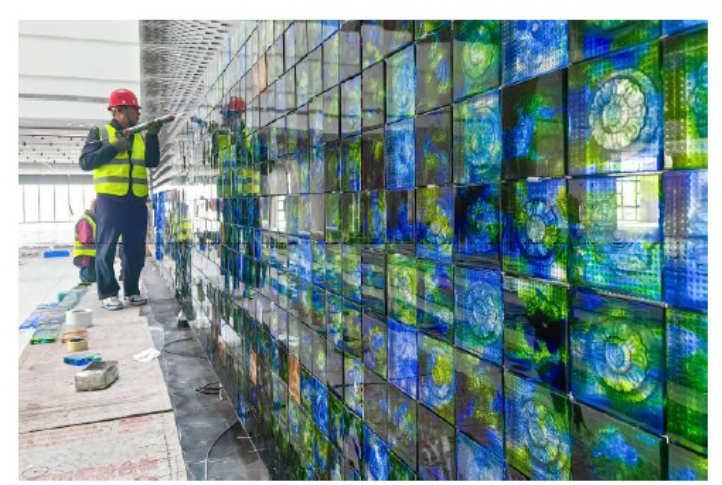
The surface of this glazed work is a lot of small pieces of glazed bricks like grains of sand, because 9 is the largest number in Buddhism, so the background wall consists of 9,999 pieces of glaze, and the surface of a single piece of glaze adopts the yin and yang cutting way to carve the lotus pattern, so as to refract the light, highlighting the glaze’s colourful, as if the auspicious clouds, and at the same time, implying that it refracts the multitudes of beings and all the world’s phenomena. When visitors walk into the glazed background wall, it will reflect the fuzzy portrait, expressing the aesthetic culture that there is no I-phase outside the glaze and no I-phase inside the glaze.
Fusion of Technology and Art In art, technology is developed to serve a concept and poetry. This work organically combines intelligent interaction with the glazed work, maintaining the traditional and classical style of the glazed work itself, creating mobility for the viewer and being more contemporary.
The work is a three-layer structure of glazed surface, stainless steel perforated back panel and LED display screen, combining into a multimedia display art installation of about 147 square metres.
The outer surface is made of 9999 lotus flowers cast in handmade ancient glaze, totalling about 12 tonnes. The middle layer is a stainless steel back plate, on which a total of 10,000 cross metal fixing brackets are welded, every four brackets can fix a piece of ancient glazed sheet of the outer surface, at the same time, 4 million holes are punched precisely by laser, which are aligned with the light beads on the LED screen at the bottom, and are used to let out the colours of the light beads.
The LED display at the bottom consists of a number of LED light beads, when the back power supply is applied to the LED light beads, the semiconductor material in the LED light beads will be activated, the electrons in the semiconductor material through the process of compounding and radiation to release the energy to produce visible light, the different colours of the LED light beads through the control of the size of the current to control the brightness of its light emission, so as to achieve the display of the image. Using this imaging principle, the image can be presented on the ancient glazed wall through the small holes on the back panel.
Under the combination of sound and light, the big screen can interpret light and shadow through the glazed wall, and change any graphics through the glazed display, the glazed itself can refract all kinds of colours through various angles of cutting, which can be as brilliant as the three thousand worlds, and can be as new and elegant as the clear sky, and it can also be created according to the theme of the unique graphics that suit the time or place, and the images on the screen can be controlled by the computer program to carry out slow and different changes, and keep changing, and the elephant can be changed to a different image, and the image can be changed to a different one. The
Contemporary Innovative Application of Ancient Glaze Craft Under the Perspective 225
images on the screen can be controlled by the computer programme to make slow and different changes, constantly changing, and the elephant is invisible (see Fig. 3).
Figure 3: Installation process.
The application scene of the work is in the school library, and new modes of combining science and art can be implanted in the work, which can expand the understanding of how traditional art is made, used and experienced in an adaptive environment, and get rid of the single attribute of the traditional glaze as a decorative object, and jump out of the long-standing definition of “luxury”for glaze products. It breaks away from the long-standing definition of “luxury” for glazed products. Meanwhile, gesture language is a special language of interaction using movement and vision, friendly, natural and effective are the advantages of the multimedia interaction mode of gesture manipulation, in order to enhance the accessibility of the art installations, the gesture recognition system, sound sensor, etc., will be added in the future, the latest suspended touch technology will be used, high-tech metal grids will be added between the glazed wall and the LED screen, and artificial intelligence will enable it to generate real-time images according to the interactive behaviours of the audience, and artificial intelligence will enable it to generate real-time images according to the interactive behaviours of the audience. Artificial intelligence enables it to generate real-time images according to the interactive behaviour of the audience, and the audience can achieve high-tech digital interaction between man and machine through hovering touch. Through the interaction with the audience, the artwork presents different forms and expressions.
226 Yuxi and Yan
CONCLUSION
In conclusion, this paper underscores the significance of integrating ancient glaze craft with modern design methodologies to ensure its sustainable inheritance as an intangible cultural heritage. By embracing both tradition and innovation, cultural artifacts like ancient glazes can transcend temporal boundaries, fostering a deeper appreciation and understanding across generations and global audiences.
REFERENCES
Chen Qiang. The Material Controversy and the Beauty of Ying-Ying: The Core Issues and Aesthetic Ideals Presented in Ancient Chinese Glass Texts [J]. Decoration, 2022, (10): 28. Izzy Wisher, Andy Needham, Illuminating palaeolithic art using virtual reality: a new
method for integrating dynamic firelight into interpretations of art production and use, Journal of Archaeological Science: Reports. Volume 50, 2023, 104102, ISSN 2352-409X. Li Jing. Material-Craft-Model-Boshan Liuli as a Carrier of Cultural Emotions[J].
Decoration, 2020, (10): 27. Li Jing. Material-Process-Model-Boshan Liuli as a Carrier of Cultural Emotions[J].
Decoration, 2020, (10): 30. [Ming] Wu Cheng’en: The Journey to the West (above) [M], note by Jia Sanqiang, Xi’an: Taibai Literature and Art Publishing House, 1995, p. 106. Shi Honglu. The application of multimedia interactive technology based on gesture
manipulation in art exhibitions [D]. Hunan University, 2016:8. Sun Tingquan, Zhang Weiyu, Yanshan miscellany, Boshang District Culture and Publication Bureau, 2010. [Tang] Xuanzang Translation: The Yakushi Liuliguang Rulai Benwangjing [M],
Tainan City: Hoyu Publishing House, 2001, pp. 12–13. Teresa Pimentel, Vasco Branco, Dynamic and interactive typography in digital art, Computers & Graphics, Volume 29, Issue 6, 2005, Pages 882, ISSN 0097-8493. Zhou Xufei. Contemporary Innovative Development of Traditional Glaze Firing
Techniques[J]. Shanghai Arts and Crafts, 2023, (02): 59.
LISTED IN THE AHFE DIGITAL BOOKSTORE CATALOGUE
Explore the complete digital volume
Human Factors in Design, Engineering, and Computing
Read this individual research paper free through the original publisher, or explore the full digital proceedings book.
ISBN 978-1-964867-35-9
Explore this ISBN in the AHFE Bookstore ↗Listed in the July 2026 bookstore catalogue; search by ISBN to confirm current availability · Digital book purchase optional