Qian Shi, Yan Luo, Tao Wang (2024). Optimized Design of Road Street Furniture for Pedestrian Traffic - Smart Zebra Crossings. In: Advances in Human Factors of Transportation. AHFE Open Access, vol. 148, pp. 624–630. https://doi.org/10.54941/ahfe1005254
The evolution of pedestrian crossings, also known as zebra crossings, traces back to their initial purpose of separating people, horses, and carriages with stepping stones to their current design of striped patterns accommodating mixed traffic of cars and pedestrians. Its development history shows the process of improving tools to meet the needs of the times, underscored by the continuous updating of facilities and equipment driven by the relentless advancement of science and technology through the ages. Under severe weather conditions such as nighttime, rainy days, and smoggy days, the reduced visibility of zebra crossings increases the risk of collisions between pedestrians and motor vehicles. The author proposed the idea of light beam wall zebra crossing based on the current smart zebra croosings. Surveys from pedestrians and drivers were collected to evaluate the pros and cons of smart zebra crossings and gauge public interest in their personalized and aesthetic design.The survey results indicate that all respondents agree that illuminated zebra crossings are beneficial to both pedestrians and drivers. Most also agree that well-designed zebra crossings can enhance the pleasure of travel. However, they also express concerns that smart zebra crossings may have disadvantages such as high costs, high maintenance expenses,and potential failures that may not function properly. Based on these findings, it is crucial to select illuminated tile materials for smart zebra crossings and found ways to control cost. The author proposed a method to offset some costs by displaying advertisements on light beam walls of smart zebra crossings. Additionally, the personalized design of zebra crossings aims to provide citizens with a more aesthetically pleasing experience, enhancing their sense of safety and happiness. The comprehensive experience of smart zebra crossings attracts footfall to nearby commercial areas. Smart zebra crossings can be seen as a lever to create a City Walk-friendly urban intelligent transportation landscape that supports urban development.
The “crosswalk line” for pedestrians to cross the street, that is, commonly known as the “zebra crossing”, was originally the stepping stones that sep- arated the sidewalk from the carriageway. Later, with the popularity of cars,
Optimized Design of Road Street Furniture for Pedestrian Traffic - Smart Zebra Crossings 625
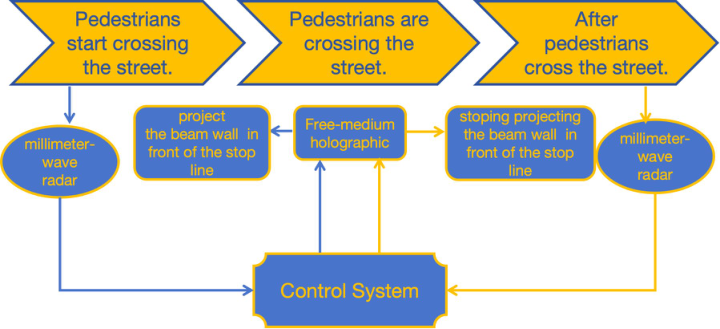
in order not to interfere with traffic, crosswalks shaped like the white stripes on the zebra were desinged. With the development of the times, the num- ber of cars has increased sharply, and pedestrian crossing safety needs to be guaranteed through zebra crossings, which is more important nowadays. In order to increase the visibility of zebra crossings in nighttime and in bad weather such as rainy days and haze days and better protect pedestrians cross- ing the street, smart illuminated zebra crossings have emerged. According to Tan Yue, the existing smart zebra crossings are composed of “embed- ded controller, illuminated floor tiles and intelligent pedestrian detection device, which can realize intelligent recognition of pedestrians and vehi- cles, correlation of traffic lights,voice reminder and other functions”(2020, 90–91). According to Zhou Rui, “when the millimeter-wave radar at both ends of the zebra crossing detects that pedestrians need to cross the street, it transmits a signal to the control system,which controls the luminescence of the illuminated floor tiles” (2023,005). The illuminated tiles will be set at both ends of the zebra crossing and at the road stop line. The illumi- nated floor tiles at the zebra crossings will keep pace with the pedestrian signal lights, which is equivalent to the smart zebra crossing with its own signal light function, with a good reminder effect on pedestrians at night, especially the “phubbers” who like to watch mobile phones. In the case of poor sight, the illuminated floor tiles at the road stop line can help drivers see the stop line, zebra crossing and signal lights (Yue, 2020). At the signal-controlled junction, the luminous floor tiles at the stop line flashes white or red light to remind motor vehicles to stop; and white or green light to alert the driver to pass through. At a non-signal-controlled junc- tion, when pedestrians are detected on the zebra crossing, the illuminated floor tiles at the stop line will automatically light up to remind passing vehi- cles, and the lighting time can be set according to the actual crossing time of the junction (Xiujuan, 2020); When there are no pedestrians crossing the zebra crossing, the luminous floor tiles at the stop line are kept unlit to improve traffic efficiency. At present, there are also yellow luminous floor tiles at the stop line at the non-light controlled intersection. When pedestri- ans pass, the yellow light flashes faster, and the flashing frequency of the yellow light decreases after the pedestrian passes. In order to meet the needs of different traffic scenarios, illuminated floor tiles should be selected with “high integration, low failure rate, appropriate hardness and toughness, as well as anti-slip and waterproof composite materials” (Yue, 2020, 90–91). The intelligent detection device set near the zebra crossing can also detect the traffic flow in real time and provide data support for the timing opti- mization of signal lights (Yue, 2020). Smart illuminated zebra crossing is a major improvement to the safety of modern cities. The development and transformation process of zebra crossing reflects that people adapt to new transportation needs through continuous improvement of tools, while wit- nessing the change of transportation tools and the continuous progress of science and technology.
Optimized Design of Smart Zebra Crossings - Light Beam Wall Before the Stop Line and Art Design of Zebra Crossings According to the current lighting method of smart zebra crossings, the illu- minated floor tiles at both ends of the zebra crossing are associated with the signal light, which directly reflects the current situation of the pedes- trian signal light. Due to the short reaction time of pedestrians, it has a very clear guiding significance for them. At present, the illuminated floor tiles at the road stop line mainly rely on the frequency variation of white light flashing to remind vehicles. When pedestrians are detected, the white light flashing frequency at the vehicle stop line increases, indicating that the vehi- cle is prohibited to pass; When no pedestrian passes, the flashing frequency of the white light at the vehicle stop line decreases, indicating vehicles can pass through. When the stop line uses a red light to indicate that vehicles are prohibited from passing and a green light to indicate that vehichles are allowed to pass, the color of the lights is opposite to the color of the lights on the nearby zebra crossing, which can also be confusing for drivers. The reminder of the illuminated floor tiles to the motor vehicle driver is not sim- ple and clear enough, and the flashing frequency of the white light cannot correspond to the pedestrian, so the reaction time of the driver is longer. To solve this problem, the author came up with a solution to optimize the smart zebra crossing by changing the luminous mode of the illuminated floor tiles at the road stop line. When a pedestrian is detected crossing a zebra crossing, the road stop line on the vehicle side lights up with a white beam wall to prohibit motor vehicles from passing; When there is no pedestrians crossing the zebra crossing, the floor tile at the stop line of the vehicle side restores the normal ground light state, so as to reduce the reaction time of the driver and achieve the purpose of optimizing the smart zebra crossing.
The beam wall can be realized by Free-medium holographic technology. According to Xianghang Technology (2023), this technology enables the direct projection of image information into the air without the need for any carrier or medium. The medium-free holographic technique utilizes a sophis- ticated optical microscope structure to accurately replicate the light field, resulting in the presentation of a realistic and fully three-dimensional image in space. The optical micro-mirror structure plays a pivotal role in this process. It captures detailed information such as the intensity, angle, and wavelength of each ray of light emitted from a real object in the “object space”. Then, it duplicates these rays to create a perfect mirror image of the original light in the “image space” on the other side. These duplicated rays undergo a refo- cusing process, ultimately forming a mirror image of the object in the “object space” at a symmetrical location in the “image space.” Remarkably, this solid image does not rely on any medium and can be observed directly with the naked eye, offering a breathtaking visual experience. In the application of the light beam wall in front of the stop line, we project a white light beam wall to give the motor vehicle driver a sense of the meta-universe, and the light beam wall is more visualized for the guidance of forbidden traffic.
In addition, in view of the high cost problem that may be brought about by Free-medium holographic display, the beam wall can also obtain some
Optimized Design of Road Street Furniture for Pedestrian Traffic - Smart Zebra Crossings 627
income through advertising, and offset its high cost to a certain extent. More- over, the beam wall can also play traffic safety slogans and other content to remind traffic participants to improve safety awareness and comply with traf- fic laws and regulations. The play of advertising and traffic safety signs on the wall of the beam can make full use of the waiting time of motorists, and to some extent to relieve the boredom of the driver’s waiting period, while bringing technology into the good experience of reality.
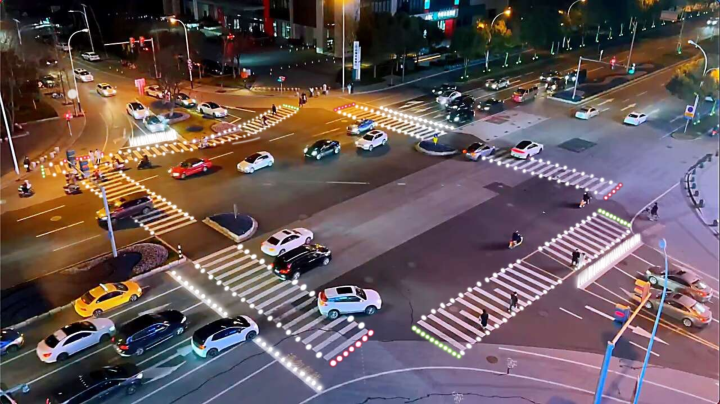
Figure 1: Rendering of smart zebra crossing with light beam walls.Figure 2: The application process of the beam wall of smart zebra crossings
With the people-oriented concept deeply rooted in people’s hearts, zebra crossing design is gradually evolving towards individuation and artistic expression. Through the clever use of patterns, text, color and other elements,
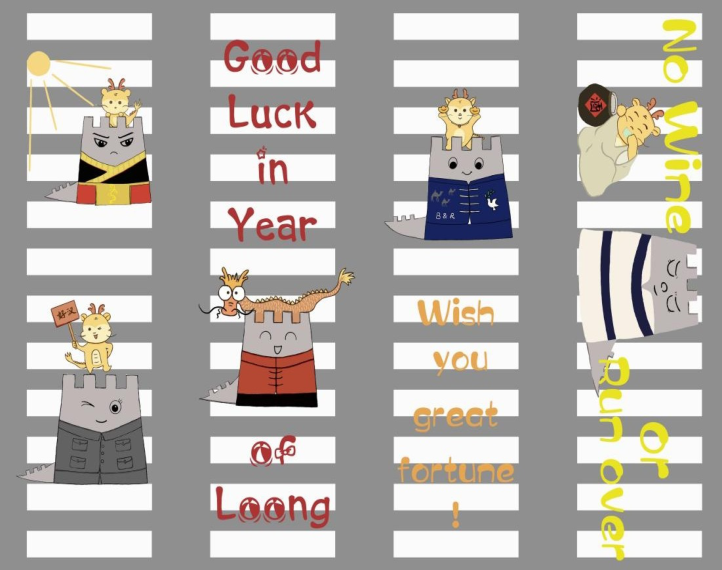
zebra crossings not only become a beautiful landscape in urban traffic, but also play an important role in enhancing the sense of security and comfort of pedestrians. Sometimes, the art design of zebra crossings can also con- vey important information such as environmental protection, energy saving, health and safety, so that people can subtly accept these positive values in their daily lives. Below is the author’s design of zebra crossings of the Year of Dragon theme.
Figure 3: Zebra crossing designs of year of dragon theme.
Questionnaire and Results on Smart Zebra Crossings and Art Designed Zebra Crossings Combined with the above ideas of the light beam wall at the stop line of the smart zebra crossing, and the idea of art design of zebra crossing, the author made and sent out a questionnaire to collect people’s daily travel habits, pedestrians’ and drivers’ cognition and demand for the smart zebra cross- ing, and their opinions on the design of the beam wall at the stop line of the road, as well as their views and needs for zebra crossing art design. A total of 110 electronic questionnaires were issued in this survey, and 110 valid ques- tionnaires were recovered. Through statistical analysis of the questionnaire data, the survey results were as follows.
Daily zebra crossing behavior: The survey results showed that sixty point ninety one percent (60.91%) of the respondents had distracted behaviors
Optimized Design of Road Street Furniture for Pedestrian Traffic - Smart Zebra Crossings 629
when crossing the road, based on the proportion, they included chatting with friends, making and receiving calls, reading information or surfing the Inter- net with mobile phone, wearing headphones to listen to music. Sixty two point seventy three percent (62.73%) of the respondents consciously waited for the green light to walk at the zebra crossing every time, and thirty seven point twenty seven percent (37.27%) of the respondents occasionally ran red lights. According to the proportion, the reasons for not walking zebra cross- ings were as follows: there was no zebra crossings at the intersection, the zebra crossing was too far away, and waiting time for the red light was long, etc. It can be seen that some pedestrians had weak awareness of traffic safety to comply with traffic laws and regulations, and it is necessary to increase publicity on traffic safety. Then, on the scene of pedestrian crossing, it might be appropriate and necessary to put traffic safety slogans on the beam wall of the parking line.
Awareness of smart zebra crossings: Basically all respondents believed that illuminated zebra crossings are helpful to drivers and pedestrians at night, in foggy days or in rainy days when the line of sight is limited, and can improve traffic safety. As for the effect of simulating the beam wall in front of the car stop line, fifty six point eighty four percent (56.84%) of the respondents believed that it will bring a good experience and be helpful to drivers and pedestrians. And the remaining forty three point sixteen percent (43.16%) of respondents said that the beam wall can effectively alert drivers, but the cost would be higher. The results showed that the beam wall would not only ensure the safety of pedestrians crossing the street, but also bring great scientific and technological experience, however, it is necessary to explore more cost-effective methods in the implementation method. The beam wall advertising mentioned earlier by the author is a way to hedge some costs.
Opinions on zebra crossing art design: Thirty eight point eighteen per- cent (38.18%) of respondents believe that crosswalks are not necessarily in the shape of zebra crossings, and some innovations can be made. And the remaining Sixty one point eighty one percent (61.81%) of the respondents believe that they have been accustomed to the shape of the crosswalk, so it can be retained. This result might be related to the relatively small propor- tion of respondents under the age of 30. Young people are more willing and able to accept new things. But at the same time, eighty percent (80%) of respondents said they felt good when they walked through a well-designed crosswalk. The author believed that in a city, for the sake of safety, art zebra crossing should be set in urban pedestrian streets, as well as residential areas and tourist areas with branch roads.
Pros and cons analysis: Respondents generally believed that smart zebra crossings can improve traffic safety, however, they were also concerned about the high cost and maintenance problems they might bring. There are sixty four point seventy one percent (64.71%) of the respondents were worried that the intelligent identification system fails and cannot work.
As we mentioned above the beam wall can obtain some income through advertising, and offset its high cost to a certain extent. Concerning poten- tial failures in the beam wall function, meticulous comparison is imperative
during the material selection and installation stages. Furthermore, regu- lar inspections, maintenance, and repairs must be conducted following the completion of installation to ensure its continued optimal performance.
CONCLUSION
As a new favorite of modern urban traffic safety, the smart zebra crossing is not only the life protection line of pedestrians crossing the street, but also a beautiful landscape of the city. The beam wall zebra crossing could escort the safer travel of the public, and make the life of the public more experience of science and technology and happiness; The zebra crossing with art design on pedestrian street can also increase the flow of people for the nearby business areas, promoting consumption. Smart zebra crossings could not only boost the construction and operation of smart cities, but also help to create a City Walk friendly urban smart transportation landscape, thus promoting urban development. However, smart zebra crossings still face some challenges in practical applications, such as cost and maintenance issues. In the future, researchers should pay more attention to the cost control and material selec- tion of smart zebra crossings to ensure their sustainability and effectiveness in practical applications.
ACKNOWLEDGMENT
Show gratitude to the 110 Respondents who participated in the survey questionnaire.
REFERENCES
Baidu Baike. (7 March, 2023). Wujiezhi quanxi jishu jieshao [The intro- duction of Free-medium holographic technology]. Retrieved from https: //baike.baidu.com/reference/62760525/533aYdO6cr3_z3kATKbfmf2lNS3AY9T 6t7WHA7RzzqIPmGapB5nyTcYq6dYx-f9mGgzAtZJrLtUam6eEXwwGmqJUI LRpXbYqnH_6Wjfckfq7ow. Duan Xiujuan (2020). Zhihui Jiaotong zai chengshi daolu sheji zhong de shentou [Integration of Intelligent Transportation into Urban Road Design]. Kexue jishu chuangxin, (34): 165–166. Tan Yue (2020). Lantai Jiaotong: Rang Banmaxian Liangqilai [Lantai Traffic and
Transportation: Lighting the zebra crossing]. Daolu jiaotong guanli, (12): 90–91. Zhao Bin (2009). Dahua Banmaxian [Introduction to Zebra Crossings]. Guancha yu sikao, (17): 24–25. Zhihui banmaxian, LEDxinhaodengn deng jiaotong anquan xinkeji liangxiang
haerbin Jingweijie [New traffic safety technologies such as smart zebra crossings and LED signal lights were unveiled on Jingwei Street in Harbin]. Guangyuan yu zhaoming, 2020, (11):3. Zhou Rui, Yang Youzong, Liu Taoxiong etc. (2023). Zhihui jiaotong ‘gengxin’ chengshi tujing [“Updating” the Urban Landscape with Intelligent Transportation]. Jingji cankao bao, 07–14(005). doi: 10.28419/n.cnki.njjck.2023.002448.
LISTED IN THE AHFE DIGITAL BOOKSTORE CATALOGUE
Explore the complete digital volume
Advances in Human Factors of Transportation
Read this individual research paper free through the original publisher, or explore the full digital proceedings book.
ISBN 978-1-964867-24-3
Explore this ISBN in the AHFE Bookstore ↗Listed in the July 2026 bookstore catalogue; search by ISBN to confirm current availability · Digital book purchase optional