Javier Anton, Victor Larripa (2022). Integrated Pedagogy Model for Training the XXIst Century Designer. In: Human Dynamics and Design for the Development of Contemporary Societies. AHFE Open Access, vol. 25, pp. 91–103. https://doi.org/10.54941/ahfe1001376
The New Degree in Design at the University of Navarra was launched in September 2016, and has recently completed the cycle of its first-generation students. The shaping process of this degree was intended to be flexible to forge the profile of a versatile and creative designer, a process that would lead to a new and innovative configuration of teaching methodologies based on the integration of contents and competences through projects.This article intends to explain how this Education Model works and which are its main principles, understood as the practical result of a permanent and ongoing research about ways of training designers for the needs of contemporary society. In fact, the scope of the text is to emphasize how this teaching methodology intends to help the students acquire the necessary skill set to face the hybrid challenges that the XXIst Century requests, challenges immersed in a world marked by an overwhelming technological development.In that sense, the entire system could be condensed into the intention of configuring mindsets of future designers in such a way that they are, at the same time, integrative and critical. That is, the development of integrative thinking is built through the aforementioned confluence of materials and knowledge in each project. And critical thinking is forged through numerous cultural subjects and through work on analysis of case studies and examples. From the combination of both faculties, the ability to integrate and the ability of critical thinking, the students will acquire the creative attitude that today’s society demands.Keywords: Teaching Methodology, Design Training, Creativity, Design Education, Integrative Thinking, Critical Thinking, Technology
TECHNOLOGY AND THE CONTEMPORARY PARADIGM The challenges that the XXIst Century proposes are very diverse and among other fields, Design is called up for duty to contribute with a hybrid mentality able to integrate technical and creative approaches. As Meyer and Norman state:
“Today, the world faces new challenges. Designers are starting to play a larger and larger role in not only designing but managing beyond the design studio and even deciding upon the activities that need to be done across the business. Our concern is that design education has not kept up with the new demands of the 21st century” (Meyer and Norman 2020, 14).
With the exponential advancement of technology, we face a new paradigm of disquietude that we must undertake face to face. In a context of uncer- tainty, Future Studies need more than ever the transversality of knowledge
to develop cross-cutting capabilities (CCCs) for an adequate mindset to face this new challenges. Among them we have for instance, the incipient arrival of the Metaverse1. In view of this new reality, enhanced by the establishment and development of NFTs, Digital Twins, and the concept of “Phygitality”, Design and Education are needed in a front row position to reflect on the con- sequences of an ecosystem whose vortex speed hinders a soothing mentality for the future generation.
Marshall McLuhan in his famous text ”The Medium is the Message” sta- ted that we need to catch up with the Medium in order to configure the Messsage (McLuhan, 1967). Clearly, the medium we are now immersed in, is very complex and requires a familiarity with it, based on a careful analy- sis of its parameters. Most of the professions of the near future don’t exist yet. Education Institutions have a special responsibility to prepare the future generation based on these summons to contest rather than foundationing its pedagogic principles on the professions and roles from the past.
In this context, this article seeks to explain the way in which the teach- ing methodology of the Degree in Design at the University of Navarre was originated for training designers whose creative skills would be appropriate for the new cultural paradigm. Thus, the following sections define, first, the general issues of the aforementioned teaching methodology, and secondly the two main qualities that intend to achieve, precisely, that solid relationship between the training provided and the needs of current and future society: the integrative thinking and the critical thinking.
THE NEW DEGREE IN DESIGN The New Degree in Design at the University of Navarra was launched in September 20162 and has recently completed the cycle of its first-generation of students. This Degree was presented to the First Edition of the New European Bauhaus Prizes in the Category of “Interdisciplinary Education Models”, and last September was announced as the winner of that category.
The shaping process of the degree was intended to be flexible to forge the profile of a very versatile, creative, and contemporary designer. A process that would lead to a new and innovative configuration of teaching methodologies based on the integration of contents and competences through the projects developed by the students (Franz, 2005).
1The Metaverse is formed by the union of the prefix "meta" and the suffix "verse" and is commonly used to describe a hybrid environment where virtually shared experience converges with the physical realm. As Smart et al. (2007, p. 4) described it: “The Metaverse is a complex concept. In recent years, the term has grown beyond Stephenson’s 1992 vision of an immersive 3D virtual world, to include aspects of the physical world objects, actors, interfaces, and networks that construct and interact with virtual environments”. 2There is a big team of professors and professionals of the School of Architecture of the University of Navarra that have participated in the set-up of this new methodology. A process which was initially led by Dean Miguel A. Alonso del Val and professors Carlos Naya Villaverde y Carlos Chocarro Bujanda. So, it is in order to thank the whole team and give credit to all the participants for what we think is an interesting and successful experience. The University and the School have benefited a lot from this pedagogic system and seems fair and stimulating to share it in the context of an academic conference. This methodology is still under construction, and as any process of design is fastened to the circular cycle of continuous improvement through feedback gathering.
Integrated Pedagogy Model for Training the XXIst Century Designer 93
The implementation process of the degree started with a research phase focused precisely on analyzing today’s challenges concerning design education: “These challenges create a new context for the design process. Some forms of design remain similar to what they have long been. Other forms of design emerge in response to new developments, new tools, new situations, and new technologies” (Friedman 2019, pp. 46–48).
This required an in-depth study of the cultural and productive particu- larities of the contemporary world, but also of how the most important educational projects of the 20th century had faced a similar task3. In this way, with the support of historical teaching methodologies as an example, and with the knowledge of the most current paradigm, it was possible to devise a curriculum with its own identity and a coherent methodology.
This teaching methodology seeks to integrate all the theoretical, practical, technical, and creative contents, which acquire their whole meaning when they are perceived simultaneously and always applied pragmatically to a pro- ject. Thus, the students, through the practical and creative exercise of the project, can connect and understand the whole constellation of subjects, ideas and teachings offered to them. That is why the word “integration” is parti- cularly appropriate in this case. In fact, the ideal name for this system would probably then be “integrated project-based learning.”
The first two years are common for all students and the final two years are split in three different areas of interest—fashion, product, and service design. The intention is also to combine in a transversal manner both the huma- nistic and technical fields. The fact of having “common” first and second years, materializes that desire to train designers “with broad foundation”. The intention in those two years is to open the spectrum and confront them with interdisciplinary challenges through integrated projects.
Afterwards, the students might be already in the position to evaluate or select their specific fields of interest. That is why the final two years favor the deepening in the aforementioned three areas, which respond somehow to the needs that contemporary society demands from designers. Concepts or views that nowadays are urgently needed, such as sustainability, inclusive design, the relationship among crafts and industry, the role of new technologies, and the influence of new digital paradigms, are integrated in the pedagogical core of each correspondent itinerary.
The essential points of the presented pedagogical system -the project as a central part of education, the integration of all subjects around the pro- ject, the “learning by doing” approach, and the conscientious forging of a powerful memory and cultural baggage - have been tested as successive "pro- totypes" in the various courses and generations. As in any design process, the prototypes are a tool for discovering ways to implement and develop ideas.
3Mainly, these Design educational projects are the Bauhaus program, and later the HFG-Ulm and Black Mountain College programs. These approaches to design training are still at the core of current discussions in the pedagogy of design and the creative realm. All these experiences, in fact, shared a common concern in tackling design education from a holistic, interdisciplinary, practical, and project-centered point of view.
94 Anton Sancho and Larripa Artieda
The success of prototyping as a project mechanism lies in understanding that all design is an open process and is susceptible to changes, improvements and adaptations. Thus, such a teaching methodology must be an open process that allows permanent update and the revalidation or improvement of the premises on which it is based. Now more than ever, we live in an extremely changing world where its demands and means are in constant evolution. In order to respond to that cultural paradigm, every good educational system must allow -in its own functioning and gearing- enough plasticity to not get trapped in its own mechanisms.
In short, The entire system could be condensed into the intention of mol- ding the mindsets of future designers in such a way that they are, at the same time, integrative and critical. That is, the development of integrative thinking is built through the aforementioned confluence of materials and knowledge in each project. And critical thinking is forged through numerous cultural sub- jects and through work on analysis of case studies and examples. From the combination of both faculties, the ability to integrate and the ability of criti- cal thinking, the students will acquire the creative attitude that today’s society demands. This pedagogical approach intends to help them acquire the neces- sary skill set to face the hybrid challenges that the XXIst Century requests, challenges immersed in a world marked by an overwhelming technological development.
INTEGRATIVE THINKING: LEARNING THROUGH PROJECTS The well-known “Project Based Learning” system was the starting point that allowed discussions and reflections in the process of the setting up of the methodology for this Degree in Design. However, much has been written about “Project Based Learning”, and thus, it is rather a general idea that can be understood and applied in many ways (Franz 2007).
Within that open spectrum, this degree found its identity by unifying all the pedagogy through the project as the main common ground. Around each project, the different subjects would organize their contents with a practical approach and a very intertwining attitude rather than a stagnate one. In other words, the project would no longer belong to a specific subject but would rather be part of all the subjects of each term. And, therefore, the different disciplines that had usually been understood as watertight compartments, now had to integrate their contents and competences alongside the others and associated with each specific project. They also would adapt their schedules to each project and negotiate the boundaries between the contents of each field.
It is worth recalling Bruno Munari’s words when he stated that “the design method for the designer is not something absolute and definitive; it is some- thing modifiable if other objective values are found to improve the process”; and this view is precisely what an integrated method fosters. It is a pedagogy that “does not block the personality of the designer but, on the contrary, stimulates him to discover...” (Munari 1983, 12).
This pedagogical methodology incorporates the theoretical, practical, tech- nical, and creative contents, which reach their whole sense when they are
Integrated Pedagogy Model for Training the XXIst Century Designer 95
perceived together, and are applied simultaneously to a project. That way, the students, by means of the practical and creative exercise of the project, can understand and integrate the whole amalgam of principles and teachings offered to them.
The advantage here is clear: if the contributions of the different courses— representing their fields of study—are correctly coordinated, the student can incorporate the different approaches with significant depth and perspective. In addition, by matching all subjects under the same topic at the same time, the student is encouraged to inter-relate the various contents, forming a com- prehensive ensemble. In fact, the practical and simultaneous application of these aspects through the project reinforces the assimilation dynamic. It cre- ates the philosophy behind the practical approach. Donald A. Schon “spoke from philosophy and design to professional practice, conceiving design to be its unifying core. From his philosophy of design, he projected a new model for teaching and learning in the professions, and a new conception of the research university” (Waks 2001, 37).
From the point of view of faculty organization and management, this requires an effective effort to coordinate the team of professors involved. This promotes a fluid and successful communication between subjects and encou- rages a transversal approach that enriches the faculty interaction . Clearly, it is essential that the projects proposed to the students are conceived, discus- sed, and assimilated by all faculty members. They should be open enough in such a way that each subject finds its appropriate field of action within the same project frame.
In any case, this transversal and integrated approach, which promotes a holistic and creative mindset for the student, is far from the approach that most students have previously received in school. In school years compulsory educational systems rarely addresses questions of creativity or project work4, let alone particular questions of design or design history. Munari points out: “Anyone working in the field of design has a hard task ahead of him; to clear his neighbor’s mind of all preconceived notions of art and artists, notions picked up at schools where they condition you to think one way for the whole of your life, without stopping to think that life changes –and today more rapidly than ever”. (Munari 1966, pp. 25–26)
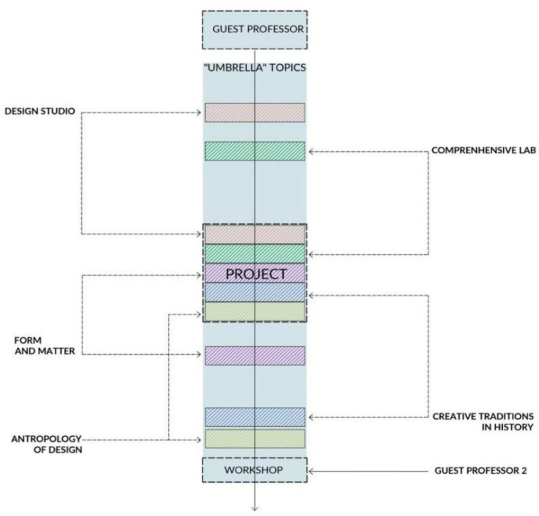
However, the fact that freshmen students usually arrive at the university without any precise knowledge of design, or even with misconceptions, could also be perceived as a good opportunity for starting design education from the ground up. This is where one of the particularities of this pedagogy arises: to set everything in motion, the projects proposed to the students are simul- taneously framed in broader theoretical topics. These topics, or “umbrella themes”, cover the foundations of design knowledge.
Within each theme, the students would carry out the project that would allow them, precisely, to delve into that topic and understand its dimen- sion and importance from both theoretical and practical standpoint (Griggs
4In the national formative and educational context in which the Degree in Design of the University of Navarra is present, the teaching by projects and the consideration of creativity as a value to be developed, has been implemented in a very limited number of K-12 curricula in Spain.
96 Anton Sancho and Larripa Artieda
Figure 1: Scheme of the organization of the subjects around the project. Source: authors of the article.
2005). The selected “umbrella themes” would remain stable every year, but the projects could change their briefing.
The distinction between topic and project allows each subject to organize its teaching and convey its contents in a twofold manner -conceptual and pragmatic-, that seems highly effective and constructive. On the one hand, within the conceptual spectrum, the courses provide theoretical contents and develop particular competences specific to their field. Contents and compete- nces that, precisely, prepare the student to tackle the project itself. And on the other hand, the subjects devote part of their teaching time to work directly reviewing the students’ projects, helping them with comments and suggesti- ons. Of course, in this practical work each subject fosters the projects from its particular point of view (see Figure 1).
CRITICAL THINKING: LEARNING THROUGH EXAMPLES The intense and conscientious work of case study analysis, through graphic documents, drawings and images, is the essential way to generate a solid critical capacity in the designer of the future. Learning through the criti- cal analysis of cases gradually strengthens and forges the student’s memory. Memory works as an active and creative mental faculty that not only acts as a repository of previous experiences, lessons and images. Memory is capable of creatively combining previously accumulated baggage in a way that enhances the designer’s ability to produce ideas and solutions. A strong memory also allows the designer to confront the new images, examples or experiences that
Integrated Pedagogy Model for Training the XXIst Century Designer 97
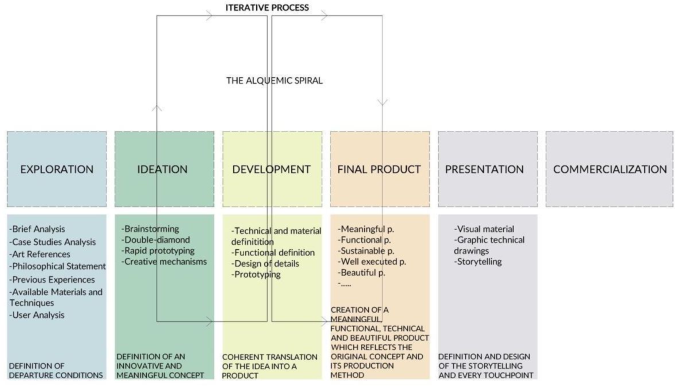
Figure 2: Scheme of the creative process and breakdown of the internal process of each phase. Source: authors of the article.
he encounters -either in his professional work and his daily life- in a critical and reflective way (Marina, 1993).
To carry out a project in the field of Design consists in devising and materi- alizing a creative solution that effectively and beautifully resolves a given real situation (Munari 1981). In fact, the designer does not create or invent from scratch; “Nothing comes from nothing”, as first Parmenides stated (Burnet 1908, 2906). Designer’s mind, by means of memory, works from the images, ideas, knowledge, and information that it already contains. Thus, memory, moved by the voluntary search for a creative idea, removes, sifts, combines, and even transforms information it already possesses. It puts that amalgam at the service of the project that the creator is trying to carry out.
Therefore, the more knowledge, information and images the designer’s head contains, the more creative the designer will be. And thus, more capa- city the designer will have for devising solutions to different design problems. It seems essential for the designer to possess and train a powerful memory, capable of storing as much information as possible and capable of develo- ping an extraordinary ability to combine it. Only in this way the ideas can be successfully weaved from that network of information present in the desi- gner’s mind. As the philosopher José Ortega y Gasset pointed out, “when there is scant memory there cannot be much imagination” (Ortega y Gasset 1931, 358)5. Furthermore, memory not only triggers the creative capacity, but even before, it helps to develop the critical mechanisms of the designer’s mind. The content present in memory is the interface that the designer has to con- front or evaluate critically the visual information that continuously reaches
5The quote has been translated by the authors because the book does not have an English translation. The original sentence is: “cuando se tiene poca memoria no se puede tener mucha imaginación”.
98 Anton Sancho and Larripa Artieda
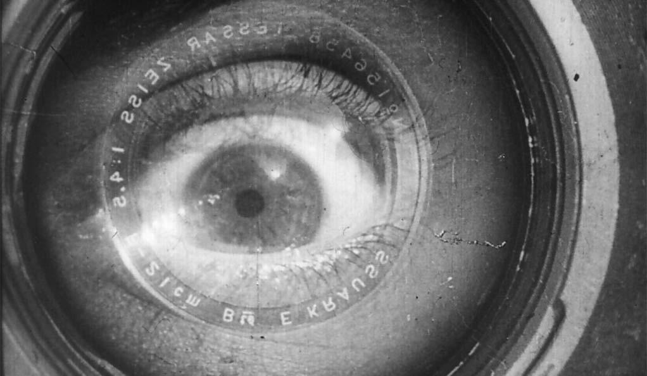
Figure 3: Dziga Vertov, 1929. Source: Final shot of the film “Man with a Movie Camera”.
the eye: new images, digital experiences, graphic expressions, project rende- rings. And thus, in order to properly nourish the designer’s memory with a deep knowledge of good examples and images, the study of cases seems an essential mechanism for training designers.
Within the methodology developed in the Degree in Design, this particular activity is tackled in a transversal way. It is practiced by different subjects -the cultural and creative ones- in parallel to the work and time that the students devote to the projects. The selection and study of cases can be carried out in many ways and under the different points of view that the subjects need to cover. Nonetheless, it seems worth providing some general notes that explain this process, currently quite forgotten by the designers themselves or by the universities in the formation task.
Obviously, a good designer always has an attentive eye, which constantly scans the objects, shapes, or images encountered on a daily basis. It is essential for the designer to continually reflect about the suitability of the designs and images that regularly the eye catches, as well as to pay attention to their details, materials, mechanisms, or shapes. All the more, when we talk about case studies as a learning mechanism, we are always referring to a careful, deep, and critical study, which goes even further than having an attentive look.
It is a matter of looking, but also of analyzing, understanding, studying, and even re-drawing the studied examples of recognized quality. In this sense, resorting to the works of the great Masters of Design is always advisable as a source of reference, given that the most current examples tend to reach our hands distorted by the fashions of the moment.
In any case, that same attentive gaze must also be open. Is it possible to talk about the design project from closed or unidirectional positions? Adopting an open and integrating way of looking at things, places the designer in a very favorable position to undertake the task successfully.
Integrated Pedagogy Model for Training the XXIst Century Designer 99
When selecting the examples to be examined, an open eye will lead to widening the spectrum of possibilities and cases as much as possible. This is the only way to understand and apprehend different positions and ways of doing things, and to establish links or relationships between them. Learning through examples doesn’t consist of initially pronouncing a sort of theory or general position that is then confirmed by the samples being studied. This method proposes quite the opposite: the path consists in weaving knowledge, little by little, based on the small certainties or discoveries that emerge from the different designs that are studied. This would lead to building a more solid structure that reinforces the designer’s creative capacity, but that also remains open to new discoveries or changes (Blundell-Jones 2002).6 Thus, the great virtue of the system is probably that it favors a direct and critical dialogue with the examples being studied. It empowers the designer to avoid recipes, labels or general theories that explain everything in them- selves. In short, it is a matter of undertaking a reflective and critical study of a series of concrete and diverse designs, analyzing each one of them in all their complexity and, at the same time, establishing connections and com- parisons between them. This “interplay” (Berman 1988, 5)7 moves from the individuality of each case to the possible relationships between the different examples. It allows the designer to gradually induce their qualities, design strategies, mechanisms, or forms. These will now remain as useful tools in the designer’s creative memory.
Since this specific training mechanism is based on the acquisition of good design examples, the first interface encountered by the subject’s eye within this process is unavoidably the image. In other words, images constitute the immediate way for designers to reach and get new examples or sources of knowledge. Those images are obtained by means of very different approa- ches, being always partial fragments of the examples that must be somehow filtered and assembled by the designer’s critical mind.
When it comes to confronting new images, designers usually turn up to former images they already had previously recorded in their memory. Thus, the way to learn and understand new design examples seems strongly lin- ked to the capacity of mentally reconstruct them by sequentially gathering their images and comparing them with a set of prior known images (Rojas and Marín 2014, 136-152). Basically, this mechanism consists in relating the particular example, through its various visual manifestations, with the visual repository already present in memory, in such a way that this reference is correctly understood and integrated.
In short, the mechanism could be also defined as the practice of a certain method which creates new meanings by means of connecting new visual infor- mation with already known semantic signs. Thus, when designers, in their 6The idea of the construction of knowledge by means of certainties that are obtained through cases, and not from previous great theories, has been explained and tested by the architectural historian Peter Blundell Jones. 7In the “Broad and Open Way”, the preface of the Penguin Edition of his book, the philosopher Marshall Berman explains that an open and broad approach is essential to tackle a study that intends to understand different visions or fundamentals. He underlines the idea of developing a creative interplay among the different visions or fields analyzed through the study.
100 Anton Sancho and Larripa Artieda
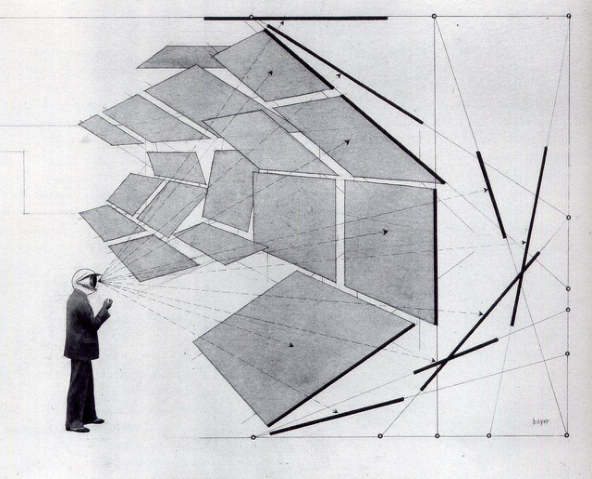
Figure 4: Herbert Bayer, 1930. Source: Catalogue of the Werkbund Exhibition, Paris, 1930.
daily work and research, come across new images -fragments of an example- they might establish a sort of mental dialogue: one that connects that new visual material with the already known visual baggage. It is by means of that relational mechanism that the essence of the example studied is assembled. It, alongside its particularities, is stored in the designer’s memory as a useful reference becoming part of a sort of mental “atlas” (Warburg 2020)8.
This essay proposes, among other aims, a redefinition of ‘Design’ as an innovative activity whose training is linked to a tradition. The intention here pursued drives towards adding new cultural meanings by means of incor- porating previous examples of design and understanding them through the analysis of their images. Therefore, when it comes to training new designers, one of the main purposes of the faculty is to help students to perfectly manage the language of vision9. If designers can manage a given amalgam of images and combine them meaningfully, they will be able to de-code visual narratives and extract cultural references from them.
One of the characteristics of current times is the hyper-inflation of images alongside a hyper-deficit of content. We are in an era of ‘iconic
8The idea of atlas is mentioned here intentionally generating a parallel with the Mnemosyne Atlas that the historian Aby Warburg produced between 1924 and 1929. The Warburg atlas was a kind of procedure (more physical than mental) to combine, superpose, and generate unexpected analogies or relationships between very diverse images. 9In fact, these ideas were already part of the discussions among the Bauhaus faculty in the 20’s and 30’s. The well-known schemata by Herbert Bayer, “Ideas about the extended field of vision. Bayer applied the scheme for the first time at the Paris exhibitions of the German Werkbund (Artistic and Industrial Union), which took place in 1930.
Integrated Pedagogy Model for Training the XXIst Century Designer 101
Figure 5: Photograph in “The Interface Effect” Cover. Source: Galloway, Alexander R. 2012. The Interface Effect. Cambridge: Polity.
overabundance’, as stated by Joan Fontcuberta (Forns 2017, 4), due to the saturation of digital images that reach us almost unwillingly. The profusion of images usually hampers designers (especially those in their early stages of training) from having time enough to properly select and digest the essence that lies underneath each image. The current reality, with this visual over- flow, makes it necessary to develop a critical capacity to decant the essence of things that are hidden behind that curtain of images.
This dynamic makes more sense, if possible, if we take into account that visual narratives work in a different way than written ones. Following Mar- shall McLuhan theory, technology has changed society and has also changed Design. If the “medium is the message” (McLuhan, 1967) designers should perfectly master the medium: the visual language and its codes and techni- ques to decode visual narratives. It is about properly understanding the clues, the dynamics and the features of the media that creates those narratives.
This pre-eminence of the medium above the message, leads us to consider the ‘interface effect’ explained by Alexander Galloway (Galloway, 2012). As Galloway states, the interface that relates two different realities is even more important than the realities themselves. In fact, that interface can highlight at the same time what is common between the two of them and what is specific to each one. As expressed before, images are the main interface for designers to acquire examples of good design. In consequence, the comprehension of their images is precisely the key translator that allows us to delineate what is particular and universal of each example, when relating it to others.
The more comparisons, superpositions or confrontations one can achieve between two realities, the more capacity to understand both one will reach. That is why, seeking for those comparisons, designers tend to relate new visual findings with previously known images that are at disposal in their memory. It is, thus, the most effective tool to induce the essence -the universal features- of the design example that those new images depict.
102 Anton Sancho and Larripa Artieda
In short, the good knowledge of such examples, little by little, nourishes the memory. This vast faculty of the human mind, which is creative and intelligent, comes into operation when creatives undertake their projects and works. After all, the stronger the memory —the more images it has correctly digested— the more examples swarming in its confines, and the more crea- tive the designer will be. And it follows, moreover, that the more digital our world becomes, the more relevant it is to train designers in an activity as old as studying the best works that other well-known designers or creatives have previously developed.
CONCLUSION
In short, the training that is being implemented in this Educational Model is situated in a healthy balance between a critical mentality to be analytical and selective with respect to the examples of the past; and on the other hand, to have a creative capacity to integrate tools and disciplines capable of respon- ding to the new needs that are appearing. In other words, the creative capacity of the designer, capable of assuming the challenges that the present -or the future- cultural paradigm brings, is born from the simultaneous combination of both capacities: the integrative capacity and the critical capacity.
It is precisely through critical thinking that the contemporary designer can move and dive into the visual overload that new technological milestones represent (social media, the metaverse…) without losing control. The desi- gner can perfectly understand the mechanisms that operate behind reality and take advantage of all the new graphic and virtual elements and tools that are worthwhile. And, at the same time, through its integrative capacity, the designer can also combine, transform, disentangle and recreate the different inputs -physical or virtual- on which he or she works; in order to generate new content and ideas as a professional.
In addition, all this does not make sense if we do not value, by way of conclusion, one more question that lies above the previous ones. The figure of the designer that the XXIst century needs also involves a social responsibility of this profession that can move between technical and creative solutions, but focused on promoting a better society, a Human Centered Design one. This is precisely the figure that the New European Bauhaus is promoting: “By creating bridges between different backgrounds, cutting across disci- plines and building on participation at all levels, the New European Bauhaus inspires a movement to facilitate and steer the transformation of our societies along three inseparable values: sustainability, aesthetics, inclusion” (Von der Leyen 2021).
REFERENCES
Berman, Marshall (1988). All that is Solid Melts into Air. New York: Penguin Books. Blundell-Jones, Peter (2002). Modern Architecture through Case Studies. Oxford: Architectural Press. Burnet, John (1908). Early Greek Philosophy. London: Adam and Charles Black.
Integrated Pedagogy Model for Training the XXIst Century Designer 103
Franz, Jill. (2005) “Practice-led Research in Architecture and Design: The Potential for Something Unique.” Speculation and Innovation Conference. Queensland University of Technology. Franz, Jill (2007). Work Integrated Learning for Design: A Scholarship of Integration.
In Proceedings of Connected 2007 International Conference on Design Education edited by Robert Zehner, 1–4. Sydney: University of New South Wales. Friedman, Ken (2019) “Design Education Today: Challenges, Opportunities, Failures.” In Chatterjee Global Lecture Series, 46–48. Cincinnati, Ohio: College of Design, Architecture, Art and Planning, the University of Cincinnati. Forns, Albert (2017). “Joan Fontcuberta. Benvinguts a l’era postfotogràfica” [Joan
Fontcuberta. Welcome to the Post-photographic Era]. Barcelona Metropolis. Capital en transformació (105), 4–7. Galloway, Alexander R (2012). The Interface Effect. Cambridge: Polity. Griggs, Lynden (2005). “Comment: The Integration of Teaching and Research in Higher Education.” HERDSA News 25 (3): 1–5. Marina, José Antonio (1993). Teoría de la inteligencia creadora [Theory of Creative
Intelligence] Barcelona: Anagrama McLuchan, Marshall (1967). The Medium is The Massage. An Inventory of Effects.
New York: Bantam Book. Meyer W., Michael, and Don Norman (2020). “Changing Design Education for the 21st Century.” She Ji: The Journal of Design, Economics, and Innovation 6 (1): 13–39. https://doi.org/10.1016/j.sheji.2019.12.002. Munari, Bruno (1966). Design as Art. London: Penguin. Munari, Bruno (1983). Como nacen los objetos. Apuntes para una metodología
proyectual [How Objects are Born. Notes on a Design Methodology]. Ortega y Gasset, José (1931). “Los ‘nuevos’ Estados Unidos”[The “new”United States]. In 1966. Obras completas [Complete Works] (4), 357–360. Madrid: Revista de Occidente.Barcelona: Gustavo Gili Rojas, F. Roberto and Antonio M. Marín (2014). “La deconstrucción: un viaje
estético reflexivo para comprender el arte y el diseño” [The Deconstruction: An Aesthetic Journey to Understand Art and Design]. I+Diseño 9, (April): 136–152 Von der Leyen, Ursula (2021). The New European Bauhaus Initiative. The New European Bauhaus Website: https://europa.eu/new-european-bauhaus/index_en Waks, Leonard J (2001) “Donald Schon: Philosophy of Design and Design Educa-
tion.” International Journal of Technology and Design Education 11 (1): 37–51. https://doi.org/10.1023/A:1011251801044. Warburg, Aby (2020). Bilderatlas Mnemosyne. The original. Stuttgart: Hatje Cantz.
LISTED IN THE AHFE DIGITAL BOOKSTORE CATALOGUE
Explore the complete digital volume
Human Dynamics and Design for the Development of Contemporary Societies
Read this individual research paper free through the original publisher, or explore the full digital proceedings book.
ISBN 978-1-958651-01-8
Explore this ISBN in the AHFE Bookstore ↗Listed in the July 2026 bookstore catalogue; search by ISBN to confirm current availability · Digital book purchase optional